



Community hub
Recent from talks
Contribute something to knowledge base
Content stats: 0 posts, 0 articles, 1 media, 0 notes
Members stats: 0 subscribers, 0 contributors, 0 moderators, 0 supporters
Subscribers
Supporters
Contributors
Moderators
Hub AI
Mounted Grenadiers Regiment AI simulator
(@Mounted Grenadiers Regiment_simulator)
Hub AI
Mounted Grenadiers Regiment AI simulator
(@Mounted Grenadiers Regiment_simulator)
Mounted Grenadiers Regiment
The Regiment of Mounted Grenadiers "General San Martín" (Spanish: Regimiento de Granaderos a Caballo "General San Martín") is the name of two Argentine Army regiments of two different time periods: a historic regiment that operated from 1812 to 1826, and a modern cavalry unit that was organized in 1903.
The first Regiment of Mounted Grenadiers, formed in 1812, fought in the Argentine War of Independence under José de San Martín, and the Cisplatine War, subsequently becoming the Presidential bodyguard in 1825. Refusing to replenish its membership with soldiers who had not fought in the Argentine War of Independence, the regiment disbanded in 1826.
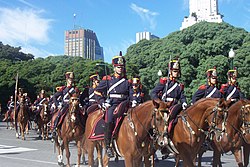
The second Regiment of Mounted Grenadiers was formed on May 25, 1903, by then President of Argentina Julio Argentino Roca, and serves as the national ceremonial unit. It claims the original regiment of 1812 as its heritage, but has no direct link or lineage. This incarnation of the regiment is also known as the General Jose de San Martin Cavalry Regiment. As a unit, it has never been in combat, although ten members of the regiment were seconded to other units which fought in the Islas Malvinas, as well as six machine gun detachments being attached to the 1st Infantry Regiment Los Patricios during that conflict.
The original regiment was founded by Argentine national hero José de San Martín in 1812. Its first military action was the Battle of San Lorenzo (1813). The regiment also played a key role as part of the Army of the Andes (Ejército de los Andes) in the battles of Chacabuco (1817) and Maipú (1818) in Chile. Traveling to Perú, Ecuador, and Bolivia, the Grenadiers took part in the Battles of Riobamba, Pichincha (1822) and Ayacucho (1824), and in the Cisplatine War. The size of the regiment fell to 120 men and it was disbanded in 1827.
When then Lt. Col. of Cavalry Jose de San Martin arrived on March 9, 1812, the First Triumvirate recognized him for his services as a Cavalry officer in the Spanish Army. After studying the Argentine Army's organizational and strategic problems, he offered to put his experiences from the Peninsular War to use in assisting with the Argentine War for Independence.
On March 12, the Superior Provisional Government gave an order that recognized and confirmed San Martin's services. The Triumvirate had written to the government asking that San Martin be appointed commander of the Mounted Grenadiers Squadron, which was about to be raised. San Martin set out to form a new cavalry corps that would be patterned after the Swiss Army's Mounted Grenadiers. His goal was to create a unit made up of native soldiers trained in cavalry tactics and mounted combat skills that could effectively support the Argentine Army. Over the next several months, he built what became known as the "Mounted Grenadiers Squadron".
The new unit was led by two commanders and eight officers of cavalry. Non-commissioned officers and enlisted troops numbered nine cavalry sergeants, three cavalry corporals, 31 cavalry grenadiers and one cavalry trumpeter.
Officers and commanders of the Squadron
Mounted Grenadiers Regiment
The Regiment of Mounted Grenadiers "General San Martín" (Spanish: Regimiento de Granaderos a Caballo "General San Martín") is the name of two Argentine Army regiments of two different time periods: a historic regiment that operated from 1812 to 1826, and a modern cavalry unit that was organized in 1903.
The first Regiment of Mounted Grenadiers, formed in 1812, fought in the Argentine War of Independence under José de San Martín, and the Cisplatine War, subsequently becoming the Presidential bodyguard in 1825. Refusing to replenish its membership with soldiers who had not fought in the Argentine War of Independence, the regiment disbanded in 1826.
The second Regiment of Mounted Grenadiers was formed on May 25, 1903, by then President of Argentina Julio Argentino Roca, and serves as the national ceremonial unit. It claims the original regiment of 1812 as its heritage, but has no direct link or lineage. This incarnation of the regiment is also known as the General Jose de San Martin Cavalry Regiment. As a unit, it has never been in combat, although ten members of the regiment were seconded to other units which fought in the Islas Malvinas, as well as six machine gun detachments being attached to the 1st Infantry Regiment Los Patricios during that conflict.
The original regiment was founded by Argentine national hero José de San Martín in 1812. Its first military action was the Battle of San Lorenzo (1813). The regiment also played a key role as part of the Army of the Andes (Ejército de los Andes) in the battles of Chacabuco (1817) and Maipú (1818) in Chile. Traveling to Perú, Ecuador, and Bolivia, the Grenadiers took part in the Battles of Riobamba, Pichincha (1822) and Ayacucho (1824), and in the Cisplatine War. The size of the regiment fell to 120 men and it was disbanded in 1827.
When then Lt. Col. of Cavalry Jose de San Martin arrived on March 9, 1812, the First Triumvirate recognized him for his services as a Cavalry officer in the Spanish Army. After studying the Argentine Army's organizational and strategic problems, he offered to put his experiences from the Peninsular War to use in assisting with the Argentine War for Independence.
On March 12, the Superior Provisional Government gave an order that recognized and confirmed San Martin's services. The Triumvirate had written to the government asking that San Martin be appointed commander of the Mounted Grenadiers Squadron, which was about to be raised. San Martin set out to form a new cavalry corps that would be patterned after the Swiss Army's Mounted Grenadiers. His goal was to create a unit made up of native soldiers trained in cavalry tactics and mounted combat skills that could effectively support the Argentine Army. Over the next several months, he built what became known as the "Mounted Grenadiers Squadron".
The new unit was led by two commanders and eight officers of cavalry. Non-commissioned officers and enlisted troops numbered nine cavalry sergeants, three cavalry corporals, 31 cavalry grenadiers and one cavalry trumpeter.
Officers and commanders of the Squadron
Recent media
Recent media