



Community hub
Recent from talks
Knowledge base stats:
Talk channels stats:
Members stats:
Must
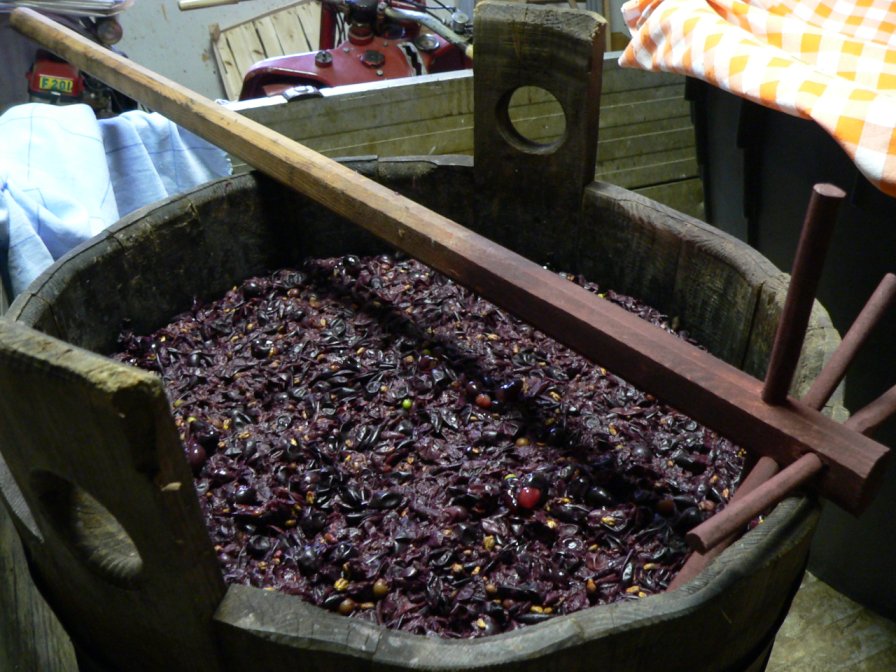
Must is freshly crushed fruit juice (usually grape juice) that contains the skins, seeds, and stems of the fruit. The solid portion of the must is called pomace and typically makes up 7–23% of the total weight of the must. Making must is the first step in winemaking. Because of its high glucose content, typically between 10 and 15%, must is also used as a sweetener in a variety of cuisines. Unlike commercially sold grape juice, which is filtered and pasteurized, must is thick with particulate matter, opaque, and comes in various shades of brown and purple. The name comes from the Latin vinum mustum; lit. 'young wine'.
The length of time the pomace stays in the juice is critical for the final character of the wine. When the winemaker judges the time to be right, the juice is drained off the pomace, which is then pressed to extract the juice retained by the matrix. Yeast is added to the juice to begin the fermentation, while the pomace is often returned to the vineyard or orchard for use as fertilizer. A portion of selected unfermented must may be kept as Süssreserve, to be added as a sweetening component before bottling. Some winemakers create a second batch of wine from the used pomace by adding a quantity of water equivalent to the juice removed, letting the mixture sit for 24 hours, and draining off the liquid. This wine may be used as a drink for the employees of the winemaker or as a basis for some pomace brandies. Grappa, however, must by law be produced only from the pomace solids, with no water added.
The must is also an essential ingredient for the production of balsamic vinegar. Two traditional varieties of this vinegar (traditional balsamic vinegar) from Italy is protected through the European protected designation of origin system (PDO). A cheaper mass-market variety (balsamic vinegar of Modena), also from the provinces of Modena and Reggio Emilia, is protected as a European protected geographical indication (PGI).
For the PGI variety, selected bacterial colonies or the lenta in superficie (slow surface) or lenta a truciolo (slow wood shavings) methods are used for acetification, and then there is a maturation phase. Both the acetification and the maturation take place in precious sessile oak (Quercus petraea), chestnut, oak, mulberry, and juniper barrels. After a minimum maturation period of 60 days, a group of expert technicians will test the resulting product analytically as well as organoleptically (via taste, aroma, the palette and other senses).
The two PDO traditional varieties have stricter rules. The must can only be concentrated by heating, and not by any other method. The minimum maturation period is higher at 12 years.
This term is also used by meadmakers for the unfermented honey-water mixture that becomes mead. The analogous term in beer brewing is wort.[citation needed]
In ancient Greece, must condensed by boiling was called siraion (σίραιον) and was used as a sweetener in the kitchen in various recipes (and as a syrup over teganitai (pancakes)). From the Greeks, the Romans in ancient Rome also used the condensed must in cooking, as a sweetener. Must was boiled in lead or bronze kettles into a milder concentrate called defrutum or a stronger concentrate called sapa. It was often used as a souring agent and preservative, especially in fruit dishes.
Currently, reduced must is used in Greek, other Balkan countries, French and Middle Eastern cookery as a syrup known as petimezi, pekmez or dibis. In Greece, petimezi is a basic ingredient for a must-custard known as moustalevria, and a sweet-meal known as soutzoukos, churchkhela. The Moustokoúloura or "must cookies" are also popular Greek cookies, which are based on a sweet dough made by kneading flour, olive oil, spice, and must. They are made in various shapes and sizes, and they are dark brown in color because of the must and the spice in them. In the wine making areas of South Africa must is used to make a sweet bun known as mosbolletjies.
Hub AI
Must AI simulator
(@Must_simulator)
Must
Must is freshly crushed fruit juice (usually grape juice) that contains the skins, seeds, and stems of the fruit. The solid portion of the must is called pomace and typically makes up 7–23% of the total weight of the must. Making must is the first step in winemaking. Because of its high glucose content, typically between 10 and 15%, must is also used as a sweetener in a variety of cuisines. Unlike commercially sold grape juice, which is filtered and pasteurized, must is thick with particulate matter, opaque, and comes in various shades of brown and purple. The name comes from the Latin vinum mustum; lit. 'young wine'.
The length of time the pomace stays in the juice is critical for the final character of the wine. When the winemaker judges the time to be right, the juice is drained off the pomace, which is then pressed to extract the juice retained by the matrix. Yeast is added to the juice to begin the fermentation, while the pomace is often returned to the vineyard or orchard for use as fertilizer. A portion of selected unfermented must may be kept as Süssreserve, to be added as a sweetening component before bottling. Some winemakers create a second batch of wine from the used pomace by adding a quantity of water equivalent to the juice removed, letting the mixture sit for 24 hours, and draining off the liquid. This wine may be used as a drink for the employees of the winemaker or as a basis for some pomace brandies. Grappa, however, must by law be produced only from the pomace solids, with no water added.
The must is also an essential ingredient for the production of balsamic vinegar. Two traditional varieties of this vinegar (traditional balsamic vinegar) from Italy is protected through the European protected designation of origin system (PDO). A cheaper mass-market variety (balsamic vinegar of Modena), also from the provinces of Modena and Reggio Emilia, is protected as a European protected geographical indication (PGI).
For the PGI variety, selected bacterial colonies or the lenta in superficie (slow surface) or lenta a truciolo (slow wood shavings) methods are used for acetification, and then there is a maturation phase. Both the acetification and the maturation take place in precious sessile oak (Quercus petraea), chestnut, oak, mulberry, and juniper barrels. After a minimum maturation period of 60 days, a group of expert technicians will test the resulting product analytically as well as organoleptically (via taste, aroma, the palette and other senses).
The two PDO traditional varieties have stricter rules. The must can only be concentrated by heating, and not by any other method. The minimum maturation period is higher at 12 years.
This term is also used by meadmakers for the unfermented honey-water mixture that becomes mead. The analogous term in beer brewing is wort.[citation needed]
In ancient Greece, must condensed by boiling was called siraion (σίραιον) and was used as a sweetener in the kitchen in various recipes (and as a syrup over teganitai (pancakes)). From the Greeks, the Romans in ancient Rome also used the condensed must in cooking, as a sweetener. Must was boiled in lead or bronze kettles into a milder concentrate called defrutum or a stronger concentrate called sapa. It was often used as a souring agent and preservative, especially in fruit dishes.
Currently, reduced must is used in Greek, other Balkan countries, French and Middle Eastern cookery as a syrup known as petimezi, pekmez or dibis. In Greece, petimezi is a basic ingredient for a must-custard known as moustalevria, and a sweet-meal known as soutzoukos, churchkhela. The Moustokoúloura or "must cookies" are also popular Greek cookies, which are based on a sweet dough made by kneading flour, olive oil, spice, and must. They are made in various shapes and sizes, and they are dark brown in color because of the must and the spice in them. In the wine making areas of South Africa must is used to make a sweet bun known as mosbolletjies.