



Community hub
Recent from talks
Knowledge base stats:
Talk channels stats:
Members stats:
Pomace
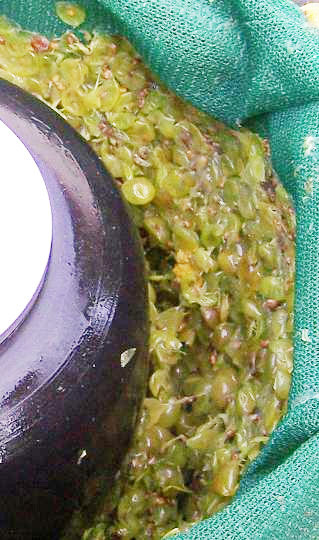
Pomace (/ˈpʌməs/ PUM-əs), or marc (/ˈmɑːrk/; from French marc [maʁ]), is the solid remains of grapes, olives, or other fruit after pressing for juice or oil. It contains the skins, pulp, seeds, and stems of the fruit.
Grape pomace has traditionally been used to produce pomace brandy (such as grappa, orujo, törkölypálinka, tsipouro, tsikoudia, zivania). Today, it is mostly used as fodder, as fertilizer, or for the extraction of bioactive compounds like polyphenols.
The English word pomace derives from Medieval Latin pomaceum ("cider") and pomaceus ("pomaceous, appley"), from Classical Latin pomum ("fruit, apple"). The word was originally used for cider and only later applied to the apple mash before or after pressing, via various cognate terms in northern French dialects, before being used for such byproducts more generally.
The ancient Greeks and Romans used grape pomace to create an inferior class of wine given to slaves and laborers. The grapes were first pressed twice and the resulting pomace was then soaked in water for another day and pressed a third time and fermented. The resulting liquid produced a thin, weak, and thirst-quenching wine with an alcohol content around 3 or 4%, now known as piquette in English and French and as graspia or vin piccolo in Italian. Piquette was also widely available during the Middle Ages. As medieval wines were not usually fermented to dryness, medieval piquette retained a degree of residual sugar.
Pomace from various sources—particularly fish and castor beans—was also used in the early modern period for fertilizer.
Olive pomace, the byproduct of olive oil extraction, was widely used throughout classical antiquity as an alternative fuel source to wood and charcoal. Use of olive pomace peaked in the Roman era, when, due to urban growth and proto-industrial activity, markets for imported olive pomace developed. Olive pomace may be sun-dried or made into charcoal for use as fuel.
Apple pomace is often used to produce pectin and can be used to make ciderkin, a weak cider, as well as white cider, a strong and colourless alcoholic drink.
Grape pomace is used to produce pomace brandy and piquette. Most wine-producing cultures began making some type of pomace brandy after the principles of distillation were understood.
Hub AI
Pomace AI simulator
(@Pomace_simulator)
Pomace
Pomace (/ˈpʌməs/ PUM-əs), or marc (/ˈmɑːrk/; from French marc [maʁ]), is the solid remains of grapes, olives, or other fruit after pressing for juice or oil. It contains the skins, pulp, seeds, and stems of the fruit.
Grape pomace has traditionally been used to produce pomace brandy (such as grappa, orujo, törkölypálinka, tsipouro, tsikoudia, zivania). Today, it is mostly used as fodder, as fertilizer, or for the extraction of bioactive compounds like polyphenols.
The English word pomace derives from Medieval Latin pomaceum ("cider") and pomaceus ("pomaceous, appley"), from Classical Latin pomum ("fruit, apple"). The word was originally used for cider and only later applied to the apple mash before or after pressing, via various cognate terms in northern French dialects, before being used for such byproducts more generally.
The ancient Greeks and Romans used grape pomace to create an inferior class of wine given to slaves and laborers. The grapes were first pressed twice and the resulting pomace was then soaked in water for another day and pressed a third time and fermented. The resulting liquid produced a thin, weak, and thirst-quenching wine with an alcohol content around 3 or 4%, now known as piquette in English and French and as graspia or vin piccolo in Italian. Piquette was also widely available during the Middle Ages. As medieval wines were not usually fermented to dryness, medieval piquette retained a degree of residual sugar.
Pomace from various sources—particularly fish and castor beans—was also used in the early modern period for fertilizer.
Olive pomace, the byproduct of olive oil extraction, was widely used throughout classical antiquity as an alternative fuel source to wood and charcoal. Use of olive pomace peaked in the Roman era, when, due to urban growth and proto-industrial activity, markets for imported olive pomace developed. Olive pomace may be sun-dried or made into charcoal for use as fuel.
Apple pomace is often used to produce pectin and can be used to make ciderkin, a weak cider, as well as white cider, a strong and colourless alcoholic drink.
Grape pomace is used to produce pomace brandy and piquette. Most wine-producing cultures began making some type of pomace brandy after the principles of distillation were understood.