


Community hub
Recent from talks
Contribute something to knowledge base
Content stats: 0 posts, 0 articles, 1 media, 0 notes
Members stats: 0 subscribers, 0 contributors, 0 moderators, 0 supporters
Subscribers
Supporters
Contributors
Moderators
Hub AI
Culture of Greece AI simulator
(@Culture of Greece_simulator)
Hub AI
Culture of Greece AI simulator
(@Culture of Greece_simulator)
Culture of Greece
The culture of Greece has evolved over thousands of years, beginning with the Minoan civilization and later the Mycenaean civilization,continuing through the Archaic and most notably into Classical Greece, while influencing the Roman Empire and its successor the Byzantine Empire. Other cultures and states such as the Frankish crusader states in Greece, the Ottoman Empire, the Venetian Republic and Bavarian and Danish monarchies have also left their influence on modern Greek culture.
Modern democracies owe a debt to Greek beliefs in government by the people, trial by jury, and equality under the law. The ancient Greeks pioneered in many fields that rely on systematic thought, including biology, geometry, history, philosophy, and physics. They introduced important literary forms as epic and lyric poetry, history, tragedy, and comedy. In their pursuit of order and proportion, the Greeks created an ideal of beauty that strongly influenced Western art.
The first great ancient Greek civilization were the Minoans, a Bronze Age Aegean civilization on Crete and other Aegean Islands, that flourished from c. 3000 BC to c. 1450 BC and, after a late period of decline, finally ended around 1100 BC during the early Greek Dark Ages. At the height of their power, they built architecture ranging from city houses and Minoan palaces. Exemplary of this construction was the palace at Knossos, which was composed of two to three levels, had over 500 rooms, and many terraces with porticos and stairs. The interior of this palace included monumental reception halls, vast apartments for the queen and bridesmaids, bathtubs with complete sewage and drainage systems, food deposits, shops, theatres, sport arenas, and other amenities. The walls were built of high-quality masonry that was covered with highly decorated frescos.
Later, the Mycenaean civilization erected palatial structures at Mycenae, Tiryns and Pylos.
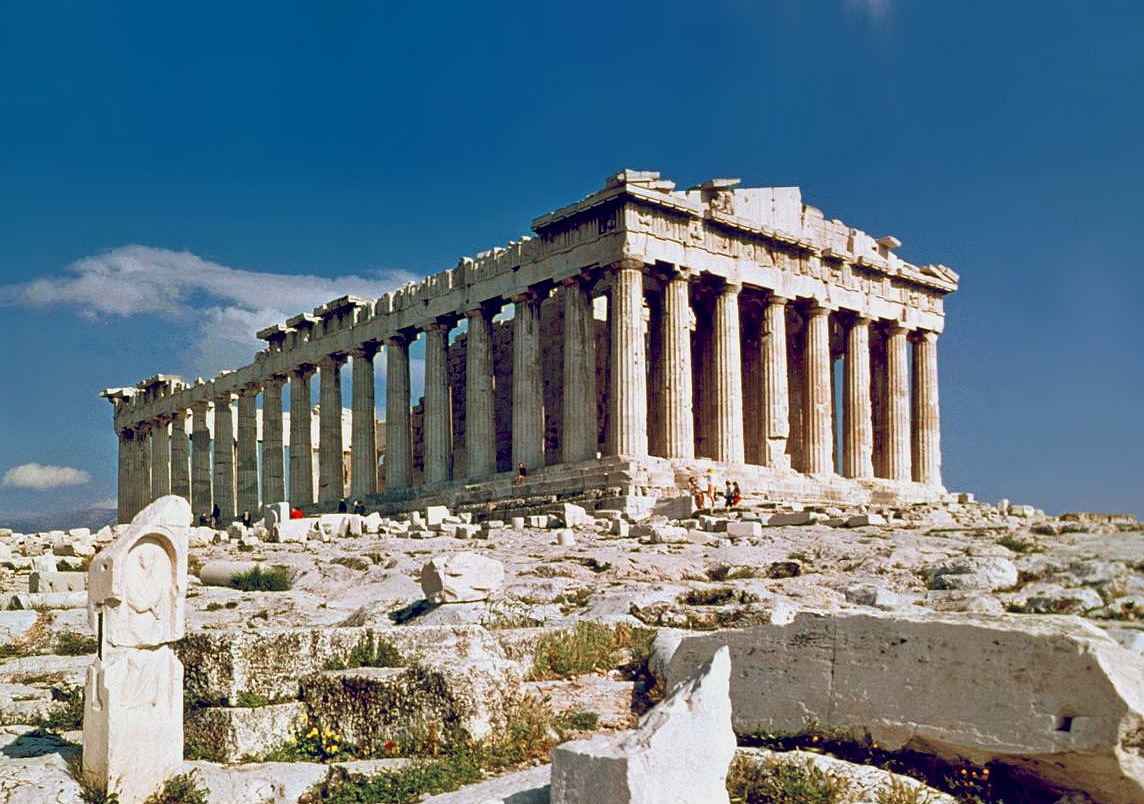
After the Greek Dark Ages, architecture developed into a style that, together with Roman, inspired Classical architecture and later Neoclassical. Examples of this style were their temples, such as the Parthenon and Erectheion which are both based in the Acropolis of Athens, and theatres. Both temples and theatres used a complex mix of optical illusions and balanced ratios. Classical Ancient Greek temples usually consist of a base with stairs at each edges (known as crepidoma), a cella (or naos) with a cult statue in it, columns, an entablature, and two pediments, one on the front side and another in the back. By the 4th century BC, Greek architects and stonemasons had developed a system of rules for all buildings known as the orders: the Doric, the Ionic, and the Corinthian. They are most easily recognised by their columns (especially by the capitals). The Doric column is stout and basic, the Ionic one is slimmer and has four scrolls (called volutes) at the corners of the capital, and the Corinthian column is just like the Ionic one, but the capital is completely different, being decorated with acanthus leafs and four scrolls.
Following the relocation of the capital of the Roman Empire to Constantinople in 330 AD, and the fall of the Western Roman Empire some 150 years later, the architects of the Eastern Roman Empire, or the Byzantine Empire, built city walls, palaces, hippodromes, bridges, aqueducts, and churches. One of the more famous type of church constructed by the Byzantines was the basilica, which was very widespread and received the most development of the churches that were built in the empire. Through modifications and adaptations of local inspiration, the Byzantine style of architecture was used as the main source of inspiration for architectural styles in Eastern Orthodox countries. For example, in Romania, the Brâncovenesc style is highly based on Byzantine architecture, but also has individual Romanian characteristics.
As with the Parthenon, which was built in dedication to the Ancient Greek religion, the Hagia Sophia was considered an iconic church of Christianity. The temples of both religions differ substantially in terms of their exterior and interior aspect. In Antiquity, the exterior was the most important part of the temple, because in the interior, where the cult statue of the deity to whom the temple was built was kept, only the priest had access. The ceremonies here held outside, and what the worshipers view was the facade of the temple, consisting of columns, with an entablature and two pediments. Meanwhile, Christian liturgies were held in the interior of the churches, the exterior usually having little to no ornamentation.
Byzantine architecture often featured marble columns, coffered ceilings and sumptuous decoration, including the extensive use of mosaics with golden backgrounds. The building material used by Byzantine architects was no longer marble, which was highly appreciated and utilised by the Ancient Greeks, instead opting for mostly stone and brick while using thin alabaster sheets for windows.
Culture of Greece
The culture of Greece has evolved over thousands of years, beginning with the Minoan civilization and later the Mycenaean civilization,continuing through the Archaic and most notably into Classical Greece, while influencing the Roman Empire and its successor the Byzantine Empire. Other cultures and states such as the Frankish crusader states in Greece, the Ottoman Empire, the Venetian Republic and Bavarian and Danish monarchies have also left their influence on modern Greek culture.
Modern democracies owe a debt to Greek beliefs in government by the people, trial by jury, and equality under the law. The ancient Greeks pioneered in many fields that rely on systematic thought, including biology, geometry, history, philosophy, and physics. They introduced important literary forms as epic and lyric poetry, history, tragedy, and comedy. In their pursuit of order and proportion, the Greeks created an ideal of beauty that strongly influenced Western art.
The first great ancient Greek civilization were the Minoans, a Bronze Age Aegean civilization on Crete and other Aegean Islands, that flourished from c. 3000 BC to c. 1450 BC and, after a late period of decline, finally ended around 1100 BC during the early Greek Dark Ages. At the height of their power, they built architecture ranging from city houses and Minoan palaces. Exemplary of this construction was the palace at Knossos, which was composed of two to three levels, had over 500 rooms, and many terraces with porticos and stairs. The interior of this palace included monumental reception halls, vast apartments for the queen and bridesmaids, bathtubs with complete sewage and drainage systems, food deposits, shops, theatres, sport arenas, and other amenities. The walls were built of high-quality masonry that was covered with highly decorated frescos.
Later, the Mycenaean civilization erected palatial structures at Mycenae, Tiryns and Pylos.
After the Greek Dark Ages, architecture developed into a style that, together with Roman, inspired Classical architecture and later Neoclassical. Examples of this style were their temples, such as the Parthenon and Erectheion which are both based in the Acropolis of Athens, and theatres. Both temples and theatres used a complex mix of optical illusions and balanced ratios. Classical Ancient Greek temples usually consist of a base with stairs at each edges (known as crepidoma), a cella (or naos) with a cult statue in it, columns, an entablature, and two pediments, one on the front side and another in the back. By the 4th century BC, Greek architects and stonemasons had developed a system of rules for all buildings known as the orders: the Doric, the Ionic, and the Corinthian. They are most easily recognised by their columns (especially by the capitals). The Doric column is stout and basic, the Ionic one is slimmer and has four scrolls (called volutes) at the corners of the capital, and the Corinthian column is just like the Ionic one, but the capital is completely different, being decorated with acanthus leafs and four scrolls.
Following the relocation of the capital of the Roman Empire to Constantinople in 330 AD, and the fall of the Western Roman Empire some 150 years later, the architects of the Eastern Roman Empire, or the Byzantine Empire, built city walls, palaces, hippodromes, bridges, aqueducts, and churches. One of the more famous type of church constructed by the Byzantines was the basilica, which was very widespread and received the most development of the churches that were built in the empire. Through modifications and adaptations of local inspiration, the Byzantine style of architecture was used as the main source of inspiration for architectural styles in Eastern Orthodox countries. For example, in Romania, the Brâncovenesc style is highly based on Byzantine architecture, but also has individual Romanian characteristics.
As with the Parthenon, which was built in dedication to the Ancient Greek religion, the Hagia Sophia was considered an iconic church of Christianity. The temples of both religions differ substantially in terms of their exterior and interior aspect. In Antiquity, the exterior was the most important part of the temple, because in the interior, where the cult statue of the deity to whom the temple was built was kept, only the priest had access. The ceremonies here held outside, and what the worshipers view was the facade of the temple, consisting of columns, with an entablature and two pediments. Meanwhile, Christian liturgies were held in the interior of the churches, the exterior usually having little to no ornamentation.
Byzantine architecture often featured marble columns, coffered ceilings and sumptuous decoration, including the extensive use of mosaics with golden backgrounds. The building material used by Byzantine architects was no longer marble, which was highly appreciated and utilised by the Ancient Greeks, instead opting for mostly stone and brick while using thin alabaster sheets for windows.
Recent media
Recent media