




Community hub
Recent from talks
Contribute something to knowledge base
Content stats: 0 posts, 0 articles, 1 media, 0 notes
Members stats: 0 subscribers, 0 contributors, 0 moderators, 0 supporters
Subscribers
Supporters
Contributors
Moderators
Cursive
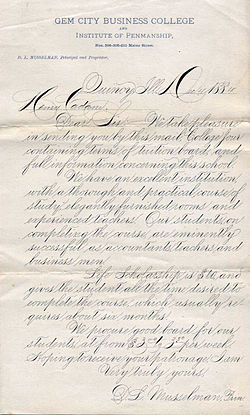
Cursive (also known as joined-up writing) is any style of penmanship in which characters are written joined in a flowing manner, generally for the purpose of making writing faster, in contrast to block letters. It varies in functionality and modern-day usage across languages and regions; being used both publicly in artistic and formal documents as well as in private communication. Formal cursive is generally joined, but casual cursive is a combination of joins and pen lifts. The writing style can be further divided as "looped", "italic", or "connected".
The cursive method is used with many alphabets due to infrequent pen lifting which allows increased writing speed. However, more elaborate or ornamental calligraphic styles of writing can be slower to reproduce. In some alphabets, many or all letters in a word are connected, sometimes making a word one single complex stroke.
Cursive is a style of penmanship in which the symbols of the language are written in a conjoined, or flowing, manner, generally for the purpose of making writing faster. This writing style is distinct from "print-script" using block letters, in which the letters of a word are unconnected. Not all cursive copybooks join all letters; formal cursive is generally joined, but casual cursive is a combination of joins and pen lifts. In the Arabic, Syriac, Latin, and Cyrillic scripts, many or all letters in a word are connected (while others must not), sometimes making a word one single complex stroke. In Hebrew cursive and Roman cursive, the letters are not connected. In Maharashtra, there was a cursive alphabet, known as the 'Modi' script, used to write the Marathi language.
Ligature is writing the letters of words with lines connecting the letters so that one does not have to pick up the pen or pencil between letters. Commonly some of the letters are written in a looped manner to facilitate the connections. In common printed Greek texts, the modern small letter fonts are called "cursive" (as opposed to uncial) though the letters do not connect.
In looped cursive penmanship, some ascenders and descenders have loops which allows for the letters to link. This is generally what people refer to when they say "cursive" in the context of English. The letters in this style have their own unique characteristics. For example the lowercase t is taller, while the lowercase v and w are rounder. Also, the lowercase x links out at the baseline.
Cursive italic penmanship—derived from chancery cursive—uses non-looped joins, and not all letters are joined. In italic cursive, there are no joins from g, j, q, or y, and a few other joins are discouraged.[failed verification] Italic penmanship became popular in the 15th-century Italian Renaissance. The term "italic" as it relates to handwriting is not to be confused with italic typed letters. Many, but not all, letters in the handwriting of the Renaissance were joined, as most are today in cursive italic.
The origins of the cursive method are associated with the practical advantages of writing speed and infrequent pen-lifting to accommodate the limitations of the quill. Quills are fragile, easily broken, and will spatter unless used properly. They also run out of ink faster than most contemporary writing utensils. Steel dip pens followed quills; they were sturdier, but still had some limitations. The individuality of the provenance of a document (see Signature) was a factor also, as opposed to machine font. Cursive was also favoured because the writing tool was rarely taken off the paper. The term cursive derives from Middle French cursif from Medieval Latin cursivus, which literally means 'running'. This term in turn derives from Latin currere ('to run, hasten'). Although by the 2010s, the use of cursive appeared to be on the decline, as of 2019[update] it seemed to be coming back into use.
In the Bengali cursive script (also known in Bengali as "professional writing"[citation needed]) the letters are more likely to be more curvy in appearance than in standard Bengali handwriting. Also, the horizontal supporting bar on each letter (matra) runs continuously through the entire word, unlike in standard handwriting. This cursive handwriting often used by literature experts differs in appearance from the standard Bengali alphabet as it is free hand writing, where sometimes the alphabets are complex and appear different from the standard handwriting.[citation needed]
Cursive
Cursive (also known as joined-up writing) is any style of penmanship in which characters are written joined in a flowing manner, generally for the purpose of making writing faster, in contrast to block letters. It varies in functionality and modern-day usage across languages and regions; being used both publicly in artistic and formal documents as well as in private communication. Formal cursive is generally joined, but casual cursive is a combination of joins and pen lifts. The writing style can be further divided as "looped", "italic", or "connected".
The cursive method is used with many alphabets due to infrequent pen lifting which allows increased writing speed. However, more elaborate or ornamental calligraphic styles of writing can be slower to reproduce. In some alphabets, many or all letters in a word are connected, sometimes making a word one single complex stroke.
Cursive is a style of penmanship in which the symbols of the language are written in a conjoined, or flowing, manner, generally for the purpose of making writing faster. This writing style is distinct from "print-script" using block letters, in which the letters of a word are unconnected. Not all cursive copybooks join all letters; formal cursive is generally joined, but casual cursive is a combination of joins and pen lifts. In the Arabic, Syriac, Latin, and Cyrillic scripts, many or all letters in a word are connected (while others must not), sometimes making a word one single complex stroke. In Hebrew cursive and Roman cursive, the letters are not connected. In Maharashtra, there was a cursive alphabet, known as the 'Modi' script, used to write the Marathi language.
Ligature is writing the letters of words with lines connecting the letters so that one does not have to pick up the pen or pencil between letters. Commonly some of the letters are written in a looped manner to facilitate the connections. In common printed Greek texts, the modern small letter fonts are called "cursive" (as opposed to uncial) though the letters do not connect.
In looped cursive penmanship, some ascenders and descenders have loops which allows for the letters to link. This is generally what people refer to when they say "cursive" in the context of English. The letters in this style have their own unique characteristics. For example the lowercase t is taller, while the lowercase v and w are rounder. Also, the lowercase x links out at the baseline.
Cursive italic penmanship—derived from chancery cursive—uses non-looped joins, and not all letters are joined. In italic cursive, there are no joins from g, j, q, or y, and a few other joins are discouraged.[failed verification] Italic penmanship became popular in the 15th-century Italian Renaissance. The term "italic" as it relates to handwriting is not to be confused with italic typed letters. Many, but not all, letters in the handwriting of the Renaissance were joined, as most are today in cursive italic.
The origins of the cursive method are associated with the practical advantages of writing speed and infrequent pen-lifting to accommodate the limitations of the quill. Quills are fragile, easily broken, and will spatter unless used properly. They also run out of ink faster than most contemporary writing utensils. Steel dip pens followed quills; they were sturdier, but still had some limitations. The individuality of the provenance of a document (see Signature) was a factor also, as opposed to machine font. Cursive was also favoured because the writing tool was rarely taken off the paper. The term cursive derives from Middle French cursif from Medieval Latin cursivus, which literally means 'running'. This term in turn derives from Latin currere ('to run, hasten'). Although by the 2010s, the use of cursive appeared to be on the decline, as of 2019[update] it seemed to be coming back into use.
In the Bengali cursive script (also known in Bengali as "professional writing"[citation needed]) the letters are more likely to be more curvy in appearance than in standard Bengali handwriting. Also, the horizontal supporting bar on each letter (matra) runs continuously through the entire word, unlike in standard handwriting. This cursive handwriting often used by literature experts differs in appearance from the standard Bengali alphabet as it is free hand writing, where sometimes the alphabets are complex and appear different from the standard handwriting.[citation needed]
Recent media
Recent media