Hubbry Logo
Cross-border flag for IrelandCross-border flag for IrelandMain
Open search
Cross-border flag for Ireland
Community hub
Cross-border flag for Ireland
logo
7 pages, 0 posts
0 subscribers
Be the first to start a discussion here.
Cross-border flag for Ireland
from Wikipedia

There is no cross-border flag universally accepted as representing both jurisdictions on the island of Ireland. This can be a problem in contexts where a body organised on an all-island basis needs to be represented by a flag in an international context.

The island is politically divided into the Republic of Ireland (a sovereign state comprising 26 of Ireland's 32 traditional counties) and Northern Ireland (a part of the United Kingdom, comprising the remaining 6 counties in the north-east of Ireland), but all-island organisations are common. Examples include the Catholic Church in Ireland, the Presbyterian Church in Ireland, the Church of Ireland, the Gaelic Athletic Association, the Orange Order, Scouting Ireland and the Irish Rugby Football Union.

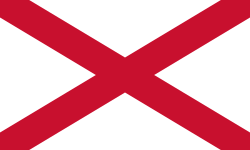
Saint Patrick's Saltire

[edit]

The Saint Patrick's Saltire was incorporated into the Union Flag in 1801 by way of the Act of Union 1800 to represent Ireland within the new United Kingdom of Great Britain and Ireland.

The Church of Ireland orders that, apart from the flag of the Anglican Communion, only this saltire may be flown on its church grounds—as opposed to the tricolour, the Union Flag or the former flag of Northern Ireland. This follows the practice of other Anglican churches in England, Scotland, and Wales, which fly the flags of their respective patron saints instead of the Union Flag.[1]

The saltire is also flown by the Catholic St. Patrick's College, Maynooth, on graduation days.

Modified versions have been used formerly by the Irish Rugby Football Union, and currently by the Royal College of Surgeons in Ireland and the Commissioners of Irish Lights.[2]

Irish tricolour

[edit]

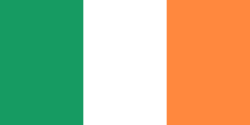
The tricolour of green, white and orange, the official flag of the Republic of Ireland, was originally intended by nationalists to represent the entire island. When it was first publicly unveiled by Thomas Francis Meagher in Waterford in 1848 he suggested a possible alternative design incorporating the red hand of Ulster:

"If this flag be destined to fan the flames of war, let England behold once more, upon the white centre, the Red Hand that struck her down from the hills of Ulster."[3]

The intended symbolism of unity is rejected by Ulster unionists, as illustrated by an exchange in the House of Commons of Northern Ireland in 1951:[4]

-James McSparran (Nationalist Party): The tricolour is admitted by all nations within the comity of nations to be the national flag of Ireland.
-Honorable members: No.
-McSparran: We are having interruptions already. It is the national flag of the Irish Republic.
-William May (Ulster Unionist Party): That is better.

The Gaelic Athletic Association (GAA) flies this flag at matches regardless of whether either or both teams are from Northern Ireland. It is also used for the Ireland international rules football team, selected by the GAA on an all-island basis.

The Golfing Union of Ireland covers the whole island and competes under the tricolour in international events such as the World Cup, Alfred Dunhill Cup and the Eisenhower Trophy.[5]

Four Provinces flag

[edit]

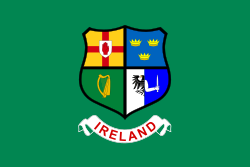
The Four Provinces Flag of Ireland is a quartering of the arms of the four provinces of Ireland. The order of the provinces varies.

Various all-Ireland sports teams and organisations use the Four Provinces Flag of Ireland and a four province Crest of Ireland, including the Ireland field hockey team, Ireland rugby league team, Irish rugby union team and Irish Amateur Boxing Association.

Erne flag

[edit]

This flag was initially used on the Shannon–Erne Waterway, which is bisected by the border. Rather than flying a national flag, boats fly this green, white and blue flag.[6][failed verification] It is endorsed by the Inland Waterways Association of Ireland, an all-island organisation.[7] This design is, however, very similar to the national flag of Sierra Leone.

Harp flags

[edit]

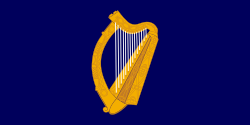
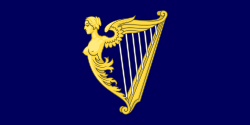
The harp (or cláirseach) has long been a symbol of Ireland, being first recorded in a French roll of arms known as the Armorial Wijnbergen, which dates to the late 13th century. It first featured on Irish coins in the reign of Henry VIII around 1534.[8] During the seventeenth and eighteenth century, the harp became adorned with progressively more decoration, ultimately becoming a "winged maiden".[9][10] In the nineteenth century, the Maid of Erin, a personification of Ireland, was a woman holding a more realistic harp than the "winged maiden". This style of harp was then also used in Irish flags. The harp on the modern coat of arms of Ireland is modelled on the "Brian Boru" harp in the library of Trinity College, Dublin, as it appeared after an 1840s restoration.

Blue harp flag

[edit]

The lower left quadrant of the Royal Standard of the United Kingdom has featured a harp on a blue field, representing Ireland since 1603.[8] The current version, designed in 1953, uses a winged-maiden harp and consists of a golden cláirseach with silver strings on a blue background. The shade of blue in the field was known as Saint Patrick's Blue when used in 1783 for the regalia of the Order of Saint Patrick.[11]

Green harp flag

[edit]

The flag of a harp on a green background was first used by Owen Roe O'Neil in 1642. The change from blue to green started in the 17th century with Owen Roe O'Neill and Confederate Ireland,[12] The colour green became associated with Ireland from the 1640s onwards. The United Irishmen adopted this flag which already had strong associations with Ireland, it was unofficially the national flag for centuries, The united Irishmen was an Irish nationalist movement associated with both Catholic and Protestant Irish – its leader Wolfe Tone was Anglican Protestant; green was a colour of rebellion in the eighteenth century.[13] Since at least the 17th century Ireland has been known by the poetic name the Emerald Isle due to its abundance of green countryside.[14] This was a common flag used to represent Ireland during the nineteenth and early twentieth centuries. It consisted of a gold cláirseach on a green background. It was associated with moderate nationalism at a time when the tricolour was confined to more radical movements.[citation needed] It is the same as the modern Flag of Leinster. It was used by the Irish team at the 1930 British Empire Games.

Sporting flags

[edit]

Several all-island sporting organisations send representative teams to compete internationally. In some cases, a flag unique to that organisation is used in lieu of a national flag. Typically such flags include one of the traditional symbols of Ireland.

Cricket Ireland uses a green flag depicting three shamrocks.

The Ireland national field hockey team uses a bespoke flag with a shield quartered with the symbols of the four provinces.

The Ireland rugby team's flag is a green flag containing the shields of the four provinces and the Irish Rugby Football Union's logo. At matches outside Ireland, this is the only flag displayed. At matches in Northern Ireland (typically at Ravenhill) the Flag of Ulster (yellow background) is also displayed. This is the flag of the nine-county province (including the three Ulster counties in the Republic of Ireland), similar to but distinct from the Ulster Banner (white background), the former flag of the Northern Irish government. At matches in the Republic of Ireland (typically at Lansdowne Road), the Irish tricolour is flown along with the preceding two.

Eddie Irvine, a Formula One driver from Conlig in Northern Ireland, asked for a white flag with a shamrock to be used if he secured a podium finish.[15] There had been controversy when an Irish tricolour had been used incorrectly for him in 1997.[15] The FIA insisted the Union Flag be used in conformance with its regulations.[15]

The Show Jumping Association of Ireland (SJAI; subsequently renamed Showjumping Ireland) used a green flag with its crest based on the four provinces when competing internationally, from its formation after the Second World War. In FEI Nations Cup events, Ireland was represented by the Irish Army Equitation School under the tricolour. From the late 1960s, the SJAI joined forces with the army in FEI competitions and competed under the tricolour, although it retained its own flag in other competitions until the late 1970s.[16]

See also

[edit]

References

[edit]
Revisions and contributorsEdit on WikipediaRead on Wikipedia
from Grokipedia
The cross-border flag for Ireland refers to the absence of a universally accepted symbol representing the entire island across the political jurisdictions of the and , complicating representation in all-island institutions, , and cooperative bodies established under agreements like the . In practice, cross-border entities such as the North/South Ministerial Council fly both the Irish tricolour and the Union Flag to acknowledge the divided sovereignty, rather than adopting a unified . All-island governing bodies, including the and , employ bespoke flags incorporating elements like shamrocks or provincial arms to signify island-wide participation without endorsing partisan national symbols. Proposed alternatives, such as the Four Provinces flag combining the of , , , and , have gained traction in cultural and some sporting contexts but lack official endorsement for broader governmental use. This symbolic vacuum reflects underlying constitutional tensions, where unionist sensitivities toward Irish unification motifs and nationalist aversion to British emblems hinder consensus on a neutral banner.

Historical Background

Origins of Irish Symbolism Pre-Partition

The red saltire, or Saint Patrick's Cross, emerged as a key emblem of Irish identity through its adoption in the insignia of the Order of Saint Patrick, founded on 5 March 1783 by King George III to honor Anglo-Irish elites loyal to the crown. This chivalric order's badge featured a red diagonal cross on a white field, drawing on the X-shaped staff legendarily attributed to Saint Patrick in hagiographic traditions, though direct medieval attestations remain sparse and primarily associative rather than documentary. The saltire's use in this context marked an early instance of a symbol uniquely tied to the entire island of Ireland, predating formalized national flags and reflecting heraldic conventions under the Kingdom of Ireland. The gold on a field, rooted in Gaelic cultural reverence for the cláirseach, appeared in Irish armorial bearings by the 13th century, signifying royal authority among native lords. English monarchs integrated this motif into representations of from the , with employing it on coinage issued for the lordship and later kingdom, establishing it as a proto-national device under both Gaelic and Tudor rule. By 1603, formalized the azure field with or stringed argent in the royal arms for upon uniting the crowns, perpetuating its role as a neutral emblem of the island's sovereignty within the . Ireland's pre-partition symbolic framework also encompassed the four ancient provinces—, , , and —whose heraldic charges, such as Ulster's dexter hand gules from 13th-century lore and Munster's three gold crowns, dated to medieval grants and evidenced a longstanding conception of island-wide unity divided into these historic divisions. These provincial arms, while not uniformly flown as flags before the , informed composite designs evoking collective Irish territory, emphasizing geographic and legendary cohesion absent politicized overtones of later eras.

Impact of Partition on Flag Usage (1921 Onward)

The , formalized by the and the of 1921, established the in the south and in the north, resulting in separate sovereign entities with distinct flag protocols reflective of their opposing constitutional aspirations. The adopted the green-white-orange tricolour as its national flag in 1922, continuing its use from the First Dáil's declaration in 1919, symbolizing the aspiration for a free from British rule. In contrast, , as part of the , initially relied on the for official purposes, with the —based on the province's heraldic arms and redesigned in 1924—formally adopted as the government flag only in 1953, serving until in 1973. This divergence entrenched flags as markers of irreconcilable identities, with the tricolour viewed in as a republican emblem incompatible with unionist loyalty to , precluding any shared cross-border symbol. To manage sectarian tensions arising from partition's deliberate allocation of a unionist majority in —achieved through boundary adjustments favoring Protestant demographics—the Stormont government enacted the Flags and Emblems (Display) Act (Northern Ireland) 1954. This legislation criminalized interference with the while authorizing the Royal Ulster Constabulary to remove any flag or emblem, including the tricolour, if its display was deemed likely to provoke a , often applied selectively against nationalist expressions. The Act's intent was to preserve public order amid underlying divisions engineered by partition, but it institutionalized asymmetry, permitting widespread loyalist displays while restricting Irish symbols, thereby exacerbating perceptions of without resolving the absence of neutral protocols. These frictions manifested in recurrent violence during from the late 1960s to 1998, where flag usage became a flashpoint for communal conflict. A notable early incident occurred in September 1964 during the Divis Street riots in , triggered by the theft of a tricolour from a office, leading to three nights of clashes involving petrol bombs, stones, and police using armored vehicles and water cannons, resulting in dozens of arrests and injuries. Throughout the period, unauthorized tricolour hoisting in nationalist areas or near unionist sites frequently prompted removals, boycotts, or riots, such as those in 1969 amid broader civil rights protests, underscoring how partition's legacy rendered flags proxies for unresolved sovereignty disputes rather than unifying emblems. Empirical records from the era document hundreds of such confrontations, contributing to over 3,500 deaths in the conflict, though official inquiries often highlighted enforcement biases favoring the status quo.

Current Cross-Border Practices

Institutional and Sporting Contexts

All-island sporting organizations prioritize neutral symbols in their flag designs to encompass participants from both and the without evoking partisan affiliations. The (IRFU), governing across the island since its founding in 1875, employs a flag featuring the heraldic shields of the four provinces—, , , and —arranged on a green field, often incorporating the union's logo. This design, used for international matches, underscores provincial representation over national sovereignty claims. Similarly, the field hockey teams representing adopt a green flag displaying the coats of arms of the same four provinces, a practice that maintains inclusivity for cross-border athletes. The (GAA), operational since 1884, structures its events around county teams with colors and emblems derived from traditional affiliations, allowing counties like those in to compete uniformly irrespective of jurisdictional boundaries, though without a centralized all-island . In institutional settings under the 1998 , cross-border entities such as Tourism Ireland, tasked with joint promotion of the island's tourism, utilize the as a core emblem within their branding to evoke shared Irish identity sans state flags. These bodies, including six North-South implementation areas covering domains like and , eschew official national flags in favor of logos or generic Celtic motifs, aligning with the agreement's ethos of mutual cooperation and equivalence of identities to sidestep symbolic discord.

Everyday and Official Flag Restrictions in Northern Ireland

Following the imposition of in March 1972 and the abolition of the Northern Ireland Parliament in 1973, the ceased to have any official status as a flag for . has had no designated official flag since that time, with the Union Flag serving as the primary symbol on public buildings and in official contexts. Under the Flags Regulations (Northern Ireland) 2000, as amended in 2002, the Union Flag must be flown from specified , including those of central departments and courts, only on designated days—typically around 18 occasions annually, aligned with UK-wide observances such as royal birthdays and national holidays. This policy underscores the absence of a distinct emblem, emphasizing integration with broader flag protocol rather than regional symbolism. In everyday practice, unionists frequently display the unofficially at private residences, parades, and community events as a marker of Northern Irish identity within the , viewing it as a continuation of pre-1973 heritage. Nationalists, however, reject the banner, associating it with the unionist-dominated Stormont era and the , preferring symbols that transcend divisional lines or align with all-island aspirations. Tensions over flag display erupted in the 2012–2013 Belfast City Hall protests, triggered by a December 2012 council vote—supported by and Alliance Party members—to restrict the Union Flag to designated days, mirroring government policy. The ensuing unrest, spanning late 2012 to early 2013, involved widespread demonstrations, rioting, and violence primarily from unionist groups protesting the perceived downgrading of British symbols, resulting in more than 200 arrests for offenses including riotous assembly and . At least 37 participants were subsequently jailed, highlighting entrenched unionist grievances over diminishing visibility of UK flags in public spaces amid power-sharing governance.

Traditional and Historical Proposals

Saint Patrick's Saltire

The , featuring a red diagonal cross () on a white field, emerged as an Irish symbol in the , with the earliest documented depiction appearing on a 1576 map of by John Goghe. This design gained formal association with through its adoption as the badge of the Order of Saint Patrick, a chivalric order instituted by King George III in 1783. Intermittent use of red saltires in Irish contexts predates this, including occasional 17th-century representations, though without explicit ties to the saint until the late . In 1801, the was integrated into the Union Flag via the design approved by the following the Acts of Union, which united and ; the red saltire, counterchanged with the blue , symbolized Ireland's inclusion in the . This incorporation underscored its role as a for the Kingdom of Ireland prior to partition, rooted in heraldic tradition rather than popular flag usage. Advocates have highlighted its potential as an apolitical cross-border emblem, citing its pre-modern heraldic origins and shared Christian heritage via Ireland's patron saint, which sidesteps the sectarian color associations of green and orange prevalent in modern Irish symbolism. Such neutrality could foster unity across the border without evoking partition-era divisions, leveraging the saltire's avoidance of tricolor or unionist motifs. However, empirical adoption remains confined largely to heraldry, the Union Flag, and niche contexts like the Order of Saint Patrick, with no widespread institutional embrace in either jurisdiction post-1921. Criticisms from Irish nationalists portray the as an artificial British invention, lacking authentic pre-colonial Irish pedigree and tainted by its Union Flag linkage, rendering it unsuitable as a unifying symbol. Sources describe it as a "fictitious emblematic representation" imposed during the 1801 union, more reflective of Anglo-Irish elite than indigenous . This perception limits its cross-border viability, as it fails to resonate empirically beyond symbolic or historical niches, despite theoretical appeal for transcending contemporary divides.

Harp Flags

The emerged as an emblem of Irish sovereignty rooted in ancient Gaelic traditions, where the instrument symbolized cultural prestige and was linked to figures like High King during the 11th century, as evidenced by surviving artifacts such as the late-medieval cláirseach now housed in . This pre-Christian Gaelic heritage underscores the 's indigenous origins, predating external influences and representing native bardic and royal authority. However, its adoption into formal by English monarchs from the 16th century onward introduced competing claims, with the symbol co-opted to signify dominion over while retaining its Gaelic aesthetic. The blue harp variant, depicting a gold harp on a blue field, originated as the standard of the Kingdom of Ireland following the Crown of Ireland Act of 1542, which formalized English sovereignty and established the as a quartered element in royal arms. This design persisted in official usage, including as a component of the Royal Standard until the partition era, and was borne by Irish regiments in the , such as the Royal Irish Regiment formed in 1684, which incorporated the harp in its colors and badges to denote regimental heritage. The blue field's heraldic precedence reflects its institutional entrenchment under pre-partition governance, evoking continuity with monarchical traditions rather than separatist aspirations. In contrast, the green harp flag, featuring a harp on a green background, gained prominence through nationalist circles, particularly with the United Irishmen during the 1798 Rebellion led by figures like , who revived it as a banner of republican independence drawing on earlier Catholic Confederate usage from the 1640s. This iteration emphasized the harp's Gaelic roots while aligning green with emerging ethnic and insurgent identities, yet its association with rebellion limited cross-community resonance, as unionist elements favored the blue harp's established, crown-aligned form over what they perceived as a politicized inversion. The divergence in coloration thus highlights causal tensions between the symbol's primordial Irish authenticity and its layered appropriations, fostering dual narratives of ownership without resolving underlying sovereignty disputes.

Four Provinces Flag

The Four Provinces Flag features the heraldic arms of Ireland's traditional provinces—, , , and —quartered on a green field, often with a central overlay in some variants. This design emphasizes geographic unity across the island, encompassing all nine counties of , including the six in , without explicit ethnic or political affiliations. The provincial arms derive from medieval origins, with the combined flag gaining prominence during the late 19th-century Gaelic cultural revival as a symbol of pan-Irish identity. Adopted by all-island organizations, the flag has been employed in inter-provincial (GAA) competitions since the 1920s to signify shared heritage transcending partition. Its inclusivity of provides a neutral framework for cross-border representation, appealing to those seeking alternatives to partisan symbols like the Irish tricolour. However, some nationalists perceive the Ulster quarter—featuring a red hand on gold—as evoking Protestant associations, linked historically to unionist , which tempers broader acceptance. Empirically, usage remains sporadic, appearing occasionally in tourism promotions and cultural events but lacking official endorsement in either due to the entrenched legacy of 1921 partition and competing national symbols. No governmental body has conferred formal status, reflecting persistent divisions in flag symbolism post-independence.

National Flags in Cross-Border Context

Irish Tricolour as a Proposed Unifier

The Irish Tricolour, comprising vertical stripes of green, white, and orange, was designed in 1848 by , a leader of the Young Irelanders, who presented it as a symbol of harmony between Ireland's Catholic and Protestant communities. It gained formal recognition when adopted by the Éireann on 21 January 1919 as the national flag of the proclaimed Irish Republic. Following the , the flag became the ensign of the in 1922 and retained its status through the 1937 Constitution and the 1949 Republic of Ireland Act. The colours carry specific symbolic intent: green for the nationalist Gaelic tradition, orange for the linked to William of Orange, and white for enduring peace between the two. This design has achieved broad international acknowledgment as Ireland's sovereign emblem, appearing at UN events and diplomatic representations since the Republic's establishment. However, its cross-border viability as a unifier remains contested due to partition-era divisions. In , the Tricolour's display has long been restricted under the Flags and Emblems (Display) Act (Northern Ireland) 1954, which empowered police to remove flags likely to provoke public disorder, with the Tricolour frequently targeted as emblematic of irredentist claims on the region. Its association intensified during (1969–1998), when republican groups including the prominently flew it, cementing unionist perceptions of it as a marker of anti-partition militancy rather than reconciliation. Proponents of Irish reunification, particularly nationalists, have floated retaining the Tricolour for a 32-county state to leverage its established prestige and intended inclusivity. Yet surveys reveal entrenched unionist rejection, with Protestant respondents in expressing widespread opposition to its adoption, viewing it as effacing British ties and identity. In the , attachment persists, though ARINS/Irish Times polling highlights southern voters' reluctance to alter symbols amid unity discussions, underscoring the flag's polarizing legacy over its unifying origins.

British Symbols and Unionist Preferences

In Northern Ireland, the Union Jack functions as the exclusive official flag for government buildings, as stipulated by the Flags Regulations (Northern Ireland) 2000, which mandate its display on designated days and prohibit other flags on such sites. Unionists, prioritizing constitutional ties to the , favor the as the paramount symbol of British sovereignty, often displaying it alongside the during parades, loyalist gatherings, and sports representing Northern Ireland. The —characterized by a white field bearing the centered under a six-pointed star and crown, based on the provincial formalized in 1924 and adopted as Northern Ireland's flag in 1953—ceased official use following the 1972 suspension of the Stormont Parliament but endures as a emblem among unionists, signifying regional identity within the UK framework. This affinity for British symbols originates in the 1921 partition, formalized under the , which delineated to accommodate ' resolute rejection of Irish legislation passed in 1914. Unionists, concentrated in the six northeastern counties, opposed on grounds of preserving British governance, , and economic links to , mobilizing through organizations like the —formed in 1912—to thwart integration into a Dublin-led administration perceived as antithetical to their interests. The partition thus enshrined for this demographic bloc, embedding British symbols as affirmations of that settlement against irredentist claims. Contemporary unionist preferences align with 2021 census data indicating 31.9% of residents self-identify exclusively as British, alongside higher proportions incorporating British identity in multiple affiliations, reinforcing the legitimacy of UK-oriented symbols in reflecting electoral and demographic majorities opposed to unification. Unionists contend that prioritizing the and upholds the democratic mandate for 's UK membership, viewing cross-border Irish symbols as impositions that erode minority protections and the partition's rationale. Nationalists, conversely, deride the as a partisan loyalist marker intertwined with iconography and historical unionist dominance, though unionists counter that its persistence has sustained communal cohesion and deterred destabilizing concessions to separatist agendas.

Modern Proposals and Alternatives

Erne Flag

The Erne flag consists of three equal horizontal stripes of green, white, and blue, serving as a neutral ensign for vessels navigating the Shannon–Erne Waterway, a cross-border linking the River Shannon in the to the River Erne in . Adopted upon the waterway's restoration and reopening on May 12, 1994, the design eschews national symbols to prevent sectarian friction, with green evoking Ireland's landscape, white signifying peace, and blue representing the waterways themselves. Intended to foster cross-community in a marked by partition, the flies exclusively on boats along this 63-kilometer route, which traverses both jurisdictions without requiring customs checks for leisure craft. Its use remains confined to this practical, navigational context, with occasional debate among enthusiasts over proper orientation—some favoring green toward the hoist (ground) and blue to the fly (sky) to align with traditional maritime conventions. Despite occasional proposals in online discussions for broader application as a unifying , no official or widespread adoption beyond the has occurred, reflecting its origin as a solution rather than a culturally resonant symbol. The flag's contrived nature, devised specifically for mid-1990s infrastructure revival amid ' waning but persistent divisions, underscores its limited traction; lacking pre-existing historical or folkloric associations, it has not gained traction in ecumenical or public settings, remaining a niche maritime courtesy flag per available records from waterways associations.

Custom and Ad Hoc Designs

In recent years, online communities have produced numerous flag designs aimed at fostering cross-border unity , often blending traditional elements like the and harp without official endorsement. For instance, a November 2023 Reddit proposal featured an emerald green field with five stars symbolizing the four provinces and national unity, intended as a neutral alternative for a potential . Similar user-generated designs on platforms like 's r/ and r/ subreddits from 2023 to 2024 have incorporated green and red hues with harps or provincial symbols, reflecting grassroots attempts to create inclusive symbols amid discussions of reunification. These informal experiments highlight fragmented efforts rather than convergence, as discussions reveal persistent divisions in preferences, with some users favoring modifications to existing flags and others advocating entirely new creations to transcend historical associations. A March 2024 thread soliciting opinions on flags elicited varied responses, including calls for harp-inclusive designs but criticism of options like adding a red hand to the tricolour as exacerbating divisions. This lack of consensus mirrors broader surveys indicating wariness among Northern Irish Protestants toward Irish symbols, underscoring the causal endurance of distinct identities even in post-Brexit contexts of border poll speculation. Opinion pieces in 2025 have amplified calls for bespoke flags to jettison "baggage" from entrenched symbols, arguing that a fresh design could mitigate sectarian perceptions and appeal to diverse constituencies in a hypothetical . One September 2025 analysis contended that the tricolour's associations with division and recent anti-immigrant protests necessitate a new emblem for genuine unity, prioritizing forward-looking symbolism over historical continuity. Such proposals offer flexibility in adapting to evolving identities but suffer from lacking institutional authority, resulting in ephemeral traction without measurable adoption or polling majorities favoring any single variant.

Debates and Controversies

Symbolism Divisions and Sectarian Tensions

Flag disputes in have frequently escalated into violence, underscoring deep-seated divisions over and sovereignty. The 2012–2013 protests following City Council's December 3, 2012, decision to restrict the Union Flag's display at City Hall to designated days only triggered widespread unrest, with loyalist demonstrators clashing with police over nearly 60 nights, resulting in over 40 officers injured and dozens arrested. These events, rooted in perceptions of democratic erosion for unionists who viewed the flag as a core emblem of constitutional ties to the , highlighted how symbolic concessions can ignite paramilitary-linked mobilization and attacks on cross-community politicians. Nationalists interpret British flags like the as enduring markers of colonial partition and , evoking historical grievances over the 1921 Government of Ireland Act's imposition of borders without majority consent in affected areas. In contrast, unionists regard Irish republican symbols, such as the tricolour, as existential threats implying irredentist ambitions to dismantle the union through demographic or political shifts, rather than consensual referenda under the . This mutual framing—British icons as tools of subjugation for one side, Irish ones as harbingers of enforced absorption for the other—fuels a zero-sum logic where territorial displays reinforce community boundaries and deter integration. Annual flag displays, estimated at around 4,000 during the marching season peak, systematically delineate ethno-national enclaves, correlating with heightened public order demands and sporadic clashes as groups police perceived encroachments on "their" spaces. Post-Brexit tensions amplified these dynamics, with 2021 loyalist protests against the —seen as severing economic parity with —incorporating flag-waving rallies that devolved into arson and petrol bombings in , injuring over 50 police officers amid broader identity anxieties. Media portrayals of such incidents often emphasize unionist reactions as disproportionate or "futile," while understating parallel nationalist sensitivities to British symbols, a critiqued as perpetuating conflict legacies through selective framing that aligns with institutional preferences for stability over equitable scrutiny. These disputes reveal causal chains where symbols serve not merely as decor but as proxies for unresolved power asymmetries, with protests reinforcing segregation rather than bridging divides.

Implications for Irish Reunification

A 2022 Irish Times poll found that nearly half of voters in the stated that potential changes to the or would make them less likely to support Irish unity, reflecting strong attachment to existing s among southern respondents. In contrast, a 2023 survey indicated division in the on altering the flag or for unification, with northern respondents twice as likely to favor such changes. Unionist perspectives emphasize rejection of the Irish tricolour, often viewing it as emblematic of republican paramilitarism rather than a neutral state , with many insisting on a new design or retention of British elements like the in any scenario. Proposals for addressing flag divisions include adopting a neutral new to symbolize inclusivity, potentially incorporating shared geographic or cultural motifs, or flying dual flags to accommodate both traditions during a transitional period. Advocates for change argue that the tricolour carries sectarian associations from its historical ties to and recent misuse in anti-immigrant protests, potentially alienating unionists and complicating consensus. Defenders counter that such critiques overlook the flag's intended representation of between green (Catholic/nationalist) and orange (Protestant/unionist) traditions, prioritizing unity's broader benefits over symbolic concessions. Despite these debates, empirical evidence underscores that flag symbolism ranks below , institutional reforms, and cultural accommodations as barriers to reunification, with polls showing persistent majorities in opposing unity altogether. The mandates concurrent majorities in both jurisdictions for border polls, implying no viable path to consensus on symbols—or unification—without demonstrated cross-community support, as symbolic changes alone fail to address underlying demographic and fiscal realities.

References

Add your contribution
Related Hubs
User Avatar
No comments yet.