


Community hub
Recent from talks
Contribute something
Nothing was collected or created yet.
Podium
View on Wikipedia

A podium (pl.: podiums or podia) is a platform used to raise something to a short distance above its surroundings. In architecture a building can rest on a large podium.[1] Podiums can also be used to raise people, for instance the conductor of an orchestra stands on a podium as do many public speakers. Common parlance has shown an increasing use of podium in North American English to describe a lectern.[2][3][4][5]
In sports, a type of podium can be used to honor the top three competitors in events. In the modern Olympics a tri-level podium is used. Traditionally, the highest platform is in the center for the gold medalist. To their right is a lower platform for the silver medalist, and to the left of the gold medalist is a lower platform for the bronze medalist. At the 2016 Rio Summer Olympics, the Silver and Bronze podium places were of equal elevation. In many sports, results in the top three of a competition are often referred to as podiums or podium finishes. In some individual sports, podiums is an official statistic, referring to the number of top three results an athlete has achieved over the course of a season or career. The word may also be used, chiefly in the United States, as a verb, "to podium", meaning to attain a podium place.[4]
Etymology
[edit]
The word podium derives from Latin, which in turn borrowed it from Ancient Greek πόδιον (podion), a word derived from πούς (pous, "foot", with a stem pod-).
Use at modern Olympics
[edit]
Podiums were first used at the 1930 British Empire Games (now Commonwealth Games) in Hamilton, Ontario and subsequently during the 1932 Winter Olympics in Lake Placid and the 1932 Summer Olympics in Los Angeles.[6][7]
Podiuming has become a slang term for finishing a contest within the first three places. The use of the word podium as a verb instead of noun is controversial. The New York Times wrote on the very subject of the correct use of the word podium during its Winter Olympic coverage in 2010.[8]
In motorsport
[edit]In many forms of motorsport, the three top-placed drivers in a race stand on a podium for the trophy ceremony. The winner stands in the middle, with the second placed driver to their right and the third place driver to their left. Also present are the dignitaries selected by the race organisers who will present the trophies.[9]
.jpg)
In some motorsport events, including Formula One, a representative of the team that won the race will also be present at the podium, with a fourth podium step, trophy and champagne. In some series, drivers are provided with a baseball cap with the logo of the series' tyre provider to wear while on the podium. In an international series, the national anthem of the winning driver, and the winning team or constructor may be played over a public address system and the flags of the drivers' countries are hoisted above them. The recordings are short versions of the national anthems, ensuring the podium ceremony stays within its allocated time. Should a driver experience problems with his car on a slow lap in Formula One, that driver is transported to the pit lane via road car by the Formula One Administration security officer.[9]
Following the presentation of the trophies, the drivers will often spray Champagne over each other and their team members watching below, a tradition started by Dan Gurney following the 1967 24 Hours of Le Mans race.[10] The drivers will generally refrain from spraying champagne if a fatality or major accident occurs during the event. Also, in countries where alcohol sponsorship or drinking is prohibited, alcoholic beverages may be replaced by other drinks, for example rose water.[9][11]
The term has become common parlance in the media, where a driver may be said to "be heading for a podium finish" or "just missing out on a podium" when he is heading for, or just misses out on a top three finish. The NASCAR Cup Series, the highest level of stock car racing in the United States, does not use a podium in post-game events or statistics. Instead, the winning team celebrates in victory lane, and top-five and top-ten finishes are recognized statistically. Those finishing second to fifth are required to stop in a media bullpen located on pit lane for interviews. The INDYCAR NTT IndyCar Series does not use a podium at either the Indianapolis 500 or at Texas Motor Speedway. The Indy 500 has a long tradition of the winning driver and team celebrating in victory lane, while Texas Motor Speedway president Eddie Gossage has stated that victory lane should be reserved for the winner of the race.[12] The series uses a podium at all other races, particularly road course events.
In architecture
[edit]Architectural podiums consist of a projecting base or pedestal at ground level, and they have been used since ancient times. Originally sometimes only meters tall, architectural podiums have become more prominent in buildings over time, as illustrated in the gallery.
-
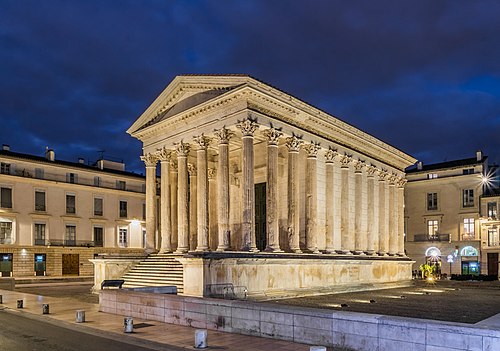 Maison Carrée, a Roman temple (4–7 AD)
 -
 London terrace housing (18th century)
 -
 Centre City Tower, Birmingham (1975)
.jpg)


See also
[edit]References
[edit]
- ^ "podium: definition of podium in Oxford dictionary (American English) (US)". oxforddictionaries.com. Archived from the original on 21 January 2013.
- ^ "podium Meaning in the Cambridge English Dictionary". cambridge.org. Archived from the original on 28 September 2015. Retrieved 6 March 2017.
- ^ "Definition of PODIUM". merriam-webster.com. Archived from the original on 6 July 2008. Retrieved 6 March 2017.
- ^ a b "podium - definition of podium in English - Oxford Dictionaries". oxforddictionaries.com. Archived from the original on 17 November 2012. Retrieved 6 March 2017.
- ^ "xkcd: Podium". xkcd.com. Archived from the original on 28 March 2016. Retrieved 6 March 2017.
- ^ Department of Communications and Public Affairs, Western University (23 July 2018). "Western News - Search". Western News. Archived from the original on 22 February 2014.
- ^ Martin, D. E., Martin, D. A., & Gynn, R. W. (2000). The olympic marathon. Human Kinetics. p. 146.
- ^ "Zimmer, Ben" [1], "The New York Times", Feb. 4, 2010
- ^ a b c Saward, Joe (13 September 1997). "Podium Ceremonies". GrandPrix.com. Inside F1, Inc. Archived from the original on 3 March 2016. Retrieved 25 December 2015.
- ^ Franck, Lewis (August 1996). "Sometimes It Just Flows". Inside Sports. Archived from the original on 24 June 2001.
- ^ F1 will have Arab flavour - Roland Hughes, The National, Abu Dhabi, 10 July 2008, Archived 4 July 2013 at the Wayback Machine
- ^ Thatsracin.com[permanent dead link] Dixon looks forward to next week's break Retrieved 6/19/2009
Podium
View on GrokipediaEtymology and Definition
Etymology
The word "podium" derives from the Latin podium, referring to a raised platform or balcony in Roman architecture, which itself originates from the Greek podion, a diminutive form of pous (foot), evoking the idea of a small foot-like base or support.[8] This etymological root underscores its initial connotation as a low, supportive structure, akin to the foundation of columns or statues in classical design.[5] In ancient Roman texts, the term appears in Marcus Vitruvius Pollio's De Architectura (c. 15 BCE), where it describes the elevated base or continuous low wall (podium) surrounding temple platforms, emphasizing its role in structural stability and elevation for ceremonial purposes. Vitruvius details the podium's integration into temple architecture, specifying proportions such as its height relative to columns and its construction on three sides for aesthetic and functional harmony.[9] The term entered English in the mid-18th century, with the earliest recorded use around 1743–1748, initially denoting an architectural element like a projecting base or plinth in classical revival contexts.[5] By the 19th century, its meaning expanded to include raised platforms for public speaking and conducting, influenced by the French adoption of podium from Latin, which facilitated its broader application in European cultural and oratorical settings. This evolution is documented in major lexicographical sources, such as the Oxford English Dictionary, which traces the semantic shift from static architectural features to dynamic platforms for elevation and visibility.Definitions and Terminology
A podium is primarily defined as a low platform, typically raised about 4 feet (1.2 meters) above the surrounding level, on which speakers, performers, or award recipients stand to enhance visibility and prominence during public addresses, musical conductions, or ceremonies.[10][6] This elevation distinguishes it as a functional structure for individual or small-group elevation without extensive spatial demands.[5][11] In architecture, a podium serves as the secondary definition: a base or substructure that supports and elevates a building, monument, or colonnade, often functioning as a low wall or terrace to provide stability and aesthetic grounding.[12] This structural role emphasizes its foundational purpose rather than performative use.[5] The term podium is distinguished from related structures: a dais, which is typically higher (often 4 feet or more) and designed for seating such as thrones or multiple participants in formal settings; a stage, a broader elevated area for dynamic performances with props and movement; and a rostrum, a speaker's platform often featuring a curved design for oratory projection.[13][14][15] Variations in terminology reflect contextual applications, such as "victory podium" for tiered sports platforms honoring winners and "speaker's podium" for debate or lecture elevations.[10] In Spanish-speaking regions, the cognate "podio" denotes the same platform across similar uses.[16]Podium in Sports
Olympic and Award Ceremonies
The Olympic podium was first introduced at the 1932 Summer Games in Los Angeles as a three-tiered structure designed to elevate the gold, silver, and bronze medalists, marking a significant evolution in victory ceremonies.[17] This innovation, the first of its kind in the modern Olympics, allowed athletes to stand prominently while receiving their awards, with the gold medalist positioned on the highest tier.[18] Prior to 1932, medals were simply handed over without such a ceremonial platform, but IOC President Henri de Baillet-Latour had instructed the Los Angeles organizers in 1931 to incorporate national flag-raising and the playing of the victor's national anthem during presentations, establishing these elements as integral to the podium ritual from its debut.[19] The design emphasized hierarchy through height differences, symbolizing achievement while fostering national pride through the flags and music.[20] Following the 1936 Berlin Games, the International Olympic Committee (IOC) began standardizing podium protocols to ensure consistency across future editions, building on the 1932 model to formalize the victory ceremony as a global tradition.[21] This post-1936 refinement included guidelines for podium construction and ceremony flow, though specific dimensions varied by host; for instance, modern iterations often feature the top tier at approximately 35 cm for the gold medalist and 20 cm for silver and bronze, as seen in Paris 2024, to maintain visibility and accessibility.[22] These standards aimed to preserve the podium's role in celebrating athletic excellence while adapting to logistical needs of international events. By the 2000s, Olympic podium designs evolved to incorporate advanced features like LED lighting for enhanced visibility and dramatic effect during evening ceremonies, alongside prominent national symbols to reflect host cultures.[21] Examples include the Sydney 2000 fibreglass podiums emblazoned with Olympic rings, the Beijing 2008 "Lucky Cloud" motifs symbolizing harmony, and the London 2012 purple structures inspired by the Games' logo, all illuminated to highlight medalists against stadium backdrops.[21] This period also saw a push toward sustainability, culminating in the Tokyo 2020 Games (held in 2021), where podiums were constructed entirely from 24.5 tons of recycled plastic collected from households and oceans, 3D-printed into modular panels for eco-friendly reuse.[23] Olympic medal ceremony protocols dictate precise positioning and mechanics to honor achievements equitably, with the gold medalist ascending the central highest platform, flanked by silver on one side and bronze on the other at equal lower heights.[24] Flags for all three nations are then raised simultaneously— the gold medalist's in the center and elevated highest—while the victor's national anthem plays, followed by applause; this sequence, executed by host nation personnel such as military flag bearers, ensures smooth timing and avoids diplomatic errors.[25] Since the 2010s, podium designs have increasingly aligned with IOC gender equality initiatives, incorporating neutral aesthetics and inclusive layouts to accommodate mixed-gender events without traditional hierarchies that could imply bias.[26]Motorsport
The podium ceremony in motorsport developed from early 20th-century Grand Prix racing presentations, such as the 1906 French Grand Prix where finishers received trophies in the grandstand, but the modern format was formalized in Formula One during the 1950s as the FIA World Championship launched, standardizing ceremonies for the top three finishers to include trophy presentations and national anthems. A defining element of the F1 podium emerged with the champagne spraying tradition, which began at the 1950 French Grand Prix at Reims-Gueux when winner Juan Manuel Fangio was awarded a large bottle of Moët & Chandon from a nearby vineyard.[27] The deliberate spraying ritual originated in 1967 when Dan Gurney shook and sprayed a bottle during his Le Mans victory celebration with A.J. Foyt, a practice that quickly spread to F1 podiums by the late 1960s, symbolizing exuberant triumph among drivers and teams.[27] This informal flair contrasted with the structured protocol, evolving into a global spectacle while adapting for cultural contexts, such as using rose water in alcohol-prohibited nations like Saudi Arabia since 2021.[27] In Formula One, the podium consists of a three-tiered structure positioned near the finish line at the end of the pit straight, featuring steps for first, second, and third place, covered in green or dark blue carpet, with a minimum 50 cm space behind for flag bearers and team banners.[28] Exclusive to the top three drivers and a constructor representative, the setup emphasizes brevity and media access, with drivers required to wear full racing suits during the proceedings.[28] Team branding, including banners and sponsor logos, adorns the platform to highlight victories, though regulations limit commercial elements to maintain focus on the sport.[29] Iconic podium venues underscore the ceremony's prestige, such as Monaco's harborside rostrum, where post-race celebrations overlooking the Mediterranean harbor have occurred since the 1929 race—with top drivers initially presenting awards in the royal box—and a dedicated podium introduced in 2017, renowned for its celebrity-filled ambiance amid superyachts.[30][31][32] The Indianapolis 500 has hosted top-three celebrations since its 1911 debut, initially as informal gatherings that evolved into formal victory lane ceremonies by the mid-20th century, where the top finishers are recognized with interviews, photos, and traditions like the winner's milk chug.[33] Following the fatal 1994 San Marino Grand Prix accident involving Ayrton Senna, circuits implemented safety enhancements, including reinforced barriers and expanded run-off zones adjacent to podium areas, as part of broader FIA reforms to mitigate risks during post-race activities.[34] Podium formats vary by series to suit their dynamics; the FIA World Rally Championship features stage-end podiums after each timed section to honor daily top performers, building excitement toward the rally's concluding ceremony.[35] In NASCAR, victory lane serves as the equivalent, a trackside enclosure for winner interviews and photos without tiered steps, where sponsor integrations intensified in the 1980s as brands like Coca-Cola secured naming rights for events and celebrations, transforming the space into a key marketing platform.[36]Other Athletic Contexts
In road races such as the Boston Marathon, which began in 1897 as the first annual marathon in the United States, awards are presented at the finish line to recognize the top three finishers across open, wheelchair, and para athletics divisions. These setups are typically integrated with electronic timing mats to verify official results and ensure accurate placements, allowing for immediate medal presentations and photo opportunities amid large crowds. The tradition underscores the event's emphasis on honoring elite performance while accommodating diverse participants, including wheelchair athletes since the division's official inclusion in 1975.[37] Cycling competitions like the Tour de France have incorporated stage podiums since the race's debut in 1903, serving as central elements for daily award ceremonies that celebrate individual and classification leaders. Winners ascend the podium to receive distinctive jerseys—such as the polka-dot design for the best climber, awarded annually since its introduction in 1975—and floral bouquets, symbolizing excellence in categories like overall time, points, and youth. These rituals, held immediately after each stage finish, foster a sense of pageantry and allow for sponsor integrations, drawing global audiences to the blend of athletic achievement and cultural flair.[38][39] In team sports, podium adaptations appear in major championships like the FIFA World Cup finals, where ceremonies have occurred since the 1930 inaugural edition in Uruguay, featuring trophy presentations on elevated platforms to the winning squad. For instance, Jules Rimet personally handed the trophy to Uruguay's captain following their victory, evolving into structured medal and anthem sequences for finalists. Similarly, the NBA Finals, originating in 1947 with the Philadelphia Warriors' triumph, employ podium-like areas on the court for Larry O'Brien Trophy unveilings and MVP honors, often configured to facilitate group photographs of the entire championship roster amid confetti and celebrations. These formats accommodate team dynamics by prioritizing collective recognition over individual ascents.[40][41] Contemporary endurance events, including Ironman triathlons, favor portable and modular podium systems that can be quickly assembled for finish-line awards, reflecting logistical needs across global venues since the series' expansion in the 1980s. A key evolution in the 2010s involves enhanced accessibility, with wheelchair ramps and adaptive features mandated under policies to support paratriathletes, ensuring inclusive participation for athletes with disabilities in both racing and ceremonies. This shift aligns with broader inclusivity efforts, allowing wheelchair competitors to join able-bodied finishers on the podium without barriers.[42]Architectural and Structural Uses
Historical Origins
The podium as an architectural element originated in ancient Greece, where it manifested as the stylobate—the uppermost step of the crepidoma, a stepped platform that raised temples slightly above ground level to provide stability, visual prominence, and protection from soil moisture and occasional flooding in vulnerable sites. This design ensured a level foundation for colonnades while harmonizing the structure with its surroundings through subtle curvatures for optical correction. A prime example is the Temple of Athena Nike on the Athenian Acropolis, built around 420 BCE by architect Kallikrates, which rests on a raised bastion approximately 8 meters high, adapting the podium concept to the site's defensive and elevational needs.[43][44] The Romans significantly adapted and elevated the Greek podium into a more pronounced structural feature, using high platforms to combat the frequent flooding of the Forum Romanum and Tiber River areas, thereby safeguarding important civic and religious buildings. Marcus Vitruvius Pollio, in his treatise De Architectura (c. 30–15 BCE), detailed the podium's construction for temples, recommending it be built on three sides with proportional plinths, bases, dies, coronae, and cymatia aligned to the stylobate beneath the columns for both functional support and aesthetic integration. He emphasized solid foundations dug deep into stable ground to match the building's scale, underscoring the podium's role in durability (firmitas). The Rostra in the Roman Forum, a monumental podium-like platform dating to the 4th–3rd centuries BCE and rebuilt by Julius Caesar around 44 BCE, exemplifies this adaptation as a continuous raised base for oratory, adorned with bronze ship prows (rostra) from captured vessels and rising about 4 meters to dominate public assemblies.[9][45] Although less prominent during the Medieval period amid shifting architectural priorities toward verticality in Gothic designs, the podium revived during the Renaissance as Italian architects drew on classical precedents to create functional divisions in urban palazzos. In these structures, the podium—often a rusticated stone base—separated the ground floor, used for storage, shops, or services, from the elevated piano nobile above, enhancing privacy, flood resistance, and social hierarchy while evoking Roman solidity. The Palazzo Farnese in Rome, designed by Antonio da Sangallo the Younger and completed under Michelangelo in the 16th century, features such a robust podium about 2 meters high, crafted from travertine and brick to underscore the building's grandeur and practicality in a flood-prone city. From an engineering perspective, classical podiums typically employed durable materials like limestone, tufa, or Pentelic marble, quarried for their compressive strength and weather resistance, with heights standardized at 1–2 meters in Greek orders for subtle elevation but scaling to 3–5 meters in Roman examples for enhanced protection and monumentality. These dimensions, proportioned to the overall structure per Vitruvian principles, ensured load distribution and seismic resilience in ancient Mediterranean contexts.[9]Modern Design and Applications
In the 20th century, podium designs evolved within modernist architecture to serve as foundational bases for high-rise structures, accommodating amenities such as retail spaces, parking, and communal facilities while elevating the main residential or office towers above street level. A seminal example is Le Corbusier's Unité d'Habitation in Marseille, completed in 1952, which features a robust concrete base on pilotis that houses shopping and service areas, exemplifying the modernist principle of separating functional ground-level uses from habitable upper volumes to enhance urban livability.[46] This approach addressed post-World War II housing shortages by integrating mixed-use elements, influencing subsequent designs that prioritized efficient land use in dense cities.[47] In urban planning, podium-style buildings gained prominence through zoning regulations that facilitated their integration into cityscapes, particularly in high-density areas like New York. The 1961 New York City Zoning Resolution permitted podium bases up to 85 feet in height for street walls, allowing developers to incorporate retail, parking, and public spaces at the lower levels while setbacks enabled taller towers above, promoting a balanced skyline and pedestrian-friendly environments.[48] This "podium and tower" typology became a standard for mixed-use developments, optimizing ground-level activation and vertical density in commercial districts.[49] Sustainable innovations have further advanced podium designs, incorporating green elements to enhance biodiversity and energy efficiency in urban high-rises. The Bosco Verticale in Milan, completed in 2014 by Stefano Boeri Architetti, exemplifies this through its podium-integrated structure supporting over 900 trees and 20,000 plants across two towers, which provide natural insulation, reduce urban heat islands, and absorb CO2 equivalent to 30,000 square meters of forest.[50] Such green podiums with rooftop gardens mitigate environmental impacts in dense settings, fostering ecological corridors and improving air quality.[51] From an engineering perspective, modern podiums fulfill critical load-bearing functions in high-density developments, distributing the weight of upper structures while accommodating seismic forces through adaptations developed post-1980s building standards. Following major earthquakes like the 1985 Mexico City event, international codes emphasized ductile detailing and base isolation in podium designs, enabling structures to flex without collapse; for instance, rocking podium systems implemented in seismic-prone regions since the early 1980s use post-tensioned connections to recenter after deformation.[52] Material choices often favor reinforced concrete for podiums due to its superior compressive strength and fire resistance in load-bearing applications, though steel frames are preferred in some high-density projects for faster erection and lighter weight, balancing cost and performance.[53][54]References
- Podium is a computer software company that offers a customer communication platform for businesses that interact with customers on a local level.
- Nov 15, 2023 · Podium is a customer communications platform that helps local businesses shape their online reputation, manage leads, and convert them into customers.Founding Story · Product · Market
- Developer of an enterprise-class customer review management platform designed to change the way businesses communicate with their customers.
- Podium is the all-in-one AI-powered lead management and communication platform used by more than 100,000 businesses to acquire and convert new customers.Missing: overview | Show results with:overview