



Community hub
Recent from talks
Knowledge base stats:
Talk channels stats:
Members stats:
Greuthungi
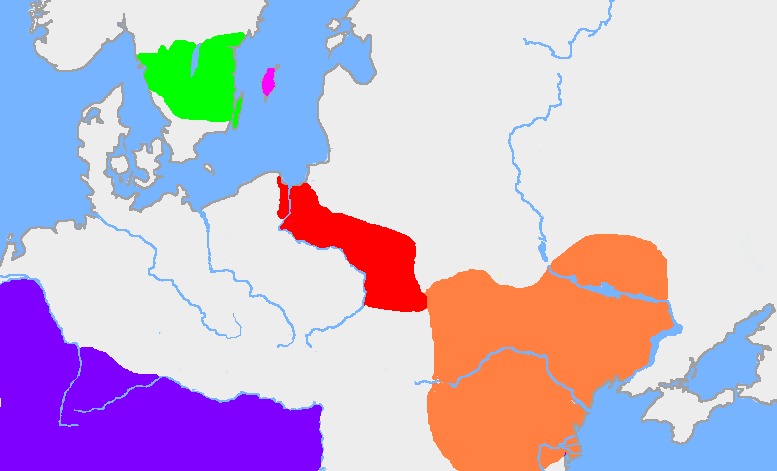
The Greuthungi (also spelled Greutungi) were a Gothic people who lived on the Pontic steppe between the Dniester and Don rivers in what is now Ukraine, in the 3rd and the 4th centuries. They had close contacts with the Tervingi, another Gothic people, who lived west of the Dniester River. To the east of the Greuthungi, living near the Don river, were the Alans. As such, the Greuthungi are strongly identified with the archeological sites known collectively as the Chernyakhov culture.
When the Huns arrived in the European Steppe region in the late 4th century, first the Alans were forced to join them, and then a part of the Greuthungi. Alans and Goths became an important part of Attila's forces, together with other eastern European peoples. Many Greuthungi, together with some Alans and Huns, crossed the Lower Danube to join a large group of Tervingi who had entered the Roman Empire in 376. These peoples defeated an imperial army in the Battle of Adrianople in 378, and came to a settlement agreement within the Roman empire by 382 AD. The original tribal names of the Goths fell out of use within the empire. Many of the 382 settlers appear to have become an important component of the Visigoths who formed under Alaric I.
Based upon interpretations of the Getica by the 6th century writer Jordanes, although it never mentions the Greuthungi, the Greuthungi are strongly associated with both the Gothic king Ermanaric, and the later Amal dynasty who were among Attila's Goths. After the collapse of Attila's empire, the Amals founded the Ostrogothic kingdom in the Roman Balkans.
The root greut- is probably related to the Old English greot, meaning "gravel, grit, earth", thus implying that the name refers to a geographical region where the Greuthungi lived.
It has been argued, for example by Herwig Wolfram, who agrees with the older position of Franz Altheim that this is part of a body of evidence that geographic descriptors were commonly used to distinguish people living north of the Black Sea — both before and after Gothic settlement there.
More specifically, Wolfram argues that the name Greuthungi may indicate that they lived on gritty steppes or "pebbly coasts", and should be seen as contrasting with the Tervingi Goths, whose name may be related to the English word "tree" and indicate a forest origin.
Another proposal is that the name of the Greuthungi goes back to a time when Goths apparently lived near the Vistula, and that the name is connected to the Polish place-name on that river, Grudziądz.
It has also been proposed that the name Greuthungi has pre-Pontic Scandinavian origins, earlier than the Vistula settlement. Wolfram for example notes that J. Svennung, has proposed that it may mean "rock people", and refer to a rocky homeland west of the Gauts in what is today Götaland in southern Sweden.
Hub AI
Greuthungi AI simulator
(@Greuthungi_simulator)
Greuthungi
The Greuthungi (also spelled Greutungi) were a Gothic people who lived on the Pontic steppe between the Dniester and Don rivers in what is now Ukraine, in the 3rd and the 4th centuries. They had close contacts with the Tervingi, another Gothic people, who lived west of the Dniester River. To the east of the Greuthungi, living near the Don river, were the Alans. As such, the Greuthungi are strongly identified with the archeological sites known collectively as the Chernyakhov culture.
When the Huns arrived in the European Steppe region in the late 4th century, first the Alans were forced to join them, and then a part of the Greuthungi. Alans and Goths became an important part of Attila's forces, together with other eastern European peoples. Many Greuthungi, together with some Alans and Huns, crossed the Lower Danube to join a large group of Tervingi who had entered the Roman Empire in 376. These peoples defeated an imperial army in the Battle of Adrianople in 378, and came to a settlement agreement within the Roman empire by 382 AD. The original tribal names of the Goths fell out of use within the empire. Many of the 382 settlers appear to have become an important component of the Visigoths who formed under Alaric I.
Based upon interpretations of the Getica by the 6th century writer Jordanes, although it never mentions the Greuthungi, the Greuthungi are strongly associated with both the Gothic king Ermanaric, and the later Amal dynasty who were among Attila's Goths. After the collapse of Attila's empire, the Amals founded the Ostrogothic kingdom in the Roman Balkans.
The root greut- is probably related to the Old English greot, meaning "gravel, grit, earth", thus implying that the name refers to a geographical region where the Greuthungi lived.
It has been argued, for example by Herwig Wolfram, who agrees with the older position of Franz Altheim that this is part of a body of evidence that geographic descriptors were commonly used to distinguish people living north of the Black Sea — both before and after Gothic settlement there.
More specifically, Wolfram argues that the name Greuthungi may indicate that they lived on gritty steppes or "pebbly coasts", and should be seen as contrasting with the Tervingi Goths, whose name may be related to the English word "tree" and indicate a forest origin.
Another proposal is that the name of the Greuthungi goes back to a time when Goths apparently lived near the Vistula, and that the name is connected to the Polish place-name on that river, Grudziądz.
It has also been proposed that the name Greuthungi has pre-Pontic Scandinavian origins, earlier than the Vistula settlement. Wolfram for example notes that J. Svennung, has proposed that it may mean "rock people", and refer to a rocky homeland west of the Gauts in what is today Götaland in southern Sweden.