Recent from talks
Nothing was collected or created yet.
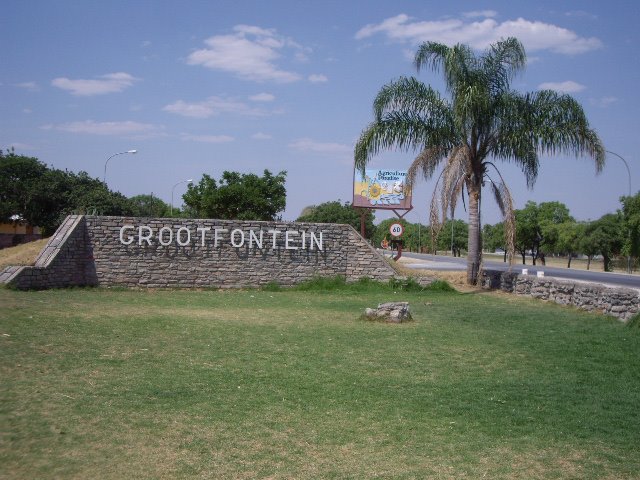
Grootfontein
View on WikipediaGrootfontein (lit. 'great fountain') is a city[4] with 26,839 inhabitants in the Otjozondjupa Region of central Namibia. It is one of the three towns in the Otavi Triangle, situated on the B8 national road that leads from Otavi to the Caprivi Strip.
Key Information
Overview
[edit]The place was known to the Herero under the name Otjivanda.[5] In 1885, 40 Boer families from the north-west of South Africa settled at Grootfontein. Part of the Dorsland trekkers, they were heading towards Angola. When that territory fell under Portuguese control, they turned back and established the Republic of Upingtonia at Grootfontein. Abandoned by 1887, it became the headquarters of the South West Africa Company in 1893.
In 1908, the Roman Catholic church established a mission in Grootfontein as the basis of their eventually successful attempt to establish missions in Kavango.[6]
Like all the towns in the Otavi Triangle, Grootfontein is green in summer but drier in winter. In spring, jacaranda and flamboyant trees bloom in profusion. The town has an old German Schutztruppe fortress from the year 1896, which today houses a museum that expounds on the local history. The economic mainspring of the area were for many decades the Berg Aukas and Abenab mines to the north east of the town. These produced zinc and vanadium but have since closed. Namibia is a dolomite country and the carbonate deposits in the upper parts of the mine have yielded interesting fossils of simian or pongoid creatures that lived millions of years before modern humans evolved.

Twenty-four kilometres west of Grootfontein lies the huge Hoba meteorite. At more than 60 tons, it is the largest known meteorite on Earth, as well as the largest naturally occurring mass of iron known to exist on the planet's surface.
Economy and infrastructure
[edit]Transport
[edit]
Grootfontein is a railhead on TransNamib, the national railway and transport system. The next station to the west is Otavi. Grootfontein is also home of Namibia's main military base which housed several units of the now departed South African Defence Force.
It has an airfield that can handle large transport carriers such as the Hercules C130, as well as commercial passenger aircraft.
Agriculture
[edit]The Grootfontein Show, an annual agricultural exhibition that has taken place since 1911,[7] is the second largest annual entrepreneurial exhibition in the country, after the Windhoek Show.[8]
Climate
[edit]Grootfontein receives an annual average rainfall of 557 millimetres (21.9 in), with a high of 956 mm (37.6 in) in the 2010/2011 rainy season,[9] and a low of 230 mm (9.1 in) during the 2010s drought in 2018/19.[10]
The town has a hot semi arid climate (Koppen:BSh).
| Climate data for Grootfontein, Namibia | |||||||||||||
|---|---|---|---|---|---|---|---|---|---|---|---|---|---|
| Month | Jan | Feb | Mar | Apr | May | Jun | Jul | Aug | Sep | Oct | Nov | Dec | Year |
| Mean daily maximum °C (°F) | 30.9 (87.6) |
29.8 (85.6) |
29.4 (84.9) |
28.5 (83.3) |
26.5 (79.7) |
24.0 (75.2) |
23.8 (74.8) |
26.8 (80.2) |
30.6 (87.1) |
32.1 (89.8) |
31.9 (89.4) |
31.3 (88.3) |
28.8 (83.8) |
| Mean daily minimum °C (°F) | 18.5 (65.3) |
18.0 (64.4) |
17.1 (62.8) |
14.4 (57.9) |
10.4 (50.7) |
7.1 (44.8) |
6.8 (44.2) |
9.6 (49.3) |
13.8 (56.8) |
16.9 (62.4) |
18.0 (64.4) |
18.4 (65.1) |
14.1 (57.4) |
| Average precipitation mm (inches) | 141.7 (5.58) |
127.0 (5.00) |
99.6 (3.92) |
30.1 (1.19) |
4.3 (0.17) |
0.4 (0.02) |
0 (0) |
1.3 (0.05) |
4.9 (0.19) |
21.5 (0.85) |
51.6 (2.03) |
70.7 (2.78) |
553.1 (21.78) |
| Average relative humidity (%) | 58 | 66 | 66 | 70 | 51 | 48 | 43 | 34 | 28 | 33 | 42 | 46 | 49 |
| Source: Ministry of Works and Transport (Meteorological Service Division)
"Ministry of Works & Transport: Tabulation of Climate Statistics for Selected Stations in Namibia" (PDF). 2012. | |||||||||||||
Politics
[edit]Grootfontein is governed by a municipal council that has seven seats.[11]
The 2015 local authority election was won by Namibia's ruling SWAPO party which gained five seats and 2,019 votes. One seat each went to the Democratic Turnhalle Alliance (DTA, 546 votes) and to the All People's Party (APP, 154 votes).[12] SWAPO also won the 2020 local authority election, obtaining 1,727 votes and gaining four seats. The Independent Patriots for Change (IPC), an opposition party formed in August 2020, obtained 653 votes and gained two seats. The remaining seat went to the Popular Democratic Movement (PDM, the new name of the DTA) with 309 votes.[13]
Education
[edit]Previously, the German school Regierungsschule Grootfontein had been in Grootfonten. In 1965, it had four teachers and 117 learners and was supported by the German government.[14]
Nowadays, Grootfontein is home to four high schools, Grootfontein Secondary School, Otjiwanda High School[15] Friedrich Awaseb Senior Secondary School,[16] and a private school named Karstveld Academy. Further the primary schools Luiperdheuwel, Kalenga, Makalani, Omulunga and Wilhelm Nortier are located here. The city also hosts a private German medium primary school (Deutsche Privatschule Grootfontein – DPG).[17]
Notable people
[edit]- Behati Prinsloo – model, best known for working with Victoria's Secret and wife of the band Maroon 5's lead vocalist, Adam Levine
- Leon Jooste – SWAPO politician and businessman[18]
- Hage Geingob – former president of the Republic of Namibia
- Lydia Katjita – SWAPO politician and member of the Pan-African Parliament
- Hannes Smith – journalist
- Inge Zaamwani – businesswoman
External links
[edit]References
[edit]- ^ "Four towns re-elect mayors". The Namibian. NAMPA. 9 December 2013. Archived from the original on 2021-10-24.
- ^ "Table 4.2.2 Urban population by Census years (2001 and 2011)" (PDF). Namibia 2011 - Population and Housing Census Main Report. Namibia Statistics Agency. p. 39. Retrieved 24 August 2016.
- ^ "2023 Population & Housing Census Preliminary Report" (PDF). Statistics Namibia.
- ^ "Local Authorities". Association of Local Authorities in Namibia (ALAN). Archived from the original on 10 June 2013. Retrieved 1 October 2012.
- ^ Menges, Werner (12 May 2005). "Windhoek?! Rather make that Otjomuise". The Namibian.
- ^ Peltola, Matti (1958). Sata vuotta suomalaista lähetystyötä 1859–1959. II: Suomen Lähetysseuran Afrikan työn historia [‘One Hundred Years of Finnish Missionary Work 1859–1959. II: The History of FMS’s Missionary Work in Africa’]. Helsinki: The Finnish Missionary Society. p. 217.
- ^ "Onÿarata @ Grootfontein Show centenary while The Wire storm the coastal towns". New Era. 23 September 2011. Archived from the original on 21 February 2013.
- ^ "Farmer dies at Show". The Namibian. 29 September 2004. Archived from the original on 2021-10-24.
- ^ Menges, Werner (26 May 2011). "Rainy season was one for the record books". The Namibian. Archived from the original on 15 December 2011.
- ^ Menges, Werner; Oliveira, Yokany (23 May 2019). "Khomas faces worst drought in 90 years". The Namibian. p. 1.
- ^ "Know Your Local Authority". Election Watch. No. 3. Institute for Public Policy Research. 2015. p. 4.
- ^ "Local elections results". Electoral Commission of Namibia. 28 November 2015. p. 6. Archived from the original on 10 December 2015.
- ^ "2020 Local Authority Elections Results and Allocation of Seats" (PDF). Electoral Commission of Namibia. 29 November 2020. p. 15. Archived from the original (PDF) on 24 January 2021. Retrieved 4 March 2021.
- ^ "Deutscher Bundestag 4. Wahlperiode Drucksache IV/3672" (Archive). Bundestag (West Germany). 23 June 1965. Retrieved on 12 March 2016. p. 31.
- ^ Matali, John Travolter (24 January 2014). "Another school defies ministry". New Era. Archived from the original on January 29, 2014.
- ^ "Grootfontein learner allegedly dies after punch to the head". Nampa. 5 April 2014. Archived from the original on 18 April 2018. Retrieved 21 February 2017.
- ^ Deutsche Privatschule Grootfontein Archived 2015-04-15 at the Wayback Machine, dsvg.iway.na
- ^ Leon Jooste Archived 2011-06-11 at the Wayback Machine Namibia Institute for Democracy
19°33′57″S 18°06′13″E / 19.56583°S 18.10361°E
Grootfontein
View on GrokipediaGrootfontein is a town and constituency in the Otjozondjupa Region of north-eastern Namibia, characterized by a lush green environment conducive to agriculture and abundant wildlife.[1] The 2023 Population and Housing Census recorded a population of 36,951 residents in the Grootfontein constituency, reflecting steady growth from prior enumerations.[2] As a regional economic center within the Otavi Triangle, it primarily supports cattle ranching, maize, bean, and squash cultivation, alongside administrative and service sectors that sustain local development.[1] The town's origins trace to 1885, when Boer families from the Dorsland Trek—originally seeking passage to Angola—established settlements in the area after initial explorations in the late 1870s.[3] These pioneers laid the groundwork for Grootfontein's role as a farming district, leveraging natural water sources implied by its Afrikaans name meaning "big fountain."[4] During the German colonial era and subsequent South African administration, the locale developed infrastructure including railways, enhancing its connectivity to northeastern Namibia. Grootfontein's prominence is elevated by the nearby Hoba Meteorite, situated approximately 20 kilometers west on the Hoba West farm, representing the largest intact meteorite known on Earth at roughly 60 metric tons of iron-nickel composition.[5] Discovered in 1920 during plowing, this extraterrestrial remnant, estimated to have impacted around 80,000 years ago, draws scientific and touristic interest while remaining in situ as a national monument.[6] The town's agricultural productivity and natural attractions underscore its status as a verdant outlier in Namibia's semi-arid landscape, fostering both subsistence and commercial activities amid the country's broader reliance on mining and pastoralism.[1]
Geography
Location and Physical Features
Grootfontein lies in the Otjozondjupa Region of north-central Namibia, situated approximately 450 km north of the capital city Windhoek.[7] The town's geographic coordinates are 19°34′S 18°07′E.[8] The area features an elevation of about 1,440 meters above sea level, contributing to its temperate highland climate within the broader Namibian landscape.[9] The topography consists of undulating savanna plains, influenced by the proximity to the Otavi Mountains to the north, which form part of the region's hilly karst terrain.[10] This savanna environment transitions toward the eastern Kalahari sands, characterized by semi-arid grasslands and acacia woodlands that support local wildlife such as antelope and birds.[11] A defining natural feature is the large spring from which the town derives its Afrikaans name, "Grootfontein" meaning "big fountain," serving as a historical water source in the otherwise dry surroundings.[4] Nearby, approximately 20 km west, the Hoba Meteorite represents a significant geological landmark, the largest known intact meteorite on Earth, embedded in the local farmland soil.[4] These elements highlight Grootfontein's position at the interface of Namibia's central plateau and semi-arid eastern expanses.[12]Climate and Environment
Grootfontein experiences a hot semi-arid climate (BSh) under the Köppen classification, characterized by significant seasonal temperature variations and low, erratic precipitation.[13] Average high temperatures reach 32–35°C during the hot summer months from October to March, while winter lows in June and July typically dip to 7–10°C, with rare frosts.[14] Annual rainfall averages 550–600 mm, concentrated almost entirely in the summer rainy season from November to April, leading to dry winters and high evaporation rates that exacerbate water scarcity.[15] The local environment reflects the interplay of this semi-arid regime and proximity to the Kalahari Desert's arid influences, resulting in sparse, drought-adapted ecosystems dominated by acacia thornbush savannas and mopane woodlands.[16] These habitats support moderate biodiversity, including grasses, shrubs, and scattered tree species resilient to prolonged dry spells, though underground water sources are critical for persistence amid surface aridity.[17] Historical precipitation records indicate cyclical droughts, with multi-year deficits—such as those observed in southern Kalahari-adjacent areas—causing vegetation die-off, reduced herbaceous cover, and heightened vulnerability to further aridity from variable rainfall patterns.[18][19] Empirical data from regional monitoring underscore how low-rainfall years intensify water stress, limiting perennial plant establishment and favoring opportunistic annuals in the savanna mosaic.History
Pre-Colonial Era and Early Exploration
The Grootfontein area, centered around a prominent perennial spring, was initially occupied by San hunter-gatherer communities, whose nomadic lifestyle relied on foraging and hunting in the surrounding savanna and semi-arid landscapes. Archaeological evidence, including stone tools and rock engravings from broader Namibian sites dating back to 25,000 BCE, indicates sporadic human presence by these groups, though specific artifacts directly tied to the Grootfontein spring remain limited.[20] The spring itself served as a vital water source, facilitating seasonal gatherings for water and game, as corroborated by oral traditions preserved among descendant communities.[21] By the early 19th century, Bantu-speaking pastoralists, particularly the Herero, migrated southward into central and northern Namibia, including the Grootfontein vicinity, introducing cattle herding and establishing temporary grazing camps around the spring. Herero oral histories describe the site as Otjivanda-Tjongue, interpreted as "hill of the leopard" or "leopard flats," reflecting its topographic features and wildlife associations.[22] Conflicts arose as Herero herds competed with earlier Khoekhoe groups like the Nama moving northward, but the area saw no dense settlements, only transient use for livestock watering during migrations. Ovambo groups from the far north occasionally extended grazing southward to the spring, though their primary polities remained in the Cuvelai floodplain.[23][21] European exploration of the inland Grootfontein region remained minimal until the mid-19th century, with initial contacts limited to coastal Portuguese voyages by Diogo Cão in 1486 and Bartolomeu Dias in 1488, far from the interior. Inland penetration accelerated in the 1850s through hunters and traders like Charles Andersson, who traversed northern routes toward Ovamboland, noting water sources but not specifically documenting Grootfontein.[23] The first direct European visitors arrived in the mid-1880s as Dorsland Trek Boers from the Transvaal, seeking routes to Angola, who recognized the spring's significance and temporarily settled after negotiating with local Ovambo leaders, though no permanent outposts were founded until German colonial assertions in the 1890s.[21] These early interactions relied on trade in ivory and cattle, with records emphasizing the spring's strategic value amid ongoing indigenous pastoral mobility.[24]Boer Settlement and German Colonial Period
In 1885, a group of approximately 46 Trekboer settlers, part of the Dorsland Trek migrating northward from South Africa's Transvaal to escape British colonial encroachment, established a foothold in the Grootfontein area. These Afrikaner pioneers, led initially by trader William Worthington Jordan, purchased roughly 957 square miles (about 2,480 square kilometers) of land from Ndonga chief Kambonde ka Mpimkana in April of that year for goods including 300 English pounds, rifles, and ammunition. On 20 October 1885, they formally proclaimed the short-lived Republic of Upingtonia (also known as Lijdensrust), with Grootfontein as its provisional capital, aiming to create an independent agrarian outpost amid the region's fertile soils and perennial springs—the "groot fontein" that provided reliable water for livestock and crop cultivation in an otherwise arid landscape.[25][26][27] The republic endured only until 1887, undermined by internal disputes, supply shortages, and external pressures from indigenous groups and Portuguese interests in Angola, but the Boer presence persisted through family farms focused on cattle rearing and subsistence agriculture, leveraging the natural fountains for irrigation and sustainability. This settlement pattern reflected causal drivers of migration: the Boers' pursuit of autonomy from British taxation and land policies, combined with the area's water security enabling viable pastoralism where annual rainfall averaged under 500 mm. By the early 1890s, additional Dorsland Trek families reinforced the community, numbering around 100 households by 1892, establishing Grootfontein as a Boer enclave.[28] German colonial authorities, establishing formal control over South West Africa from 1884, viewed the Boer outpost as a strategic buffer but intervened to assert imperial oversight. In 1896, the Schutztruppe constructed a fortress at Grootfontein, garrisoning 25 troops to fortify the northern frontier against potential Herero incursions and to regulate trade routes. Enlarged in the early 1900s with a watchtower added in 1904, the fort—now a museum—served as a military hub during escalating tensions that erupted into the Herero uprising of 1904, where German forces used it for logistics and defense. Regional development accelerated with prospecting; while major copper deposits at nearby Tsumeb were exploited from 1906, earlier surveys in the Otavi-Grootfontein district revealed lead and other ores, drawing administrative investment in infrastructure like roads and water diversion from the springs to support mining outposts and settler expansion.[29][30][4]South African Mandate and Apartheid Era
Following the occupation of German South West Africa by South African forces in 1915 during World War I, Grootfontein was integrated into the newly administered territory, initially under military rule and subsequently as part of the League of Nations mandate granted to South Africa on December 17, 1920.[31] This transition ensured administrative continuity, with Grootfontein serving as a district center focused on settlement and resource support rather than major governance shifts.[32] The pre-existing narrow-gauge railway from Otavi to Grootfontein, completed in 1908, linked the town to the Tsumeb-Otavi mining operations, facilitating copper and lead transport and underpinning regional economic linkages without significant new extensions during the mandate's early decades.[33] From the 1940s onward, the nearby Tsumeb mine drove a series of production expansions in the Otavi Mountain Land, where Grootfontein provided logistical and labor support; copper output contributed to Namibia's overall mineral sales rising to 120 million Rand by 1970, with copper accounting for approximately one-quarter of the total amid post-war demand. Apartheid-era land policies from the 1960s, informed by the Odendaal Commission's recommendations, allocated Grootfontein district lands predominantly to white-owned commercial farms, emphasizing extensive livestock grazing suited to the semi-arid savanna.[34] This zoning structure boosted cattle herds for slaughter and export, primarily to South Africa, with migrant labor from northern areas like Ovamboland channeled through the South West Africa Native Labour Association (SWANLA) system to sustain farm operations and mine peripheries.[35] By the 1970s, these developments had spurred population influxes in Grootfontein, driven by employment in farming and mining support roles, though ethnic zoning under separate development doctrines maintained distinct residential and land-use patterns.[36] Commercial agriculture in the district prioritized beef production, with veterinary controls and fencing enhancements enabling higher export volumes despite periodic droughts, reflecting prioritized resource utilization over subsistence models.[37]Independence and Modern Developments
Namibia achieved independence from South Africa on 21 March 1990, marking the end of the apartheid-era mandate and ushering in self-governance under the South West Africa People's Organization (SWAPO). In Grootfontein, this transition preserved the town's longstanding role as an agricultural center within the Otjozondjupa Region, with commercial livestock farming—particularly cattle and small stock—continuing to dominate local economic activity despite national efforts to redistribute land from white-owned commercial farms to previously disadvantaged Namibians.[20] However, post-independence challenges included recurrent droughts, such as the severe events of 1991-1992 and the prolonged dry spell from 2013 to 2016, which reduced water availability and livestock carrying capacity, leading to documented declines in regional agricultural yields.[38] The HIV/AIDS epidemic, which peaked in prevalence during the 1990s and early 2000s, further strained rural labor forces and household food security in areas like Grootfontein, exacerbating vulnerabilities in subsistence and commercial farming alike. Land reform initiatives, including the Affirmative Action Loan Scheme and farm resettlements under the Ministry of Land Reform, transferred thousands of hectares in the Otjozondjupa Region to new owners by the 2010s, intended to rectify colonial-era disparities. Yet empirical assessments reveal causal links between these transfers and diminished farm productivity: resettled operations frequently exhibit underutilization, infrastructure decay, and output shortfalls, with studies documenting lower livestock numbers and crop yields on post-reform farms compared to prior commercial benchmarks, attributable to factors like insufficient skills transfer and capital constraints rather than land scarcity alone.[39] For instance, national statistics indicate that while livestock remains over 50% of agricultural gross value, reform-affected regions have seen stagnant or declining per-farm efficiency, underscoring how policy-driven ownership changes disrupted established production systems without commensurate productivity gains.[40] These outcomes highlight a tension between socio-political redistribution goals and economic imperatives, with many resettled farms failing to sustain viable operations.[41] Modern developments in Grootfontein have centered on incremental agribusiness enhancements, such as the 2025 opening of a charcoal processing facility to add value to local wood resources, alongside ongoing training at the Grootfontein Agricultural College to bolster farming expertise.[42] Minor mining revivals include exploratory gold drilling on the Grootfontein project in 2021, though activity waned after divestment in 2024, reflecting limited commercial viability amid broader resource constraints.[43][44] The town's population stood at 23,973 according to the 2011 census, with subsequent growth trailing national averages due to outmigration tied to agricultural stagnation and urban opportunities elsewhere.[45] Municipal plans for 2025 emphasize infrastructure upgrades to support these sectors, yet persistent environmental and policy hurdles continue to temper expansion.[46]Demographics
Population Trends
The population of the Grootfontein constituency, encompassing the urban town and surrounding rural areas, was recorded at 23,100 in the 2011 Namibia Population and Housing Census conducted by the Namibia Statistics Agency (NSA).[47] This figure reflected steady post-independence expansion from earlier decades, when the urban population hovered around 5,000 in the 1960s amid initial infrastructure development. By the 2023 NSA census, the constituency population had risen to 36,951, indicating an average annual growth rate of 3.3% over the 12-year interval, primarily driven by natural increase and net in-migration from rural districts seeking urban amenities and services.[2][48] Urban estimates for the town proper align with modest increases, placing the 2023 population at approximately 26,800, consistent with patterns of contained growth in Namibia's regional centers amid national urbanization trends.[49] This trajectory underscores a rural-urban pull, with internal migrants contributing to sustained but not explosive expansion, as opposed to coastal hubs like Windhoek. Historical data from pre-1990 periods show even lower bases, with urban figures under 10,000 in the late colonial era, highlighting cumulative effects of post-1990 stability and connectivity improvements. Demographic structure reveals a pronounced youth bulge, with 2011 census data for the constituency indicating that individuals aged 0-9 years accounted for about 25% of the population (6,180 persons), and those aged 10-19 another 19% (4,782 persons), reflecting high fertility rates typical of Namibia's interior regions.[48] Gender distribution in the 2023 census showed near parity, with 18,705 males and 18,246 females, though urban core areas historically exhibited slight male predominance (around 53% in 2011 main place data) linked to labor mobility.[2][50] These patterns suggest a dependency ratio favoring working-age expansion in coming decades, barring shifts in migration or fertility.Ethnic and Cultural Composition
Grootfontein's ethnic makeup features a notable presence of Afrikaner descendants from the approximately 40 Boer families who settled the area in 1885, establishing farming communities that persist in cultural practices such as Afrikaans-language traditions and agricultural self-reliance.[21][4] These settlers, originating from South Africa's Transvaal via Angola, contributed to a historically European-influenced core amid broader Namibian Bantu majorities.[21] Indigenous groups including Herero, Ovambo, and San (!Kung) form significant minorities, drawn historically to the region's grazing lands and water sources; Herero and Ovambo tribes competed for control pre-colonially due to fertile pastures and copper deposits nearby.[21] Damara communities also integrate, reflecting Otjozondjupa Region's diverse Bantu and Khoisan elements. San populations, speaking Central !Kung, reside in peripheral districts like Neitsas.[51] Linguistically, Afrikaans predominates among Afrikaner residents, alongside Oshiwambo (for Ovambo speakers) and Otjiherero; English serves officially, with German spoken by some white descendants.[52] Boer cultural identity endures through farming heritage, including livestock management techniques adapted from 19th-century treks, despite national shifts toward Bantu-majority norms post-1990 independence.[53] Limited intermarriage data exists, but urban proximity fosters some integration without eroding distinct ethnic identities.[54]Economy
Agriculture and Livestock
Agriculture in the Grootfontein district centers on commercial livestock ranching, particularly cattle production on privately owned farms with extensive grazing systems adapted to semi-arid conditions.[55] These operations, often managed by families with multi-generational experience such as the Schneiders since 1912, emphasize breeds like Brahman and indigenous Nguni suited to low-rainfall environments requiring approximately 17 hectares per cow for sustainable foraging.[56][57] Private land tenure facilitates investments in infrastructure like solar-powered boreholes and fenced camps, enhancing carrying capacity and recovery from environmental stresses compared to communal systems.[58] Supplementary cropping includes maize and sorghum, with commercial producers in the Grootfontein-Tsumeb area increasing white maize yields through localized irrigation and soil management.[59] Irrigation practices inherited from early Boer settlers leverage the district's natural perennial fountains and groundwater resources, providing drought resilience by enabling fodder production and water security during prolonged dry spells.[60] This hydro-geological advantage supports consistent livestock maintenance, with farm setups featuring multiple boreholes and rotational grazing to mitigate overgrazing and vegetation loss in variable rainfall patterns averaging under 500 mm annually.[55] District-level data indicate around 291 dedicated cattle farmers contributing to regional herds, though precise head counts vary; northern Namibia's commercial segments align with national trends where cattle dominate, comprising over 2.7 million head countrywide as of late 2024.[24][61] Outputs target domestic markets and limited exports under veterinary zoning, with beef production bolstered by free-range systems yielding lean, slow-growth meat. Livestock health challenges, including sporadic foot-and-mouth disease (FMD) incursions from wildlife interfaces, are addressed through Namibia's zoned veterinary controls, maintaining non-endemic status via surveillance, fencing, and rapid response protocols.[62][63] The veterinary cordon fence delineates the Grootfontein area within northern surveillance zones, restricting live exports but allowing processed products post-quarantine, with empirical evidence from past outbreaks showing effective containment and herd recovery through vaccination and movement tracing.[64][65] These measures, combined with private incentives for biosecurity, underscore causal efficiencies in disease management, preventing widespread losses that could otherwise devastate ranching viability in this export-oriented corridor.[66]
