


Community hub
Recent from talks
Contribute something
Nothing was collected or created yet.
Boers
View on Wikipedia
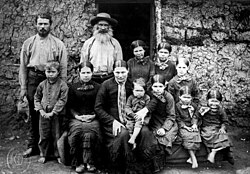
Boers (/bʊərz/ BOORZ; Afrikaans: Boere; [ˈbuːrə]) are the descendants of the proto Afrikaans-speaking Free Burghers of the eastern Cape frontier[2] in Southern Africa during the 17th, 18th, and 19th centuries. From 1652 to 1795, the Dutch East India Company controlled the Dutch Cape Colony, which the United Kingdom incorporated into the British Empire in 1806.[3] The name of the group is derived from Trekboer then later "boer", which means "farmer" in Dutch and Afrikaans.[4]
Key Information


In addition, the term Boeren also applied to those who left the Cape Colony during the 19th century to colonise the Orange Free State, and the Transvaal (together known as the Boer Republics), and to a lesser extent Natal. They emigrated from the Cape to live beyond the reach of the British colonial administration, with their reasons for doing so primarily being the new Anglophone common law system being introduced into the Cape and the British abolition of slavery in 1833.[3][need quotation to verify][5]
The term Afrikaners or Afrikaans people[6][7][8] is generally used in modern-day South Africa for the white Afrikaans-speaking population of South Africa (the largest group of White South Africans) encompassing the descendants of both the Boers, and the Cape Dutch who did not embark on the Great Trek.
According to a genetic study, 4.7% of their DNA is of non-European origin. 1.3% being Khoisan, 1.7% from South Asia slightly less than 1% from East Asia and 0.8% from East and West Africa.[9]
Origin
[edit]European colonists
[edit]
The Dutch East India Company (Dutch: Vereenigde Oostindische Compagnie; VOC) was formed in the Dutch Republic in 1602, and at this time the Dutch had entered the competition for the colonial and imperial trade of commerce in Southeast Asia. The end of the Thirty Years' War in 1648 saw European soldiers and refugees widely dispersed across Europe. Immigrants from Germany, Scandinavia, and Switzerland traveled to the Netherlands in the hope of finding employment with the VOC. During the same year, one of their ships was stranded in Table Bay near what would eventually become Cape Town, and the shipwrecked crew had to forage for themselves on shore for several months. They were so impressed with the natural resources of the country that on their return to the Dutch Republic, they presented to the VOC directors the advantages to be had for the Dutch Eastern trade from a properly provided for and fortified station at the Cape. In response, the VOC sent a Dutch expedition in 1652 led by Jan van Riebeek, who constructed a fort, laid out vegetable gardens at Table Bay, and took control over Cape Town, which he governed for a decade.
Free Burghers
[edit]VOC favored the idea of freemen at the Cape and many workers of VOC requested to be discharged in order to become free burghers (citizens). As a result, Jan van Riebeek approved the notion on favorable conditions and earmarked two areas near the Liesbeek River for the purpose of agricultural development in 1657. The two areas allocated to the freemen were named Greenfield and Dutch Garden. These areas were separated by the Amstel (Liesbeek) River. The best nine applicants[clarification needed] were selected to settle the land. The freemen (free burghers, as they were called thereafter) thus became subjects of VOC and were no longer considered servants.[10]
In 1671, the Dutch first purchased land from the indigenous Khoikhoi beyond the limits of the fort built by Van Riebeek; this marked the beginnings of the Dutch Cape Colony. As the result of the investigations of a 1685 commissioner, the government worked to recruit a greater variety of immigrants to develop a stable community. They formed part of the class of vrijlieden, also known as vrijburgers ('free citizens'), former VOC employees who remained at the Cape after serving their contracts.[11] A large number of vrijburgers became independent farmers and applied for grants of land, as well as loans of seed and tools, from VOC administration.[11]
Dutch free immigrants
[edit]VOC authorities had been endeavouring to induce gardeners and small farmers to emigrate from Europe to South Africa, but with little success. They were only able to attract a few families through the promise of wealth, but the Cape had little to offer. In October 1670, however, the Chamber of Amsterdam announced that a few families were willing to leave for the Cape and Mauritius the following December. Among the new names of burghers at this time were Jacob and Dirk van Niekerk, Johannes van As, Francois Villion, Jacob Brouwer, Jan van Eden, Hermanus Potgieter, Albertus Gildenhuis, and Jacobus van den Berg.[12]
French Huguenots
[edit]During 1688–1689, the colony was greatly strengthened by the arrival of nearly two hundred French Huguenots, who were political refugees from the religious wars in France following the revocation of the Edict of Nantes. They joined colonies at Stellenbosch, Drakenstein, Franschhoek and Paarl.[13] The Huguenots had a marked influence on the character of the colony, leading the VOC in 1701 to mandate that only Dutch be taught in schools. This resulted in the Huguenots assimilating by the middle of the 18th century, with a loss in the use and knowledge of French. The colony gradually spread eastwards, and by 1754 land as far as Algoa Bay was included in the colony.
At this time the European colonists numbered eight to ten thousand. They possessed numerous slaves, grew wheat in sufficient quantity to make it a commodity crop for export, and were famed for the good quality of their wines. But their chief wealth was in cattle. They enjoyed considerable prosperity.
Through the latter half of the 17th and the whole of the 18th century, troubles arose between the colonists and the government as the VOC administration was despotic. Its policies were not directed at development of the colony, but to profit the VOC. The VOC closed the colony against free immigration, kept the whole of the trade in its own hands, combined the administrative, legislative and judicial powers into one body, mandated the cultivation of certain crops, and demanded a large part of their produce as a kind of tax, among other exactions.
Trekboers
[edit] | This section needs additional citations for verification. (February 2021) |
From time to time, indentured VOC servants were endowed with the right of freeburghers but the VOC retained the power to compel them to return into its service whenever they deemed it necessary. This right to force into servitude those who might incur the displeasure of the governor or other high officers was not only exercised with reference to the individuals themselves; it was claimed by the government to be applicable to their children as well.
The tyranny caused many to feel desperate and to flee from oppression, even before the 1700 trekking began. In 1780, Joachim van Plettenberg, the governor, proclaimed the Sneeuberge to be the northern boundary of the colony, expressing "the anxious hope that no more extension should take place, and with heavy penalties forbidding the rambling peasants to wander beyond". In 1789, so strong had feelings amongst the burghers become that delegates were sent from the Cape to interview the authorities at Amsterdam. After this deputation, some nominal reforms were granted.
-
 Descending from the Sneeuberge, a scene near Graaff-Reinet, by Burchell
 -
 Passing Cradock Pass, Outeniqua Mountains, by Charles Collier Michell
 -
 An aquatint by Samuel Daniell of Trekboers making camp
 -
 Trekboers crossing the Karoo by Charles Davidson Bell


It was largely to escape oppression that the farmers trekked farther and farther from the seat of government. VOC, to control the emigrants, established a magistracy at Swellendam in 1745 and another at Graaff Reinet in 1786. The Gamtoos River had been declared, c. 1740, the eastern frontier of the colony but it was soon passed. In 1780, however, the Dutch, to avoid collision with the Bantu peoples, agreed with them to make the Great Fish River the common boundary. In 1795 the heavily taxed burghers of the frontier districts, who were afforded no protection against the Bantus, expelled the VOC officials, and set up independent governments at Swellendam and Graaff Reinet.
The trekboers of the 19th century[who?] were the lineal descendants of the trekboers of the 18th century. The end of the 19th century saw a revival of the same tyrannical monopolist policy as that in the VOC government in the Transvaal. If the formula, "In all things political, purely despotic; in all things commercial, purely monopolist", was true of the VOC government in the 18th century, it was equally true of Kruger's government in the latter part of the 19th.[citation needed][clarification needed]
The underlying fact which made the trek possible is that the Dutch-descended colonists in the eastern and northeastern parts of the colony were not cultivators of the soil, but of purely pastoral and nomadic habits, ever ready to seek new pastures for their flocks and herds, possessing no special affection for any particular locality. These people, thinly scattered over a wide territory, had lived for so long with little restraint from the law that when, in 1815, by the institution of "Commissions of Circuit", justice was brought nearer to their homes, various offences were brought to light, the remedying of which caused much resentment.
The Dutch-descended colonists in the eastern and northeastern parts of the colony, as a result of the Great Trek, had removed themselves from governmental rule and become widely spread out. However, the institution of "Commissions of Circuit" in 1815 allowed the prosecution of crimes, with offences committed by the trekboers—notably including many against people they had enslaved—seeing justice. These prosecutions were very unpopular amongst the trekkers and were seen as interfering with their rights over the enslaved people they viewed as their property.
-
 A map of the expansion of the Trekboers (1700–1800)
 -
 Evolution of the Dutch Cape Colony (1700–1800)
 -
 Administrative divisions of the Dutch Cape Colony


Invasion of the Cape Colony
[edit]The Invasion of the Cape Colony was a British military expedition launched in 1795 against the Dutch Cape Colony at the Cape of Good Hope. The Netherlands had fallen under the revolutionary government of France and a British force under General Sir James Henry Craig was sent to Cape Town to secure the colony from the French for the Prince of Orange, a refugee in England. The governor of Cape Town at first refused to obey the instructions from the Prince, but when the British proceeded to land troops to take possession anyway, he capitulated. His action was hastened by the fact that the Khoikhoi, escaping from their former enslavers, flocked to the British standard. The burghers of Graaff Reinet did not surrender until a force had been sent against them; in 1799 and again in 1801 they rose in revolt. In February 1803, as a result of the peace of Amiens (February 1803), the colony was handed over to the Batavian Republic which introduced many reforms, as had the British during their eight years' rule. One of the first acts of General Craig had been to abolish torture in the administration of justice. The country still remained essentially Dutch, and few British citizens were attracted to it. Its cost to the British exchequer during this period was £16,000,000.[citation needed] The Batavian Republic entertained very liberal views as to the administration of the country, but had little opportunity to enact them.[citation needed]
When the War of the Third Coalition broke out in 1803, a British force was once again sent to the Cape. After an engagement (January 1806) on the shores of Table Bay, the Dutch garrison of Castle of Good Hope surrendered to the British under Sir David Baird, and in the 1814 Anglo-Dutch treaty the colony was ceded outright by The Netherlands to the British crown. At that time the colony extended to the line of mountains guarding the vast central plateau, then called Bushmansland (after a name for the San people), and had an area of about 120000 sq km and a population of some 60000, of whom 27000 were whites, 17000 free Khoikhoi and the rest enslaved people, mostly non-indigenous blacks and Malays.[citation needed]
Dislike of British rule
[edit]Although the colony was fairly prosperous, many of the Dutch farmers were as dissatisfied with British rule as they had been with that of the VOC, though their grounds for complaint were not the same. In 1792, Moravian missions had been established which targeted the Khoikhoi, and in 1799 the London Missionary Society began work among both Khoikhoi and the Bantu peoples. The missionaries' championing of Khoikhoi grievances caused much dissatisfaction among the majority of the Dutch colonists, whose views temporarily prevailed, for in 1812 an ordinance was issued which empowered magistrates to bind Khoikhoi children as apprentices under conditions which differed little from slavery.[14] Simultaneously, the movement for the abolition of slavery was gaining strength in England, and the missionaries appealed from the colonists to the mother country.[citation needed]
Slachter's Nek
[edit]A farmer named Frederick Bezuidenhout refused to obey a summons issued on the complaint of a Khoikhoi, and, firing on the party sent to arrest him, was killed by the return fire. This caused a small rebellion in 1815, known as Slachters Nek, described as "the most insane attempt ever made by a set of men to wage war against their sovereign" by Henry Cloete. Upon its suppression, five ringleaders were publicly hanged at the spot where they had sworn to expel "the English tyrants". The feeling[clarification needed] caused by the hanging of these men was deepened by the circumstances of the execution, as the scaffold on which the rebels were simultaneously hanged broke down from their united weight and the men were afterwards hanged one by one. An ordinance was passed in 1827, abolishing the old Dutch courts of landdrost and heemraden (resident magistrates being substituted) and establishing that henceforth all legal proceedings should be conducted in English. The granting in 1828, as a result of the representations of the missionaries, of equal rights with whites to the Khoikhoi and other free coloured people, the imposition (1830) of heavy penalties for harsh treatment of enslaved people, and finally the emancipation of the enslaved people in 1834, were measures which combined to aggravate the farmers' dislike of government. Moreover, what the Boers viewed as the inadequate compensation for the freeing of the slaves, and the suspicions engendered by the method of payment, caused much resentment; and in 1835 the farmers again removed themselves to unknown country to escape the government. While emigration beyond the colonial border had been continuous for 150 years, it now took on larger proportions.[citation needed]
Cape Frontier Wars (1779–1879)
[edit]
The migration of the trekboers from the Cape Colony into the Eastern Cape parts of South Africa, where the native Xhosa people had established settlements, gave rise to a series of conflicts between the Boers and the Xhosas. In 1775 the Cape government established a boundary between the trekboers and the Xhosas at the Bushmans and Upper Fish Rivers. The Boers and Xhosas ignored the boundary, with both groups establishing homes on either side of the frontier. Governor van Plettenberg attempted to persuade both groups to respect the boundary line without success. The Xhosas were accused of stealing cattle and in 1779 a series of skirmishes erupted along the border which initiated the 1st Frontier War.[15]
The frontier remained unstable, resulting in the outbreak of the 2nd Frontier War in 1789. Raids carried out by Boers and Xhosas on both sides of the boundary caused much friction in the area which resulted in several groups being drawn into the conflict. In 1795, the British invasion of the Cape Colony resulted in a change of government. After the government takeover the British began to draw up policies with regards to the frontier resulting in a Boer rebellion in Graaff-Reinet. The policies caused the Khoisan tribes to join some Xhosa chiefs in attacks against British forces during the 3rd Frontier War (1799–1803).[15]
Peace was restored to the area when the British, under the Treaty of Amiens, returned the Cape Colony to the Dutch Batavian Republic in 1803. In January 1806 during a second invasion, the British reoccupied the colony after the Battle of Blaauwberg. Tensions in the Zuurveld led the colonial administration and Boer colonists to expel many of the Xhosa tribes from the area, initiating the 4th Frontier War in 1811. Conflicts between the Xhosas on the frontier led to the 5th Frontier War in 1819.[15]
The Xhosas, due to dissatisfaction with vacillating government policies regarding where they were permitted to live, undertook large-scale cattle thefts on the frontier. The Cape government responded with several military expeditions. In 1834 a large Xhosa force moved into the Cape territory, which began the 6th Frontier War. Additional fortifications were built by the government and mounted patrols were not well received by the Xhosas, who continued with raids on farms during the 7th Frontier War (1846–1847). The 8th (1850–1853) and 9th Frontier Wars (1877–1878) continued at the same pace as their predecessors. Eventually the Xhosas were defeated and the territories were brought under British control.[15]
Great Trek
[edit]
The Great Trek occurred between 1835 and the early 1840s. During that period some 12,000 to 14,000 Boers (including women and children), impatient with British rule, emigrated from Cape Colony into the great plains beyond the Orange River, and across them again into Natal and the vastness of the Zoutspansberg, in the northern part of the Transvaal. Those Trekboers who occupied the eastern Cape were semi-nomadic. A significant number in the eastern Cape frontier later became Grensboere ('border farmers') who were the direct ancestors of the Voortrekkers.
The Boers addressed several correspondence to the British Colonial Government before leaving the Cape Colony as reasons for their departure. Piet Retief, one of the leaders of the Boers during the time, addressed a letter to the government on 22 January 1837 in Grahamstown stating that the Boers did not see any prospect for peace or happiness for their children in a country with such internal commotions. Retief further complained that the severe financial losses had resulted from the emancipation of their enslaved people, for which the Boers considered the compensation provided by the British government to be inadequate.[16] They also felt that the English church system was incompatible with the Dutch Reformed Church. By this time the Boers had already formed a separate code of laws in preparation for the great trek and were aware of the dangerous territory they were about to enter. Retief concluded his letter with "We quit this colony under the full assurance that the English Government has nothing more to require of us, and will allow us to govern ourselves without its interference in future".[17]
Boer states and republics
[edit]
As the Voortrekkers progressed further inland, they continued to establish Boer colonies on the interior of South Africa.
| Description | Dates | Area |
|---|---|---|
 Republic of Swellendam Republic of Swellendam |
17 June – 4 November 1795 | Swellendam, Western Cape |
| Republic of Graaff-Reinet |
1 February 1795 – November 1796 | Graaff-Reinet, Eastern Cape |
 Zoutpansberg Zoutpansberg |
1835–1864 | Limpopo |
| Winburg |
1836–1844 | Free State |
 Potchefstroom Potchefstroom |
1837–1844 | North West |
 Natalia Republic Natalia Republic |
1839–1902 | Eastern Cape |
| Winburg-Potchefstroom |
1844–1843 | Potchefstroom, North West |
| Republic of Klip River |
1847–1848 | Ladysmith, KwaZulu-Natal |
| Lydenburg Republic |
1849–1860 | Lydenburg, Mpumalanga |
| Utrecht Republic |
1852–1858 | Utrecht, KwaZulu-Natal |
 South African Republic South African Republic |
1852–1877, 1881–1902 | Gauteng, Limpopo |
 Orange Free State Orange Free State |
1854–1902 | Free State |
| Klein Vrystaat |
1876–1891 | Piet Retief, Mpumalanga |
 State of Goshen State of Goshen |
1882–1883 | North West |
 Republic of Stellaland Republic of Stellaland |
1882–1883 | North West |
 United States of Stellaland United States of Stellaland |
1883–1885 | North West |
 New Republic New Republic |
1884–1888 | Vryheid, KwaZulu-Natal |
 Republic of Upingtonia/Lijdensrust Republic of Upingtonia/Lijdensrust |
1885–1887 | Namibia |
Anglo-Boer wars
[edit]
Following the British annexation of the Transvaal in 1877, Paul Kruger was a key figure in organizing a Boer resistance which led to expulsion of the British from the Transvaal. The Boers then fought the Second Boer War in the late 19th and early 20th century against the British in order to ensure the republics of the Transvaal (the Zuid-Afrikaansche Republiek) and the Orange Free State, remaining independent, ultimately capitulating in 1902.[18]
Boer War diaspora
[edit]After the Second Boer War, a Boer diaspora occurred. Starting in 1903, the largest group emigrated to the Patagonia region of Argentina and to Brazil. Another group emigrated to the British colony of Kenya, from where most returned to South Africa during the 1930s, while a third group under the leadership of General Ben Viljoen emigrated to Mexico and to New Mexico and Texas in the southwestern United States.
1914 Boer Revolt
[edit]The Maritz Rebellion (also known as the Boer Revolt, the Five Shilling Rebellion or the Third Boer War) occurred in 1914 at the start of World War I, in which men who supported the re-creation of the Boer republics rose up against the government of the Union of South Africa because they did not want to side with the British against the German Empire so soon after the war with the British.[citation needed]
Many Boers had German ancestry and many members of the government were themselves former Boer military leaders who had fought with the Maritz rebels against the British in the Second Boer War. The rebellion was put down by Louis Botha and Jan Smuts, and the ringleaders received heavy fines and terms of imprisonment. One, Jopie Fourie, an officer in the Union Defence Force, was convicted for treason when he refused to take up arms alongside the British, and was executed by the South African government in 1914.
Characteristics
[edit]Language
[edit]Afrikaans is a West Germanic language spoken widely in South Africa and Namibia, and to a lesser extent in Botswana and Zimbabwe. It evolved from the Dutch vernacular[19][20] of South Holland (Hollandic dialect)[21][22] spoken by the mainly Dutch colonists of what is now South Africa, where it gradually began to develop distinguishing characteristics in the course of the 18th century.[23] Hence, it is a daughter language of Dutch, and was previously referred to as Cape Dutch (also used to refer collectively to the early Cape colonists) or kitchen Dutch (a derogatory term used in its earlier days). However, it is also variously (although incorrectly) described as a creole or as a partially creolised language.[n 1] The term is ultimately derived from Dutch Afrikaans-Hollands meaning African Dutch.
Culture
[edit]_-_The_Voortrekkers.jpg)
The desire to wander, known as trekgees, was a notable characteristic of the Boers. It figured prominently in the late 17th century when the Trekboers began to inhabit the northern and eastern Cape frontiers, again during the Great Trek when the Voortrekkers left the eastern Cape en masse, and after the major republics were established during the Thirstland ('Dorsland') Trek.[24] One such trekker described the impetus for emigrating as, "a drifting spirit was in our hearts, and we ourselves could not understand it. We just sold our farms and set out northwestwards to find a new home".[24] A rustic characteristic and tradition was developed quite early on as Boer society was born on the frontiers of white colonisation and on the outskirts of Western civilisation.[2]
The Boer quest for independence manifested in a tradition of declaring republics, which predates the arrival of the British; when the British arrived, Boer republics had already been declared and were in rebellion from the VOC.[25]
Beliefs
[edit]The Boers of the frontier were known for their independent spirit, resourcefulness, hardiness, and self-sufficiency, whose political notions verged on anarchy but had begun to be influenced by republicanism.[25]
The Boers had cut their ties to Europe as they emerged from the Trekboer group.[26]
The Boers possessed a distinct Protestant culture, and the majority of Boers and their descendants were members of a Reformed Church. The Nederduitsch Hervormde Kerk ('Dutch Reformed Church') was the national Church of the South African Republic (1852–1902). The Orange Free State (1854–1902) was named after the Protestant House of Orange in the Netherlands.
The Calvinist influence, in such fundamental Calvinist doctrines such as unconditional predestination and divine providence, remains present in a minority of Boer culture, who see their role in society as abiding by the national laws and accepting calamity and hardship as part of their Christian duty. Many Boers have since converted denominations and are now members of Baptist, Charismatic, Pentecostal or Lutheran Churches.
Modern usage
[edit]During recent times, mainly during the apartheid reform and post-1994 eras, some white Afrikaans-speaking people, mainly with conservative political views, and of Trekboer and Voortrekker descent, have chosen to be called Boere, rather than Afrikaners, to distinguish their identity.[27] They believe that many people of Voortrekker descent were not assimilated into what they see as the Cape-based Afrikaner identity. They suggest that this developed after the Second Anglo-Boer War and the subsequent establishment of the Union of South Africa in 1910. Some Boer nationalists have asserted that they do not identify as a right-wing element of the political spectrum.[28]
They contend that the Boers of the South African Republic and Orange Free State republics were recognised as a separate people or cultural group under international law by the Sand River Convention (which created the South African Republic in 1852),[29] the Bloemfontein Convention (which created the Orange Free State Republic in 1854), the Pretoria Convention (which re-established the independence of the South African Republic 1881), the London Convention (which granted the full independence to the South African Republic in 1884), and the Vereeniging Peace Treaty, which formally ended the Second Anglo-Boer War on 31 May 1902. Others contend, however, that these treaties dealt only with agreements between governmental entities and do not imply the recognition of a Boer cultural identity per se.
The supporters of these views feel that the Afrikaner label was used from the 1930s onwards as a means of politically unifying the white Afrikaans speakers of the Western Cape with those of Trekboer and Voortrekker descent in the north of South Africa, where the Boer Republics were established.[27]
Since the Anglo-Boer war, the term Boerevolk ('farmer people') was rarely used in the 20th century by the various regimes because of the effort to assimilate the Boerevolk with the Afrikaners. A portion of those who are the descendants of the Boerevolk have reasserted use of this designation.[27]
The supporters of the Boer designation view the term Afrikaner as an artificial political label which usurped their history and culture, turning Boer achievements into Afrikaner achievements. They feel that the Western-Cape based Afrikaners – whose ancestors did not trek eastwards or northwards – took advantage of the republican Boers' destitution following the Anglo-Boer War. At that time, the Afrikaners attempted to assimilate the Boers into the new politically based cultural label.[27][30][31]
In contemporary South Africa, Boer and Afrikaner have often been used interchangeably.[dubious – discuss] Afrikaner directly translated means African, and thus refers to all Afrikaans-speaking people in Africa who have their origins in the Cape Colony founded by Jan Van Riebeeck. Boer is a specific group within the larger Afrikaans-speaking population.[32][verification needed]
During apartheid, Boer was used by opponents of apartheid in various contexts, referring to institutional structures such as the National Party, or to specific groups of people, such as members of the Police Force (colloquially known as Boere) and Army, Afrikaners, or white South Africans generally.[33][34] This usage is often viewed as pejorative in contemporary South Africa.[35][7][36]
Politics
[edit]- Boere-Vryheidsbeweging
- Boerestaat Party
- Freedom Front Plus
- Front National
- Herstigte Nasionale Party
- National Conservative Party of South Africa
Education
[edit]The Movement for Christian-National Education is a federation of 47 Calvinist private schools, primarily in the Free State and the Transvaal, committed to educating Boer children from grade 0 through to 12.[37]
Media
[edit]Some local radio stations promote the ideals of those who identify with the Boer people, like Radio Rosestad 100.6 FM (in Bloemfontein), Overvaal Stereo and Radio Pretoria. An internet-based radio station, Boervolk Radio, promotes Boer separatism.
Territories
[edit]Territorial areas in the form of a Boerestaat ('Boer State') are being developed as colonies exclusively for Boers/Afrikaners, notably Orania in the Northern Cape and Kleinfontein near Pretoria.
Notable Boers
[edit]Voortrekker leaders
Great trek
Participants in the Second Anglo-Boer War
- Koos de la Rey, general; regarded as being one of the great military leaders of the Second Anglo-Boer War
- Danie Theron, soldier
- Christiaan Rudolf de Wet, general
- Siener van Rensburg, considered a prophet by some
Politicians
- Louis Botha, first prime minister of South Africa (1910–1919) and former Boer general
- Petrus Jacobus Joubert, general and cabinet member of the Transvaal Republic
- Paul Kruger, president of the Transvaal Republic
- Martinus Theunis Steyn, 6th State President of the Orange Free State
Spies
- Robey Leibbrandt
- Fritz Joubert Duquesne, Boer captain known as the Black Panther who served in the Second Boer War
Persecution
[edit]Since the early 2000s, South African farmers, including many Boers, have faced a wave of violent attacks in rural areas, often involving extreme brutality such as torture and murder.[38][39] These incidents, which have drawn international attention, have led many within the Boer community to fear for their safety. During a political rally for the far-left political party Economic Freedom Fighters, Julius Malema and his supporters chanted, "Kill the Boer," while thousands of his supporters roared with approval and pointed their fingers in the air like guns.[40]
Some have emigrated to countries like Australia, while others have invested in private security measures to protect their families and property.[41] The ongoing attacks remain a significant concern for South Africa's rural communities. In 2020 a group of protestors in Senekal demanded that two men accused of murdering white farmers be handed over to them. The protest fell into chaos, and was described as “anarchic” by Justice Minister Ronald Lamola. Protestors attempted to force their way into the court cells, and a police vehicle was overturned and set alight.[42]
In modern fiction
[edit]The history of the Cape Colony and the Boers in South Africa is covered at length in the 1980 novel The Covenant by American author James A. Michener.
The Boers appear as a civilization in the 'Scramble to Africa' scenario in Civilization V: Brave New World.[43] Paul Kruger leads the civilization during the scenario. The Boers' unique unit is the foreign volunteer.
See also
[edit]- Boerboel
- Boerehaat
- Dubul' ibhunu, shoot the Boer, kill the Boer, South African song
- Boer goat
- Boer music
- Settler colonialism
- South African farm attacks
- Transvaal civil war
- Transvaal Colony
Notes
[edit]- ^ Afrikaans is a daughter language of Dutch; see Booij 1999, p. 2, Jansen, Schreuder & Neijt 2007, p. 5, Mennen, Levelt & Gerrits 2006, p. 1, Booij 2003, p. 4, Hiskens, Auer & Kerswill 2005, p. 19, Heeringa & de Wet 2007, pp. 1, 3, 5.
Afrikaans was historically called Cape Dutch; see Deumert & Vandenbussche 2003, p. 16, Conradie 2005, p. 208, Sebba 1997, p. 160, Langer & Davies 2005, p. 144, Deumert 2002, p. 3, Berdichevsky 2004, p. 130.
Afrikaans is rooted in seventeenth century dialects of Dutch; see Holm 1989, p. 338, Geerts & Clyne 1992, p. 71, Mesthrie 1995, p. 214, Niesler, Louw & Roux 2005, p. 459.
Afrikaans is variously described as a creole, a partially creolised language, or a deviant variety of Dutch; see Sebba 2007, p. 116.
References
[edit]- ^ Stürmann, Jan (2005). New Coffins, Old Flags, Microorganisms and the Future of the Boer. Retrieved 2 December 2011.
- ^ a b Du Toit, Brian M. (1998). The Boers in East Africa: Ethnicity and Identity. p. 1. Archived from the original on 15 February 2020. Retrieved 2 December 2011.
- ^ a b Trewhella Cameron; S. B. Spies (October 1991). A new illustrated history of South Africa. Southern Book Publishers. ISBN 9781868123612.
- ^ Bosman, D. B.; Van der Merwe, I. W.; Hiemstra, L. W. (1984). Tweetalige Woordeboek Afrikaans-Engels. Tafelberg-uitgewers. ISBN 0-624-00533-X.
- ^
Compare:Walker, Eric Anderson (1936). "14: The Formation of new states, 1835–1854". In Walker, Eric Anderson (ed.). The Cambridge History of the British Empire. Vol. 8: South Africa, Rhodesia and the protectorates. Cambridge: Cambridge University Press. pp. 320–321. Retrieved 15 September 2018.
In the latter part of 1834, the frontier districts were full of talk of a mass trek. Exploring parties rode out to South-West Africa, to the north-eastern Transvaal, and along the coast belt to Natal. [...] These preparations are conclusive evidence against the traditional idea that the two primary causes of the Great Trek were the inadequate compensation paid for emancipated slaves and the upsetting of D'Urban's settlement of the eastern frontier after the Kaffir War of 1834–5 by the combined forces of Downing Street and Exeter Hall. It is true that many Trekkers, and those the most vocal, came from the eastern frontier lands, but others came from the northern districts where there was no Kaffir menace. The overthrow of the settlement was only a subsidiary cause though a powerful one.
- ^ Pollak, Sorcha. "'The Irish remind me of Afrikaans people. They're quite reserved'". The Irish Times. Retrieved 21 June 2021.
- ^ a b "Don't call me a boer". iol.co.za. Retrieved 21 June 2021.
- ^ "Afrikaans culture (ZA)". southafrica.net. Retrieved 21 June 2021.
- ^ Schlebusch, Carina; Greeff, Jaco (20 May 2021). "What genetic analysis reveals about the ancestry of South Africa's Afrikaners". The Conversation. Retrieved 30 April 2025.
- ^ Precis of the Archives of the Cape of Good Hope, January 1652 – December 1658, Riebeeck's Journal, H.C.V. Leibrandt, pp. 47–48
- ^ a b Hunt, John (2005). Campbell, Heather-Ann (ed.). Dutch South Africa: Early Settlers at the Cape, 1652–1708. Philadelphia: University of Pennsylvania Press. pp. 13–35. ISBN 978-1904744955.
- ^ G. M. Theal (1888). History of South Africa. London. pp. 205–206
- ^ H. C. Viljoen, "The Contribution of the Huguenots in South Africa", 25 October 2009
- ^ Theal, George McCall (1894). History of South Africa (5th ed.). London: S. Sonnenschein, Lowrey, & Co. pp. 101–111.
- ^ a b c d "A short chronicle of warfare in South Africa", Compiled by the Military Information Bureau, Published: Scientia Militaria: South African Journal of Military Studies, Vol. 16, Nr. 13, 1986
- ^ "Retief's Manifesto". Graham's Town Journal. 2 February 1837.
- ^ History of the Emigrant Boers in South Africa, 2nd ed, G.M. Theal, London 1888.
- ^ Meredith, Martin (2007). Diamonds, Gold, and War: The British, the Boers, and the Making of South Africa. Public Affairs. p. 74. ISBN 978-1-58648-473-6.
- ^ K. Pithouse, C. Mitchell, R. Moletsane, Making Connections: Self-Study & Social Action, p.91
- ^ J. A. Heese (1971). Die herkoms van die Afrikaner, 1657–1867 [The origin of the Afrikaner] (in Afrikaans). Cape Town: A. A. Balkema. OCLC 1821706. OL 5361614M.
- ^ "Herkomst en groei van het Afrikaans – G.G. Kloeke (1950)" (PDF).
- ^ Heeringa, Wilbert; de Wet, Febe; van Huyssteen, Gerhard B. (2015). "The origin of Afrikaans pronunciation: a comparison to west Germanic languages and Dutch dialects". Stellenbosch Papers in Linguistics Plus. 47. doi:10.5842/47-0-649. ISSN 2224-3380.
- ^ Abel Coetzee (1948). Standaard Afrikaans (PDF). Afrikaner Pers. Archived (PDF) from the original on 9 October 2022. Retrieved 17 September 2014.
- ^ a b Ransford, Oliver (1973). "13: Epilogue". The Great Trek. Retrieved 2 December 2011.
- ^ a b Mills, Wallace G. "White Settlers in South Africa to 1870". Archived from the original on 26 September 2007. Retrieved 2 December 2011.
- ^ Ransford, Oliver (1973). "1: Trekboers". The Great Trek. Retrieved 2 December 2011.
- ^ a b c d Yolandi Groenewald. "Bang bang – you’re dead", Mail & Guardian Online.
- ^ Dr. Tobias Louw. "Open Letter to the Institute for Security Studies", 1 October 2003
- ^ "The Sand River Convention".
- ^ Sandra Swart. Journal of Southern African Studies. 30.4, Dec 2004 Archived 8 March 2010 at the Wayback Machine.
- ^ Adriana Stuijt (former South African journalist). "Boer, Afrikaner Or White – Which Are You?" 2004.
- ^ Christopher, Riches; Palmowski, Jan (1965). A dictionary of contemporary world history : over 2800 entries. Oxford University Press. ISBN 9780191802997. OCLC 965506087.
- ^ Quintal, Genevieve (19 May 2011). "'Shoot the boer': Lost in translation?". The M&G Online. Retrieved 16 March 2019.
- ^ Brkic, Branko (29 March 2010). "'Kill the Boer': a brief history". Daily Maverick. Retrieved 16 March 2019.
- ^ "Boer – definition of Boer in A Dictionary of South African English – DSAE". dsae.co.za. Retrieved 21 June 2021.
- ^ "ConCourt rules 'boer' not offensive racist term | eNCA". enca.com. Archived from the original on 14 May 2023. Retrieved 21 June 2021.
- ^ "Beweging vir Christelik Volkseie Onderwys". Retrieved 1 December 2011.
- ^ "South African farmers fearing for their lives". The Telegraph. 1 December 2012. Retrieved 14 January 2025.
- ^ "Farmers tortured and killed in horror raids". news. Archived from the original on 28 December 2022. Retrieved 14 January 2025.
- ^ Eligon, John (2 August 2023). "'Kill the Boer' Song Fuels Backlash in South Africa and U.S." The New York Times. ISSN 0362-4331. Retrieved 13 May 2025.
- ^ "Farmers in South Africa claim they are being targeted in 'horrific' attacks | The Independent". 8 December 2024. Archived from the original on 8 December 2024. Retrieved 14 January 2025 – via Internet Archive.
- ^ "South Africa white farmers condemned for storming Senekal courthouse". 7 October 2020. Retrieved 14 January 2025.
- ^ Kalweit, Robert (30 May 2014). "Civilization 5 Scramble for Africa Scenario Strategy and Achievement Guide". kalle-online.net. Retrieved 1 December 2024.
Sources
[edit]- Berdichevsky, Norman (2004), Nations, language, and citizenship, Norman Berdichevsky, ISBN 9780786427000, retrieved 31 May 2010
- Booij, Geert (1999). The Phonology of Dutch. Oxford University Press. ISBN 0-19-823869-X. Retrieved 24 May 2010.
{{cite book}}:|work=ignored (help) - Booij, Geert (2003), "Constructional idioms and periphrasis: the progressive construction in Dutch." (PDF), Paradigms and Periphrasis, University of Kentucky, archived from the original (PDF) on 3 May 2011, retrieved 19 May 2010
- Conradie, C. Jac (2005), "The final stages of deflection – The case of Afrikaans "het"", Historical Linguistics 2005, John Benjamins Publishing Company, ISBN 9027247994, retrieved 29 May 2010
- Deumert, Ana (2002), "Standardization and social networks – The emergence and diffusion of standard Afrikaans", Standardization – Studies from the Germanic languages, John Benjamins Publishing Company, ISBN 9027247471, retrieved 29 May 2010
- Deumert, Ana; Vandenbussche, Wim (2003), "Germanic standardizations: past to present", Trends in Linguistics, John Benjamins Publishing Company, ISBN 9027218560, retrieved 28 May 2010
- Geerts, G.; Clyne, Michael G. (1992), Pluricentric languages: differing norms in different nations, Walter de Gruyter, ISBN 9783110128550, retrieved 19 May 2010
- Heeringa, Wilbert; de Wet, Febe (2007), The origin of Afrikaans pronunciation: a comparison to west Germanic languages and Dutch dialects (PDF), University of Groningen, pp. 445–467, archived from the original (PDF) on 29 April 2011, retrieved 19 May 2010
- Hiskens, Frans; Auer, Peter; Kerswill, Paul (2005), The study of dialect convergence and divergence: conceptual and methodological considerations. (PDF), Lancaster University, archived (PDF) from the original on 9 October 2022, retrieved 19 May 2010
- Holm, John A. (1989), Pidgins and Creoles: References survey, Cambridge University Press, ISBN 9780521359405, retrieved 19 May 2010
- Jansen, Carel; Schreuder, Robert; Neijt, Anneke (2007), "The influence of spelling conventions on perceived plurality in compounds. A comparison of Afrikaans and Dutch." (PDF), Written Language & Literacy 10:2, Radboud University Nijmegen, archived from the original (PDF) on 29 April 2011, retrieved 19 May 2010
- Mennen, Ineke; Levelt, Clara; Gerrits, Ellen (2006), "Acquisition of Dutch phonology: an overview", Speech Science Research Centre Working Paper WP10, Queen Margaret University College, retrieved 19 May 2010
- Mesthrie, Rajend (1995), Language and Social History: Studies in South African Sociolinguistics, New Africa Books, ISBN 9780864862808, retrieved 23 August 2008
- Niesler, Thomas; Louw, Philippa; Roux, Justus (2005), "Phonetic analysis of Afrikaans, English, Xhosa and Zulu using South African speech databases" (PDF), Southern African Linguistics and Applied Language Studies, 23 (4): 459–474, doi:10.2989/16073610509486401, S2CID 7138676, archived from the original (PDF) on 21 December 2012
- Langer, Nils; Davies, Winifred V. (2005), Linguistic purism in the Germanic languages, Walter de Gruyter, ISBN 9783110183375, retrieved 28 May 2010
- Sebba, Mark (1997), Contact languages: pidgins and creoles, Palgrave Macmillan, ISBN 9780312175719, retrieved 19 May 2010
- Sebba, Mark (2007), Spelling and society: the culture and politics of orthography around the world, Cambridge University Press, ISBN 9781139462020, retrieved 19 May 2010
External links
[edit]
 Media related to Boers at Wikimedia Commons
- . Encyclopædia Britannica. Vol. 25 (11th ed.). 1911. pp. 469–81.
- . New International Encyclopedia. 1905.


Boers
View on GrokipediaDefinition and Etymology
Origins of the Term
The term "Boer" derives from the Dutch word boer, signifying "farmer" or "peasant," a usage rooted in Middle Dutch and ultimately from the Proto-Indo-European root *bheue- meaning "to be, exist, grow."[7] In the context of southern African history, it first applied during the 17th and 18th centuries to Dutch-speaking settlers in the Cape Colony who pursued independent agriculture, distinguishing them from salaried employees of the Dutch East India Company (VOC).[1] [8] Following the establishment of the Cape refreshment station in 1652, the VOC began releasing select company servants as vrijburghers (free burghers) in 1657, granting them land to farm independently beyond the initial urban confines of Cape Town.[9] These early agrarian colonists, often numbering in the dozens initially, embodied the boer archetype by cultivating crops and livestock on loaned or purchased plots, thereby laying the foundation for rural settlement expansion.[10] The term underscored their self-reliant, pastoral lifestyle, in contrast to VOC officials, town-based artisans, or enslaved laborers imported from regions like Madagascar and Southeast Asia starting in 1658.[9] By the early 18th century, "Boer" had become a descriptor for inland-migrating farmers, known as trekboers, who ventured into frontier areas for grazing lands, differentiating them from the more settled, urbanized Cape inhabitants.[1] This usage reflected a socio-economic identity tied to land tenure and mobility rather than formal ethnic or national affiliation, with the settler population growing modestly to around 1,000 Europeans by 1700 amid ongoing VOC oversight.[10]Distinction from Afrikaners
The term "Boer," derived from the Dutch word for farmer, specifically denoted the rural, semi-nomadic Trekboers and their descendants who expanded beyond the Cape Colony's frontiers in the 18th and early 19th centuries, embodying a lifestyle of agrarian independence and resistance to centralized governance. This group formed the core of the Voortrekkers during the Great Trek (1835–1840s) and the burgher-citizenry of the independent republics, such as the short-lived Natalia Republic (proclaimed 1839) and the enduring Orange Free State (constitution adopted 1854) and South African Republic (Grondwet of 1858), where self-identification emphasized republican sovereignty and frontier self-reliance over broader ethnic labels.[11] In these republics' foundational documents and censuses, inhabitants were enumerated and enfranchised as white male burghers—effectively Boers of Dutch, German, and Huguenot descent—who prioritized land ownership and military service in commando units, reflecting a causal identity forged through migration, conflicts with indigenous groups, and rejection of British abolitionist and liberal policies rather than mere ancestral ties.[12] By contrast, "Afrikaner" emerged as a deliberate ethnic construct in the late 19th century, popularized by the Genootskap van Regte Afrikaners (Society of True Afrikaners), founded on 14 August 1875 in Paarl by S.J. du Toit and associates, to unify Dutch-speaking whites—including sedentary Cape Colony residents (often termed Cape Dutch)—under a cultural-linguistic banner distinct from European Dutch or British influences.[13] This term gained traction amid rising nationalism, culminating in its widespread adoption post-Union of South Africa (1910), when it subsumed both republican Boers and urban Cape groups into a singular volk identity, diluting the latters' specific historical connotations of anti-authoritarian ruralism.[14] The empirical divide is evident in 19th-century self-perceptions: frontier Boers viewed Cape Dutch as compromised by colonial accommodation, while the latter often distanced themselves from "backveld" Boer intransigence, a rift exacerbated by differing responses to British rule—migration versus assimilation—until reconciled under Afrikaner nationalism after the Anglo-Boer Wars (1880–1881, 1899–1902).[15] This causal realism highlights Boer identity as rooted in lived frontier agency, not retroactive ethnic generalization.Historical Formation
Dutch Settlement at the Cape
The Dutch East India Company (VOC) established a permanent settlement at the Cape of Good Hope on April 6, 1652, when Jan van Riebeeck arrived with approximately 80-90 employees aboard three ships to create a refreshment station for provisioning vessels en route to the East Indies.[16][9] The primary objective was to supply ships with fresh water, vegetables, fruits, and meat to combat scurvy and sustain long voyages, as prior temporary stops had proven insufficient for reliable resupply.[17] Initially focused on a fortified outpost in Table Bay, the station relied on trade with local Khoikhoi pastoralists for livestock while cultivating gardens for produce, marking the inception of European agricultural activity in the region.[18] By 1657, the VOC recognized the limitations of company-managed farming and released nine employees as free burghers, granting them land along the Liesbeek River to independently cultivate crops and raise livestock, thereby fostering self-sufficiency and reducing dependence on imports or intermittent Khoikhoi trade.[19][11] This policy shift transformed the refreshment outpost into nascent farm colonies, with burghers allocated plots of 15-30 morgen (approximately 12-24 hectares) and required to sell surplus produce to the company at fixed prices to ensure supply stability.[20] The initiative addressed logistical challenges, as centralized VOC operations struggled with labor shortages and inefficient yields, promoting a class of independent farmers essential for the colony's economic viability.[21] The foundational population consisted mainly of Dutch men from the VOC's ranks, supplemented by German and Scandinavian employees, with a strong Protestant ethos anchored in Calvinist principles enforced by the Dutch Reformed Church.[22] Early interactions with Khoikhoi included barter for cattle and some intermarriages or concubinage, particularly involving slave women from Asia and Africa, yet the core settler demographic remained predominantly of northwest European descent, preserving cultural and religious continuity amid frontier conditions.[18][23]Emergence of Free Burghers and Trekboers
In 1657, the Dutch East India Company (VOC) released nine employees from its service at the Cape, conferring free burgher status and granting them land allocations to cultivate crops independently, thereby supplementing the company's limited agricultural output for provisioning ships.[24] This initiative addressed the inadequacy of centrally directed farming by VOC staff alone, marking the inception of private settlement beyond company oversight.[11] Population growth among free burghers, coupled with finite arable land proximate to the Cape settlement, compelled expansion into the interior where vast tracts suited pastoralism over sedentary agriculture. By around 1700, this migration crystallized into the trekboer mode of existence, characterized by semi-nomadic herding of cattle and sheep across frontier regions in pursuit of seasonal grazing.[24] The economic foundation rested on livestock as the principal commodity, enabling mobility and self-sufficiency, whereas wheat production remained more feasible in the western Cape's established districts.[25] Trekboers prioritized autonomy, frequently relocating to elude VOC administrative demands such as taxation and land registration, which reinforced their detachment from Cape Town's bureaucratic apparatus.[24] Family-centric units, often comprising extended kin networks, structured these migrations and communal activities like hunting and defense, laying groundwork for a frontier-oriented social order distinct from urban burghers. The free burgher populace burgeoned to approximately 14,000 by 1793, underscoring the viability of this dispersal amid ongoing land pressures.[26]Influence of Huguenots and Other Immigrants
In 1688, following the Revocation of the Edict of Nantes in 1685, the Dutch East India Company facilitated the arrival of the first major group of French Huguenots at the Cape Colony, with approximately 138 individuals disembarking that year and an additional 20 in 1689, totaling around 200 Protestant refugees by the early 1690s.[27] These skilled artisans, farmers, and vignerons were allocated land in areas like Drakenstein and Franschhoek, where they integrated into the existing settler economy centered on agriculture and pastoralism.[28] Despite initial linguistic and cultural distinctions, Huguenots aligned religiously with the Calvinist Dutch Reformed Church, which minimized doctrinal friction and facilitated their incorporation into the colony's theocratic-agrarian social order.[28] Linguistic assimilation occurred rapidly; Company policy mandated Dutch-language education for Huguenot children, and by the second generation, French was largely confined to domestic use, with settlers adopting the emerging Cape Dutch dialect that evolved into Afrikaans.[28] Intermarriage with Dutch free burghers further eroded distinct French identity, ensuring that Huguenot descendants contributed to a cohesive proto-Boer ethnicity without fragmenting the dominant Calvinist and frontier-oriented culture.[28] This process exemplified the colony's pattern of absorbing minorities into a unified agrarian framework, where shared religious orthodoxy and economic imperatives—such as stock farming and crop cultivation—overrode ethnic origins. Complementing the Huguenots, German and Danish immigrants, often former Company employees comprising up to one-third of early free burghers, arrived sporadically from the mid-17th century onward and similarly assimilated through marriage and cultural adaptation within a single generation.[29] These groups introduced technical proficiencies in trades like masonry and metallurgy, enhancing the self-sufficient capabilities of trekboer households, but left no enduring separate enclaves due to the homogenizing pressures of rural isolation and Calvinist communal life.[29] Huguenots particularly bolstered the Cape's viticulture; their expertise in grape cultivation and winemaking from regions like Languedoc yielded higher-quality output than Dutch predecessors, expanding production and supporting export-oriented farming by the early 18th century.[30] This infusion of specialized knowledge reinforced the Boers' economic resilience without altering the core pastoral emphasis, as vineyards integrated into diversified farmsteads rather than creating specialized urban dependencies.[30] Overall, such immigrant influences fortified rather than diluted the emergent Boer identity, embedding practical skills within an unyielding framework of religious conformity and mobile agrarianism.Frontier Expansion and Conflicts
Cape Frontier Wars with Xhosa
The Cape Frontier Wars with the Xhosa comprised nine conflicts from 1779 to 1879, rooted in competition for grazing land and cattle between eastward-expanding Boer trekboers and Xhosa herders whose economy depended on livestock raids and transhumance across the Fish River boundary.[31] These wars typically erupted from Xhosa incursions into colonial pastures for cattle raiding, met by Boer commando reprisals, as trekboers lacked consistent support from the Dutch East India Company (VOC) administration, which prioritized coastal interests over frontier defense.[32] Boer forces, organized as mounted commandos of 100–300 burghers armed with muskets and relying on horsemanship for rapid pursuit, achieved tactical advantages in open terrain but suffered from dispersed settlements vulnerable to surprise attacks.[33] The First Frontier War (1779–1781) ignited in December 1779 after Xhosa groups, including imiDange and imiNtinde clans, raided Boer cattle herds across the Fish River, seizing thousands of animals in retaliation for prior colonial encroachments but escalating mutual thefts that had intensified since the 1770s.[33] Boer frontiersmen responded with counter-raids, but without VOC troops, commandos under local leaders like Theunis Kruger recovered only portions of stolen stock amid ambushes that killed dozens on both sides.[34] The war ended in stalemate, with the Fish River reaffirmed as boundary, though Xhosa pressure forced temporary Boer retreats eastward.[35] Subsequent wars followed similar patterns of Xhosa raiding parties penetrating the Zuurveld to drive off livestock, prompting Boer commandos to pursue raiders deep into Gqunukhwebe and Rharhabe territories; in June 1780, Adriaan van Jaarsveld's commando of 120 horsemen crossed the Fish River to recover cattle and assist allied Xhosa chief Rharhabe against raiders, dispersing imiDange forces but failing to prevent further incursions due to the commandos' limited numbers and supply lines.[34] By the Third War (1799–1803), cumulative Boer reprisals had pushed the frontier to the Keiskamma River, with commandos under Frederik Bezuidenhout killing over 2,000 Xhosa warriors and capturing 20,000 cattle, though Boer losses exceeded 100 settlers in raids that destroyed farms and killed families.[32] The Sixth War (1834–1835), amid ongoing frontier volatility, saw Xhosa chief Hintsa's Gcaleka initially neutral but drawn in after Rharhabe and Ngqika factions raided colonial herds, seizing 5,000 cattle and prompting Boer and colonial forces to invade across the Kei River, where Hintsa's forces lost 10,000 warriors in defeats attributed to Boer mobility outpacing Xhosa spearmen.[31] Hintsa, coerced into a treaty ceding land, was killed during escape attempts, exacerbating Xhosa disunity.[36] Overall, these wars yielded Boer territorial gains totaling over 20,000 square kilometers by superior firepower and horsemanship, but at costs of 1,500–2,000 Boer dead and economic disruption from repeated stock losses, underscoring the defensive imperatives of trekboer pastoralism against recurrent raiding.[32]Resistance to British Colonialism
The British reoccupied the Cape Colony in 1806 following the resumption of hostilities in the Napoleonic Wars, after a brief return to Dutch control under the 1802 Treaty of Amiens.[37] Initial Boer acquiescence stemmed from military defeat at Blaauwberg in January 1806, but underlying frictions emerged as British administrators imposed centralized governance, contrasting with the decentralized trekboer autonomy under Dutch East India Company rule.[37] By the early 1810s, policies favoring anglicization—such as mandating English in courts and schools—eroded Dutch cultural dominance, fostering Boer perceptions of cultural erasure.[38] The arrival of approximately 4,000 British settlers in 1820, sponsored by the colonial government to bolster the eastern frontier, intensified these strains by diluting Boer numerical and linguistic influence in the colony.[37] These settlers, concentrated in the Albany district, accelerated the shift to English as the administrative language, marginalizing Dutch-speaking Boers who comprised the majority of the rural farming population.[39] Economic pressures mounted as British land policies prioritized settler allocations, exacerbating Boer grievances over reduced access to grazing lands essential for their pastoral economy.[37] Ordinance 50 of 1828, enacted by Lieutenant-Governor Sir John Cradock's administration, declared legal equality for Khoikhoi (Hottentots) and other free persons of color before the law, abolishing pass laws and vagrancy restrictions that had regulated their mobility and labor.[40] This measure, aimed at curbing abuses in the indentured labor system, provoked widespread Boer opposition by enabling Khoikhoi workers to terminate contracts after one year and restricting child apprenticeships without parental consent, thereby disrupting the Boers' reliance on semi-servile labor for frontier farming.[41][42] Boers viewed the ordinance as an assault on property rights and social order, with petitions to colonial authorities decrying it as favoring "native idleness" over settler productivity, though these appeals were largely dismissed.[43] These impositions, compounded by early British moves against the slave trade in 1807 and culminating in full emancipation proposals by the 1830s, cultivated a narrative among Boers of British rule as tyrannical and anti-republican, prioritizing imperial humanitarianism over colonial self-reliance.[37] Empirical records show over 1,000 Boer families submitting formal complaints by the mid-1820s against labor reforms and land encroachments, ignored in favor of metropolitan directives from London, which reinforced Boer alienation without addressing causal economic dependencies on existing hierarchies.[44] This period's policies, rather than abstract racial animus, directly eroded Boer authority, setting the stage for broader disaffection.[38]Slachter's Nek Rebellion (1815)
The Slachter's Nek Rebellion erupted in late 1815 on the eastern frontier of the Cape Colony, triggered by the killing of farmer Frederick Bezuidenhout during an attempted arrest. Bezuidenhout, accused of ill-treating and withholding wages from a Khoikhoi servant named Booy, ignored a summons to the Uitenhage court issued by Landdrost Andries Stockenström, who was enforcing British policies aimed at protecting indigenous laborers' rights.[45] When a warrant was executed, Bezuidenhout resisted, fleeing to a cave near his farm where he exchanged fire with pursuing troops led by a Khoikhoi field cornet; he was fatally shot on November 18, 1815.[46] This incident exemplified burghers' perceptions of judicial bias, as the involvement of non-white officials in frontier enforcement clashed with local customs of rough autonomy, fostering resentment toward Cape bureaucracy's intrusion.[47] In response, Bezuidenhout's brother Hans and neighbor Hendrik Prinsloo rallied a small commando of disaffected burghers—initially around 60 strong—to resist British authority and avenge the death, framing it as tyrannical overreach.[45] The uprising remained localized, lacking broader coordination or aims beyond immediate retribution, and was swiftly quashed when the rebels clashed with a British force of about 40 soldiers near Slachter's Nek on November 18.[46] Colonial authorities arrested dozens, with 39 facing trial for treason in Uitenhage; the rebellion's modest scale underscored its character as a spontaneous frontier protest rather than a coordinated revolt.[47] The harsh suppression intensified burgher distrust of British rule. Six rebels received death sentences, but despite widespread petitions for clemency and expectations of mercy from Governor Lord Charles Somerset, five—Cornelis Faber (43), Hendrik Prinsloo, Theunis de Klerk, Stephanus Botma (43), and Abraham Botma—were executed by hanging on March 9, 1816, at Van Aards Pos near Slachter's Nek; only one was reprieved.[45][46] The gallows malfunctioned initially, with ropes breaking, forcing a grim second ascent and individual hangings, which burghers later memorialized as martyrdom symbolizing official vindictiveness.[45] This punitive response, rooted in centralized enforcement disconnected from frontier realities, cemented views of British governance as favoring non-Europeans and eroding traditional burgher self-reliance, sowing seeds of enduring alienation without sparking immediate wider conflict.[47]The Great Trek (1835–1840s)
Motivations: Escape from British Policies
The Boers' migration during the Great Trek was driven by profound discontent with British colonial administration, which prioritized centralized control, native appeasement, and the dismantling of established property arrangements in favor of humanitarian reforms. The Slavery Abolition Act of 1833, effective from August 1, 1834, emancipated approximately 35,000 slaves in the Cape Colony without sufficient compensation to owners, whose pastoral economy depended on coerced labor for herding and farming; this inflicted direct financial losses on Boer families, many of whom viewed slaves as legitimate property acquired under prior Dutch law.[48] Compensation claims were often undervalued or delayed by British appraisers, exacerbating economic pressures amid rising taxes and land regulations that restricted frontier expansion.[48] Piet Retief's Manifesto, issued in February 1837, encapsulated these push factors as a call for exodus, decrying the "severe losses" from emancipation and the "vexatious laws" imposed on former slaves that disrupted labor hierarchies, while condemning British frontier policies for enabling "continual encroachments of the Kaffirs" through land restitutions to Xhosa groups and inadequate defense against raids. Retief further criticized missionary advocacy—often aligned with British officials—for privileging native interests, portraying it as unjust interference that eroded Boer authority and Calvinist social order, thereby motivating a pursuit of independent governance where property rights and religious practices could prevail without external edicts.[48] Complementing these grievances was the pull of unoccupied highveld pastures in the interior, rendered vacant by the Mfecane upheavals of the 1820s, during which Zulu expansions under Shaka displaced or decimated populations, creating expansive grazing opportunities suited to Boer trekboer traditions of mobile pastoralism.[3] These migrations proceeded in tightly knit, patriarchal family units—typically led by male heads of households with wagons, livestock, and dependents—totaling thousands of participants who prioritized communal self-reliance over subjection to Cape bureaucracy.[3]Key Routes and Battles
The Voortrekker parties pursuing settlement in Natal primarily followed a northern route from the eastern Cape frontier, navigating challenging terrain including the rugged passes of the Drakensberg Mountains to enter the region.[3] This path involved ox-wagon trains traversing high-altitude escarpments and river crossings, exposing migrants to ambushes and supply vulnerabilities amid Zulu territorial claims.[49] A pivotal confrontation occurred on 17 February 1838 at Bloukrans, where Zulu forces under King Dingane attacked Voortrekker encampments, resulting in the deaths of approximately 250 Boer men, women, and children in what became known as the Weenen Massacre.[3] This event followed the earlier execution of Piet Retief's delegation and exemplified the risks of undefended laagers against coordinated Zulu assaults, prompting retaliatory expeditions.[50] In response, Andries Pretorius led a commando of 464 Voortrekkers that formed a defensive laager at the Ncome River on 16 December 1838, repelling an estimated 12,000 Zulu warriors in the Battle of Blood River.[49] Boer tactics emphasized interlocking wagon barriers with firing slits, enabling disciplined rifle volleys that inflicted over 3,000 Zulu casualties while sustaining zero Boer fatalities and only three wounded.[51] The engagement underscored the empirical advantages of firearm accuracy and wagon fortifications over Zulu massed charges, as the laager's geometry channeled attackers into kill zones without allowing penetration.[49] Voortrekkers attributed the outcome to a covenantal vow sworn days prior, framing it as providential intervention amid their survival imperatives.[3]Establishment of Inland Settlements
Following the initial phases of the Great Trek, Voortrekker groups under Hendrik Potgieter established early inland outposts in the highveld region, seeking secure grazing lands and autonomy from British oversight. In late 1836, Potgieter's party, having endured attacks from Ndebele forces under Mzilikazi, sought refuge at Thaba Nchu, the stronghold of Rolong chief Moroka, where they received shelter and logistical support including draft oxen and provisions from Moroka and Wesleyan missionary James Archbell.[3][52] This arrangement fostered a provisional alliance, with the Boers providing military aid against mutual threats like the Ndebele, though it involved no formal land cession treaty but rather reciprocal assistance amid regional instability.[3] Tensions emerged among trekker factions, particularly between Potgieter's more cautious, northern-oriented group and Piet Uys's faction, which favored eastward expansion toward Natal; these divisions influenced settlement choices, with Uys's followers briefly aligning with Potgieter for joint commandos before pursuing separate paths.[53] By early 1837, Potgieter's settlers relocated from Thaba Nchu to the Vet River area, founding Winburg as a key outpost for administrative coordination and defense.[54] On June 6, 1837, a general assembly of Boers at Winburg adopted the "Nine Articles," a provisional constitution establishing a legislative council (Volksraad) and command structures to govern land claims and communal decisions without permanent boundaries.[54][55] These nascent settlements were precarious, marked by early church establishments like the Wesleyan station at Thaba Nchu, which served as a communal hub for worship and education amid ongoing threats.[52] The quest for independence exacted a heavy toll, with approximately 25% of trekkers lost to battles—such as the Weenen massacre in February 1838, where over 280 were killed by Zulu forces—disease, and wagon hardships, highlighting the high risks of frontier self-reliance.[3]Boer Republics (1850s–1890s)
Orange Free State and South African Republic
The South African Republic (ZAR), also known as Transvaal, secured its sovereignty through the Sand River Convention signed on 17 January 1852 between Boer representatives and British officials, which recognized Boer independence for settlements north of the Vaal River while prohibiting slavery and arms sales to African groups.[56] The Orange Free State (OFS) followed with recognition under the Bloemfontein Convention of 23 February 1854, granting independence to the territory between the Orange and Vaal Rivers and affirming prior treaties with local African chiefdoms.[57] These conventions marked the culmination of Boer efforts to establish self-governing republics free from British oversight, emphasizing local autonomy over centralized colonial administration. Both republics adopted decentralized governance structures centered on elected Volksraads—legislative assemblies comprising burghers from districts—which handled lawmaking, taxation, and executive appointments, with presidents serving as heads of state elected for fixed terms.[58] Local field cornets managed district affairs, reflecting a federal-like distribution of authority that prioritized community consensus and burgher participation over hierarchical control. Defense relied on commando systems, mandatory militias drawn from all able-bodied white male burghers aged 16 to 60, obviating the need for a permanent standing army and enabling rapid mobilization against incursions.[58] By the 1870s, the combined white population of the ZAR and OFS comprised tens of thousands of Boers, supplemented by smaller numbers of other Europeans, with governance extending to multi-ethnic arrangements through treaties and alliances with select African tribes, such as pacts with the Swazi in the ZAR against mutual threats like the Pedi.[59] These republics maintained independence amid regional pressures by leveraging such coalitions and their citizen-based defenses, fostering a constitutional framework that balanced sovereignty with practical decentralization until external conflicts intensified in the late 19th century.Economic Foundations: Agriculture and Mineral Discoveries
The economies of the Orange Free State and South African Republic relied heavily on pastoral agriculture, with sheep farming driving wool exports as a primary revenue source, often routed through Natal ports to international markets. Livestock rearing, including cattle and merino sheep, formed the backbone of rural prosperity, enabling self-sufficiency in meat, dairy, and basic grains like wheat and maize grown in fertile highveld regions. This agrarian base supported sparse populations on large farms, minimizing reliance on imports and fostering economic independence amid limited urbanization.[60][61][62] Diamond discoveries in 1867 on a Boer farm near the Vaal River, leading to the development of the Kimberley fields by 1871, introduced mineral wealth to the region, though the area fell under British Cape Colony control via annexation as Griqualand West. Boer farmers and traders from the republics supplied foodstuffs, labor, and transport services to the diggings, integrating the diamond economy into their pastoral networks and spurring cross-border commerce despite jurisdictional disputes. Annual output from Kimberley reached millions of carats by the late 1870s, indirectly bolstering republican markets through demand for agricultural produce.[63][64] The 1886 Witwatersrand gold find in the South African Republic triggered an explosive economic transformation, with payable reefs yielding over 20% of global gold production within decades and drawing tens of thousands of foreign miners (uitlanders) to the Transvaal. Government revenues surged from dynamite monopolies, import duties, and franchise taxes on uitlanders, rising from negligible pre-1886 levels to funding extensive infrastructure like the Johannesburg-Pretoria railway (completed 1896) and urban development. This fiscal windfall elevated the republic's GDP equivalents, shifting it from agrarian subsistence to a mineral-driven powerhouse and intensifying British strategic interest in the interior.[65][66][67]Governance and Calvinist Influences
The governance structures of the Boer republics, exemplified by the South African Republic's 1858 Grondwet (constitution), vested supreme authority in the Volksraad, a legislative body of elected members required to be adherents of the Transvaal Dutch Reformed Church, aged 30 to 60, landowners, and of unmixed European descent to the fifth generation.[68] The State President, elected for five-year terms by the enfranchised volk, executed laws alongside an Executive Council, with officials sworn into office through ceremonial oaths invoking fidelity to the republic's laws and underlying Calvinist moral order.[68] This framework reflected covenantal realism, wherein the body politic operated as a divinely sanctioned community bound by biblical covenants, eschewing both theocratic clerical rule and secular separation of church and state; the church received state support for ministers while providing ethical guidance without direct political control.[68][69] Calvinist theology, rooted in Dutch Reformed doctrine, permeated republican institutions through the principle of volkstem sovereignty—interpreting the people's voice as aligned with God's will—and frequent scriptural allusions in foundational documents, molding Boers' self-conception as a covenant people akin to biblical Israel.[69] Anti-centralist orientations favored decentralized administration via local landdrosts, heemraden courts, and commando systems over hierarchical bureaucracy, echoing Old Testament tribal confederacies where authority dispersed among elders and assemblies rather than kings.[68][69] Early treaties like the 1852 Sand River Convention secured Boer autonomy north of the Vaal River, permitting self-management of internal affairs including indigenous relations, without British interference in native treaties or polities.[70] Pre-1886 gold rush pacts with groups such as Griquas involved mutual recognition and alliances, though franchise remained confined to white male burghers meeting property qualifications.[70] Following the Witwatersrand discoveries and uitlander immigration surge, franchise laws were further restricted—requiring residency periods and oaths of allegiance—to safeguard Boer dominance against foreign influences, prioritizing covenantal preservation over universal suffrage.[68]Anglo-Boer Wars
First Anglo-Boer War (1880–1881): Boer Victory and Independence
The British annexation of the Transvaal (South African Republic) on 12 April 1877, under Sir Theophilus Shepstone, provided the immediate trigger for the war, as Boers chafed under imperial policies including taxation, native administration reforms, and the abolition of slavery, which undermined their republican autonomy.[71] Boer unrest escalated into open rebellion on 16 December 1880, when commandos under Commandant Frans Joubert ambushed a British infantry column of 276 men at Bronkhorstspruit, killing 56 and wounding 92 with only one Boer fatality reported.[72] This initial success exploited the asymmetry between Boer irregular forces—decentralized, mounted volunteers leveraging local terrain knowledge and long-range rifles—and the rigid British regulars under Sir George Colley, who numbered around 1,300 effectives in the theater.[73] The conflict featured four principal engagements alongside sieges at British outposts like Potchefstroom and Pretoria. At Laing's Nek on 28 January 1881, a British assault by 1,200 troops against 2,000 entrenched Boers failed, inflicting 84 British casualties (13 killed, 71 wounded) for 14 Boer losses.[71] The Battle of Schuinshoogte (Ingogo) on 6-7 February saw Colley's 500-man force mauled by 300 Boers amid a thunderstorm, yielding 145 British casualties (40 killed, 105 wounded) against minimal Boer harm.[72] The decisive rout occurred at Majuba Hill on 27 February 1881, where Colley's 400 troops occupied the summit but lacked entrenchments; 450 Boers under Nicolaas Smit scaled the slopes undetected, using accurate Mauser fire to overwhelm the exposed British, killing Colley and prompting surrender. British losses totaled 285 (92 killed, 134 wounded, 59 captured), while Boers suffered just three wounded.[74] Overall war casualties reflected this disparity: approximately 400 British killed or wounded versus 41 Boers.[73] Boer commandos' efficacy stemmed from their mobile, self-sufficient structure—farmers doubling as marksmen with personal horses and rifles—enabling rapid concentration and dispersion, which negated British advantages in discipline and artillery against defensive guerrilla tactics.[71] Colley's overreach, including premature advances without securing flanks, compounded British vulnerabilities in unfamiliar veldt conditions.[75] The Gladstone government's aversion to prolonged colonial entanglement prompted armistice talks in March 1881, culminating in the Pretoria Convention signed on 3 August 1881. This treaty restored Transvaal internal self-government, rescinded the 1877 annexation, and limited British suzerainty to foreign affairs, effectively granting Boer victory and independence despite nominal overlordship.[76] The outcome validated Boer resistance to imperial consolidation, foreshadowing tactics in later conflicts while exposing limits of conventional European armies in colonial irregular warfare.[72]Second Anglo-Boer War (1899–1902): Causes and Outbreak
The discovery of extensive gold deposits on the Witwatersrand in 1886 transformed the economy of the Zuid-Afrikaansche Republiek (ZAR, or Transvaal), attracting tens of thousands of foreign workers known as uitlanders, primarily British subjects from the Cape Colony and beyond, who by the mid-1890s formed a majority in Johannesburg and generated the bulk of the republic's revenue through mining taxation.[77][78] These uitlanders faced restrictive franchise laws requiring 14 years' residency for voting rights, high dynamite and transit duties favoring Boer interests, and limited political representation, grievances amplified by British imperial agents seeking to undermine ZAR sovereignty.[5][79] British expansionism, driven by strategic desires to consolidate control over southern Africa's resources and preempt German influence, framed these issues as pretexts for intervention, with High Commissioner Alfred Milner dispatching alarmist cables to London exaggerating uitlander oppression and advocating war to enforce reforms.[6] The failed Jameson Raid of December 1895, an incursion by 600 armed men under Leander Starr Jameson—backed by Cecil Rhodes and British South Africa Company interests—aimed to spark an uitlander revolt in Johannesburg but collapsed, heightening Boer suspicions and leading President Paul Kruger to bolster defenses while offering partial concessions like reduced residency for franchise, which Milner dismissed in escalating ultimatums demanding immediate equalization of rights.[80][81] Facing British troop concentrations exceeding 20,000 by mid-1899, the Transvaal and Orange Free State allied via treaty on October 9, 1899, issuing an ultimatum for withdrawal; Britain's refusal prompted Boer declarations of war on October 11, mobilizing approximately 35,000-40,000 commandos against initial British forces of about 13,000.[76][79] Boers launched preemptive invasions into Natal and the Cape Colony, besieging key garrisons at Ladysmith (from October 30), Mafeking (from October 13), and Kimberley (from October 14), achieving early tactical successes through mobile warfare.[6][82] Although both sides had tacit neutrality agreements with Black African groups prohibiting their arming, Britain increasingly recruited Black auxiliaries for labor and combat roles, violating these pacts and drawing thousands into service amid the conflict's outbreak.[83][84] British reinforcements would eventually total over 450,000 troops, underscoring the asymmetry in imperial commitment.[85][86]Guerrilla Warfare and British Scorched-Earth Tactics
Following the failure of conventional Boer defenses by mid-1900, Boer forces under commanders such as Christiaan de Wet transitioned to guerrilla warfare, employing small, mobile commandos for hit-and-run raids on British supply lines and isolated garrisons. De Wet, operating primarily in the Orange Free State, orchestrated ambushes like the one at Sannah's Post on March 31, 1900, where his forces captured over 400 British troops and seven guns with minimal losses, exploiting terrain familiarity and rapid dispersal to evade counterattacks. This adaptability prolonged the conflict despite numerical inferiority, with Boer guerrilla fighters numbering around 15,000–20,000 active commandos by 1901, fragmented into independent units that avoided pitched battles.[87][6] In response, British commander Lord Kitchener implemented a counterinsurgency strategy from December 1900, intensified in March 1901, that included systematic scorched-earth tactics: British columns burned or demolished over 30,000 Boer farms, slaughtered livestock, and poisoned wells to deny guerrillas food, shelter, and mobility. This approach, combined with extensive blockhouse lines and drive sweeps involving up to 200,000 British and imperial troops in the field, aimed to isolate combatants from civilian support but inflicted widespread devastation on rural Boer society. By contrast, Boer forces largely adhered to targeting military objectives, issuing formal declarations of war and initially maintaining distinctions between combatants and non-combatants, though irregular tactics blurred lines in practice.[82][6][88] The scorched-earth policy displaced tens of thousands of Boer civilians—primarily women and children—into concentration camps established from late 1900, where inadequate sanitation, overcrowding, and supply shortages fueled epidemics of measles, typhoid, and dysentery. Official records document 27,927 deaths in these camps, over 80% among children under 16, representing a mortality rate exceeding 20% in some facilities and highlighting the disproportionate civilian toll of British methods. Critics, including contemporary observers, argued this violated the 1899 Hague Convention's prohibitions on destroying private property except for imperative military necessity (Article 23(g)) and pillaging, as the scale of farm destruction exceeded targeted denial and encompassed non-combatant assets without equivalent Boer reprisals against British civilians. Boer guerrilla resilience, rooted in decentralized command and local knowledge, thus forced Britain into total-war measures that empirically amplified suffering beyond military aims, with Boer civilian fatalities dwarfing their combat losses of approximately 6,000–7,000.[89][90][91]Concentration Camps and Civilian Suffering
In response to prolonged guerrilla warfare, British commander Lord Kitchener ordered the establishment of concentration camps in late 1900, expanding the policy by early 1901 to intern Boer women, children, and non-combatant men—totaling approximately 107,719 individuals by war's end—for the stated purpose of protecting them from marauding commandos while denying resources to fighters through a scorched-earth strategy.[89] Conditions deteriorated rapidly due to overcrowding, inadequate sanitation, and logistical failures in supplying food and medical care amid wartime strains, fostering epidemics of measles, typhoid, and dysentery that disproportionately affected children, who comprised the majority of inmates.[92] Undernourishment exacerbated vulnerabilities, as initial rations proved insufficient and poorly adapted to local needs, leading to protein deficiencies and weakened immunity rather than deliberate starvation policies.[93] Mortality rates in the white camps reached approximately 26%, with 27,927 deaths recorded between September 1900 and December 1902, of which about 75% were children under 16; these figures reflect systemic neglect in camp administration, including understaffed medical facilities and delayed responses to outbreaks, rather than premeditated extermination, as evidenced by the absence of systematic killing mechanisms and British efforts to repatriate survivors post-verdicts from internal inquiries.[92] In parallel black African camps, intended to sequester laborers and prevent aid to Boers, an estimated 14,154 to 20,000 deaths occurred among roughly 115,000 internees, yielding lower proportional rates (around 12-17%) due to fewer young children, greater adult resilience to prevalent diseases, and comparatively better resource allocation despite similar infrastructural shortcomings.[94][89] Activist Emily Hobhouse's on-site inspections in 1901 revealed acute squalor—such as families sheltering in tents without bedding amid refuse-strewn grounds—prompting her June 1901 report to British authorities, which galvanized public scrutiny and led to the Fawcett Commission's investigation confirming mismanagement and recommending reforms like improved sanitation and nutrition.[95][96] British officials, including Kitchener, acknowledged administrative oversights in parliamentary testimonies, attributing high fatalities to the "unprecedented" scale of internment and supply disruptions from ongoing hostilities, though critics like Hobhouse highlighted callous indifference to civilian welfare as a causal factor in the tragedy.[97] This episode underscores the brutal exigencies of total war, where strategic imperatives prioritized military victory over civilian infrastructure, resulting in avoidable suffering without evidence of genocidal intent.[98] The Boers themselves operated smaller internment sites for African laborers, mirroring wartime practices but on a limited scale that did not match the British system's demographic impact.[94]Early 20th Century Integration
Union of South Africa (1910)
The Treaty of Vereeniging, signed on May 31, 1902, concluded the Second Anglo-Boer War by placing the former Boer republics of the Transvaal and Orange Free State under British sovereignty, while deferring self-government to a future date amid promises of reconstruction.[99] This paved the way for responsible government in those colonies by 1907, setting the stage for unification negotiations that culminated in the South Africa Act of 1909, passed by the British Parliament.[100] The Union of South Africa was established on May 31, 1910, as a self-governing dominion incorporating the Cape, Natal, Transvaal, and Orange River colonies, with a constitution that entrenched white minority rule and bilingual (English and Dutch) administration, reflecting a compromise imposed by British oversight to consolidate imperial control while granting limited autonomy.[101] Former Boer generals Louis Botha and Jan Smuts played pivotal roles in Boer integration, advocating reconciliation with British interests to secure political influence; Botha, leader of the Het Volk party, became the Union's first prime minister, while Smuts held key cabinet positions, channeling Boer support into the new South African Party.[102] Their leadership facilitated Boer concessions on unification in exchange for dominance in civil service appointments and rural representation, enabling gradual economic rehabilitation through access to mining revenues and infrastructure rebuilding, though this pragmatic cooperation stemmed from the republics' wartime devastation, including £30 million in estimated reconstruction costs borne largely by British funds.[101] The Natives Land Act of 1913 reinforced white land ownership by prohibiting black South Africans from acquiring land outside designated reserves—initially about 7-8% of the territory—while curtailing sharecropping arrangements that had allowed black tenants on white farms, thereby stabilizing Boer farmers' holdings amid post-war recovery and preventing competitive land pressures.[103] This legislation, enacted under Botha's government, addressed causal factors like Boer impoverishment from scorched-earth tactics and livestock losses (over 100,000 animals destroyed), which had forced many into debt and urban migration; cooperation with British-led unification thus traded lingering war resentments—evident in cultural grievances over concentration camp deaths exceeding 26,000 Boers—for fiscal relief and policy safeguards preserving agrarian self-sufficiency.[100]Maritz Rebellion (1914)
The Maritz Rebellion began on September 15, 1914, when Lieutenant Colonel Manie Maritz, commanding Union Defence Force troops on the border with German South West Africa, proclaimed the independence of a South African republic and allied with German forces, motivated by opposition to Prime Minister Louis Botha's decision to invade the German colony as part of Britain's war effort.[104] This act reflected broader Afrikaner resentment toward British imperial authority, stemming from unresolved bitterness over the Second Anglo-Boer War's scorched-earth policies and concentration camps, rather than direct coordination with Germany, as actual German material support remained limited to sporadic tactical assistance despite rebel appeals.[105] [106] The uprising quickly spread inland, drawing support from prominent former Boer generals including Christiaan de Wet and Jan Kemp, who mobilized around 11,500 armed rebels by late October, primarily from rural Afrikaner communities disillusioned with the Union's pro-British stance.[107] De Wet's forces clashed with loyalist troops in the Orange Free State, while Maritz's commandos operated in the northwest, achieving minor victories such as the defeat of a Union column at Nous on December 21 with German backing, but lacking the resources for sustained campaign.[104] Botha, leveraging his wartime command experience, mobilized loyal Afrikaner and English units to suppress the revolt, capturing de Wet on November 12 after a pursuit in the western Transvaal.[105] Government forces quelled the rebellion by early 1915, with Maritz fleeing into exile after failed attempts to consolidate gains, such as his repulse from Keimoes on October 22 despite German aid.[104] Outcomes included the execution of ringleaders like Jopie Fourie, who defied orders to remain loyal, underscoring the severity of treason charges, while Botha granted amnesties to most rank-and-file rebels between November 12 and 21, facilitating their reintegration but excluding leaders.[106] This leniency, combined with the rebels' military defeat, highlighted deep divisions within Afrikaner ranks—between accommodationist figures like Botha and irreconcilable anti-imperialists—without derailing the Union's wartime contributions or prompting significant German intervention beyond border skirmishes.[105]Economic and Political Marginalization
Following the Treaty of Vereeniging in 1902, which ended the Second Anglo-Boer War, Boer farmers confronted extensive economic ruin, including the destruction of over 100,000 farms and the loss of livestock herds estimated at 2.5 million head, forcing many into destitution and sharecropping arrangements known as the bywoner system.[76] Under this tenant model, impoverished Boers worked lands owned by wealthier farmers, receiving a portion of crops or wages insufficient for self-sufficiency, which perpetuated rural poverty through the 1910s and into the 1920s.[108] This agrarian decline accelerated urban migration, with Boers relocating to industrial centers like Johannesburg, where they joined the swelling ranks of unskilled laborers in slums, often preferring begging over manual work associated with black Africans.[108] By the interwar period, the "poor white" phenomenon primarily afflicted Afrikaners, comprising an estimated 300,000 individuals by the late 1920s—roughly one-third of the white population—who faced chronic unemployment and underemployment amid economic disparities.[109] Rural stagnation, exacerbated by drought and falling agricultural prices post-1910 Union formation, displaced thousands annually, yet urban opportunities remained constrained by competition and lack of skills, deepening exclusion from commercial sectors.[109] The 1924 Pact Government coalition of J.B.M. Hertzog's National Party and the Labour Party responded with protective measures, including the Mines and Works Act amendments and the Industrial Conciliation Act of 1924, which reserved skilled jobs for whites and implemented "civilized labor" policies to substitute black workers with impoverished Afrikaners in industries.[110] These initiatives expanded state employment and subsidized white labor, yet failed to dismantle English-speaking hegemony in mining—where British capital controlled 90% of gold production—and finance, confining Boers largely to lower-tier roles and perpetuating political subordination within the white power structure.[110][111] Contributing to this marginalization, Afrikaner literacy rates trailed those of English-speakers, with rural Boer communities exhibiting higher illiteracy—often exceeding 20% among adults in the 1911 census—due to limited access to formal education prioritizing Calvinist values over vocational training.[109] This gap, rooted in pre-war isolation and inadequate schooling, barred many from clerical and professional positions, reinforcing economic dependency and prompting demands for targeted upliftment without resolving underlying structural barriers.[109]Cultural and Social Identity
Afrikaans Language Development
Afrikaans originated as a daughter language of 17th-century Dutch dialects spoken by settlers establishing the Cape Colony in 1652, evolving through everyday use among frontier communities into a distinct vernacular known initially as Cape Dutch.[112] This development involved phonetic simplifications, such as the merger of certain Dutch diphthongs and the shift toward more consistent vowel pronunciations, diverging from standard Dutch forms while retaining core vocabulary.[113] By the early 19th century, this spoken form had become the primary language of Boer pastoralists, though formal writing and administration remained in Dutch, reflecting the practical demands of isolated agrarian life over metropolitan linguistic norms.[114] In the mid-19th century, amid British colonial pressures favoring English after 1806, efforts intensified to codify Afrikaans as a written medium, serving as a bulwark against linguistic assimilation. The Genootskap van Regte Afrikaners, founded on 14 August 1875 in Paarl by figures including S.J. du Toit, spearheaded standardization through publications and advocacy for its use in education and governance.[13] This group produced the first Afrikaans periodical, Die Afrikaanse Patriot, in 1876, and initiated Bible translation projects; du Toit began rendering portions like Genesis into phonetic Afrikaans by the 1880s, adapting scriptural texts to vernacular speech patterns despite resistance from Dutch-oriented elites.[115] Within Boer republics such as the Transvaal and Orange Free State, proto-Afrikaans appeared in informal republican correspondence and emerging presses, fostering a sense of cultural autonomy even as official documents clung to Dutch.[114] These initiatives preserved Boer linguistic identity against bilingual mandates that prioritized English in schools and courts post-Union in 1910, culminating in formal recognition. On 8 May 1925, the Official Languages of the Union Act No. 8 elevated Afrikaans to equal status with English, supplanting Dutch and affirming its role as a symbol of resilience forged through grassroots standardization rather than imperial decree.[116] This status reflected causal pressures of demographic continuity among Afrikaans speakers, who comprised a majority in rural heartlands, enabling the language's maturation independent of external validation.[117]Calvinist Religion and Biblical Worldview
The Boers, descendants of Dutch settlers at the Cape Colony, overwhelmingly adhered to the Dutch Reformed Church (Nederduits Gereformeerde Kerk, or NGK), a Calvinist institution rooted in the Synod of Dort's doctrines of 1618–1619, which emphasized God's sovereignty, total depravity, unconditional election, and perseverance of the saints.[118] This church served as the sole permitted denomination in the Cape until 1778, shaping Boer communal identity through field preaching, catechism, and resistance to secular influences like British Anglicanism during the early 19th century.[118] By the time of the Great Trek (1835–1840), Calvinist theology framed the Boers' migration as a divine mandate to establish godly republics free from colonial interference, prioritizing biblical obedience over assimilation.[119] Central to this worldview was covenant theology, positing a collective pact between God and the Boer people akin to ancient Israel's, evidenced by the Day of the Covenant originating from the Battle of Blood River on December 16, 1838. There, approximately 464 Voortrekkers under Andries Pretorius vowed to honor God with annual thanksgiving and a church if granted victory over an estimated 10,000–15,000 Zulu warriors; the decisive Boer triumph, with minimal casualties on their side, was interpreted as a theophany confirming divine favor and election.[120] This event, commemorated yearly until 1994 as a national holiday in Boer republics, reinforced a narrative of providential protection for a covenant nation tasked with upholding Reformed principles amid perceived threats from non-Christian forces.[121] Abraham Kuyper's neo-Calvinist thought, imported via Dutch theological networks in the late 19th century, further bolstered Boer exceptionalism by articulating "sphere sovereignty"—the idea that God ordains distinct societal domains (family, church, state) each autonomous under divine law, rather than hierarchical universalism.[122] Kuyper's antipathy to modernism and emphasis on pluriformity influenced Afrikaner theologians like J.D. du Toit (Totius), framing Boer separation not as racial supremacy but as covenantal preservation of a confessional volk against secular dilution.[118] The doctrine of predestination, underscoring God's eternal decree of the elect, underpinned this by portraying Boers as a predestined remnant called to holy segregation from "heathens" to avoid covenant breach, as articulated in trekker manifestos invoking biblical mandates like Deuteronomy 7:2–3 against intermingling.[119] Empirically, this religiosity manifested in near-universal church affiliation among Boers, with synods and consistories integral to governance in republics like the Transvaal (1852–1877), where ecclesiastical discipline enforced moral codes derived from the Heidelberg Catechism.[123] Pre-apartheid mission efforts by the NGK, including the establishment of daughter churches like the Dutch Reformed Mission Church in 1881 for converts, documented over 100 mission stations by 1900 aimed at evangelizing indigenous Africans, reflecting a Calvinist imperative for global dominion (Genesis 1:28) while maintaining doctrinal purity through segregated congregations.[124] These initiatives, though later critiqued for cultural paternalism, prioritized scriptural conversion over assimilation, aligning with Kuyperian anti-syncretism.[124]Agrarian Lifestyle and Communal Values
The agrarian lifestyle of the Boers, particularly among the Trekboers from the late 17th century onward, centered on semi-nomadic pastoralism, with families herding cattle and sheep across vast, arid landscapes requiring large land holdings typically exceeding 6,000 acres per farm to sustain livestock in the dry conditions.[125] This dispersion fostered profound self-reliance, as frontier families operated in isolation from centralized authority for much of the year, managing all aspects of production from breeding hardy stock adapted to the veld to basic provisioning without reliance on external markets.[126] Land tenure derived from direct grants by the Dutch East India Company to free burghers starting in 1657, bypassing feudal hierarchies and enabling independent farming units rather than tenanted estates under lords.[127] The family served as the core economic and social unit, with extended kin collaborating in labor-intensive tasks such as herding, dairying, and crop cultivation in fertile pockets, while men honed marksmanship through hunting and defense duties essential for protecting livestock from predators and raiders. Women and older children contributed to farm operations, including processing animal products, underscoring rigid yet pragmatic gender roles where female oversight of homesteads ensured continuity during male absences for commando service or treks.[128] Communal values emphasized clan loyalty, evident in the commando system—a decentralized militia where able-bodied men aged 16 to 60 mustered by district for mutual defense, electing field cornets as leaders in a structure reflecting direct participation over professional hierarchies.[76] Calvinist-influenced virtues shaped Boer ethos, prioritizing frugality and industriousness as bulwarks against perceived urban decadence in the Cape settlement, where company monopolies and trade dependencies were critiqued as corrosive to frontier independence.[129] This worldview valorized resourcefulness, with Boers selectively breeding resilient livestock like ancestors of the Boer goat for meat production under harsh conditions, achieving high adaptability without imported feeds.[130] Marksmanship, integral to daily survival, reinforced communal resilience, as families and clans coordinated raids and defenses, embodying a critique of centralized, effete urban life in favor of self-governing rural autonomy.[131]Mid-20th Century Role in South Africa
Afrikaner Nationalism and National Party Rise
The Broederbond, a secretive Afrikaner organization founded in 1918, exerted significant influence on the development of Afrikaner nationalism during the 1930s by coordinating efforts to unify white Afrikaners around shared cultural, economic, and political goals, including the promotion of Afrikaans-language institutions and Calvinist values against perceived British dominance.[132] This network facilitated the infiltration of key sectors such as education, civil service, and unions, where it established entities like the Spoorbond to safeguard Afrikaner employment amid industrialization's disruptions, which had left many rural Boers economically marginalized.[132] By framing unity as essential for survival against both imperial influences and emerging leftist ideologies, the Broederbond cultivated a causal link between ethnic cohesion and resistance to communism, which it portrayed as antithetical to Afrikaner Christian republicanism.[133] Cultural initiatives reinforced this nationalism, particularly the 1938 centenary celebrations of the Great Trek, which drew over 100,000 participants to reenactments and laid the foundation for the Voortrekker Monument in Pretoria as a symbol of Boer pioneers' divine covenant with the land and their triumph over adversity.[134] These events, organized by nationalist groups, emphasized historical narratives of self-reliance and separation from non-Afrikaner elements, fostering pro-white ethnic solidarity among Afrikaners who viewed fragmentation as a vulnerability to external threats like communism's class-war rhetoric.[135] The Ossewabrandwag (OB), established on February 4, 1939, in Bloemfontein, further amplified these sentiments by mobilizing up to 400,000 members in paramilitary-style activities opposing South Africa's entry into World War II under British alignment, channeling anti-imperialist grievances into a broader nationalist fervor that prioritized Afrikaner sovereignty.[136] This opposition resonated with Boers disillusioned by Jan Smuts' United Party's wartime policies, which included conscription and economic sacrifices that exacerbated poor white poverty, affecting approximately one in five Afrikaners by 1930.[137] Voter data from rural constituencies showed a decisive shift, with Afrikaner support moving from Smuts' imperialism—evident in his 1939 declaration of war without parliamentary debate—to the National Party's platform of independence and white unity.[138] Anti-communism formed a foundational causal pillar, as Afrikaner nationalists integrated it into their ideology to counter the South African Communist Party's growing influence among urban workers and its advocacy for racial integration, which threatened the ethnic homogeneity nationalists deemed necessary for preserving Western Christian civilization in Africa.[133] The National Party explicitly adopted anti-communist stances in its manifestos, linking Bolshevik egalitarianism to the erosion of white authority and using it to rally unified Afrikaner backing against Smuts' perceived leniency toward leftist elements during the war.[139] In the May 26, 1948, general election, D.F. Malan's Reunited National Party secured victory with 43 seats to the United Party's 65, but gained effective control through alliances and rural strongholds, capitalizing on a 37% popular vote that reflected consolidated Afrikaner turnout driven by these nationalist dynamics.[140] This outcome stemmed from strategic mobilization by the Broederbond and OB, which had eroded Smuts' base among traditional Boer voters by portraying his government as subservient to British and communist pressures, thereby enabling Malan's ascent on a platform stressing separate development for white preservation.[138]Apartheid Policies: Separate Development Rationale
The policy of separate development, primarily advanced by Hendrik Verwoerd as Minister of Bantu Administration and later Prime Minister, framed South Africa as comprising multiple sovereign nations—including the white nation and distinct Bantu tribal entities such as Zulu, Xhosa, and Sotho—each requiring territorial autonomy to evolve without mutual interference or dominance.[141] This rationale drew on observed tribal affiliations and inter-group hostilities, positing that egalitarian integration ignored these realities and invited conflict, as evidenced by historical patterns of ethnic friction in multi-tribal settings.[141] Verwoerd argued that parallel development preserved cultural integrity, stating, "Integration would mean the end of both White and Bantu civilizations," while enabling Bantu groups to govern themselves in designated homelands allocated roughly 13% of the land for their majority population.[141] Legislatively, the Group Areas Act, enacted on 7 July 1950, empowered the government to proclaim urban zones exclusively for racial groups, ostensibly to order land use and avert residential clashes amid growing urbanization.[142] Complementing this, the Promotion of Bantu Self-Government Act of 1959 formalized the progression toward self-ruling Bantu national units, initially through legislative councils and tribal authorities established under the earlier Bantu Authorities Act of 1951, with the aim of granting independence to approximately eight ethnic homelands.[143] These structures sought to repatriate Bantu to ancestral territories for tribal self-determination, reducing their status as perpetual migrants in white areas.[141] Economically, the framework incorporated job reservation provisions, entrenched since the 1920s Mines and Works Act and reinforced under apartheid, to reserve skilled trades for whites—many Boers who had developed expertise through apprenticeship—against competition from the unskilled Bantu influx that accelerated after World War I.[144] Verwoerd highlighted this migration as overwhelming industrial zones, necessitating controls like pass laws to mitigate urban overcrowding, resource strain, and vulnerabilities to destabilizing influences.[141] The policy thus prioritized causal containment of demographic pressures over unrestricted labor mobility, arguing that unchecked urbanization eroded white economic footholds without advancing Bantu self-sufficiency.[144]Economic Achievements and Industrialization
Under the National Party government, which assumed power in 1948 under Afrikaner leadership, South Africa's economy transitioned from primary sector dominance toward industrialization and self-sufficiency, contrasting with the pre-1948 era's reliance on gold mining and agriculture amid slower diversification. Real GDP growth averaged 4.9% annually from 1946 to 1973, outpacing many developing economies and enabling real per capita GDP to roughly double in constant terms by the early 1970s, driven by import-substitution policies and infrastructure expansion.[145] Manufacturing's share of GDP rose from about 13% in 1948 to over 20% by 1970, reflecting investments in heavy industry and state-led projects that reduced import dependence.[146] A cornerstone achievement was the development of Sasol, founded in 1950 as a state-owned entity to produce synthetic fuels from coal, achieving operational scale with its Sasolburg plant by 1955 and major expansion in the 1970s amid global oil shocks.[147] By the late 1970s, Sasol supplied up to 40% of South Africa's liquid fuels, bolstering energy security and insulating the economy from petroleum import vulnerabilities, with production reaching 140,000 barrels per day by 1980 through Fischer-Tropsch processes adapted from earlier German technology.[148] This initiative exemplified Boer-led emphasis on resource-based industrialization, contributing to sustained output despite external pressures. In agriculture, mechanization and selective subsidies under apartheid policies transformed white-owned commercial farms into highly efficient operations, boosting maize, wool, and citrus production to generate export surpluses that earned foreign exchange equivalent to 10-15% of total merchandise exports in the 1960s.[149] Tractor usage per farm increased fourfold from 1950 to 1970, enabling yields that sustained domestic food self-sufficiency and positioned South Africa as a leading exporter of subtropical fruits to Europe.[150] White unemployment remained negligible, below 1% through the 1970s, supported by job reservation laws and economic expansion that prioritized skilled labor allocation.[151] International sanctions imposed in the 1980s had limited macroeconomic effects, as evidenced by continued GDP growth into the mid-decade and adaptive strategies like reexports via neutral ports, with studies estimating sanctions reduced growth by only 0.2-0.3% annually rather than causing collapse.[152][153] Domestic innovations, including Sasol's scaling, mitigated oil embargoes, underscoring the resilience of policies focused on internal capabilities over global integration.[154]Modern Context (Post-1994)
Demographic Shifts and Affirmative Action Impacts
Following the end of apartheid in 1994, the proportion of white South Africans in the total population declined from 10.9% in the 1996 census to 7.3% in the 2022 census, reflecting higher fertility rates and immigration among black South Africans alongside white emigration and lower birth rates.[155] Afrikaners, who comprise the majority of Afrikaans-speaking whites and trace descent from Boer settlers, numbered approximately 2.5 million in the early 2020s, representing about 4% of South Africa's population of over 60 million.[156] This demographic contraction has been accompanied by a shift in white settlement patterns, with many rural Afrikaners migrating to urban centers; white-owned farmland decreased by an estimated 25% since 1994 as sales and transfers accelerated urban relocation for economic opportunities.[157] Broad-Based Black Economic Empowerment (B-BBEE) policies, enacted from 2003 onward, mandate racial quotas for ownership, management, and procurement in government contracts and private sector partnerships, effectively barring most whites from qualifying for state tenders and public sector roles without black partners. These measures prioritize demographic representation over individual merit, resulting in whites—predominantly Afrikaners in affected sectors—facing systemic exclusion from skilled employment and entrepreneurship; for instance, white unemployment stood at 7.9% in early 2025, compared to 36.9% for black South Africans, with B-BBEE compliance often cited as a barrier to white advancement in public procurement.[158] Critics, including economists like William Gumede, argue that such race-based preferences exacerbate inequality by distorting markets and sidelining qualified candidates, echoing causal patterns of policy-driven marginalization that historically prompted Boer migrations for self-reliance, as during the 19th-century Great Trek.[159] While official Statistics South Africa data report a white poverty rate of 0.9% using the national upper-bound line in recent surveys, independent estimates place functional poverty among Afrikaners—particularly displaced rural families—at 10-12%, attributed to lost farm incomes and limited access to affirmative action benefits.[160] This disparity arises from B-BBEE's focus on racial redress, which overlooks merit-based competition and has contributed to a visible underclass of "poor whites" in informal urban settlements, despite overall white household incomes remaining higher due to pre-1994 assets. The policies' emphasis on group equity over individual capability has thus intensified economic pressures on Boer descendants, fostering debates over their long-term viability in a system structurally disadvantaging non-black participants.[161]Farm Attacks and Rural Security Data
Data from organizations monitoring rural crime indicate that farm attacks in South Africa, defined as violent incidents including murder, assault, robbery, and rape on agricultural properties, have persisted since 1994, with white farmers comprising the majority of victims despite comprising a small demographic fraction. The Transvaal Agricultural Union of South Africa (TLU-SA) recorded 32 farm murders in 2024, down from 50 in 2023, while AfriForum documented 49 murders and 296 attacks in 2023. [162] [163] [164] Official South African Police Service (SAPS) figures report lower numbers, with 44 murders linked to farming communities in 2024 out of 26,232 national murders, emphasizing that such crimes reflect broader violent trends rather than targeted persecution. [165] [166] These attacks exhibit patterns of disproportionate risk relative to the general population. Estimates place the farm murder rate at 133 per 100,000 people—higher than the national average of about 45 per 100,000—though precise figures vary due to inconsistent SAPS categorization of farm-specific crimes. [167] Torture features prominently, with AfriForum analyses showing it inflicted in a substantial portion of murder cases, often via methods like burning or beating to extract information or instill terror, exceeding patterns in urban robberies. [168] [169] Government responses have included designating farm attacks as a priority crime in some periods, yet official narratives maintain no racial motivation, contrasting with civil society data highlighting rural isolation and targeted brutality. [170] [171] Economic and Political Freedom Fighters (EFF) leader Julius Malema's chants of "Kill the Boer" at rallies have fueled perceptions of incitement, with courts issuing mixed rulings: a 2024 Supreme Court of Appeal decision deemed the phrase not hate speech in its anti-apartheid context, while a 2025 Western Cape Equality Court found Malema guilty of hate speech for related statements advocating violence against perceived racists. [172] [173] In the 2020s, ongoing land expropriation debates, including the Expropriation Bill permitting nil compensation in select cases, have amplified farmer insecurity by signaling potential erosion of property rights, correlating with heightened vigilance measures and investor caution amid persistent rural threats. [174] [175]| Year | Farm Attacks | Farm Murders | Source |
|---|---|---|---|
| 2023 | 296 | 49 | AfriForum [164] |
| 2024 | Not specified | 32 (TLU-SA); 44 (SAPS-linked) | TLU-SA/SAPS [162] [165] |
Self-Determination Initiatives like Orania
Orania, established in 1991 on a former state-owned irrigation project site in South Africa's Northern Cape province, functions as a private Afrikaner enclave emphasizing voluntary self-determination through cultural and linguistic homogeneity.[176] Founded by Carel Boshoff, son-in-law of apartheid-era Prime Minister Hendrik Verwoerd, the settlement was purchased from the government to create a self-sustaining community for Afrikaans-speaking Boers seeking to preserve their identity amid post-apartheid demographic and policy shifts.[177] As of May 2025, Orania houses approximately 3,000 residents, all of whom are white Afrikaners required to commit to its Afrikaans-only ethos and communal values upon purchase of property shares.[178] The town operates without direct government subsidies, funding infrastructure and services via resident contributions and its own scrip currency, the Ora, which circulates alongside the rand.[178] This model relies on private property rights and voluntary association, contrasting with state-driven multiculturalism by prioritizing internal cohesion to mitigate external risks like national energy shortages and crime.[179] Economically, Orania achieves autonomy through agriculture, particularly pecan nut farming, which supports local employment and exports, supplemented by small-scale manufacturing and tourism. A 10.5-million-rand solar farm, completed in 2022 with municipal and private investment, generates sufficient power to insulate residents from South Africa's frequent load-shedding, enabling 24-hour operations uncommon elsewhere in the country.[180] Crime remains negligible, with no murders recorded in recent years, attributable to communal vigilance and the absence of external migration pressures that exacerbate violence in broader South African rural areas.[176] These outcomes stem from causal factors including strict entry criteria enforcing shared values, which foster trust and reduce opportunistic predation, filling voids left by national governance failures such as under-policing and infrastructure decay.[181] Similar initiatives include Kleinfontein, a smaller Afrikaner enclave near Pretoria established in 1992 on privately acquired farmland by the Boer Freedom Movement to safeguard cultural heritage amid urban demographic changes.[182] With around 100 households, it mirrors Orania's approach by limiting residency to Afrikaans-speaking whites committed to self-reliance, though on a more modest scale without independent currency or large-scale energy projects. Both exemplify private-sector responses to state incapacity, where homogeneous communities demonstrate higher functionality—evidenced by Orania's growth plans to 10,000 residents and sustained zero-tolerance for dysfunction—compared to heterogeneous national averages marked by 45 murders per 100,000 people annually.[183][176] Such enclaves persist under South Africa's constitutional allowance for cultural self-determination, operating as proof-of-concept for Boer separatism without coercive expansion.[184]Political and Global Perspectives
Boer Contributions to Anti-Communism
During the Cold War, the Boer-descended Afrikaner leadership of South Africa's National Party government positioned the country as a strategic bulwark against Soviet-backed communist expansion in southern Africa, particularly through military engagements that contained Marxist insurgencies and proxy forces.[185] From 1966 to 1989, South African Defence Force (SADF) operations in the Border War targeted the South West Africa People's Organization (SWAPO), a Marxist guerrilla group seeking to establish a communist state in Namibia (then South West Africa), preventing its advance toward South African borders.[186] The SADF conducted cross-border raids and sustained patrols, neutralizing over 10,000 SWAPO fighters by the war's end while suffering approximately 2,000 casualties, thereby maintaining control over strategic territories and disrupting Soviet-supplied infiltration routes.[187] South Africa's interventions in Angola further exemplified this anti-communist stance, supporting the National Union for the Total Independence of Angola (UNITA) against the Soviet- and Cuban-backed Popular Movement for the Liberation of Angola (MPLA) regime. Between 1975 and 1989, SADF forces launched operations such as Savannah (1975), where they advanced 1,000 kilometers into Angola to counter MPLA gains, and later Reindeer (1978), which destroyed SWAPO bases and inflicted heavy losses on Cuban troops, killing around 300 in a single engagement.[188] These actions tied down over 50,000 Cuban troops—deployed by Fidel Castro to export revolution—and limited Soviet influence, as evidenced by the USSR's provision of $4-5 billion in annual military aid to the MPLA that failed to secure a decisive victory.[187] The 1987-1988 Battle of Cuito Cuanavale highlighted South African tactical successes amid the broader Angolan campaign, where SADF artillery and air superiority repelled multiple FAPLA-Cuban assaults, destroying 80-90% of the attacking armored columns (over 400 tanks and vehicles lost) and forcing a strategic stalemate that preserved UNITA's southeastern stronghold.[189] While Cuban narratives emphasize halting a South African advance, declassified SADF records and Western analyses credit the engagement with compelling Cuba's phased withdrawal from Angola by 1991, averting a communist domino effect toward Namibia and South Africa.[190] This outcome contributed to the 1988 New York Accords, which linked Namibian independence to Cuban troop repatriation, effectively dismantling the regional communist threat without conceding to Soviet proxies.[185] Economically and intelligence-wise, Boer-led administrations defied comprehensive UN sanctions imposed from 1977 onward, sustaining a defense budget that peaked at 4% of GDP in the 1980s through domestic arms production (e.g., G5 howitzers used in Angola) and covert trade networks, enabling prolonged resistance.[191] South Africa shared reconnaissance data on Soviet weaponry and Cuban deployments with Western allies, including the U.S. under Reagan's "constructive engagement" policy, which viewed Pretoria as a key partner in containing communism despite ideological frictions.[192] This collaboration, including joint monitoring of Warsaw Pact activities, underscored South Africa's role in preserving a non-communist buffer zone across southern Africa until the USSR's collapse in 1991.[193]Controversies: Racial Separation vs. Multiculturalism
The apartheid system's policy of racial separation, formalized through legislation like the Group Areas Act of 1950 and the Bantu Homelands Citizenship Act of 1970, aimed to allocate distinct territories for ethnic groups, including Bantustans for black South Africans to foster self-governance and mitigate intergroup conflicts arising from demographic pressures in urban areas. Proponents, including Afrikaner nationalists, contended that this "separate development" reduced tribal violence by preserving ethnic homogeneity in designated homelands, where local governance could address cultural differences without the frictions of forced integration; empirical analysis indicates that post-apartheid diversification in formerly homogeneous resettlement areas correlated with steeper rises in violence, suggesting that ethnic separation may have contained such tensions during the era. However, the implementation involved severe abuses, including the forced relocation of approximately 3.5 million black South Africans between 1960 and 1983 to rural homelands, often barren and underdeveloped, disrupting communities, eroding social capital, and leading to long-term economic disadvantages like lower employment rates and educational attainment in affected areas. Influx control measures under pass laws further exacerbated hardships, resulting in arbitrary arrests and deportations to enforce residential segregation, which critics, including human rights organizations, decried as dehumanizing and economically stifling. Post-1994, the shift to multiculturalism under the African National Congress government emphasized racial integration and equality as foundational ideals, with constitutional provisions for non-racial citizenship and redress of historical inequities, yet outcomes have highlighted persistent challenges. Murder rates, while peaking in the transition period around 1994 at approximately 67 per 100,000 people, declined to about 45 per 100,000 by the 2020s but remain among the world's highest, with over 500,000 homicides recorded since democracy's advent—far exceeding global averages and underscoring failures in integrating diverse groups amid socioeconomic disparities. This has fueled white emigration, with roughly 800,000 of South Africa's 4 million whites departing since 1995, primarily citing crime and insecurity as drivers, reflecting a pragmatic response to elevated risks in a multiracial society where ethnic and class divides persist. Parallels to Zimbabwe's fast-track land reforms from 2000, which expropriated white-owned farms without compensation and precipitated hyperinflation exceeding 89 sextillion percent by 2008, food production collapse, and GDP contraction of over 40% from 2000 to 2008, serve as a cautionary example; advocates of multiculturalism often downplay such precedents in academic and media discourse, which exhibit systemic biases toward egalitarian ideals over causal analyses of ethnic incompatibilities, but the empirical record—stagnant growth, ongoing tribal ethnophobia, and violence in integrated urban zones—undermines claims of seamless harmony.Emigration Trends and Diaspora Communities
Since the end of apartheid in 1994, an estimated 611,500 white South Africans, including many of Boer descent, have emigrated up to 2021, with recent Statistics South Africa data indicating over 500,000 departures in the subsequent 25 years, reducing their share of the national population to 7.1%.[194][195] Primary destinations include Australia, which hosts about 26% of South African emigrants, and New Zealand at 9.5%, alongside the United Kingdom.[196] This outflow constitutes a significant brain drain, particularly affecting engineers, skilled tradespeople, and farmers—sectors where Boers have historically excelled due to generations of frontier self-sufficiency and agricultural expertise.[197] Emigration has been driven by disillusionment with post-1994 policies, including affirmative action measures under Black Economic Empowerment (BEE), which prioritize demographic representation over merit-based advancement, creating perceived barriers for qualified whites despite South Africa's persistent skills shortages in technical fields.[198] Surveys of skilled emigrants reveal high dissatisfaction among whites with government efficacy and representation, contrasting with the Boer cultural emphasis on individual initiative and productivity, which clashes with redistribution-focused interventions that have not reversed economic stagnation.[197] While remittances from diaspora members provide some economic support to families remaining in South Africa, the net loss exacerbates domestic innovation gaps, as return migration remains low.[199] In host countries, Boer-descended emigrants have established vibrant diaspora communities, often centered in regional hubs like Perth and Sydney in Australia, and Auckland in New Zealand, where they preserve Afrikaans language and Calvinist traditions through cultural associations and private schools.[200] These groups have achieved notable success, leveraging transferable skills in agriculture and engineering to thrive in rural economies; for instance, South African farmers have revitalized underutilized lands in Australia, applying proven dryland farming techniques amid local labor shortages.[201] Integration success stories underscore the emigrants' adaptability, with many reporting improved quality of life and professional fulfillment unhindered by quota systems, though challenges like cultural isolation persist in smaller enclaves.[196]Notable Figures
Military Leaders
Andries Pretorius commanded the Voortrekker forces at the Battle of Blood River on December 16, 1838, where approximately 464 Boer fighters in a defensive laager of wagons repelled an estimated 10,000 to 30,000 Zulu warriors led by King Dingane, resulting in no Boer fatalities and over 3,000 Zulu deaths according to contemporary accounts.[120][51] Pretorius's tactics leveraged superior firepower from rifles and cannons, coordinated volleys from entrenched positions, and mobility of mounted commandos to exploit Zulu charges, demonstrating early Boer proficiency in asymmetric defense against numerically superior foes.[202] This victory secured Voortrekker claims in Natal amid the Great Trek's expansions, though Pretorius navigated internal commando disputes over strategy and alliances.[203] In the First Anglo-Boer War (1880–1881), Boer commandos under leaders like Nicolaas Smit achieved a decisive win at Majuba Hill on February 27, 1881, where roughly 400 Boers scaled the hill under cover of night and overran British positions held by General George Colley, inflicting about 239 British casualties including Colley's death while suffering only one or two Boer losses.[204][205] The assault highlighted Boer marksmanship, terrain familiarity, and rapid maneuver tactics that negated British advantages in numbers and artillery, forcing the Pretoria Convention and temporary independence for the Transvaal Republic.[206] Internal frictions arose, as commando autonomy sometimes led to uncoordinated advances and debates over offensive versus defensive postures among Transvaal and Free State burghers.[74] During the Second Anglo-Boer War's initial phase in late 1899, Piet Cronjé directed Boer forces in successful defensive stands, notably at Magersfontein on December 11, 1899, where entrenched riflemen repelled a British assault despite being outnumbered three-to-one, contributing to Britain's "Black Week" setbacks alongside Colenso and Stormberg.[207][208] Cronjé's emphasis on prepared positions and long-range fire exemplified Boer adaptation to industrial warfare, though his later encirclement at Paardeberg in February 1900 exposed vulnerabilities in prolonged sieges.[209] Christiaan de Wet emerged as a guerrilla exponent from mid-1900, evading British columns through hit-and-run raids, such as the ambush at Sannah's Post on March 31, 1900, where his commandos captured supplies and prisoners while minimizing losses.[210][87] De Wet's mobile tactics prolonged resistance but highlighted Boer divisions, including clashes with more cautious leaders like Cronjé over shifting from conventional to irregular warfare amid depleting resources.[211][6]Political Architects
Piet Retief and Hendrik Potgieter emerged as pivotal leaders during the Great Trek of 1835–1846, spearheading the migration of approximately 12,000–14,000 Boers northward from the Cape Colony to found autonomous republics free from British oversight.[3] Retief, elected governor by trekker parties in 1837, negotiated land treaties with Zulu King Dingane for Natal territories, aiming to establish a sovereign Boer state, though his execution in 1838 underscored the perils of expansion.[212] Potgieter, leading parallel parties, secured footholds in the Transvaal region, promoting self-governance through elected commandos and Volksraads (people's assemblies) that laid the groundwork for republican constitutions emphasizing Calvinist republicanism and land ownership rights.[53] Their efforts directly resulted in the Natalia Republic (1839) and precursors to the Orange Free State (1854) and South African Republic (1852), entities that prioritized Boer independence over imperial integration.[3] Paul Kruger served as president of the South African Republic (ZAR, or Transvaal) from 1883 to 1900, fortifying its sovereignty amid gold rush influxes and British encroachments.[213] Elected four times, Kruger navigated the 1881 Pretoria Convention and 1884 London Convention to restore internal autonomy post-1877 annexation, fostering economic self-reliance via railway concessions and Uitlander franchise restrictions to preserve Boer political dominance.[214] His administration withstood the Jameson Raid of 1895, an abortive British-backed incursion, delaying full absorption until the Second Anglo-Boer War outbreak in 1899, during which the ZAR mobilized 30,000 burghers in defense of republican institutions.[215] D.F. Malan's National Party secured a narrow victory in the 1948 South African general election, winning 79 seats to the United Party's 74, propelled by Afrikaner nationalist appeals for cultural preservation and economic protectionism.[216] As prime minister until 1954, Malan initiated apartheid legislation, including the 1950 Population Registration Act classifying citizens by race and the Group Areas Act enforcing residential segregation, framing these as extensions of prior segregation to safeguard white minority interests amid urbanization pressures.[217] This policy shift entrenched Boer-descended Afrikaners in governance, sustaining National Party rule for 46 years despite international condemnation.[218] Hendrik Verwoerd, as minister of native affairs from 1950 and prime minister from 1958 until his 1966 assassination, systematized apartheid into "separate development," positing ethnically homogeneous homelands (Bantustans) for black populations to achieve self-determination parallel to white South Africa.[219] Verwoerd's 1951 Bantu Authorities Act revived tribal governance structures, culminating in the 1959 Bantu Self-Government Act granting nominal independence to four territories by 1981, though covering only 13% of land for 75% of the population.[220] He justified this framework as equitable parallelism, drawing on empirical observations of tribal disunity to argue against forced integration, policies that endured structurally until the 1990s despite economic inefficiencies and resistance.[219] These architects' legacies manifest in the Boer republics' endurance—Transvaal and Orange Free State persisted from 1852–1854 until British annexation in 1902 after defeating 88,000 British troops—and apartheid's implementation spanning 1948–1994, reflecting causal persistence of self-determination imperatives against demographic and imperial pressures.[4] Republican constitutions influenced federalist elements in later South African governance, while separate development policies demonstrably reduced urban flashpoints initially, per administrative records, though at the cost of sustained inequality.[44]References
- https://en.wikisource.org/wiki/Sand_River_Convention