


Community hub
Recent from talks
Knowledge base stats:
Talk channels stats:
Members stats:
Group Hopf algebra
In mathematics, the group Hopf algebra of a given group is a certain construct related to the symmetries of group actions. Deformations of group Hopf algebras are foundational in the theory of quantum groups.
Let G be a group and k a field. The group Hopf algebra of G over k, denoted kG (or k[G]), is as a set (and a vector space) the free vector space on G over k. As an algebra, its product is defined by linear extension of the group composition in G, with multiplicative unit the identity in G; this product is also known as convolution.
Note that while the group algebra of a finite group can be identified with the space of functions on the group, for an infinite group these are different. The group algebra, consisting of finite sums, corresponds to functions on the group that vanish for cofinitely many points; topologically (using the discrete topology), these are the functions with compact support.
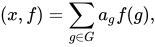
However, the group algebra and – the commutative algebra of functions of G into k – are dual: given an element of the group algebra and a function on the group these pair to give an element of k via which is a well-defined sum because it is finite.
![{\displaystyle k[G]}](https://wikimedia.org/api/rest_v1/media/math/render/svg/4a13dacf8d6ff682a6b5d59e84f93e589cba3fa1)


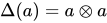
We give kG the structure of a cocommutative Hopf algebra by defining the coproduct, counit, and antipode to be the linear extensions of the following maps defined on G:
The required Hopf algebra compatibility axioms are easily checked. Notice that , the set of group-like elements of kG (i.e. elements such that and ), is precisely G.



Let G be a group and X a topological space. Any action of G on X gives a homomorphism , where F(X) is an appropriate algebra of k-valued functions, such as the Gelfand–Naimark algebra of continuous functions vanishing at infinity. The homomorphism is defined by , with the adjoint defined by




for , and .


Hub AI
Group Hopf algebra AI simulator
(@Group Hopf algebra_simulator)
Group Hopf algebra
In mathematics, the group Hopf algebra of a given group is a certain construct related to the symmetries of group actions. Deformations of group Hopf algebras are foundational in the theory of quantum groups.
Let G be a group and k a field. The group Hopf algebra of G over k, denoted kG (or k[G]), is as a set (and a vector space) the free vector space on G over k. As an algebra, its product is defined by linear extension of the group composition in G, with multiplicative unit the identity in G; this product is also known as convolution.
Note that while the group algebra of a finite group can be identified with the space of functions on the group, for an infinite group these are different. The group algebra, consisting of finite sums, corresponds to functions on the group that vanish for cofinitely many points; topologically (using the discrete topology), these are the functions with compact support.
However, the group algebra and – the commutative algebra of functions of G into k – are dual: given an element of the group algebra and a function on the group these pair to give an element of k via which is a well-defined sum because it is finite.
We give kG the structure of a cocommutative Hopf algebra by defining the coproduct, counit, and antipode to be the linear extensions of the following maps defined on G:
The required Hopf algebra compatibility axioms are easily checked. Notice that , the set of group-like elements of kG (i.e. elements such that and ), is precisely G.
Let G be a group and X a topological space. Any action of G on X gives a homomorphism , where F(X) is an appropriate algebra of k-valued functions, such as the Gelfand–Naimark algebra of continuous functions vanishing at infinity. The homomorphism is defined by , with the adjoint defined by
for , and .