Hubbry Logo
GüiroGüiroMain
Open search
Güiro
Community hub
Güiro
logo
8 pages, 0 posts
0 subscribers
Be the first to start a discussion here.
Güiro
Güiro
from Wikipedia
Güiro
Puerto Rican güiro on display in the Musical Instrument Museum of Phoenix
Percussion instrument
Other namesGüira, rascador, güícharo (Puerto Rican, made from plastic), candungo, carracho, rayo
Classification Idiophone, can be made from wood, gourd, metal, plastic or fiberglass
Hornbostel–Sachs classification112.23
(Scraped idiophone, vessel)
Playing range
Speed of scrape produces some variation
Related instruments
Güira, guayo, guacharaca, reco-reco, quijada, washboard, vest frottoir

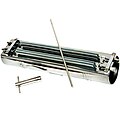
The güiro (Spanish pronunciation: [ˈɡwiɾo]) is a percussion instrument consisting of an open-ended, hollow gourd with parallel notches cut in one side. It is played by rubbing a stick or tines (see photo) along the notches to produce a zipper-like ratchet sound.

The güiro is commonly used in Cuban, Puerto Rican, and other forms of Latin American music, and plays a key role in the typical rhythm section of important genres like son, trova and salsa. Playing the güiro usually requires both long and short sounds, made by scraping up and down in long or short strokes.[1]

The güiro, like the maracas, is often played by a singer. It is closely related to the Cuban guayo, Dominican güira, and Haitian graj which are made of metal. Other instruments similar to the güiro are the Colombian guacharaca, the Brazilian reco-reco, the Cabo Verdean ferrinho, the quijada (cow jawbone) and the frottoir (French) or fwotwa (French Creole) (washboard).[1]

Etymology

[edit]

In the Arawakan language, a language of the indigenous people of Latin America and spread throughout the Caribbean spoken by groups such as the Taíno, güiro referred to fruit of the güira and an instrument made from fruit of the güira.[2]

Construction and design

[edit]

The güiro is a notched, hollowed-out gourd.[3] Often, the calabash gourd is used.[4] The güiro is made by carving parallel circular stripes along the shorter section of the elongated gourd. Today, many güiros are made of wood or fiberglass.[5]

History

[edit]

The güiro was adapted from an instrument which originated in South America. The Aztecs produced an early cousin to the güiro, called the omitzicahuastli, which was created from a small bone with serrated notches and was played in the same manner as the güiro.[6] The Taíno people of the Caribbean have been credited with the origins of the güiro.[7] The Taínos of Dominican Republic, Cuba and Puerto Rico developed the güajey, a long gourd or animal bone with notches, an antecedent of the modern day güiro.[8] Alternatively, the güiro is also believed to have origins in Africa and to have been brought over to Latin American and the Caribbean by African slaves.[9] Blench (2009) suggests a connection with the scraped idiophones of Cameroon and other regions of West and Central Africa (see list of musical instruments of Cameroon).[10] The Berom people of central Nigeria also have scraper or guiro-like instrument called gwák or gwàshák.[11]

Use in music

[edit]

Across Latin America, the Caribbean, the güiro can be found in a variety of traditional, folk dance music and used in dance ensembles and religious festivals.[5] In the Yucatán Peninsula, the güiro is used in two Mayan dances, the mayapax and the jarana.[7] In Cuba, the güiro is used in the genre danzón.[7] In Puerto Rico, the güiro often associated with the music of the jíbaro and is used in the musical genres of the plena, the seis, and the danza.[8][12] In the Caribbean coast, the güiro was used in traditional, folk dance cumbia music and is still used in modern cumbia music.[7] In Panama, the güiro can be found in folk dances such as the merjorana and cumbia.[5]

Use in classical music

[edit]

The güiro is used in classical music both to add Latin American flavor, and also purely for its instrumental qualities.

Examples of compositions including a güiro are Uirapuru by Heitor Villa-Lobos (though the score specifies reco-reco), Latin-American Symphonette by Morton Gould and The Rite of Spring (Le Sacre du printemps) by Stravinsky.[13]

[edit]

See also

[edit]

References

[edit]
[edit]
Revisions and contributorsEdit on WikipediaRead on Wikipedia
from Grokipedia
The güiro is a scraped (Hornbostel-Sachs 131.231) originating from the , traditionally crafted from a hollowed-out with parallel notches or ridges carved along its length, which is played by scraping a stick or tines across the textured surface to produce a distinctive rasping or rattling . Its construction typically involves a cylindrical or elongated body from the higüero tree (), often with a natural handle for grip, though modern variants are made from wood, metal, , or plastic for durability and varied tonal qualities. Players hold the instrument in one hand—often securing it by inserting the thumb into a —and use a wooden stick, metal rod, or comb in the other to execute short or long strokes, creating rhythmic patterns that range from sharp accents to sustained glides. The güiro's origins trace back to pre-Columbian indigenous cultures of the , particularly the people. By the , it had become integral to Puerto Rican and musical traditions, evolving alongside genres that blended indigenous, African, and European elements. Culturally, the güiro symbolizes resilience and rhythmic innovation in Latin American music, serving as a core element in the rhythm section of styles such as salsa, , bomba y , merengue, and , where it provides syncopated textures that drive danceable grooves. It appears in ceremonial contexts like , community festivals, and modern ensembles, including and orchestral adaptations, underscoring its enduring role in preserving Afro-Caribbean heritage. In , a similar instrument known as the reco-reco reflects its broader regional adaptations.

Etymology and Origins

Etymology

The term güiro derives from the word guajey, referring to the crafted from the fruit of the tree—known in Taíno as güira and in Spanish as the or higüero—by hollowing and notching the for scraping. In Taíno, the instrument form was specifically termed guajey, denoting an early scraper variant made from the elongated , which produced rhythmic sounds when rasped with a stick. Related terms appear in other indigenous Arawakan dialects, such as güira for the Crescentia cujete tree itself, whose hard-shelled fruit served as the primary material for the instrument and various utilitarian objects in pre-colonial societies. These linguistic roots highlight the Taíno's integral connection to local flora, transforming the gourd from a natural resource into a cultural artifact. Scholarly debate exists on the instrument's etymology and origins, with some attributing primary influence to African rasping traditions introduced via the slave trade, alongside indigenous Arawakan roots. During the Spanish colonial period in the Caribbean, the name güiro evolved through phonetic adaptation into , retaining the guajey but spelled with a diaeresis (ü) to preserve the [gwi] pronunciation distinct from standard . This incorporation reflected broader linguistic borrowing from indigenous terms into colonial vernacular, facilitating the instrument's integration into emerging musical traditions across , , and the .

Historical Origins

The güiro traces its roots to pre-Columbian times among the people of the , including regions now known as and , where it was crafted from natural or bones and used as a scraper in ceremonial rituals around the time of European contact in 1492. The instrument, referred to by the as güajey, consisted of a long, notched or bone that produced rasping sounds when scraped, serving a vital role in indigenous musical and spiritual practices. In parallel, a similar rasping instrument known as the omitzicahuastli developed among the in , fashioned from notched bone or wood and documented in 16th-century historical accounts of . This scraper, played by rubbing a smaller stick across its serrations, shared functional similarities with the Taíno güajey and highlighted independent evolutions of percussion in pre-Columbian Americas. During the 16th to 19th centuries, the arrival of enslaved Africans in the and introduced rasping instruments like the reco-reco, originating from African traditions, which blended with indigenous designs to influence the güiro's form and rhythmic application in colonial contexts. These cross-cultural exchanges occurred amid the transatlantic slave trade, enriching the instrument's versatility within emerging hybrid musical expressions. Through Spanish colonization starting in the early , the güiro spread southward to regions such as and by the 18th century, where it integrated into mestizo traditions combining indigenous, European, and African elements. In these areas, originally linked to Arawakan-speaking groups like the who inhabited parts of present-day , the instrument adapted to local folk practices, solidifying its role in colonial-era ensembles.

Design and Construction

Materials and Variations

The traditional güiro is crafted from a hollowed-out derived from the tree, commonly known as the or higüero, which is native to the and . Parallel notches are meticulously carved along one side of the using knives or similar sharp tools to create the rasping surface essential for its function. These instruments typically measure 25 to 40 centimeters in length, featuring an open-ended design to optimize within the hollow chamber. In contemporary production, güiros incorporate diverse materials to enhance durability, portability, and tonal consistency, including wooden constructions, for lightweight resilience, and molded for affordability and weather resistance. Regional adaptations further diversify the form; Puerto Rican variants often adopt a distinctive fish-shaped , evoking marine motifs in local craftsmanship. Larger iterations, extending up to 50 centimeters, are employed in orchestral settings to project sound across ensembles. Notable regional differences manifest in the notch configurations: Cuban son güiros feature wider and deeper grooves for a robust scrape, whereas Puerto Rican plena versions employ smaller, shallower notches that yield a more refined texture. These variations in construction influence the instrument's portability and acoustic profile, with traditional models prized for their organic warmth despite their fragility compared to synthetic alternatives.

Playing Technique

The güiro is held in the non-dominant hand, typically with fingers inserted through sound holes or grasping the body vertically to secure it firmly while allowing . A rigid stick, known as a palo de güiro and often made of wood or , or sometimes metal tines, is grasped in the dominant hand and scraped across the instrument's parallel notches to produce sound. Variations in scraping technique allow for diverse timbres and rhythms. Long, slow scrapes, executed as full downstrokes or upstrokes, generate a sustained rasping with a ratchet-like quality, while short, rapid flicks produce staccato effects suitable for accenting beats. The direction of the stroke—upward or downward—can slightly alter the pitch and intensity, with adjustments in speed and pressure further modifying the articulation. Acoustically, the notches on the güiro's surface create as the stick passes over them, generating that are amplified by the hollow body of the instrument, resulting in a distinctive percussive scrape. This rasping arises from the intermittent , producing a noisy, rich in harmonics that emphasizes rhythmic texture rather than melodic content. In performance, the güiro is typically played by secondary percussionists within an ensemble, providing subtle rhythmic marking that supports the overall groove without dominating other elements.

Musical and Cultural Role

Traditional Uses in Latin American Music

The güiro plays a central role in Puerto Rican , a genre that emerged in the early in working-class neighborhoods like those in Ponce, where it provides syncopated scrapes that drive the call-and-response vocals characteristic of the style. As a scraped , the güiro's rhythmic patterns, produced by dragging a stick across its notches, establish a steady that underscores the interactive and storytelling elements of plena, often serving as the "sung newspaper" to comment on social issues. In Puerto Rican bomba, another traditional genre with African roots, the güiro was historically used in certain regional styles, such as in Loíza, to provide rhythmic texture alongside barrel drums, though maracas have largely replaced it in modern ensembles. In Cuban son and rumba traditions of the 19th and 20th centuries, the güiro accentuates the clave rhythm, a foundational two-bar pattern that organizes the music's phrasing, while complementing congas and maracas to create layered percussion textures. Originating in eastern Cuba's changüí style—a precursor to son—the instrument adds a raspy pulse that enhances the danceable syncopation, evolving through urban septetos and influencing broader Afro-Cuban ensembles. In Dominican merengue, the güiro—often a metal variant called —delivers a sharp, scraping rhythm that propels the fast-paced , working with tambora and guira to maintain the genre's energetic pulse since the . In salsa, a 20th-century fusion genre blending Cuban , mambo, and other styles, the güiro contributes syncopated accents to the rhythm section, enhancing the danceable grooves in ensembles featuring piano, horns, and congas. Within 20th-century Colombian and traditions, the güiro—often locally known as guacharaca—contributes a textural rasp that enriches the rhythmic foundation, particularly in ensembles featuring gaita flutes. In , it integrates with Afro-Cuban influences like congas and maracas to support the genre's swaying, circular rhythms derived from coastal Indigenous and African roots, while in , it pairs with caja drums and accordions to propel narrative-driven folk songs. The güiro holds deep cultural significance as a symbol of resistance and identity in Afro-Caribbean communities, embodying blended Indigenous, African, and Spanish heritages through its role in communal expression and social commentary. In Cuban Santería, güiro ceremonies feature the instrument as a primary percussion element, accompanying call-and-response chants to invoke orishas without batá drums, preserving sacred Afro-Cuban rituals. It is prominently featured in festivals such as Puerto Rico's Fiestas de la Calle San Sebastián, where plena ensembles use it to celebrate and preserve cultural narratives during street performances in Old San Juan.

Applications in Classical and Contemporary Music

The güiro has been incorporated into classical music compositions to evoke exotic or primal timbres, expanding its role beyond folk traditions. In Heitor Villa-Lobos's 1917 ballet Uirapuru, the instrument—specified as a reco-reco variant—provides percussive staccato effects that enhance the Brazilian orchestral color, marking one of the earliest integrations of Latin American percussion into symphonic works. Similarly, Igor Stravinsky's The Rite of Spring (1913) employs the güiro among its extensive percussion array to produce scraping sounds that underscore the score's ritualistic and primitive intensity. These examples illustrate how early 20th-century composers drew on the güiro's rasping quality to add textural depth in ensemble settings. During the 20th century, the güiro found further prominence in symphonic jazz and Latin fusions, bridging classical and popular idioms. George Gershwin's Cuban Overture (1932), inspired by his trip, features the güiro alongside maracas, , and to capture authentic Cuban rhythms within a symphonic framework. Later, composers like integrated it into works, such as his Gran Danzón Concerto, where the güiro serves as a key rhythmic element alongside and , blending Afro-Cuban patterns with . In , the güiro appears in diverse global genres, often amplifying its rhythmic versatility. Carlos Santana's 1970s albums, including Amigos (1976), utilize the güiro in percussion layers to infuse with traditional scrapes, as credited in ensemble performances. Since the , its sound has been sampled in hip-hop and electronic tracks, appearing in production libraries for loops that add ethnic texture to beats. It also features in ensembles, providing idiophonic scrapes in multicultural fusions that extend beyond Latin roots. Innovations in the address the güiro's acoustic limitations, enabling louder projections in amplified environments. Electronic MIDI versions, such as virtual instruments simulating the scrape via modulation wheels, allow integration into digital compositions and live electronic sets. Amplified physical güiros, equipped with pickups for stage use, overcome volume challenges in large-scale performances, preserving the instrument's while adapting to modern amplification needs.

References

Add your contribution
Related Hubs
User Avatar
No comments yet.