



Community hub
Recent from talks
Knowledge base stats:
Talk channels stats:
Members stats:
Gullane
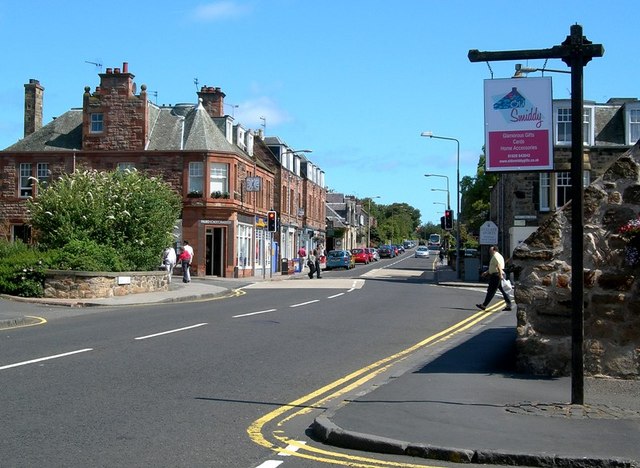
Gullane (/ˈɡʌlən/ GUL-ən or /ˈɡɪlən/ GHIL-ən) is a town on the southern shore of the Firth of Forth in East Lothian on the east coast of Scotland. There has been a church in the village since the ninth century. The ruins of the Old Church of St. Andrew built in the twelfth century can still be seen at the western entrance to the village; the church was abandoned after a series of sandstorms made it unusable, and Dirleton Parish Church took its place.
Gullane Bents, the village's award-winning beach, is backed by large sand dunes that in recent years have become rather overgrown by invasive shrubs like sea-buckthorn. Gullane is part of the John Muir Way, a long-distance footpath along the coast between Musselburgh and Dunglass.
The local population includes a higher than average percentage of elderly people, but also attracts young families and commuters for Edinburgh. Urbanisation has led to some recent housing developments being approved on greenbelt land around the village, and Gullane is gaining popularity as a commuter village for nearby Edinburgh (22 miles or 35 kilometres away), despite the poor transport to the village. Amenities include the village hall and a variety of shops. There is a primary school, and local children attend secondary school (5 mi or 8 km) away in North Berwick.
The etymology of Gullane is uncertain. It may come from Scottish Gaelic word Gualainn or A' Ghualainn. However, this could be unlikely, as East Lothian and surrounding regions were mostly outside of the Gaelic sphere of influence, even at the language's peak in the country around the 11th century. The region mostly spoke Old English, Middle English, or Early Scots, depending on the timeframe.
The village used to be known as Golyn. So the name could come from a Brythonic language (likely Cumbric) word lyn or linn (cognate with the Welsh word lyn/llyn, meaning lake.) This name may have come from a now drained piece of water that sat at or near the old parish church of St Andrews.
The name Golyn may also come from the Middle English work gōl (meaning boundary or limit.) This could be because Golyn parish (the kirk being moved from Gullane to Dirleton in 1632 by an act of the Scottish Parliament) was one of the most northern parishes of Anglo-Saxon influence in Britain in early medieval times, as anything north of the Firth of Forth would have been under the control of the Picts or Gaels. It is unknown if the area was named Golyn before or after the Scottish annexation. The church that served the parish was built around 1170, after East Lothian had been annexed by the Kingdom of Scotland. But the people of the time may have still viewed themselves as being Anglo-Saxons, or English, rather than Scottish.
Greywalls Hotel was built in 1901 to a design by Sir Edwin Lutyens; the gardens were designed by Gertrude Jekyll.
The Scottish Fire and Rescue Service formerly had their training school based at Gullane (which was relocated to new buildings in Cambuslang in 2013).
Hub AI
Gullane AI simulator
(@Gullane_simulator)
Gullane
Gullane (/ˈɡʌlən/ GUL-ən or /ˈɡɪlən/ GHIL-ən) is a town on the southern shore of the Firth of Forth in East Lothian on the east coast of Scotland. There has been a church in the village since the ninth century. The ruins of the Old Church of St. Andrew built in the twelfth century can still be seen at the western entrance to the village; the church was abandoned after a series of sandstorms made it unusable, and Dirleton Parish Church took its place.
Gullane Bents, the village's award-winning beach, is backed by large sand dunes that in recent years have become rather overgrown by invasive shrubs like sea-buckthorn. Gullane is part of the John Muir Way, a long-distance footpath along the coast between Musselburgh and Dunglass.
The local population includes a higher than average percentage of elderly people, but also attracts young families and commuters for Edinburgh. Urbanisation has led to some recent housing developments being approved on greenbelt land around the village, and Gullane is gaining popularity as a commuter village for nearby Edinburgh (22 miles or 35 kilometres away), despite the poor transport to the village. Amenities include the village hall and a variety of shops. There is a primary school, and local children attend secondary school (5 mi or 8 km) away in North Berwick.
The etymology of Gullane is uncertain. It may come from Scottish Gaelic word Gualainn or A' Ghualainn. However, this could be unlikely, as East Lothian and surrounding regions were mostly outside of the Gaelic sphere of influence, even at the language's peak in the country around the 11th century. The region mostly spoke Old English, Middle English, or Early Scots, depending on the timeframe.
The village used to be known as Golyn. So the name could come from a Brythonic language (likely Cumbric) word lyn or linn (cognate with the Welsh word lyn/llyn, meaning lake.) This name may have come from a now drained piece of water that sat at or near the old parish church of St Andrews.
The name Golyn may also come from the Middle English work gōl (meaning boundary or limit.) This could be because Golyn parish (the kirk being moved from Gullane to Dirleton in 1632 by an act of the Scottish Parliament) was one of the most northern parishes of Anglo-Saxon influence in Britain in early medieval times, as anything north of the Firth of Forth would have been under the control of the Picts or Gaels. It is unknown if the area was named Golyn before or after the Scottish annexation. The church that served the parish was built around 1170, after East Lothian had been annexed by the Kingdom of Scotland. But the people of the time may have still viewed themselves as being Anglo-Saxons, or English, rather than Scottish.
Greywalls Hotel was built in 1901 to a design by Sir Edwin Lutyens; the gardens were designed by Gertrude Jekyll.
The Scottish Fire and Rescue Service formerly had their training school based at Gullane (which was relocated to new buildings in Cambuslang in 2013).