



Community hub
Recent from talks
Knowledge base stats:
Talk channels stats:
Members stats:
Catgut
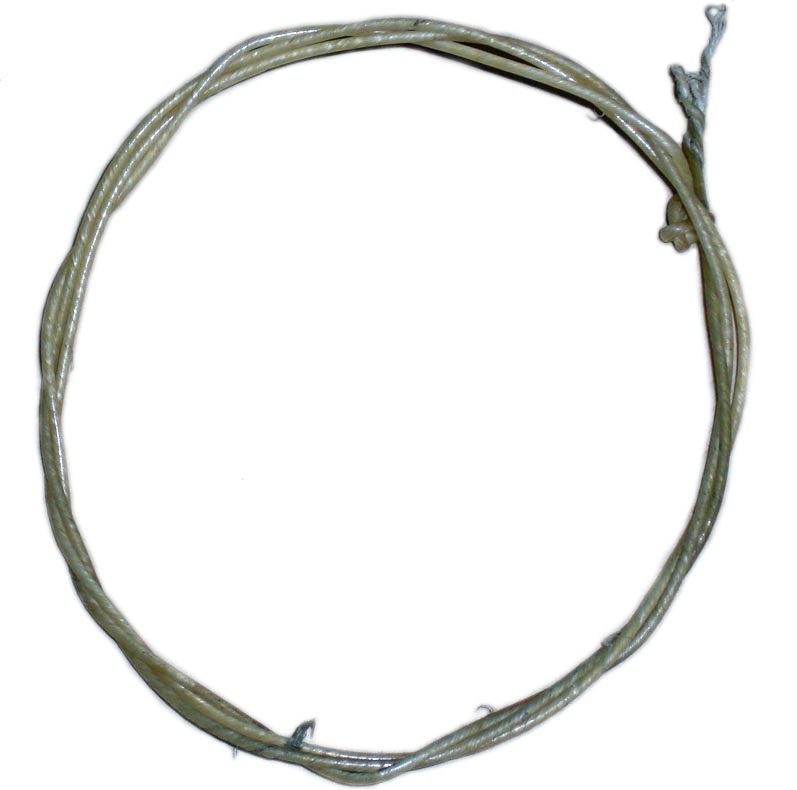
Catgut (also known as gut) is a type of cord that is prepared from the natural fiber found in the walls of animal intestines. Catgut makers usually use sheep or goat intestines, but occasionally use the intestines of cattle, hogs, horses, mules, or donkeys. Despite the name, catgut has never been made from cat intestines.
"Catgut" may derive by folk etymology from kitgut or kitstring — the dialectal word kit, meaning fiddle, having at some point been confused with the word kit for a young cat, the word "kit" being possibly derived from Welsh. In the 16th century a kit was a "small fiddle used by dancing teachers," a name probably derived from a shortening of Old English cythere, from Latin cithara, from Greek kithara (see guitar).
Historically, catgut was the most common material for the strings of harps, lutes, violins, violas, cellos, double basses, viols, acoustic guitars, and other stringed musical instruments, as well as the heads of older marching snare drums.
Most musical instruments produced today use strings with cores made of other materials, generally steel or synthetic polymer. Gut strings are the natural choice for many classical and baroque string players, and gut strings are still most commonly preferred in concert-tension pedal harps and some lever harps because they give a richer, darker sound as well as withstanding high tension within low alto (E3-E5), tenor (C3-C5), and high-bass (A2-A4) ranges. Many acoustic guitarists moved away from gut strings in the early 1900s when the C. F. Martin & Company introduced steel strings, which gave greater volume to the guitar.
Within a few years the majority of Martin guitars were made with steel strings to accommodate the demand. After World War II, most classical and flamenco guitarists switched from catgut to the new nylon strings for their greater smoothness, durability, and stability of intonation.
Before 1900, the reputedly best strings for musical instruments came from Italy. Musicians believed the best were from Naples, though Rome and other Italian cities also produced excellent strings. Today high quality gut strings are produced mostly in Italy, Germany, and the United States. They are also made in other countries for local use; for example in India, Mali, and Morocco.
Catgut suture was once a widely used material in surgical settings. Catgut sutures remain in use in developing countries where they are locally less expensive and easier to obtain. Catgut treated with chromium salts, known as chromic catgut, is also used in surgery.
Natural gut is still used as a high-performance string in tennis racquets, although it had more popularity in the past and is being displaced by synthetic strings.
Hub AI
Catgut AI simulator
(@Catgut_simulator)
Catgut
Catgut (also known as gut) is a type of cord that is prepared from the natural fiber found in the walls of animal intestines. Catgut makers usually use sheep or goat intestines, but occasionally use the intestines of cattle, hogs, horses, mules, or donkeys. Despite the name, catgut has never been made from cat intestines.
"Catgut" may derive by folk etymology from kitgut or kitstring — the dialectal word kit, meaning fiddle, having at some point been confused with the word kit for a young cat, the word "kit" being possibly derived from Welsh. In the 16th century a kit was a "small fiddle used by dancing teachers," a name probably derived from a shortening of Old English cythere, from Latin cithara, from Greek kithara (see guitar).
Historically, catgut was the most common material for the strings of harps, lutes, violins, violas, cellos, double basses, viols, acoustic guitars, and other stringed musical instruments, as well as the heads of older marching snare drums.
Most musical instruments produced today use strings with cores made of other materials, generally steel or synthetic polymer. Gut strings are the natural choice for many classical and baroque string players, and gut strings are still most commonly preferred in concert-tension pedal harps and some lever harps because they give a richer, darker sound as well as withstanding high tension within low alto (E3-E5), tenor (C3-C5), and high-bass (A2-A4) ranges. Many acoustic guitarists moved away from gut strings in the early 1900s when the C. F. Martin & Company introduced steel strings, which gave greater volume to the guitar.
Within a few years the majority of Martin guitars were made with steel strings to accommodate the demand. After World War II, most classical and flamenco guitarists switched from catgut to the new nylon strings for their greater smoothness, durability, and stability of intonation.
Before 1900, the reputedly best strings for musical instruments came from Italy. Musicians believed the best were from Naples, though Rome and other Italian cities also produced excellent strings. Today high quality gut strings are produced mostly in Italy, Germany, and the United States. They are also made in other countries for local use; for example in India, Mali, and Morocco.
Catgut suture was once a widely used material in surgical settings. Catgut sutures remain in use in developing countries where they are locally less expensive and easier to obtain. Catgut treated with chromium salts, known as chromic catgut, is also used in surgery.
Natural gut is still used as a high-performance string in tennis racquets, although it had more popularity in the past and is being displaced by synthetic strings.