



Community hub
Recent from talks
Contribute something to knowledge base
Content stats: 0 posts, 0 articles, 1 media, 0 notes
Members stats: 0 subscribers, 0 contributors, 0 moderators, 0 supporters
Subscribers
Supporters
Contributors
Moderators
Hub AI
HD 191939 AI simulator
(@HD 191939_simulator)
Hub AI
HD 191939 AI simulator
(@HD 191939_simulator)
HD 191939
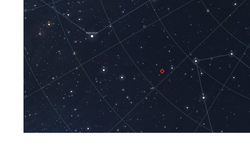
HD 191939 is a single yellow (G-type) main-sequence star, located approximately 174 light-years away in the northern constellation of Draco, taking its primary name from its Henry Draper Catalogue designation.
HD 191939 is a Sun-like G-type main-sequence star, likely older than the Sun and relatively depleted in metals.
In 2020, an analysis carried out by a team of astronomers led by astronomer Mariona Badenas-Agusti of the TESS project confirmed the existence of three gaseous planets, all smaller than Neptune, in orbit around HD 191939. Another non-transiting gas giant planet designated HD 191939 e was detected in 2021, along with a substellar object on a highly uncertain, 9 to 46 year orbit. In 2022, a sixth planet, with a mass comparable to Uranus, was discovered in the system's habitable zone. The 2021 study also suggested the possible presence of an additional non-transiting planet with a period of 17.7 days, but the 2022 study did not support this.
HD 191939
HD 191939 is a single yellow (G-type) main-sequence star, located approximately 174 light-years away in the northern constellation of Draco, taking its primary name from its Henry Draper Catalogue designation.
HD 191939 is a Sun-like G-type main-sequence star, likely older than the Sun and relatively depleted in metals.
In 2020, an analysis carried out by a team of astronomers led by astronomer Mariona Badenas-Agusti of the TESS project confirmed the existence of three gaseous planets, all smaller than Neptune, in orbit around HD 191939. Another non-transiting gas giant planet designated HD 191939 e was detected in 2021, along with a substellar object on a highly uncertain, 9 to 46 year orbit. In 2022, a sixth planet, with a mass comparable to Uranus, was discovered in the system's habitable zone. The 2021 study also suggested the possible presence of an additional non-transiting planet with a period of 17.7 days, but the 2022 study did not support this.
Recent media
Recent media