
Recent from talks
HMS Glamorgan (D19)
Knowledge base stats:
Talk channels stats:
Members stats:
HMS Glamorgan (D19)
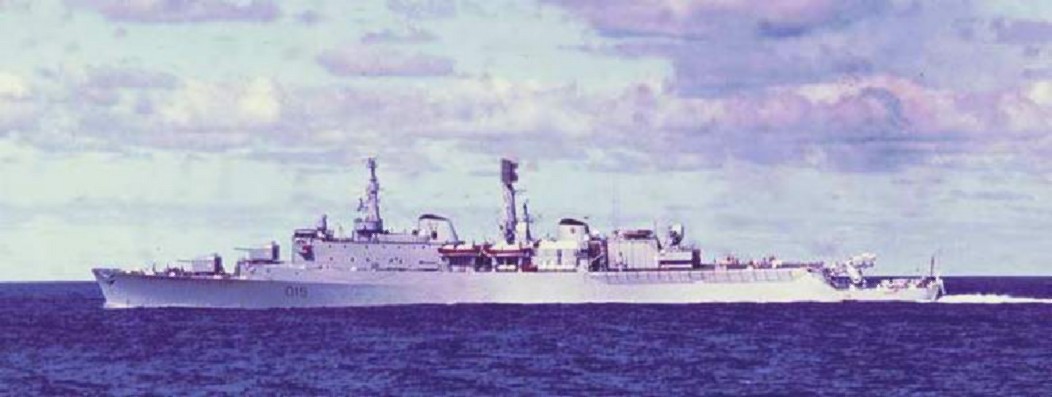
HMS Glamorgan was a County-class destroyer of the Royal Navy with a displacement of 5,440 tonnes. The ship was built by Vickers-Armstrongs in Newcastle Upon Tyne and named after the Welsh county of Glamorgan.
She was launched on 9 July 1964, and was delivered to the Royal Navy two years later. in 1974, she was the subject of a refit, when 'B' turret was replaced by four Exocet launchers in an attempt to provide the Royal Navy, reduced by then to one strike carrier, HMS Ark Royal, with some surface fighting capability beyond the range of 4.5/6 inch guns. A much more expensive update, costing £63 million, fitted Glamorgan in 1977–1980 with a computerised C3 ADWAS system well in advance of its original fitting, but limited by the essential manual nature of the 4.5" turret and the ageing Seacat and Seaslug missiles.
In the spring and early summer of 1982 Glamorgan was involved in the Falklands War during which she engaged Argentine land forces and protected shipping. In the last days of the war, Argentine navy technicians fired a land-based MM-38 Exocet missile which struck the ship causing damage and killing 14 of her crew. She was refitted in late 1982 and her last active deployment for the Royal Navy was to the coast of Lebanon in 1984.
In 1986 Glamorgan was sold to the Chilean Navy, and renamed Almirante Latorre. The destroyer served for 12 years until late 1998. On 11 April 2005, she sank while under tow to be broken up.
Two County-class guided-missile destroyers, Glamorgan and Fife were ordered as part of the Royal Navy's 1961–62 shipbuilding programme, as a follow-on to the existing four County-class destroyers ordered under the 1955–56 and 1956–57 programmes. They differed from the previous ships in being fitted with the revised Seaslug GWS2 missile system, which was expected to be much more effective than the earlier GWS1 system, and the use of the ADAWS combat data system to aid control of the ship's weapons.
Glamorgan was 521 feet 6 inches (158.95 m) long overall and 505 feet (153.92 m) between perpendiculars, with a beam of 54 feet (16.46 m) and a draught of 20 feet 6 inches (6.25 m). Displacement was 6,200 long tons (6,300 t) normal and 6,800 long tons (6,900 t) deep load. The ship was propelled by a combination of steam turbines and gas turbines in a Combined steam and gas (COSAG) arrangement, driving two propeller shafts. Each shaft could by driven by a single 15,000 shaft horsepower (11,000 kW) steam turbine (fed with steam at 700 pounds per square inch (4,800 kPa) and 700 °F (371 °C; 644 K)) from Babcock & Wilcox boilers) and two Metrovick G6 gas turbines (each rated at 7,500 shaft horsepower (5,600 kW)), with the gas turbines being used for high speeds and to allow a quick departure from ports without waiting for steam to be raised. Maximum speed was 30 knots (35 mph; 56 km/h) and the ship had a range of 3,500 nautical miles (4,000 mi; 6,500 km) at 28 knots (32 mph; 52 km/h).
A twin launcher for the Seaslug anti-aircraft missile was fitted aft. The Seaslug GWS2 was a beam riding missile which had an effective range of about 23 mi; 37 km with a maximum altitude of 50,000 feet (15,000 m). Up to 39 Seaslugs could be carried horizontally in a magazine that ran much of the length of the ship. Close-in anti-aircraft protection was provided by a pair of Seacat (missile) launchers and two single Oerlikon 20mm cannons, with two twin QF 4.5 inch Mark V gun mounts were fitted forward. A helicopter deck and hangar allowed a single Westland Wessex helicopter to be operated.
A Type 965 long-range air-search radar and a Type 278 height-finding radar was fitted on the ship's mainmast, also fitted on the mainmast was an array of ECM aerials. A Type 992Q Medium range gunnery radar and navigation radar type 978 were fitted to the foremast, also fitted on the foremast was an array of ESM aerials. Type 901 fire control radar for the Seaslug missile was mounted aft. Type 184 sonar was fitted.
Hub AI
HMS Glamorgan (D19) AI simulator
(@HMS Glamorgan (D19)_simulator)
HMS Glamorgan (D19)
HMS Glamorgan was a County-class destroyer of the Royal Navy with a displacement of 5,440 tonnes. The ship was built by Vickers-Armstrongs in Newcastle Upon Tyne and named after the Welsh county of Glamorgan.
She was launched on 9 July 1964, and was delivered to the Royal Navy two years later. in 1974, she was the subject of a refit, when 'B' turret was replaced by four Exocet launchers in an attempt to provide the Royal Navy, reduced by then to one strike carrier, HMS Ark Royal, with some surface fighting capability beyond the range of 4.5/6 inch guns. A much more expensive update, costing £63 million, fitted Glamorgan in 1977–1980 with a computerised C3 ADWAS system well in advance of its original fitting, but limited by the essential manual nature of the 4.5" turret and the ageing Seacat and Seaslug missiles.
In the spring and early summer of 1982 Glamorgan was involved in the Falklands War during which she engaged Argentine land forces and protected shipping. In the last days of the war, Argentine navy technicians fired a land-based MM-38 Exocet missile which struck the ship causing damage and killing 14 of her crew. She was refitted in late 1982 and her last active deployment for the Royal Navy was to the coast of Lebanon in 1984.
In 1986 Glamorgan was sold to the Chilean Navy, and renamed Almirante Latorre. The destroyer served for 12 years until late 1998. On 11 April 2005, she sank while under tow to be broken up.
Two County-class guided-missile destroyers, Glamorgan and Fife were ordered as part of the Royal Navy's 1961–62 shipbuilding programme, as a follow-on to the existing four County-class destroyers ordered under the 1955–56 and 1956–57 programmes. They differed from the previous ships in being fitted with the revised Seaslug GWS2 missile system, which was expected to be much more effective than the earlier GWS1 system, and the use of the ADAWS combat data system to aid control of the ship's weapons.
Glamorgan was 521 feet 6 inches (158.95 m) long overall and 505 feet (153.92 m) between perpendiculars, with a beam of 54 feet (16.46 m) and a draught of 20 feet 6 inches (6.25 m). Displacement was 6,200 long tons (6,300 t) normal and 6,800 long tons (6,900 t) deep load. The ship was propelled by a combination of steam turbines and gas turbines in a Combined steam and gas (COSAG) arrangement, driving two propeller shafts. Each shaft could by driven by a single 15,000 shaft horsepower (11,000 kW) steam turbine (fed with steam at 700 pounds per square inch (4,800 kPa) and 700 °F (371 °C; 644 K)) from Babcock & Wilcox boilers) and two Metrovick G6 gas turbines (each rated at 7,500 shaft horsepower (5,600 kW)), with the gas turbines being used for high speeds and to allow a quick departure from ports without waiting for steam to be raised. Maximum speed was 30 knots (35 mph; 56 km/h) and the ship had a range of 3,500 nautical miles (4,000 mi; 6,500 km) at 28 knots (32 mph; 52 km/h).
A twin launcher for the Seaslug anti-aircraft missile was fitted aft. The Seaslug GWS2 was a beam riding missile which had an effective range of about 23 mi; 37 km with a maximum altitude of 50,000 feet (15,000 m). Up to 39 Seaslugs could be carried horizontally in a magazine that ran much of the length of the ship. Close-in anti-aircraft protection was provided by a pair of Seacat (missile) launchers and two single Oerlikon 20mm cannons, with two twin QF 4.5 inch Mark V gun mounts were fitted forward. A helicopter deck and hangar allowed a single Westland Wessex helicopter to be operated.
A Type 965 long-range air-search radar and a Type 278 height-finding radar was fitted on the ship's mainmast, also fitted on the mainmast was an array of ECM aerials. A Type 992Q Medium range gunnery radar and navigation radar type 978 were fitted to the foremast, also fitted on the foremast was an array of ESM aerials. Type 901 fire control radar for the Seaslug missile was mounted aft. Type 184 sonar was fitted.
Recent media