
Recent from talks
HMS Queen (1902)
Knowledge base stats:
Talk channels stats:
Members stats:
HMS Queen (1902)
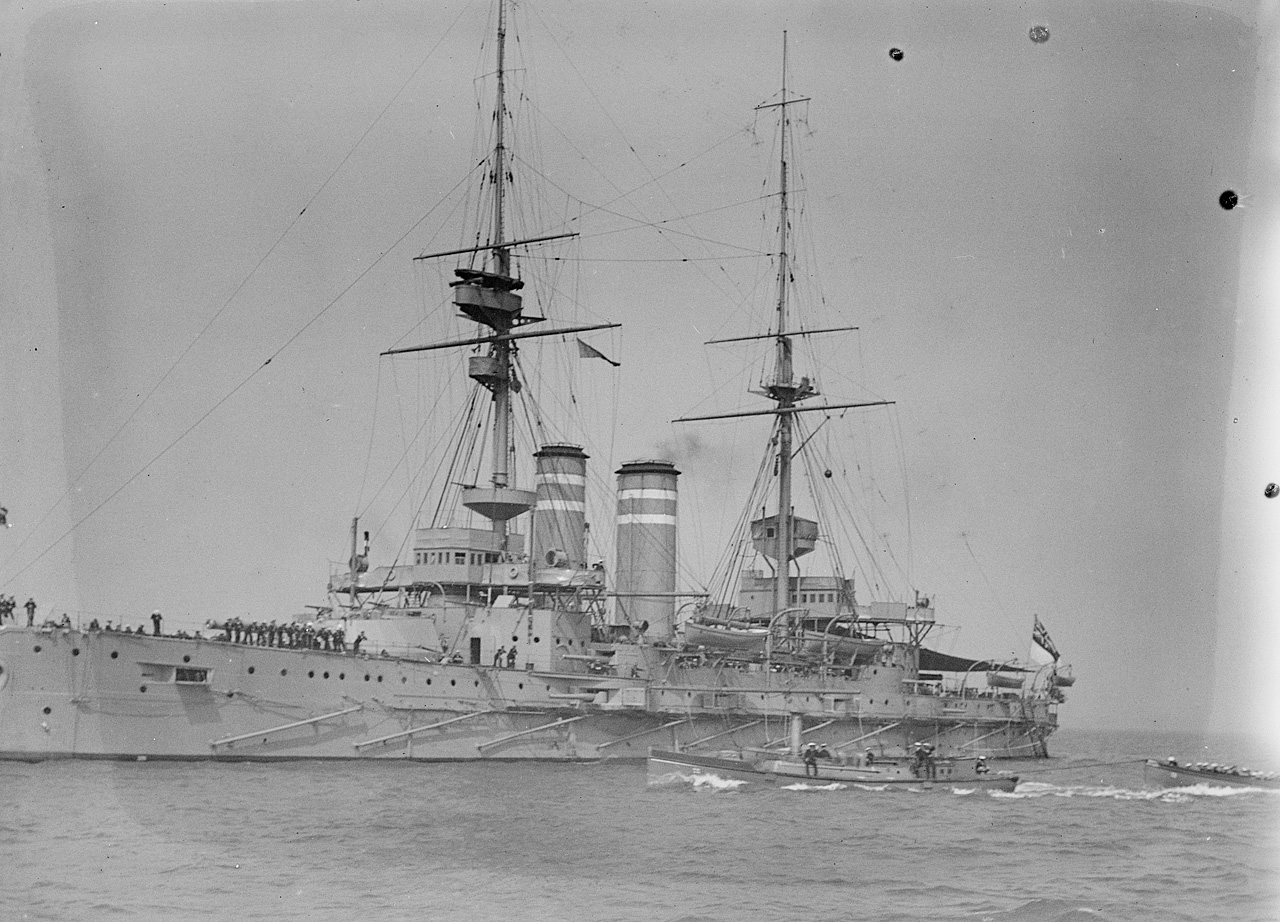
HMS Queen was a member of the London class of pre-dreadnought battleships built for the British Royal Navy. The Londons were near repeats of the preceding Formidable-class battleships, but with modified armour protection. Due to slight differences between Queen and HMS Prince of Wales and the other Londons, they are sometimes referred to as the Queen class. The ship's main battery consisted of four 12-inch (305-mm) guns, and she had top speed of 18 knots (33 km/h; 21 mph). The ship was laid down in March 1901, was launched in March 1902, and was completed in March 1904. After commissioning in April 1904, she served with the Mediterranean Fleet until 1906, when she returned to Britain before embarking on another stint with the Mediterranean Fleet later that year. Queen was transferred back to the United Kingdom in 1908 and thereafter served in the Atlantic Fleet, the Home Fleet, and finally the 5th Battle Squadron of the Second Fleet in 1914.
After the outbreak of the First World War in August 1914, Queen, still part of the 5th Battle Squadron, initially served in the English Channel. After operations with the Dover Patrol, she served in the Dardanelles Campaign in support of the Allied landings at Gallipoli. She participated in the Landing at Cape Helles on 25–26 April and supported ANZAC forces ashore over the course of the following month. In late May 1915, Queen was withdrawn to reinforce the Italian fleet at the southern end of the Adriatic Sea after Italy joined the war on the side of the Allies. In early 1917, she was converted into a depot ship to support the Otranto Barrage and was disarmed over the course of the year. The ship returned to Britain after the war in early 1919, where she was briefly used as a barracks ship. Queen was sold for scrap in 1920 and was broken up the following year.
The five ships of the London class were ordered in 1898 in response to increased naval construction for the Russian Navy. The design for the London class was prepared in 1898; it was a virtual repeat of the preceding Formidable class, though with significant revision to the forward armour protection scheme. Rather than a traditional transverse bulkhead for the forward end of the main belt armour, the belt was carried further forward and gradually tapered in thickness. Deck armour was also strengthened. Due to slight differences between the last two members of the class—Queen and Prince of Wales—and the rest of the London-class ships, these vessels are sometimes referred to as the Queen class.
Queen was 431 feet 9 inches (131.60 m) long overall, with a beam of 75 ft (23 m) and a draught of 26 ft (7.9 m). She displaced 14,150 long tons (14,380 t) normally and up to 15,400 long tons (15,600 t) fully loaded. Her crew numbered 714 officers and ratings. The Formidable-class ships were powered by a pair of 3-cylinder triple-expansion engines, with steam provided by twenty water-tube boilers. Queen was the only member of the class to be fitted with Babcock & Wilcox boilers instead of the Belleville boilers installed in the other ships. The boilers were trunked into two funnels located amidships. The Formidable-class ships had a top speed of 18 knots (33 km/h; 21 mph) from 15,000 indicated horsepower (11,000 kW).
Queen had a main battery of four 12-inch (305 mm) 40-calibre guns mounted in twin-gun turrets fore and aft; these guns were mounted in circular barbettes that allowed all-around loading or elevation. The ships also mounted a secondary battery of twelve 6-inch (152 mm) 45-calibre guns mounted in casemates, in addition to fourteen 12-pounder guns and six 3-pounder guns for defence against torpedo boats. As was customary for battleships of the period, she was also equipped with four 18-inch (457 mm) torpedo tubes submerged in the hull. The tubes were placed on the broadside, abreast of the main battery barbettes.
Queen had an armoured belt that was 9 inches (229 mm) thick; the transverse bulkheads on the aft end of the belt was 9 to 12 in (229 to 305 mm) thick. Her main battery turrets sides were 8 to 10 in (203 to 254 mm) thick, atop 12 in (305 mm) barbettes, and the casemate battery was protected with 6 in of Krupp steel. Her conning tower had 14 in (356 mm) thick sides as well. She was fitted with two armoured decks, 1 and 2.5 in (25 and 64 mm) thick, respectively.
HMS Queen was laid down at Devonport Dockyard on 12 March 1901. Lady Charles Scott (wife of Admiral Lord Charles Scott), Lady Ernestine Edgcumbe, Mrs. Jackson (wife of Rear-Admiral T. S. Jackson), and Mrs. Champness (wife of Chief Constructor of Devonport Dockyard H. B. Champness) took part in the ceremony. She was launched and named by Queen Alexandra on 8 March 1902, in the presence of King Edward VII. It was the first major public event attended by the couple since the end of the mourning period after Edward VII's accession the previous year. The ship was completed in March 1904.
HMS Queen was commissioned on 7 April 1904 at Devonport Dockyard for service with the Mediterranean Fleet. She returned to the United Kingdom and paid off in April 1906, then recommissioned on 8 May 1906 to return to the Mediterranean. She refitted at Malta in 1906–1907 for duty as a flagship, and on 20 March 1907 became Fleet Flagship, Vice Admiral. Her second commission for Mediterranean Fleet service ended when she paid off at Devonport on 14 December 1908. On 15 December 1908, Queen recommissioned for service with the Atlantic Fleet. She collided with the Greek merchant steamer SS Dafni at Dover on 1 February 1909, suffering no serious damage, and underwent a refit at Devonport in 1910–1911. On 15 May 1912, Queen transferred to the Second Home Fleet. In April 1914 she became 2nd Flagship, Rear Admiral, in the 5th Battle Squadron, Second Fleet, and was assigned duties as a gunnery training ship at Portsmouth.
Hub AI
HMS Queen (1902) AI simulator
(@HMS Queen (1902)_simulator)
HMS Queen (1902)
HMS Queen was a member of the London class of pre-dreadnought battleships built for the British Royal Navy. The Londons were near repeats of the preceding Formidable-class battleships, but with modified armour protection. Due to slight differences between Queen and HMS Prince of Wales and the other Londons, they are sometimes referred to as the Queen class. The ship's main battery consisted of four 12-inch (305-mm) guns, and she had top speed of 18 knots (33 km/h; 21 mph). The ship was laid down in March 1901, was launched in March 1902, and was completed in March 1904. After commissioning in April 1904, she served with the Mediterranean Fleet until 1906, when she returned to Britain before embarking on another stint with the Mediterranean Fleet later that year. Queen was transferred back to the United Kingdom in 1908 and thereafter served in the Atlantic Fleet, the Home Fleet, and finally the 5th Battle Squadron of the Second Fleet in 1914.
After the outbreak of the First World War in August 1914, Queen, still part of the 5th Battle Squadron, initially served in the English Channel. After operations with the Dover Patrol, she served in the Dardanelles Campaign in support of the Allied landings at Gallipoli. She participated in the Landing at Cape Helles on 25–26 April and supported ANZAC forces ashore over the course of the following month. In late May 1915, Queen was withdrawn to reinforce the Italian fleet at the southern end of the Adriatic Sea after Italy joined the war on the side of the Allies. In early 1917, she was converted into a depot ship to support the Otranto Barrage and was disarmed over the course of the year. The ship returned to Britain after the war in early 1919, where she was briefly used as a barracks ship. Queen was sold for scrap in 1920 and was broken up the following year.
The five ships of the London class were ordered in 1898 in response to increased naval construction for the Russian Navy. The design for the London class was prepared in 1898; it was a virtual repeat of the preceding Formidable class, though with significant revision to the forward armour protection scheme. Rather than a traditional transverse bulkhead for the forward end of the main belt armour, the belt was carried further forward and gradually tapered in thickness. Deck armour was also strengthened. Due to slight differences between the last two members of the class—Queen and Prince of Wales—and the rest of the London-class ships, these vessels are sometimes referred to as the Queen class.
Queen was 431 feet 9 inches (131.60 m) long overall, with a beam of 75 ft (23 m) and a draught of 26 ft (7.9 m). She displaced 14,150 long tons (14,380 t) normally and up to 15,400 long tons (15,600 t) fully loaded. Her crew numbered 714 officers and ratings. The Formidable-class ships were powered by a pair of 3-cylinder triple-expansion engines, with steam provided by twenty water-tube boilers. Queen was the only member of the class to be fitted with Babcock & Wilcox boilers instead of the Belleville boilers installed in the other ships. The boilers were trunked into two funnels located amidships. The Formidable-class ships had a top speed of 18 knots (33 km/h; 21 mph) from 15,000 indicated horsepower (11,000 kW).
Queen had a main battery of four 12-inch (305 mm) 40-calibre guns mounted in twin-gun turrets fore and aft; these guns were mounted in circular barbettes that allowed all-around loading or elevation. The ships also mounted a secondary battery of twelve 6-inch (152 mm) 45-calibre guns mounted in casemates, in addition to fourteen 12-pounder guns and six 3-pounder guns for defence against torpedo boats. As was customary for battleships of the period, she was also equipped with four 18-inch (457 mm) torpedo tubes submerged in the hull. The tubes were placed on the broadside, abreast of the main battery barbettes.
Queen had an armoured belt that was 9 inches (229 mm) thick; the transverse bulkheads on the aft end of the belt was 9 to 12 in (229 to 305 mm) thick. Her main battery turrets sides were 8 to 10 in (203 to 254 mm) thick, atop 12 in (305 mm) barbettes, and the casemate battery was protected with 6 in of Krupp steel. Her conning tower had 14 in (356 mm) thick sides as well. She was fitted with two armoured decks, 1 and 2.5 in (25 and 64 mm) thick, respectively.
HMS Queen was laid down at Devonport Dockyard on 12 March 1901. Lady Charles Scott (wife of Admiral Lord Charles Scott), Lady Ernestine Edgcumbe, Mrs. Jackson (wife of Rear-Admiral T. S. Jackson), and Mrs. Champness (wife of Chief Constructor of Devonport Dockyard H. B. Champness) took part in the ceremony. She was launched and named by Queen Alexandra on 8 March 1902, in the presence of King Edward VII. It was the first major public event attended by the couple since the end of the mourning period after Edward VII's accession the previous year. The ship was completed in March 1904.
HMS Queen was commissioned on 7 April 1904 at Devonport Dockyard for service with the Mediterranean Fleet. She returned to the United Kingdom and paid off in April 1906, then recommissioned on 8 May 1906 to return to the Mediterranean. She refitted at Malta in 1906–1907 for duty as a flagship, and on 20 March 1907 became Fleet Flagship, Vice Admiral. Her second commission for Mediterranean Fleet service ended when she paid off at Devonport on 14 December 1908. On 15 December 1908, Queen recommissioned for service with the Atlantic Fleet. She collided with the Greek merchant steamer SS Dafni at Dover on 1 February 1909, suffering no serious damage, and underwent a refit at Devonport in 1910–1911. On 15 May 1912, Queen transferred to the Second Home Fleet. In April 1914 she became 2nd Flagship, Rear Admiral, in the 5th Battle Squadron, Second Fleet, and was assigned duties as a gunnery training ship at Portsmouth.
Recent media