



Community hub
Recent from talks
Knowledge base stats:
Talk channels stats:
Members stats:
HP 200LX
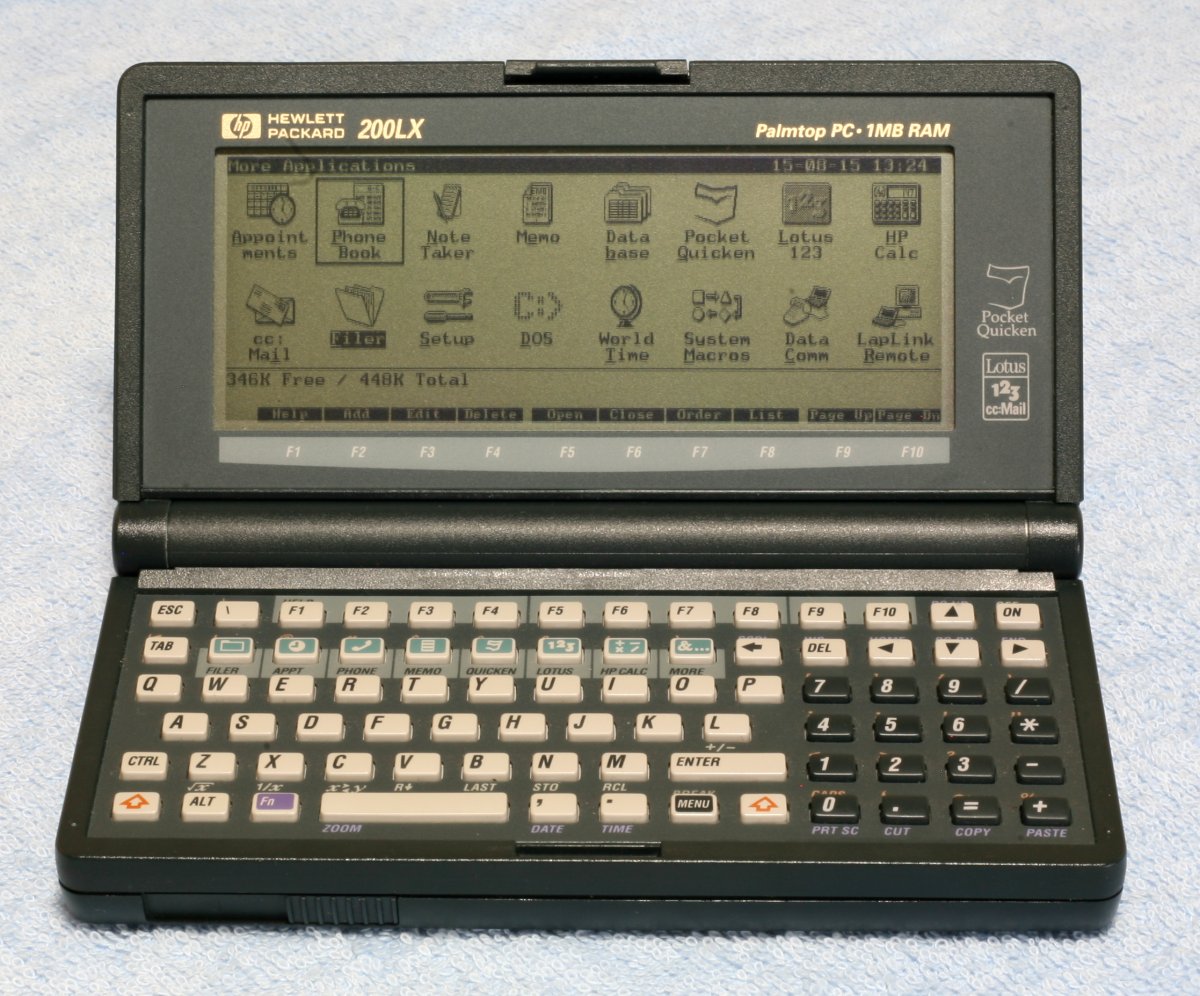
The HP 200LX Palmtop PC (F1060A, F1061A, F1216A), also known as project Felix, is a personal digital assistant introduced by Hewlett-Packard in August 1994. It was often called a Palmtop PC, and it was notable that it was, with some minor exceptions, a DOS-compatible computer in a palmtop format, complete with a monochrome graphic display, QWERTY keyboard, serial port, and PCMCIA expansion slot. The abbreviation "LX" stood for "Lotus Expandable".
Input is accomplished via a small QWERTY-keyboard with a numeric keypad, enclosed in a clamshell-style case, less than about 25% of the size of a standard notebook computer. The palmtop runs for about 30–40 hours on two size AA alkaline or Ni-Cd rechargeable cells and can charge batteries (both Ni-Cd and NiMH) via a 12 V DC wall adapter.
The HP 200LX has an Intel 80186 compatible embedded central processing unit named "Hornet", which runs at ~7.91 megahertz (which can be upgraded or overclocked to up to 15.8 MHz) and 1, 2 or 4 MB of memory, of which 640 KB is RAM and the rest can be used for expanded memory (EMS) or memory-based storage space. After-market updates can bring the memory chips to up to 64 MB, which frees the PCMCIA slot for modem or Ethernet card use. The Silicom, Accton 2212/2216, Netgear FA411, and Sohoware ND5120 network cards were compatible. Being IBM PC/XT compatible and running MS-DOS 5.0 from ROM, the HP 200LX can run virtually any program that would run on a full-size PC compatible computer as long as the code is written for the Intel 8086, 8088 or 80186 CPU and can run using CGA graphics. It can also run programs written for the 80286 CPU, provided they do not require the use of protected mode. It has a 16-bit PCMCIA Type II expansion slot that supports 5 V at 150 mA maximum, a SIR compatible infrared port and a full serial port (but with a proprietary mini connector for space constraint reasons).
The built-in software suite runs from ROM and includes the Lotus 1-2-3 Release 2.4 spreadsheet, a calendar, a phone book, a terminal, Lotus cc:Mail and a scientific/business calculator (among other applications). With a large CompactFlash storage card and a serial mouse, Microsoft Windows 3.0 can be run on the palmtop. Running Windows was limited by the hardware, and the maximum version that can be run is Windows 3.0 in Real Mode. However, Word 1.x and Excel 2.x for Windows will run (since they can run in Real Mode), allowing for the authoring of MS Office format-compatible files. The 640×200 resolution CGA compatible 4-shade gray-scale LCD screen has no back light. An electroluminescent back light installation is available from a third party since 2004, but keen eyesight is still required to use the small palmtop effectively without resorting to using its 2× and 4× zoom modes.
While true CGA displays do not allow for redefinable fonts in text mode and support a hardware code page 437, the HP 95LX supports code page 850 instead. Starting with the HP 100LX, the LX series supports user-switchable text mode ROM fonts for both code page 437 and 850 as well as software-definable RAM fonts (for codepages 437G, 437T, 852, 866 via KEYBEZ). Lotus 1-2-3 internally uses the Lotus International Character Set (LICS), but characters are translated to code page 850 for display and printing purposes.
The HP 100LX Palmtop PC (F1020A for the 1 MB, F1022A for the 2 MB model), also known as project Cougar, is the direct predecessor of the 200LX. It was released in 1993 and available in International English, U.S. English, French, German and Spanish variants with localized keyboard and messages. It is almost the same, including the Hornet CPU and MS-DOS 5.0, but with earlier built-in application versions.
The HP Palmtop FX is a variant of the HP 100LX with up to 2 MB flashable memory in 1993. FAT flash disk images could be created and written to drive F: by a special FLASHDSK.EXE utility. According to one source, it was developed for a Korean insurance company.
The HP 200LX AIA is a 2 MB double-speed variant of the HP 200LX manufactured for the insurance company American International Assurance (AIA).
Hub AI
HP 200LX AI simulator
(@HP 200LX_simulator)
HP 200LX
The HP 200LX Palmtop PC (F1060A, F1061A, F1216A), also known as project Felix, is a personal digital assistant introduced by Hewlett-Packard in August 1994. It was often called a Palmtop PC, and it was notable that it was, with some minor exceptions, a DOS-compatible computer in a palmtop format, complete with a monochrome graphic display, QWERTY keyboard, serial port, and PCMCIA expansion slot. The abbreviation "LX" stood for "Lotus Expandable".
Input is accomplished via a small QWERTY-keyboard with a numeric keypad, enclosed in a clamshell-style case, less than about 25% of the size of a standard notebook computer. The palmtop runs for about 30–40 hours on two size AA alkaline or Ni-Cd rechargeable cells and can charge batteries (both Ni-Cd and NiMH) via a 12 V DC wall adapter.
The HP 200LX has an Intel 80186 compatible embedded central processing unit named "Hornet", which runs at ~7.91 megahertz (which can be upgraded or overclocked to up to 15.8 MHz) and 1, 2 or 4 MB of memory, of which 640 KB is RAM and the rest can be used for expanded memory (EMS) or memory-based storage space. After-market updates can bring the memory chips to up to 64 MB, which frees the PCMCIA slot for modem or Ethernet card use. The Silicom, Accton 2212/2216, Netgear FA411, and Sohoware ND5120 network cards were compatible. Being IBM PC/XT compatible and running MS-DOS 5.0 from ROM, the HP 200LX can run virtually any program that would run on a full-size PC compatible computer as long as the code is written for the Intel 8086, 8088 or 80186 CPU and can run using CGA graphics. It can also run programs written for the 80286 CPU, provided they do not require the use of protected mode. It has a 16-bit PCMCIA Type II expansion slot that supports 5 V at 150 mA maximum, a SIR compatible infrared port and a full serial port (but with a proprietary mini connector for space constraint reasons).
The built-in software suite runs from ROM and includes the Lotus 1-2-3 Release 2.4 spreadsheet, a calendar, a phone book, a terminal, Lotus cc:Mail and a scientific/business calculator (among other applications). With a large CompactFlash storage card and a serial mouse, Microsoft Windows 3.0 can be run on the palmtop. Running Windows was limited by the hardware, and the maximum version that can be run is Windows 3.0 in Real Mode. However, Word 1.x and Excel 2.x for Windows will run (since they can run in Real Mode), allowing for the authoring of MS Office format-compatible files. The 640×200 resolution CGA compatible 4-shade gray-scale LCD screen has no back light. An electroluminescent back light installation is available from a third party since 2004, but keen eyesight is still required to use the small palmtop effectively without resorting to using its 2× and 4× zoom modes.
While true CGA displays do not allow for redefinable fonts in text mode and support a hardware code page 437, the HP 95LX supports code page 850 instead. Starting with the HP 100LX, the LX series supports user-switchable text mode ROM fonts for both code page 437 and 850 as well as software-definable RAM fonts (for codepages 437G, 437T, 852, 866 via KEYBEZ). Lotus 1-2-3 internally uses the Lotus International Character Set (LICS), but characters are translated to code page 850 for display and printing purposes.
The HP 100LX Palmtop PC (F1020A for the 1 MB, F1022A for the 2 MB model), also known as project Cougar, is the direct predecessor of the 200LX. It was released in 1993 and available in International English, U.S. English, French, German and Spanish variants with localized keyboard and messages. It is almost the same, including the Hornet CPU and MS-DOS 5.0, but with earlier built-in application versions.
The HP Palmtop FX is a variant of the HP 100LX with up to 2 MB flashable memory in 1993. FAT flash disk images could be created and written to drive F: by a special FLASHDSK.EXE utility. According to one source, it was developed for a Korean insurance company.
The HP 200LX AIA is a 2 MB double-speed variant of the HP 200LX manufactured for the insurance company American International Assurance (AIA).