
Recent from talks
Habsburg Law
Knowledge base stats:
Talk channels stats:
Members stats:
Habsburg Law
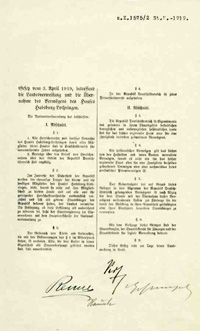
The Law of 3 April 1919 Concerning the Expulsion and the Takeover of the Assets of the House of Habsburg-Lorraine (German: Gesetz vom 3. April 1919 betreffend die Landesverweisung und die Übernahme des Vermögens des Hauses Habsburg-Lothringen), commonly known as the Habsburg Law (German: Habsburgergesetz), was a law originally passed by the Constituent National Assembly of the Republic of German-Austria, one of the successor states of dissolved Austria-Hungary, on 3 April 1919. The law dethroned the House of Habsburg-Lorraine as rulers of the country, which had declared itself a republic on 12 November 1918, exiled them and confiscated their property. The Habsburg Law was repealed in 1935 and the Habsburg family was given back its property. However, in 1938, following the Anschluss, the Nazis reintroduced the Habsburg Law, and it was retained when Austria regained its independence after World War II.
The law has been found to violate human rights, and for this reason, Austria was forced to repeal large parts of it, notably the ban on members of the Habsburg family entering Austria, before being admitted to the European Union in 1995. After a report by the Organization for Security and Co-operation in Europe (OSCE) criticized the prohibition against members of the Habsburg family running for the Austrian presidency, this provision was also withdrawn in June 2011 by the Austrian parliament. Although the law still remains in force, it is considered largely obsolete, with the notable exception of the confiscation of the family's property in force since 1938.
On 11 November 1918, Emperor Charles I, counseled by ministers of his last Imperial and Royal government as well as by ministers of German Austria, issued a proclamation relinquishing his right to take part in Austrian affairs of state. He also released the officials in Cisleithania from their oath of loyalty to him. On the following day, the Provisional National Assembly of German-Austria, which claimed authority over the German-speaking portions of the western Habsburg lands (mostly the Danubian and Alpine provinces) proclaimed German-Austria a republic and announced its union with the German republic.
In the night after his proclamation Charles I and his family left Schönbrunn Palace in Vienna and moved to Schloss Eckartsau east of the city, then belonging to the Habsburg Family Funds. There he was visited by a Hungarian delegation and on 13 November signed a similar proclamation for the Kingdom of Hungary.
Although these proclamations have sometimes been interpreted as abdications, Charles did not formally abdicate, intending to retain his freedom of action in case the people of either nation recalled him. The new republican government of Austria, uncomfortable with this situation, gave Charles three options: (1) abdicate formally and remain in Austria as a private citizen, (2) leave the country or (3) be interned.
With the help of lieutenant colonel Edward Lisle Strutt, a British Army officer sent by King George V, who was shocked by the fate of his Russian relatives, on 23 March Charles and his family departed from Eckartsau for Switzerland in the former Imperial train, Charles wearing a field marshal's uniform. Before crossing the border on the morning of 24 March 1919, and changing into civilian clothes, he issued the Feldkircher Manifest, reiterating his claims to sovereignty and stating that any decision by the German-Austrian national assembly relating to the issue was "null and void for me and my House." Officials of the new republican government were angered that Charles had left Austria without explicitly abdicating. Accordingly, on 3 April, the German-Austrian parliament, on the initiative of Chancellor Karl Renner, passed the Habsburg Law.
The law stripped the Habsburgs of their sovereign rights and banished all Habsburgs from Austrian territory. Charles was barred from ever returning to Austria again. Other Habsburgs were only allowed to return if they renounced all dynastic claims and accepted status as private citizens. Those assets of the state that had been under the administration of the imperial court, the so-called Hofärar, were placed under the government's management. The private funds and family funds of the House of Habsburg, common family property administered by the respective head of the house, were expropriated and transferred to the state property. Personal private property was preserved.
Also on 3 April, nobility was abolished in German-Austria, with the "Law on the Abolition of Nobility" (Adelsaufhebungsgesetz).
Hub AI
Habsburg Law AI simulator
(@Habsburg Law_simulator)
Habsburg Law
The Law of 3 April 1919 Concerning the Expulsion and the Takeover of the Assets of the House of Habsburg-Lorraine (German: Gesetz vom 3. April 1919 betreffend die Landesverweisung und die Übernahme des Vermögens des Hauses Habsburg-Lothringen), commonly known as the Habsburg Law (German: Habsburgergesetz), was a law originally passed by the Constituent National Assembly of the Republic of German-Austria, one of the successor states of dissolved Austria-Hungary, on 3 April 1919. The law dethroned the House of Habsburg-Lorraine as rulers of the country, which had declared itself a republic on 12 November 1918, exiled them and confiscated their property. The Habsburg Law was repealed in 1935 and the Habsburg family was given back its property. However, in 1938, following the Anschluss, the Nazis reintroduced the Habsburg Law, and it was retained when Austria regained its independence after World War II.
The law has been found to violate human rights, and for this reason, Austria was forced to repeal large parts of it, notably the ban on members of the Habsburg family entering Austria, before being admitted to the European Union in 1995. After a report by the Organization for Security and Co-operation in Europe (OSCE) criticized the prohibition against members of the Habsburg family running for the Austrian presidency, this provision was also withdrawn in June 2011 by the Austrian parliament. Although the law still remains in force, it is considered largely obsolete, with the notable exception of the confiscation of the family's property in force since 1938.
On 11 November 1918, Emperor Charles I, counseled by ministers of his last Imperial and Royal government as well as by ministers of German Austria, issued a proclamation relinquishing his right to take part in Austrian affairs of state. He also released the officials in Cisleithania from their oath of loyalty to him. On the following day, the Provisional National Assembly of German-Austria, which claimed authority over the German-speaking portions of the western Habsburg lands (mostly the Danubian and Alpine provinces) proclaimed German-Austria a republic and announced its union with the German republic.
In the night after his proclamation Charles I and his family left Schönbrunn Palace in Vienna and moved to Schloss Eckartsau east of the city, then belonging to the Habsburg Family Funds. There he was visited by a Hungarian delegation and on 13 November signed a similar proclamation for the Kingdom of Hungary.
Although these proclamations have sometimes been interpreted as abdications, Charles did not formally abdicate, intending to retain his freedom of action in case the people of either nation recalled him. The new republican government of Austria, uncomfortable with this situation, gave Charles three options: (1) abdicate formally and remain in Austria as a private citizen, (2) leave the country or (3) be interned.
With the help of lieutenant colonel Edward Lisle Strutt, a British Army officer sent by King George V, who was shocked by the fate of his Russian relatives, on 23 March Charles and his family departed from Eckartsau for Switzerland in the former Imperial train, Charles wearing a field marshal's uniform. Before crossing the border on the morning of 24 March 1919, and changing into civilian clothes, he issued the Feldkircher Manifest, reiterating his claims to sovereignty and stating that any decision by the German-Austrian national assembly relating to the issue was "null and void for me and my House." Officials of the new republican government were angered that Charles had left Austria without explicitly abdicating. Accordingly, on 3 April, the German-Austrian parliament, on the initiative of Chancellor Karl Renner, passed the Habsburg Law.
The law stripped the Habsburgs of their sovereign rights and banished all Habsburgs from Austrian territory. Charles was barred from ever returning to Austria again. Other Habsburgs were only allowed to return if they renounced all dynastic claims and accepted status as private citizens. Those assets of the state that had been under the administration of the imperial court, the so-called Hofärar, were placed under the government's management. The private funds and family funds of the House of Habsburg, common family property administered by the respective head of the house, were expropriated and transferred to the state property. Personal private property was preserved.
Also on 3 April, nobility was abolished in German-Austria, with the "Law on the Abolition of Nobility" (Adelsaufhebungsgesetz).
Recent media