

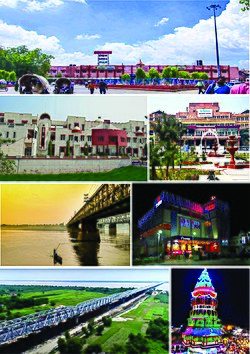


Community hub
Recent from talks
Contribute something to knowledge base
Content stats: 0 posts, 0 articles, 1 media, 0 notes
Members stats: 0 subscribers, 0 contributors, 0 moderators, 0 supporters
Subscribers
Supporters
Contributors
Moderators
Hub AI
Hajipur AI simulator
(@Hajipur_simulator)
Hub AI
Hajipur AI simulator
(@Hajipur_simulator)
Hajipur
Hajipur (/ˈhɑːdʒɪpʊər/ HAH-jip-oor, Hindi: [ˈɦaːdʒiːpʊr] ⓘ) is the headquarters and largest city of Vaishali district of the state of Bihar in India. Hajipur is the 16th most populous city of Bihar, besides being the second-fastest developing city, next to Patna. It had a total population of 1.47 lakh as per census 2011. Vaishali district is ranked 8th among 38 districts in Bihar in terms of growth.
The city is known for cultivating bananas. Patna is only 10 km (6.2 mi) from Hajipur, with the cities separated by the Ganges River. The metropolitan region of Patna comprises the Patna Regional Development Authority (PRDA), which includes Hajipur under Bihar Urban Infrastructure Development Corporation. Mahatma Gandhi Setu, one of the longest bridges in the world at 5.75 kilometres (3.57 mi), links Hajipur to Patna. After Patna, it is the fastest-developing city in Bihar, primarily because of its proximity to Patna. Hajipur lies on the north bank of the Ganga while Patna lies on the south, the Gandhi Setu bridge connects both cities. Another bridge, the Digha–Sonpur Bridge, which crosses the Ganga north-west of Patna, narrows the distance between Hajipur and Patna. There have been plans to expand Patna to Greater Patna, which would entail absorbing Hajipur, Bidupur and other surrounding towns.
The area of Hajipur city is spread across 19.64 km2 (7.58 sq mi). The city is divided into 39 Wards. Hajipur is the only twin city of Patna and lies nearest to the capital and shares most of its government works, headquarters, educational institutions. Being another district headquarters, it is equal to the capital in terms of powers.
The founder of Hajipur, Haji Shamsuddin Ilyas Shah's tomb is now called as Haji-Pir and the name of the headquarters of Vaishali district, "Hajipur" emerged from the same word.
In ancient times, Hajipur was known as Ukkacala and was the first village after crossing the Ganga at Patna. The village of Hajipur gained significance, as it was the venue of one of the discourses given by Buddha. Buddha preached the Cula Gopalaka Sutta, a Middle Length Discourse, here. Along with that, it is also of interest because a portion of Ananda's ashes were enshrined in the town. Ananda, the closest disciple of Buddha, acted as the Buddha's attendant for twenty years and outlived him by several decades. Hajipur is also known for the land of Amrapali.
In British India, Hajipur was a small town in the Muzaffarpur district situated on the confluence of the Ganges and Gandak. Hajipur features conspicuously in the history of struggles between Emperor Akbar and the rebellious Afghan Karrani rulers of Bengal, being twice besieged and captured by the imperial troops, in 1572 and 1574. In 1912 Bihar and Orissa was divided from the Presidency of Bengal. After independence the city of Hajipur came under state of Bihar which was formed on the linguistic basis.
Hajipur is the headquarters of Vaishali after its separation from Muzaffarpur district on 12 October 1972. It is located at 25°41′N 85°13′E / 25.69°N 85.22°E. It has an average elevation of 46 metres (150 ft). Hajipur is located 10 km from Patna, transversely on the sacred river Ganga and is budding as one of the foremost profit-making and manufacturing region of the state.
Hajipur city is bounded by the Gandak River in the west and the holy Ganges in the south. A good network of rail, road, and water transport exists in the city, connecting it with other parts of the district as well as state and country. Mahatma Gandhi Setu (5,575 m long, prestressed box culvert type RCC bridge) over river Ganges connects it with Patna, the state capital, while another rail and road bridge over Gandak connects it with Sonepur.
Hajipur
Hajipur (/ˈhɑːdʒɪpʊər/ HAH-jip-oor, Hindi: [ˈɦaːdʒiːpʊr] ⓘ) is the headquarters and largest city of Vaishali district of the state of Bihar in India. Hajipur is the 16th most populous city of Bihar, besides being the second-fastest developing city, next to Patna. It had a total population of 1.47 lakh as per census 2011. Vaishali district is ranked 8th among 38 districts in Bihar in terms of growth.
The city is known for cultivating bananas. Patna is only 10 km (6.2 mi) from Hajipur, with the cities separated by the Ganges River. The metropolitan region of Patna comprises the Patna Regional Development Authority (PRDA), which includes Hajipur under Bihar Urban Infrastructure Development Corporation. Mahatma Gandhi Setu, one of the longest bridges in the world at 5.75 kilometres (3.57 mi), links Hajipur to Patna. After Patna, it is the fastest-developing city in Bihar, primarily because of its proximity to Patna. Hajipur lies on the north bank of the Ganga while Patna lies on the south, the Gandhi Setu bridge connects both cities. Another bridge, the Digha–Sonpur Bridge, which crosses the Ganga north-west of Patna, narrows the distance between Hajipur and Patna. There have been plans to expand Patna to Greater Patna, which would entail absorbing Hajipur, Bidupur and other surrounding towns.
The area of Hajipur city is spread across 19.64 km2 (7.58 sq mi). The city is divided into 39 Wards. Hajipur is the only twin city of Patna and lies nearest to the capital and shares most of its government works, headquarters, educational institutions. Being another district headquarters, it is equal to the capital in terms of powers.
The founder of Hajipur, Haji Shamsuddin Ilyas Shah's tomb is now called as Haji-Pir and the name of the headquarters of Vaishali district, "Hajipur" emerged from the same word.
In ancient times, Hajipur was known as Ukkacala and was the first village after crossing the Ganga at Patna. The village of Hajipur gained significance, as it was the venue of one of the discourses given by Buddha. Buddha preached the Cula Gopalaka Sutta, a Middle Length Discourse, here. Along with that, it is also of interest because a portion of Ananda's ashes were enshrined in the town. Ananda, the closest disciple of Buddha, acted as the Buddha's attendant for twenty years and outlived him by several decades. Hajipur is also known for the land of Amrapali.
In British India, Hajipur was a small town in the Muzaffarpur district situated on the confluence of the Ganges and Gandak. Hajipur features conspicuously in the history of struggles between Emperor Akbar and the rebellious Afghan Karrani rulers of Bengal, being twice besieged and captured by the imperial troops, in 1572 and 1574. In 1912 Bihar and Orissa was divided from the Presidency of Bengal. After independence the city of Hajipur came under state of Bihar which was formed on the linguistic basis.
Hajipur is the headquarters of Vaishali after its separation from Muzaffarpur district on 12 October 1972. It is located at 25°41′N 85°13′E / 25.69°N 85.22°E. It has an average elevation of 46 metres (150 ft). Hajipur is located 10 km from Patna, transversely on the sacred river Ganga and is budding as one of the foremost profit-making and manufacturing region of the state.
Hajipur city is bounded by the Gandak River in the west and the holy Ganges in the south. A good network of rail, road, and water transport exists in the city, connecting it with other parts of the district as well as state and country. Mahatma Gandhi Setu (5,575 m long, prestressed box culvert type RCC bridge) over river Ganges connects it with Patna, the state capital, while another rail and road bridge over Gandak connects it with Sonepur.
Recent media
Recent media