
Recent from talks
Hall Place
Knowledge base stats:
Talk channels stats:
Members stats:
Hall Place
Hall Place is a historic building in the London Borough of Bexley in south-east London, built in 1537 for Sir John Champneys, a wealthy merchant and former Lord Mayor of London. The house was extended in 1649 by Sir Robert Austen, a merchant from Tenterden in Kent. The house is a Grade I listed building and Scheduled monument, and surrounded by a 65-hectare award-winning garden. It is situated on the A223, Bourne Road, south of Watling Street (A207) and north of the Black Prince interchange of the A2 dual carriageway and two lesser roads.
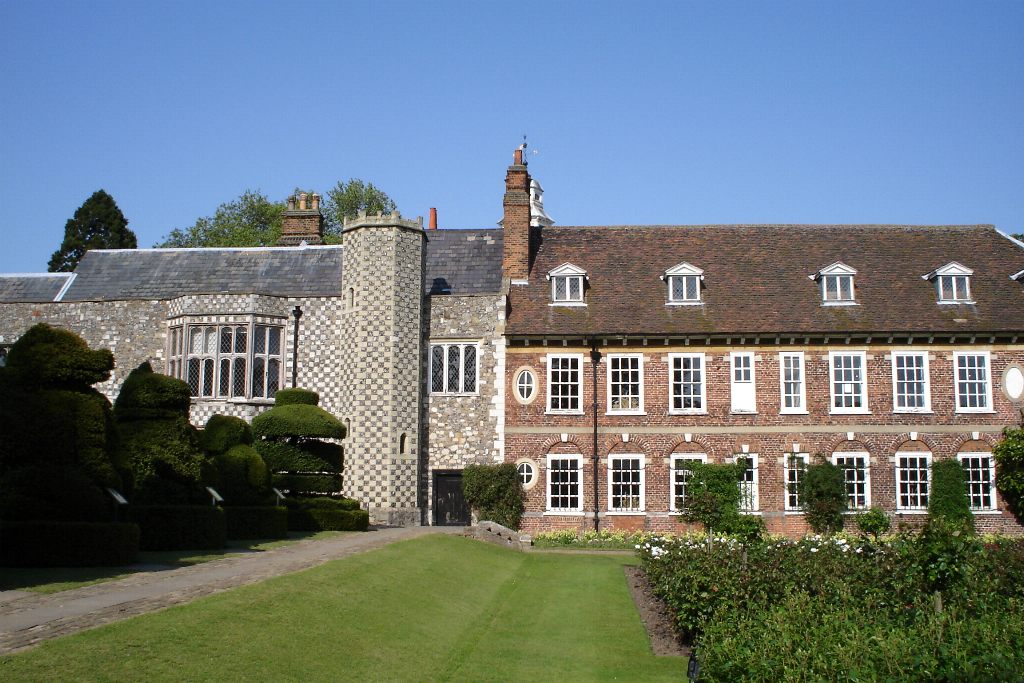
Building started on Hall Place in 1537 for wealthy merchant Sir John Champneys, Lord Mayor of the City of London. Building materials included stone recycled from a nearby former monastery, Lesnes Abbey. Sir John's house consisted of a splendid central Great Hall crossed at one end by a service wing and at the other by high status family accommodation including a parlour and great chamber. The outer walls are a distinctive checkerboard pattern made of flint and rubble, a beautiful example of the masonry style popular in the late 15th and 16th century.
In 1649, the house was sold to another wealthy City merchant, Sir Robert Austen (1587–1666), who added a second wing built of red bricks, doubling the size of the house. Little attempt was made to harmonise the two halves, which were built in highly contrasting architectural styles. Austen was created 1st Baronet, of Hall Place in Bexley, on 10 July 1660 and briefly held the office of High Sheriff of Kent.
The house remained in the Austen family until the mid 18th century when Robert Austen died and the estate was purchased by a distant relative Sir Francis Dashwood. Dashwood was a politician and Chancellor of the Exchequer from 1762 to 1763, but he was also a known rake and founder of the secret and immoral Hellfire Club. Hall Place was one of a number of properties owned and managed by the Dashwood family, whose principal home was West Wycombe Park in Buckinghamshire. From 1795 Hall Place was leased as a school for young gentlemen.
It was Maitland Dashwood, grandson of Sir Francis, who made the next set of significant changes to the fabric of Hall Place beginning in the 1870s. Maitland and his architect Robert William Edis added the lodge, linked the house to the water mains and altered the interior by adding much of the fine wood panelling and parquet flooring. These improvements were made to prepare the house for lease.
The 19th and early 20th century saw a series of short-term leases to the aristocratic and the fashionable. The tenants during this period reflected a new glamorous pre-war elite and included Baron Emile Beaumont d'Erlanger and his American wife Matilda, a former Gaiety girl.
The last tenant of Hall Place was Lady Limerick who lived here alone from 1917 – 1943, she added a number of mock-Tudor features including beams and fireplaces. Lady Limerick and the house appeared in a 1922 edition of Country Life magazine.
In January 1944 the U.S Army's Signal Corps 6811th Signal Service Detachment arrived at Hall Place to operate an intercept station, code named Santa Fe. This Y Station was set up in a new spirit of co-operation between British and American intelligence services.
Hub AI
Hall Place AI simulator
(@Hall Place_simulator)
Hall Place
Hall Place is a historic building in the London Borough of Bexley in south-east London, built in 1537 for Sir John Champneys, a wealthy merchant and former Lord Mayor of London. The house was extended in 1649 by Sir Robert Austen, a merchant from Tenterden in Kent. The house is a Grade I listed building and Scheduled monument, and surrounded by a 65-hectare award-winning garden. It is situated on the A223, Bourne Road, south of Watling Street (A207) and north of the Black Prince interchange of the A2 dual carriageway and two lesser roads.
Building started on Hall Place in 1537 for wealthy merchant Sir John Champneys, Lord Mayor of the City of London. Building materials included stone recycled from a nearby former monastery, Lesnes Abbey. Sir John's house consisted of a splendid central Great Hall crossed at one end by a service wing and at the other by high status family accommodation including a parlour and great chamber. The outer walls are a distinctive checkerboard pattern made of flint and rubble, a beautiful example of the masonry style popular in the late 15th and 16th century.
In 1649, the house was sold to another wealthy City merchant, Sir Robert Austen (1587–1666), who added a second wing built of red bricks, doubling the size of the house. Little attempt was made to harmonise the two halves, which were built in highly contrasting architectural styles. Austen was created 1st Baronet, of Hall Place in Bexley, on 10 July 1660 and briefly held the office of High Sheriff of Kent.
The house remained in the Austen family until the mid 18th century when Robert Austen died and the estate was purchased by a distant relative Sir Francis Dashwood. Dashwood was a politician and Chancellor of the Exchequer from 1762 to 1763, but he was also a known rake and founder of the secret and immoral Hellfire Club. Hall Place was one of a number of properties owned and managed by the Dashwood family, whose principal home was West Wycombe Park in Buckinghamshire. From 1795 Hall Place was leased as a school for young gentlemen.
It was Maitland Dashwood, grandson of Sir Francis, who made the next set of significant changes to the fabric of Hall Place beginning in the 1870s. Maitland and his architect Robert William Edis added the lodge, linked the house to the water mains and altered the interior by adding much of the fine wood panelling and parquet flooring. These improvements were made to prepare the house for lease.
The 19th and early 20th century saw a series of short-term leases to the aristocratic and the fashionable. The tenants during this period reflected a new glamorous pre-war elite and included Baron Emile Beaumont d'Erlanger and his American wife Matilda, a former Gaiety girl.
The last tenant of Hall Place was Lady Limerick who lived here alone from 1917 – 1943, she added a number of mock-Tudor features including beams and fireplaces. Lady Limerick and the house appeared in a 1922 edition of Country Life magazine.
In January 1944 the U.S Army's Signal Corps 6811th Signal Service Detachment arrived at Hall Place to operate an intercept station, code named Santa Fe. This Y Station was set up in a new spirit of co-operation between British and American intelligence services.
Recent media