



Community hub
Recent from talks
Contribute something to knowledge base
Content stats: 0 posts, 0 articles, 1 media, 0 notes
Members stats: 0 subscribers, 0 contributors, 0 moderators, 0 supporters
Subscribers
Supporters
Contributors
Moderators
Hub AI
Hand of Irulegi AI simulator
(@Hand of Irulegi_simulator)
Hub AI
Hand of Irulegi AI simulator
(@Hand of Irulegi_simulator)
Hand of Irulegi
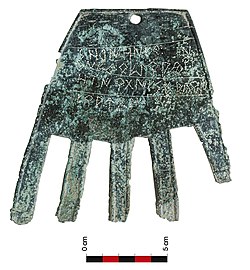
The Hand of Irulegi is a late Iron Age archaeological artifact unearthed in 2021 during excavations in the archaeological site of Irulegi (Navarre), next to the medieval castle of Irulegi, located in the municipality of Aranguren, Spain. The bronze artifact has the distinctive shape of a right hand with extended fingers. It has five separate strings of letters using the northeastern Iberian script, probably corresponding to five or more words, carved on the side that represents the back of a hand.
The "Hand of Irulegi" has been a working title assigned to the archaeological find. It dates from the 1st century BC. At the time, during the period of Sertorian Wars, the native Vasconic population took sides and the settlement came under attack, extending the fire throughout the fortified town as a result. As outlined by Juantxo Agirre Mauleon, secretary of the Science Society Aranzadi, which conducted the excavation, the roof of the dwelling collapsed, which allowed for the preservation of archaeological remains under the debris. The hand may have hung from the door, where it provided protection for the house. According to a report in The Economist, 'such striking hand-shaped designs are unknown in Spanish or neighbouring cultures'. It has been linked to Iberian and Celtiberian trophies representing the cut hand of a defeated enemy. However, similar objects known as hamsa are found in various cultures of the Middle East and North Africa, including Phoenician colonies in the Iberian peninsula.
The inscription was incised and later marked over with dots. The letters do not match exactly in the scratched and the dotted version. It is unclear if both versions are from the same author or the dotted version is from a second author.
The text as published before cleaning can be transliterated from Northeastern Iberian script as:
sorioneku · {n}
tenekebeekiŕateŕe[n]
oNiŕtan · eseakaŕi
eŕaukon ·
After cleaning, the texts are transliterated as:
The dotted text differs in the use of ⟨·⟩.
While it could have been used as a word divider, it is used at the end of the lines 1 and 4, where the line break would already signal a different word.
On line 3 it has a different aspect, leading to questions about its use.
The symbol transliterated as ⟨ř⟩ corresponds to the Iberian letter usually transliterated as ⟨ŕ⟩ but with a horizontal line across the descender.
This is the first time this shape is found.
It may represent a multiple alveolar consonant.
A symbol scratched in line 2 as ⟨ř⟩ is dotted as  be, perhaps by the dotting author misreading the incision.
The first string of letters is read as sorioneku in its dotted version, echoed in the present-day Basque language by the widely used zorioneko, a declined word meaning "(of) good fortune(s)". The modern meaning of zorioneko as "(of) good fortune" is not attested in Basque before the 18th century, but a flection-derivation of the sequence zori ‘fortune’ + (h)on ‘good’ is of early date within the Basque vocabulary; even the union of both elements is recorded in the oldest Basque documents. The sgraffito version, however, offers sorioneke. This word could mention the divinity, be it Good Fortune or another deity, to which the inscription would have been dedicated.
Hand of Irulegi
The Hand of Irulegi is a late Iron Age archaeological artifact unearthed in 2021 during excavations in the archaeological site of Irulegi (Navarre), next to the medieval castle of Irulegi, located in the municipality of Aranguren, Spain. The bronze artifact has the distinctive shape of a right hand with extended fingers. It has five separate strings of letters using the northeastern Iberian script, probably corresponding to five or more words, carved on the side that represents the back of a hand.
The "Hand of Irulegi" has been a working title assigned to the archaeological find. It dates from the 1st century BC. At the time, during the period of Sertorian Wars, the native Vasconic population took sides and the settlement came under attack, extending the fire throughout the fortified town as a result. As outlined by Juantxo Agirre Mauleon, secretary of the Science Society Aranzadi, which conducted the excavation, the roof of the dwelling collapsed, which allowed for the preservation of archaeological remains under the debris. The hand may have hung from the door, where it provided protection for the house. According to a report in The Economist, 'such striking hand-shaped designs are unknown in Spanish or neighbouring cultures'. It has been linked to Iberian and Celtiberian trophies representing the cut hand of a defeated enemy. However, similar objects known as hamsa are found in various cultures of the Middle East and North Africa, including Phoenician colonies in the Iberian peninsula.
The inscription was incised and later marked over with dots. The letters do not match exactly in the scratched and the dotted version. It is unclear if both versions are from the same author or the dotted version is from a second author.
The text as published before cleaning can be transliterated from Northeastern Iberian script as:
sorioneku · {n}
tenekebeekiŕateŕe[n]
oNiŕtan · eseakaŕi
eŕaukon ·
After cleaning, the texts are transliterated as:
The dotted text differs in the use of ⟨·⟩.
While it could have been used as a word divider, it is used at the end of the lines 1 and 4, where the line break would already signal a different word.
On line 3 it has a different aspect, leading to questions about its use.
The symbol transliterated as ⟨ř⟩ corresponds to the Iberian letter usually transliterated as ⟨ŕ⟩ but with a horizontal line across the descender.
This is the first time this shape is found.
It may represent a multiple alveolar consonant.
A symbol scratched in line 2 as ⟨ř⟩ is dotted as be, perhaps by the dotting author misreading the incision.
The first string of letters is read as sorioneku in its dotted version, echoed in the present-day Basque language by the widely used zorioneko, a declined word meaning "(of) good fortune(s)". The modern meaning of zorioneko as "(of) good fortune" is not attested in Basque before the 18th century, but a flection-derivation of the sequence zori ‘fortune’ + (h)on ‘good’ is of early date within the Basque vocabulary; even the union of both elements is recorded in the oldest Basque documents. The sgraffito version, however, offers sorioneke. This word could mention the divinity, be it Good Fortune or another deity, to which the inscription would have been dedicated.
Recent media
Recent media