


Community hub
Recent from talks
Contribute something
Nothing was collected or created yet.
Basque language
View on Wikipedia | This article has an unclear citation style. (September 2025) |
| Basque | ||||
|---|---|---|---|---|
| euskara | ||||
| Pronunciation | IPA: [eus̺ˈkaɾa] | |||
| Native to | France, Spain | |||
| Region | Basque Country | |||
| Ethnicity | Basque | |||
Native speakers | 806,000 (2021)[1] 434,000 passive speakers[2] | |||
Early forms | ||||
| Dialects | ||||
| Official status | ||||
Official language in | Spain | |||
| Regulated by | Euskaltzaindia | |||
| Language codes | ||||
| ISO 639-1 | eu | |||
| ISO 639-2 | baq (B) eus (T) | |||
| ISO 639-3 | eus | |||
| Glottolog | basq1248 | |||
| Linguasphere | 40-AAA-a | |||
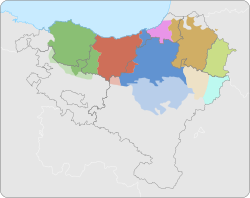
 Dialect areas of Basque. Light-coloured dialects are extinct. See § Dialects | ||||
.svg) Basque speakers, including second-language speakers[3]
| ||||
| Person | Basque (Euskaldun) |
|---|---|
| People | Basques (Euskaldunak) |
| Language | Basque (Euskara) |
| Culture of Basque Country |
|---|
 |
| Mythology |
| Literature |
.JPG)


Basque (/ˈbæsk, ˈbɑːsk/ BASK, BAHSK;[4] euskara [eus̺ˈkaɾa]) is a language spoken by Basques and other residents of the Basque Country, a region that straddles the westernmost Pyrenees in adjacent parts of southwestern France and northern Spain. Basque is classified as a language isolate (unrelated to any other known languages), the only one in Europe. The Basques are indigenous to and primarily inhabit the Basque Country.[5] The Basque language is spoken by 806,000 Basques in all territories. Of them, 93.7% (756,000) are in the Spanish area of the Basque Country and the remaining 6.3% (51,000) are in the French portion.[1]
Native speakers live in a contiguous area that includes parts of four Spanish provinces and the three "ancient provinces" in France. Gipuzkoa, most of Biscay, a few municipalities on the northern border of Álava and the northern area of Navarre formed the core of the remaining Basque-speaking area before measures were introduced in the 1980s to strengthen Basque fluency. By contrast, most of Álava, the westernmost part of Biscay, and central and southern Navarre are predominantly populated by native speakers of Spanish, either because Basque was replaced by either Navarro-Aragonese or Spanish over the centuries (as in most of Álava and central Navarre), or because it may never have been spoken there (as in parts of Enkarterri and south-eastern Navarre).
In Francoist Spain, Basque language use was discouraged by the government's repressive policies. In the Basque Country, "Francoist repression was not only political, but also linguistic and cultural."[6] Franco's regime suppressed Basque from official discourse, education, and publishing,[7] making it illegal to register newborn babies under Basque names,[8] and even requiring tombstone engravings in Basque to be removed.[9] In some provinces the public use of Basque was suppressed, with people fined for speaking it.[10] Public use of Basque was frowned upon by supporters of the regime, often regarded as a sign of anti-Francoism or separatism.[11] In the 1960s and later, the trend reversed and education and publishing in Basque began to flourish.[12] As a part of this process, a standardised form of the Basque language, called Euskara Batua, was developed by the Euskaltzaindia in the late 1960s.
Besides its standardised version, the five historic Basque dialects are Biscayan, Gipuzkoan, and Upper Navarrese in Spain and Navarrese–Lapurdian and Souletin in France. They take their names from the historic Basque provinces, but the dialect boundaries are not congruent with province boundaries. Euskara Batua was created so that the Basque language could be used—and easily understood by all Basque speakers—in formal situations (education, mass media, literature), and this is its main use today. In both Spain and France, the use of Basque for education varies from region to region and from school to school.[13]
Basque is the only surviving Paleo-European language in Europe. The current mainstream scientific view on the origin of the Basques and of their language is that early forms of Basque developed before the arrival of Indo-European languages in the area, i.e. before the arrival of Celtic, and Romance languages in particular, as the latter today geographically surround the Basque-speaking region. Typologically, with its agglutinative morphology and ergative–absolutive alignment, Basque grammar remains markedly different from that of Standard Average European languages. Nevertheless, Basque has borrowed up to 40 percent of its vocabulary from Romance languages,[14] and the Latin script is used for the Basque alphabet.
Names of the language
[edit]In Basque, the name of the language is officially euskara (alongside various dialect forms).
In French, the language is normally called basque though euskara has become common in recent times. Spanish has a greater variety of names for the language. Today, it is most commonly referred to as vasco, lengua vasca, or euskera. Both terms, vasco and basque, are inherited from the Latin ethnonym Vascones, which in turn goes back to the Greek term Οὐάσκωνες (ouáskōnes), an ethnonym used by Strabo in his Geographica (23 CE, Book III).[15]
The Spanish term vascuence, derived from Latin vasconĭce,[16] has acquired negative connotations over the centuries and is not well-liked amongst Basque speakers generally. Its use is documented at least as far back as the 14th century when a law passed in Huesca in 1349 stated that Item nuyl corridor nonsia usado que faga mercadería ninguna que compre nin venda entre ningunas personas, faulando en algaravia nin en abraych nin en basquenç: et qui lo fara pague por coto XXX sol—essentially penalising the use of Arabic, Hebrew, or Basque in marketplaces with a fine of 30 sols (the equivalent of 30 sheep).[17]
History and classification
[edit]Despite the Basque language being geographically surrounded by Romance languages, it is a language isolate that is unrelated to them or to any other living language. Most scholars believe Basque to be the last remaining descendant of one of the pre-Indo-European languages of prehistoric Europe.[15] Consequently, it may be impossible to reconstruct the prehistory of the Basque language by the traditional comparative method except by applying it to differences between Basque dialects. Little is known of its origins, but it is likely that an early form of the Basque language was present in and around the area of modern Basque Country before the arrival of the Indo-European languages in western Europe during the 3rd millennium BC.
Authors such as Miguel de Unamuno and Louis Lucien Bonaparte have noted that the words for "knife" (aizto), "axe" (aizkora), and "hoe" (aitzur) appear to derive from the word for "stone" (haitz), and have therefore concluded that the language dates to prehistoric Europe when those tools were made of stone.[18][19] Others find this theory unlikely.
Latin inscriptions in Gallia Aquitania preserve a number of words with cognates in the reconstructed proto-Basque language, for instance, the personal names Nescato and Cison (neskato and gizon mean 'young girl' and 'man', respectively in modern Basque). This language is generally referred to as Aquitanian and is assumed to have been spoken in the area before the Roman Republic's conquests in the western Pyrenees. Some authors even argue for late Basquisation, that the language moved westward during Late Antiquity after the fall of the Western Roman Empire into the northern part of Hispania into what is now the Basque Country.[15]
Roman neglect of this area allowed Aquitanian to survive while the Iberian and Tartessian languages became extinct. Through the long contact with Romance languages, Basque adopted a sizeable number of Romance words. Initially the source was Latin, later Gascon (a branch of Occitan) in the north-east, Navarro-Aragonese in the south-east and Spanish in the south-west.
Since 1968, Basque has been immersed in a revitalisation process, facing formidable obstacles. However, significant progress has been made in numerous areas. Six main factors have been identified to explain its relative success:
- implementation and acceptance of Unified Basque (Batua),
- integration of Basque in the education system
- creation of media in Basque (radio, newspapers, and television)
- the established new legal framework
- collaboration between public institutions and people's organisations, and
- campaigns for Basque language literacy.[20]
While those six factors influenced the revitalisation process, the extensive development and use of language technologies is also considered a significant additional factor.[21]
Hypotheses concerning Basque's connections to other languages
[edit]Many linguists have tried to link Basque with other languages, but no hypothesis has gained mainstream acceptance. Apart from pseudoscientific comparisons, the appearance of long-range linguistics gave rise to several attempts to connect Basque with geographically very distant language families such as Georgian. Historical work on Basque is challenging since written material and documentation has been available only for some few hundred years. Almost all hypotheses concerning the origin of Basque are controversial, and the suggested evidence is not generally accepted by mainstream linguists. Some of these hypothetical connections are:

- Ligurian substrate: this hypothesis, proposed in the 19th century by d'Arbois de Jubainville, J. Pokorny, P. Kretschmer and several other linguists, encompasses the Basco-Iberian hypothesis.
- Iberian: another ancient language once spoken in the Iberian Peninsula, shows several similarities with Aquitanian and Basque. However, most scholars say that there is not enough evidence to distinguish geographical connections from linguistic ones. Iberian itself remains unclassified. Eduardo Orduña Aznar claims to have established correspondences between Basque and Iberian numerals[22] and noun case markers. Other scholars have also claimed to identify a similarity between Iberian and Basque.[23]
- Vasconic substratum hypothesis: this proposal, made by the German linguist Theo Vennemann, claims that enough toponymical evidence exists to conclude that Basque is the only survivor of a larger family that once extended throughout most of western Europe, and has also left its mark in modern Indo-European languages spoken in Europe.
- Georgian: linking Basque to the Kartvelian languages is now widely discredited. The hypothesis was inspired by the existence of the ancient Kingdom of Iberia in the Caucasus and some similarities in societal practices and agriculture between the two populations. Historical comparisons are difficult due to the dearth of historical material for Basque and several of the Kartvelian languages. Typological similarities have been proposed for some of the phonological characteristics and most importantly for some of the details of the ergative constructions, but they alone cannot prove historical relatedness between languages since such characteristics are found in other languages across the world, even if not in Indo-European.[24][25] According to J. P. Mallory, the hypothesis was also inspired by a Basque place-name ending in -dze which is common in Kartvelian.[26] The hypothesis suggested that Basque and Georgian were remnants of a pre-Indo-European group.
- Northeast Caucasian languages, such as Chechen, are seen by some linguists as more likely candidates for a very distant connection.[27]
- Dené–Caucasian: based on the possible Caucasian link, some linguists, for example John Bengtson and Merritt Ruhlen, have proposed including Basque in the Dené–Caucasian superfamily of languages, but the proposed superfamily includes languages from North America and Eurasia, and its existence is highly controversial.[15]
- Indo-European: a genetic link between Basque and the Indo-European languages has been proposed by Forni (2013),[28][29] Blevins (2018),[30] though their contributions to the hypothesis have been rejected by most reviewers,[31][32][33][34][35][36] both including scholars adhering to the mainstream view of Basque as a language isolate (Gorrochategui, Lakarra) and proponents of wide-range genetic relations (Bengtson).
Geographic distribution
[edit]


The region where Basque is spoken has become smaller over centuries, especially at the northern, southern, and eastern borders. Nothing is known about the limits of the region in ancient times but on the basis of toponyms and epigraphs, it seems that in the beginning of the Common Era it stretched to the river Garonne in the north (including the south-western part of present-day France); at least to the Val d'Aran in the east (now a Gascon-speaking part of Catalonia), including lands on both sides of the Pyrenees;[37] the southern and western boundaries are not clear at all.
The Reconquista temporarily counteracted that contracting tendency when the Christian lords called on northern Iberian peoples (Basques, Asturians, and "Franks") to colonise the new conquests.
By the 16th century, the Basque-speaking area was reduced basically to the present-day seven provinces of the Basque Country, excluding the southern part of Navarre, the south-western part of Álava, and the western part of Biscay, and including some parts of Béarn.[38]
In 1807, Basque was still spoken in the northern half of Álava—including its capital city Vitoria-Gasteiz[39]—and a vast area in central Navarre, but in those two provinces, Basque experienced a rapid decline that pushed its border northwards. In the French Basque Country, Basque was still spoken in all the territory except in Bayonne and some villages around, and including some bordering towns in Béarn.
In the 20th century, however, the rise of Basque nationalism spurred increased interest in the language as a sign of ethnic identity, and with the establishment of autonomous governments in the Southern Basque Country, it has recently made a modest comeback. In the Spanish part, Basque-language schools for children and Basque-teaching centres for adults have brought the language to areas such as western Enkarterri and the Ribera del Ebro in southern Navarre, where it is not known to ever have been widely spoken; and in the French Basque Country, those schools and centres have almost stopped the decline of the language.
Official status
[edit]
Historically, Latin or Romance languages have been the official languages in the region. However, Basque was explicitly recognised in some areas. For instance, the fuero or charter of the Basque-colonised Ojacastro (now in La Rioja) allowed the inhabitants to use Basque in legal processes in the 13th and 14th centuries. Basque was allowed in telegraph messages in Spain thanks to the royal decree of 1904.[40]
The Spanish Constitution of 1978 states in Article 3 that the Spanish language is the official language of the nation, but allows autonomous communities to provide a co-official language status for the other languages of Spain.[41] Consequently, the Statute of Autonomy of the Basque Autonomous Community establishes Basque as the co-official language of the autonomous community. The Statute of Navarre establishes Spanish as the official language of Navarre, but grants co-official status to the Basque language in the Basque-speaking areas of northern Navarre. Basque has no official status in the French Basque Country and French citizens are barred from officially using Basque in a French court of law. However, the use of Basque by Spanish nationals in French courts is permitted (with translation), as Basque is officially recognised on the other side of the border.
The positions of the various existing governments differ with regard to the promotion of Basque in areas where Basque is commonly spoken. The language has official status in those territories that are within the Basque Autonomous Community, where it is spoken and promoted heavily but only partially in Navarre. The Ley del Vascuence ('Law of Basque'), seen as contentious by many Basques, but considered fitting Navarra's linguistic and cultural diversity by some of the main political parties of Navarre,[42] divides Navarre into three language areas: Basque-speaking, non-Basque-speaking, and mixed. Support for the language and the linguistic rights of citizens vary, depending on the area. Others consider it unfair, since the rights of Basque speakers differ greatly depending on the place they live.
Demographics
[edit]

The 2021 sociolinguistic survey of all Basque-speaking territories showed that, of all people aged 16 and above:[1]
- In the Basque Autonomous Community, 36.2% were fluent Basque speakers, 18.5% passive speakers and 45.3% did not speak Basque. The percentage was highest in Gipuzkoa (51.8% speakers) and Bizkaia (30.6%) and lowest in Álava (22.4%). Those results represent an increase from previous years (33.9% in 2016, 30.1% in 2006, 29.5% in 2001, 27.7% in 1996 and 24.1% in 1991). The highest concentration of speakers can now be found in the 16–24 age range (74.5%) vs. 22.0% in the 65+ age range.
- In the French Basque Country, in 2021, 20.0% were fluent Basque speakers. Because the French Basque Country is not under the influence of the Basque Autonomous Country government, people in the region have fewer incentives from government authorities to learn the language. As such, those results represent another decrease from previous years (22.5% in 2006, 24.8% in 2001 and 26.4 in 1996 or 56,146 in 1996 to 51,197 in 2016). However, for those in the 16-24 age range, the proportion of Basque speakers increased to 21.5%, from 12.2% 20 years earlier.
- In Navarre, 14.1% were fluent Basque speakers, 10.5% passive speakers, and 75.4% did not speak Basque. The percentage was highest in the Basque-speaking zone in the north (62.3% speakers, including 85.9% of youth) and lowest in the non-Basque-speaking zone in the south (1.6%). The overall proportion of 14.1% represented a slight increase from previous years (12.9% in 2016, 11.1% in 2006,10.3% in 2001, 9.6% in 1996 and 9.5% in 1991). Among age groups, the highest percentage of speakers can now be found in the 16–24 age range (28%) vs. 8.3% in the 65+ age range.
In 2021, out of a population of 2,634,800 over 16 years of age (1,838,800 in the Autonomous community, 546,000 in Navarre and 250,000 in the Northern Basque Country), 806,000 spoke Basque, which amounted to 30.6% of the population. Compared to the 1991 figures, that represents an overall increase of 266,000, from 539,110 speakers 30 years previously (430,000 in the BAC,[clarification needed] 40,110 in FCN,[clarification needed] and 69,000 in the Northern provinces). The number has tended to increase, as in all regions the age group most likely to speak Basque was those between 16 and 24 years old. In the BAC, the proportion in that age group that spoke the language (74.5%) was nearly triple the comparable figure from 1991, when barely a quarter of the population spoke Basque.[1]
While there is a general increase in the number of Basque speakers during the period, that is mainly because of bilingualism. Basque transmission as a sole mother tongue has decreased from 19% in 1991 to 15.1% in 2016, and Basque and another language being used as mother language increased from 3% to 5.4% in the same time period. General public attitude towards efforts to promote the Basque language have also been more positive, with the share of people against those efforts falling from 20.9% in 1991 to 16% in 2016.[43]
In 2021, the study found that in the BAC, when both parents were Basque speakers, 98% of children were communicated to only in Basque, and 2% were communicated to in both Basque and Spanish. When only one parent was a Basque-speaker and had Basque as a first language, 84% used Basque and Spanish and 16% only Spanish. In Navarre, the family language of 94.3% of the youngest respondents with both Basque parents was Basque. In the Northern Basque Country, however, when both parents were Basque-speaking, just two thirds transmitted only Basque to their offspring, and as age decreased, the transmission rate also decreased.[1]
| Across all | BAC | Navarre | FBC | |
|---|---|---|---|---|
| 1991[44] | 22.3% | 24.1% | 9.5% | - |
| 1996[44] | 24.4% ( 2.1%) 2.1%)
|
27.7% ( 3.6%)
|
9.6% ( 0.1%)
|
26.4% |
| 2001[44] | 25.4% ( 1%)
|
29.4% ( 1.7%)
|
10.3% ( 0.7%)
|
24.8% ( 1.6%) 1.6%)
|
| 2006[44] | 25.7% ( 0.3%)
|
30.1% ( 0.7%)
|
11.1% ( 0.8%)
|
22.5% ( 2.3%)
|
| 2011[45] | 27.0% ( 1.3%)
|
32.0% ( 1.9%)
|
11.7% ( 0.6%)
|
21.4% ( 1.1%)
|
| 2016[43] | 28.4% ( 1.4%)
|
33.9% ( 1.9%)
|
12.9% ( 1.2%)
|
20.5% ( 0.9%)
|
| 2021[1] | 30.6% ( 2.2%)
|
36.2% ( 2.3%)
|
14.1% ( 1.2%)
|
20.0% ( 0.5%)
|
Basque is used as a language of commerce both in the Basque Country and in locations around the world where Basques immigrated throughout history.[46]
Dialects
[edit]
The modern Basque dialects show a high degree of dialectal divergence, sometimes making cross-dialect communication difficult. That is especially true in the case of Biscayan and Souletin, which are regarded as the most divergent Basque dialects.
Modern Basque dialectology distinguishes five dialects:[47]
Those dialects are divided in 11 subdialects, and 24 minor varieties among them. According to Koldo Zuazo,[48] the Biscayan dialect or "Western" is the most widespread dialect, with around 300,000 speakers out of a total of around 660,000 speakers. The dialect is divided in two minor subdialects (Western Biscayan and Eastern Biscayan), as well as transitional dialects.
Influence on other languages
[edit]Although the influence of the neighbouring Romance languages on the Basque language (especially the lexicon, but also to some degree Basque phonology and grammar) has been much more extensive, it is usually assumed that there has been some influence from Basque into those languages as well. Gascon and Aragonese particularly and Spanish to a lesser degree are thought to have received Basque influence in the past. In the cases of Aragonese and Gascon, that would have been through substrate interference following language shift from Aquitanian or Basque to a Romance language that has affected all levels of the language, including place names around the Pyrenees.[49][50][51][52][53]
Although a number of words of alleged Basque origin in Spanish are circulated (e.g. anchoa 'anchovies', bizarro 'dashing, gallant, spirited', cachorro 'puppy', etc.), most of them have more easily-explained Romance etymologies or not particularly-convincing derivations from Basque.[15] Ignoring cultural terms, there is one strong loanword candidate, ezker, long considered the source of the Pyrenean and Iberian Romance words for "left (side)" (izquierdo, esquerdo, esquerre).[15][54] The lack of initial /r/ in Gascon could arguably be from Basque influence, but that issue is under-researched.[15]
There are other most commonly-claimed substrate influences:
- the Old Spanish merger of /v/ and /b/.
- the simple five-vowel system.
- change of initial /f/ into /h/ (e.g. fablar → hablar, with Old Basque lacking /f/ but having /h/).
- voiceless alveolar retracted sibilant [s̺], a sound transitional between laminodental [s] and palatal [ʃ]; this sound also influenced other Ibero-Romance languages and Catalan.
The first two features are common, widespread developments in many Romance (and non-Romance) languages.[15][specify] The change of /f/ to /h/ occurred historically only in limited areas (Gascony and northern Old Castile), which correspond almost exactly to the places where heavy Basque bilingualism in the past is assumed and, as a result, has been widely postulated and equally strongly disputed. Substrate theories are often difficult to prove (especially in the case of phonetically-plausible changes like /f/ to /h/). As a result, many arguments have been made on both sides, but the debate largely comes down to the a priori tendency on the part of particular linguists to accept or reject substrate arguments.
Examples of arguments against the substrate theory[15] and possible responses:
- Spanish did not fully shift /f/ to /h/; instead, it has preserved /f/ before consonants such as /w/ and /ɾ/ (cf fuerte, frente). (On the other hand, the occurrence of [f] in those words might be a secondary development from an earlier sound such as [h] or [ɸ] and learned words or words influenced by written Latin form. Gascon has /h/ in these words, which might reflect the original situation.)
- Evidence of Arabic loanwords in Spanish points to /f/ continuing to exist long after a Basque substrate might have had any effect on Spanish. (On the other hand, the occurrence of /f/ in those words might be a late development. Many languages have come to accept new phonemes from other languages after a period of significant influence. For example, French lost /h/ but later regained it as a result of Germanic influence, and it has recently gained /ŋ/ as a result of English influence.)
- Basque regularly developed Latin /f/ into /b/ or /p/.
- The same change also occurs in parts of Sardinia, Italy and the Romance languages of the Balkans where no Basque substrate can be reasonably argued for. (On the other hand, the fact that the same change might have occurred elsewhere independently does not disprove substrate influence. Furthermore, parts of Sardinia also have prothetic /a/ or /e/ before initial /r/, just as in Basque and Gascon, which may actually argue for some type of influence between both areas.)
Some examples in the initial position are for example, /v/ in Latin vulture, which became the /p/ of putre; initial Spanish /b/ of bolsa, "purse" also converged to a voiceless in Basque poltsa, while /p/ of Latin pace[m], "peace" has evolved into the reverse direction, the voicing sound /b/ of bake, or Latin pica[m], "magpie", which didn't change anything as pika. Latin /f/ of ficus, "fig" or fagus, "beech" changed also into /p/ piku and pago. Each parallelism depends on phonetic evolutions, the time of the borrowing, and the language from which it was loaned (Latin, Late Latin, Early Romance, Spanish, French or others). The same could be said for the borrowings in the reverse direction.
Beyond those arguments, a number of nomadic groups of Castile are also said to use or have used Basque words in their jargon, such as the gacería in Segovia, the mingaña, the Galician fala dos arxinas[55] and the Asturian Xíriga.[56]
Part of the Romani community in the Basque Country speaks Erromintxela, which is a rare mixed language, with a Kalderash Romani vocabulary and Basque grammar.[57]
Basque pidgins
[edit]A number of Basque-based or Basque-influenced pidgins have existed. In the 16th century, Basque sailors used a Basque–Icelandic pidgin in their contacts with Iceland.[58] The Algonquian–Basque pidgin arose from contact between Basque whalers and the Algonquian peoples in the Gulf of Saint Lawrence and Strait of Belle Isle.[59]
Phonology
[edit]Vowels
[edit]| Front | Central | Back | |
|---|---|---|---|
| Close | i /i/ |
u /u/ | |
| Mid | e /e/ |
o /o/ | |
| Open | a /a/ |
The Basque language features five vowels: /a/, /e/, /i/, /o/ and /u/ (the same that are found in Spanish, Asturian and Aragonese). In the Zuberoan dialect, extra phonemes are featured:
- the close front rounded vowel /y/, graphically represented as ⟨ü⟩;
- a set of contrasting nasal vowels.
There is no distinctive vowel length in Basque although vowels may be lengthened for emphasis. The mid vowels /e/ and /o/ are raised before nasal consonants.[60]
Basque has an elision rule according to which the vowel /a/ is elided before any following vowel.[61] That does not prevent the existence of diphthongs with /a/ present.
| IPA | Example | Meaning | IPA | Example | Meaning |
|---|---|---|---|---|---|
| /ai̯/ | bai | yes | /au̯/ | gau | night |
| /ei̯/ | sei | six | /eu̯/ | euri | rain |
| /oi̯/ | oin | foot | |||
| /ui̯/ | fruitu | fruit |
There are six diphthongs in Basque, all falling and with /i̯/ or /u̯/ as the second element.[62]
Consonants
[edit]| Labial | Lamino- dental |
Apico- alveolar |
Palatal or postalveolar |
Velar | Glottal | ||
|---|---|---|---|---|---|---|---|
| Nasal | m /m/ |
n /n/ |
ñ, -in- /ɲ/ |
||||
| Plosive | voiceless | p /p/ |
t /t/ |
tt, -it- /c/ |
k /k/ |
||
| voiced | b /b/ |
d /d/ |
dd, -id- /ɟ/ |
g /ɡ/ |
|||
| Affricate | tz /t̻s̻/ |
ts /t̺s̺/ |
tx /tʃ/ |
||||
| Fricative | voiceless | f /f/ |
z /s̻/ |
s /s̺/ |
x /ʃ/ |
h /∅/, /h/ | |
| (mostly)1 voiced | j /j/~/x/ |
||||||
| Lateral | l /l/ |
ll, -il- /ʎ/ |
|||||
| Rhotic[a] | Trill | r-, -rr-, -r /r/ |
|||||
| Tap | -r-, -r /ɾ/ |
||||||
- ^ Basque's two rhotics contrast only between vowels, and the trill is then written as -rr- and the tap as -r-. When a suffix is added to a word ending in -r, a trill is generally used, as in ederrago 'more beautiful', from eder 'beautiful' and -ago. There is a small number of words that are exceptions to the rule, with de Rijk listing the following ten common ones: zer, ezer, nor, inor, hor, paper, plater, plazer, ur, and zur.[63]
In syllable-final position, all plosives are devoiced and are spelled accordingly in Standard Basque. When between vowels, and often when after /r/ or /l/, the voiced plosives /b/, /d/, and /ɡ/, are pronounced as the corresponding fricatives [β], [ð], and [ɣ].[62]
Basque has a distinction between laminal and apical articulation for the alveolar fricatives and affricates. With the laminal alveolar fricative [s̻], the friction occurs across the blade of the tongue, the tongue tip pointing toward the lower teeth. That is the usual /s/ in most European languages and is written with an orthographic ⟨z⟩. In contrast, the voiceless apicoalveolar fricative [s̺] is written ⟨s⟩; the tip of the tongue points toward the upper teeth and friction occurs at the tip (apex). For example, zu 'you' (singular, respectful) is distinguished from su 'fire'. The affricate counterparts are written ⟨tz⟩ and ⟨ts⟩. So, etzi 'the day after tomorrow' is distinguished from etsi 'to give up'; atzo 'yesterday' is distinguished from atso 'old woman'.[64]
In the westernmost parts of the Basque country, only the apical ⟨s⟩ and the alveolar affricate ⟨tz⟩ are used.
Basque also features postalveolar sibilants (/ʃ/, written ⟨x⟩, and /tʃ/, written ⟨tx⟩).[65]

The letter ⟨j⟩ has a variety of realisations according to the regional dialect: [j, dʒ, x, ʃ, ɟ, ʝ], as pronounced from west to east in south Bizkaia and coastal Lapurdi, central Bizkaia, east Bizkaia and Gipuzkoa, south Navarre, inland Lapurdi and Low Navarre, and Zuberoa, respectively.[66]

The letter ⟨h⟩ is pronounced in the northern dialects but not in the southern ones. Unified Basque spells it except when it is predictable, after a consonant.[clarification needed][67]
Unless they are recent loanwords (e.g. Ruanda 'Rwanda', radar, robot ... ), words may not have initial ⟨r⟩. In older loans, initial r- took a prosthetic vowel, resulting in err- (Erroma 'Rome', Errusia 'Russia'), more rarely irr- (for example irratia 'radio', irrisa 'rice') and arr- (for example arrazional 'rational').[68]
Basque does not have /m/ in syllable final position, and syllable-final /n/ assimilates to the place of articulation of following plosives. As a result, /nb/ is pronounced like [mb], and /nɡ/ is realized as [ŋɡ].[69]
Palatalization
[edit]Basque has two types of palatalization, automatic palatalization and expressive palatalization. Automatic palatalization occurs in western Labourd, much of Navarre, all of Gipuzkoa, and nearly all of Biscay. As a result of automatic palatalization, /n/ and /l/ become the palatal nasal [ɲ] and the palatal lateral [ʎ] respectively after the vowel /i/ and before another vowel. An exception is the loanword lili 'lily'. The same palatalization occurs after the semivowel [j] of the diphthongs ai, ei, oi, ui. The palatalization occurs in a wider area, including Soule, all of Gipuzkoa and Biscay, and almost all of Navarre. In a few regions, /n/ and /l/ can be palatalized even in the absence of a following vowel. After palatalization, the semivowel [j] is usually absorbed by the palatal consonant. That can be seen in older spellings, such as malla instead of modern maila 'degree'. However, the modern orthography for Standard Basque ignores automatic palatalization.[70]
In certain regions of Gipuzkoa and Biscay, intervocalic /t/ is often palatalized after /i/ and especially [j]. It may become indistinguishable from the affricate /tʃ/,[71] spelled ⟨tx⟩, so aita 'father' may sound like it were spelled atxa or atta.[72] That type of palatalization is far from general, and is often viewed as substandard.[71]
In Goizueta Basque, there are a few examples of /nt/ being palatalized after /i/, and optional palatalization of /ld/. For example, mintegi 'seedbed' becomes [mincei], and bildots 'lamb' can be /biʎots̺/.[72]
Basque nouns, adjectives, and adverbs can be expressively palatalized and express 'smallness', rarely literal; they often show affection in nouns and mitigation in adjectives and adverbs. That is often used in the formation of pet names and nicknames. In words containing one or more sibilant, those sibilants are palatalized to form the palatalized form. That is, s and z become x, and ts and tz become tx. As a result, gizon 'man' becomes gixon 'little fellow', zoro 'crazy, insane' becomes xoro 'silly, foolish', and bildots 'lamb' becomes bildotx 'lambkin, young lamb'.
In words without sibilants, /t/, /d/, /n/, and /l/ can become palatalized, which is indicated in writing with a double consonant except in the case of palatalized /n/, which is written ⟨ñ⟩. Thus, tanta 'drop' becomes ttantta 'droplet', and nabar 'grey' becomes ñabar 'grey and pretty, greyish'.[71]
The pronunciation of tt and dd, and the existence of dd, differ by dialect. In the Gipuzkoan and Biscayan dialects tt is often pronounced the same as tx, that is, as [tʃ], and dd does not exist.[71] Likewise, in Goizueta Basque, tt is a voiceless palatal stop [c] and the corresponding voiced palatal stop, [ɟ], is absent except as an allophone of /j/. In Goizueta Basque, /j/ is sometimes the result of an affectionate palatalization of /d/.[73]
Palatalization of the rhotics is rare and occurs only in the eastern dialects. When palatalized, the rhotics become the palatal lateral [ʎ]. Likewise, palatalization of velars, resulting in tt or tx, is quite rare.[74]
A few common words, such as txakur 'dog', pronounced /tʃakur/, use palatal sounds even though in current usage, they have lost the diminutive sense, the corresponding non-palatal forms now acquiring an augmentative or pejorative sense: zakur 'big dog'.[74]
Sandhi
[edit]There are some rules governing the behaviour of consonants in contact with each other and apply both within and between words. When two plosives meet, the first one is dropped, and the second becomes voiceless. If a sibilant follows a plosive, the plosive is dropped, and the sibilant becomes the corresponding affricate. When a plosive follows an affricate, the affricate becomes a sibilant, and a voiced plosive is devoiced. When a voiced plosive follows a sibilant, it is devoiced except in very slow and careful speech. In the central dialects of Basque, a sibilant turns into an affricate if it follows a liquid or a nasal. When a plosive follows a nasal, there is a strong tendency for it to become voiced.[75]
Stress and pitch
[edit]Basque features great dialectal variation in accentuation, from a weak pitch accent in the western dialects to a marked stress in central and eastern dialects, with varying patterns of stress placement.[76]
Stress is in general not distinctive (and for historical comparisons not very useful); there are, however, a few instances in which stress is phonemic, serving to distinguish between a few pairs of stress-marked words and between some grammatical forms (mainly plurals from other forms), e.g. basóà ('the forest', absolutive case) vs. básoà ('the glass', absolutive case; an adoption from Spanish vaso); basóàk ('the forest', ergative case) vs. básoàk ('the glass', ergative case) vs. básoak ('the forests' or 'the glasses', absolutive case).
Given its great deal of variation among dialects, stress is not marked in the standard orthography and Euskaltzaindia (the Academy of the Basque Language) provides only general recommendations for a standard placement of stress, basically to place a high-pitched weak stress (weaker than that of Spanish, let alone that of English) on the second syllable of a syntagma, and a low-pitched even-weaker stress on its last syllable, except in plural forms in which stress is moved to the first syllable.
That scheme provides Basque with a distinct musicality that differentiates its sound from the prosodical patterns of Spanish (which tends to stress the second-last syllable). Some Euskaldun berriak ('new Basque-speakers', i.e. second-language Basque-speakers) with Spanish as their first language tend to carry the prosodical patterns of Spanish into their pronunciation of Basque, e.g. pronouncing nire ama ('my mum') as nire áma (– – ´ –), instead of as niré amà (– ´ – `).
Morphophonology
[edit]![[icon]](https://en.wikipedia.org/wiki/File:Wiki_letter_w_cropped.svg) | This section needs expansion. You can help by adding to it. (November 2016) |
The combining forms of nominals in final /-u/ vary across the regions of the Basque Country. The /u/ can stay unchanged, be lowered to an /a/, or it can be lost. Loss is most common in the east, while lowering is most common in the west. For instance, buru, 'head', has the combining forms buru- and bur-, as in buruko, 'cap', and burko, 'pillow', whereas katu, 'cat', has the combining form kata-, as in katakume, 'kitten'. Michelena suggests that the lowering to /a/ is generalised from cases of Romance borrowings in Basque that retained Romance stem alternations, such as kantu, 'song' with combining form kanta-, borrowed from Romance canto, canta-.[77]
Grammar
[edit]Basque is an ergative–absolutive language. The subject of an intransitive verb is in the absolutive case (which is unmarked), and the same case is used for the direct object of a transitive verb. The subject of the transitive verb is marked differently, with the ergative case (shown by the suffix -k). That also triggers main and auxiliary verbal agreement.
The auxiliary verb, which accompanies most main verbs, agrees not only with the subject but also with any direct or indirect object present. Among European languages, the polypersonal agreement is found only in Basque, some languages of the Caucasus (especially the Kartvelian languages), Mordvinic languages, Hungarian, and Maltese (all non-Indo-European). The ergative–absolutive alignment is also rare among European languages and occurs only in some languages of the Caucasus but is frequent worldwide.
Consider the phrase:
Martin-ek
Martin-ERG
egunkari-ak
newspaper-PL.ABS
erosten
buy-GER
di-zki-t
AUX.3.OBJ-PL.OBJ-me.IO[3SG_SBJ]
"Martin buys the newspapers for me."
Martin-ek is the agent (transitive subject), so it is marked with the ergative case ending -k (with an epenthetic -e-). Egunkariak has an -ak ending, which marks plural object (plural absolutive, direct object case). The verb is erosten dizkit, in which erosten is a kind of gerund ("buying") and the auxiliary dizkit means "he/she (does) them for me". The dizkit can be divided like this:
- di- is used in the present tense when the verb has a subject (ergative), a direct object (absolutive), and an indirect object, and the object is him/her/it/them.
- -zki- means the absolutive (in this case the newspapers) is plural; if it were singular there would be no infix; and
- -t or -da- means "to me/for me" (indirect object).
- in this instance there is no suffix after -t. A zero suffix in this position indicates that the ergative (the subject) is third person singular (he/she/it).
Zu-ek
you-ERG(PL)
egunkari-ak
newspaper-PL
erosten
buy-GER
di-zki-da-zue
AUX.3.OBJ-PL.OBJ-me.IO-you(PL).SBJ
"You (plural) buy the newspapers for me."
The auxiliary verb is composed as di-zki-da-zue' and means 'you pl. (do) them for me'.
- di- indicates that the main verb is transitive and in the present tense
- -zki- indicates that the direct object is plural
- -da- indicates that the indirect object is me (to me/for me; -t becomes -da- unless final)
- -zue indicates that the subject is you (plural)
The pronoun zuek 'you (plural)' has the same form both in the nominative or absolutive case (the subject of an intransitive sentence or direct object of a transitive sentence) and in the ergative case (the subject of a transitive sentence). In spoken Basque, the auxiliary verb is never dropped even if it is redundant: dizkidazue in zuek niri egunkariak erosten dizkidazue 'you (pl.) are buying the newspapers for me'. However, the pronouns are almost always dropped: zuek in egunkariak erosten dizkidazue 'you (pl.) are buying the newspapers for me'. The pronouns are used only to show emphasis: egunkariak zuek erosten dizkidazue 'it is you (pl.) who buys the newspapers for me', or egunkariak niri erosten dizkidazue 'it is me for whom you buy the newspapers'.
Modern Basque dialects allow for the conjugation of about fifteen verbs, called synthetic verbs, some occurring only in literary contexts. They can exist in the present and the past tenses in the indicative and the subjunctive moods, in three tenses in the conditional and the potential moods, and in one tense in the imperative. Each verb that can be taken intransitively has a nor (absolutive) paradigm and possibly a nor-nori (absolutive–dative) paradigm, as in the sentence Aititeri txapela erori zaio ('The hat fell from grandfather['s head]').[78] Each verb that can be taken transitively uses those two paradigms for antipassive-voice contexts in which no agent is mentioned (Basque lacks a passive voice, and displays instead an antipassive voice paradigm), and also has a nor-nork (absolutive–ergative) paradigm and possibly a nor-nori-nork (absolutive–dative–ergative) paradigm. The last is exemplified by dizkidazue above. In each paradigm, each constituent noun can take on any of eight persons, five singular and three plural, with the exception of nor-nori-nork in which the absolutive can be only third-person singular or plural. The most ubiquitous auxiliary, izan, can be used in any of those paradigms, depending on the nature of the main verb.
There are more persons in the singular (5) than in the plural (3) for synthetic (or filamentous) verbs because of the two familiar persons—informal masculine and feminine second-person singular. The pronoun hi is used for both of them, but though the masculine form of the verb uses a -k, the feminine uses an -n. That is a property rarely found in Indo-European languages. The entire paradigm of the verb is further augmented by inflecting for "listener" (the allocutive) even if the verb contains no second person constituent. If the situation calls for the familiar masculine, the form is augmented and modified accordingly and likewise for the familiar feminine.
(Gizon bat etorri da, 'a man has come'; gizon bat etorri duk, 'a man has come [you are a male close friend]', gizon bat etorri dun, 'a man has come [you are a female close friend]', gizon bat etorri duzu, 'a man has come [I talk to you (Sir / Madam)]')[79] That multiplies the number of possible forms by nearly three. Still, the restriction on contexts in which those forms may be used is strong since all participants in the conversation must be friends of the same sex and not too far apart in age. Some dialects dispense with the familiar forms entirely, but the formal second-person singular conjugates in parallel to the other plural forms, which perhaps indicates that it was originally the second-person plural and later came to be used as a formal singular, and the modern second-person plural was formulated only later as an innovation.
All other verbs in Basque are called periphrastic and behave much as participles would in English. They have only three forms in total, called aspects: perfect (various suffixes), habitual[80] (suffix -t[z]en), and future/potential (suffix. -ko/-go). Verbs of Latinate origin in Basque, as well as many other verbs, have a suffix -tu in the perfect, adapted from the Latin perfect passive -tus suffix. The synthetic verbs also have periphrastic forms, for use in perfects and in simple tenses in which they are deponent.
Within a verb phrase, the periphrastic verb comes first, followed by the auxiliary.
A Basque noun phrase is inflected in 17 different ways for case, multiplied by four ways for its definiteness and number (indefinite, definite singular, definite plural, and definite close plural: euskaldun [Basque-speaker], euskalduna [the Basque speaker, a Basque-speaker], euskaldunak [Basque-speakers, the Basque-speakers], and euskaldunok [we Basque speakers, those Basque-speakers]). The first 68 forms are further modified based on other parts of the sentence, which in turn are inflected for the noun again. It has been estimated that with two levels of recursion, a Basque noun may have 458,683 inflected forms.[81]
| Word | Case | Result | meaning |
|---|---|---|---|
| etxe | Ø | etxe | house |
| etxe | a | etxea | the house |
| etxe | ak | etxeak | the houses |
| etxe | a + ra | etxera | to the house |
| etxe | ak + ra | etxeetara | to the houses |
| etxe | a + tik | etxetik | from the house |
| etxe | ak + tik | etxeetatik | from the houses |
| etxe | a + (r)aino | etxeraino | until the house |
| etxe | ak + (r)aino | etxeetaraino | until the houses |
| etxe | a + n | etxean | in the house |
| etxe | ak + n | etxeetan | in the houses |
| etxe | a + ko | etxeko | of the house (belonging to) |
| etxe | ak + ko | etxeetako | of the houses (belonging to) |
The common noun liburu 'book' is declined as follows:
| Case/Number | Singular | Plural | Undetermined |
|---|---|---|---|
| Absolutive | liburu-a-Ø | liburu-ak | liburu-Ø |
| Ergative | liburu-a-k | liburu-e-k | liburu-k |
| Dative | liburu-a-ri | liburu-e-i | liburu-ri |
| Local genitive | liburu-ko | liburu-e-ta-ko | liburu-tako |
| Possessive genitive | liburu-a-ren | liburu-e-n | liburu-ren |
| Comitative (with) | liburu-a-rekin | liburu-e-kin | liburu-rekin |
| Benefactive (for) | liburu-a-rentzat | liburu-e-ntzat | liburu-rentzat |
| Causal (because of) | liburu-a-rengatik | liburu-e-ngatik | liburu-rengatik |
| Instrumental | liburu-a-z | liburu-etaz | liburu-taz |
| Inessive (in, on) | liburu-a-n | liburu-e-ta-n | liburu-tan |
| Ablative (from) | liburu-tik | liburu-e-ta-tik | liburu-tatik |
| Allative (where to: 'to') | liburu-ra | liburu-e-ta-ra | liburu-tara |
| Directive ('towards') | liburu-rantz | liburu-e-ta-rantz | liburu-tarantz |
| Terminative (up to) | liburu-raino | liburu-e-ta-raino | liburu-taraino |
| Prolative | liburu-tzat | ||
| Partitive | liburu-rik |
The proper name Mikel (Michael) is declined as follows:
| Word | Case | Result | meaning |
|---|---|---|---|
| Mikel | (r)en | Mikelen | of Mikel |
| Mikel | (r)engana | Mikelengana | to Mikel |
| Mikel | (r)ekin | Mikelekin | with Mikel |
Within a noun phrase, modifying adjectives follow the noun. As an example of a Basque noun phrase, etxe zaharrean 'in the old house' is morphologically analysed as follows by Agirre et al.[82]
| Word | Form | Meaning |
|---|---|---|
| etxe | noun | house |
| zahar- | adjective | old |
| -r-e- | epenthetical elements | n/a |
| -a- | determinate, singular | the |
| -n | inessive case | in |
Basic word order in syntactic construction is subject–object–verb. The order of the phrases within a sentence can be changed for thematic purposes, whereas the order of the words within a phrase is usually rigid. As a matter of fact, Basque phrase order is topic–focus, meaning that in neutral sentences (such as sentences to inform someone of a fact or event) the topic is stated first, then the focus. In such sentences, the verb phrase comes at the end. In brief, the focus directly precedes the verb phrase. This rule is also applied in questions, for instance, What is this? can be translated as Zer da hau? or Hau zer da?, but in both cases the question tag zer immediately precedes the verb da. This rule is so important in Basque that, even in grammatical descriptions of Basque in other languages, the Basque word galdegai 'focus' is used.[clarification needed]
In negative sentences, the order changes. Since the negative particle ez must always directly precede the auxiliary, the topic most often comes beforehand, and the rest of the sentence follows. This includes the periphrastic, if there is one: Aitak frantsesa irakasten du, 'Father teaches French', in the negative becomes Aitak ez du frantsesa irakasten, in which irakasten ('teaching') is separated from its auxiliary and placed at the end.
Vocabulary
[edit]Through contact with neighbouring peoples, Basque has adopted many words from Latin, Spanish, French and Gascon, among other languages. There are a considerable number of Latin loans (sometimes obscured by being subject to Basque phonology and grammar for centuries), for example: lore ('flower', from florem), errota ('mill', from rotam, '[mill] wheel'), gela ('room', from cellam), gauza ('thing', from causa).[83]
Writing system
[edit]
Basque is written using the Latin script including ⟨ñ⟩ and sometimes ⟨ç⟩ and ⟨ü⟩. Basque does not use ⟨c, q, v, w, y⟩ for native words, but the Basque alphabet (established by Euskaltzaindia) does include them for loanwords:[84]
- ⟨Aa, Bb, Cc, Dd, Ee, Ff, Gg, Hh, Ii, Jj, Kk, Ll, Mm, Nn, Ññ, Oo, Pp, Qq, Rr, Ss, Tt, Uu, Vv, Ww, Xx, Yy, Zz⟩
The phonetically meaningful digraphs ⟨dd, ll, rr, ts, tt, tx, tz⟩ are treated as pairs of letters.
All letters and digraphs represent unique phonemes. The main exception is ⟨i⟩ if it precedes ⟨l⟩ and ⟨n⟩, which, in most dialects, palatalises their sounds into /ʎ/ and /ɲ/, even if they are not written. Hence, Ikurriña can also be written Ikurrina without changing the sound, and the proper name Ainhoa requires the mute ⟨h⟩ to break the palatalisation of the ⟨n⟩.

⟨h⟩ is mute in most regions but is pronounced in many places in the north-east, the main reason for its existence in the Basque alphabet. Its acceptance was a matter of contention during the standardisation process because the speakers of the most widespread dialects had to learn where to place ⟨h⟩, which was silent for them.
In Sabino Arana's (1865–1903) alphabet,[85] digraphs ⟨ll⟩ and ⟨rr⟩ were replaced with ⟨ĺ⟩ and ⟨ŕ⟩, respectively.
A typically Basque style of lettering is sometimes used for inscriptions. It derives from the work of stone and wood carvers and is characterised by thick serifs.
Number system used by millers
[edit]
Basque millers traditionally employed a separate number system of unknown origin.[86] In this system the symbols are arranged either along a vertical line or horizontally. On the vertical line the single digits and fractions are usually off to one side, usually at the top. When used horizontally, the smallest units are usually on the right and the largest on the left. As with the Basque system of counting in general, it is vigesimal (base 20). Although it is in theory capable of indicating numbers above 100, most recorded examples do not go above 100. Fractions are relatively common, especially 1⁄2.
The exact systems used vary from area to area but generally follow the same principle with 5 usually being a diagonal line or a curve off the vertical line (a V shape is used when writing a 5 horizontally). Units of ten are usually a horizontal line through the vertical. The twenties are based on a circle with intersecting lines. This system is no longer in general use but is occasionally employed for decorative purposes.
Examples
[edit]Article 1 of the Universal Declaration of Human Rights
[edit]| Gizon-emakume guztiak aske jaiotzen dira, duintasun eta eskubide berberak dituztela; eta ezaguera eta kontzientzia dutenez gero, elkarren artean senide legez jokatu beharra dute. | Basque pronunciation: [ɡis̻onemakume ɡus̻tiak as̺ke jajots̻en diɾa | duintas̺un eta es̺kubide berbeɾak ditus̻tela | eta es̻aɡueɾa eta konts̻ients̻ia dutenes̻ ɡeɾo | elkaren artean s̺enide leges̻ jokatu be(h)ara dute] | All human beings are born free and equal in dignity and rights. They are endowed with reason and conscience and should act towards one another in a spirit of brotherhood. |
Esklabu erremintaria
[edit]|
Esklabu erremintaria
|
IPA pronunciation
|
The blacksmith slave
|
| Joseba Sarrionandia | Joseba Sarrionandia |
Language video gallery
[edit]-
A Basque speaker
-
A Basque speaker, recorded in the Basque Country, Spain
-
A Basque speaker, recorded during Wikimania 2019
See also
[edit]References
[edit]- ^ a b c d e f "The Basque Language Gains Speakers, but No Surge in Usage – Basque Tribune". Archived from the original on 30 December 2023. Retrieved 5 May 2024.
- ^ (in French) VI° Enquête Sociolinguistique en Euskal herria (Communauté Autonome d'Euskadi, Navarre et Pays Basque Nord) Archived 21 August 2018 at the Wayback Machine (2016).)
- ^ The data is the most recent available:
- from 2016 for Álava, Biscay and Gipuzkoa (VI Mapa Sociolingüístico, 2016, Basque Government)
- from 2018 for Navarre (Datos sociolingüísticos de Navarra, 2018, Government of Navarre)
- from 2016 for Labourd, Lower Navarre and Soule (L'enquête sociolinguistique de 2016, Mintzaira)
- ^ "Basque". Oxford English Dictionary (Online ed.). Oxford University Press. (Subscription or participating institution membership required.); [bæsk] US; [bask] or [bɑːsk] UK
- ^ Porzucki, Nina (16 May 2018). "How the Basque language has survived". The World from PRX. theworld.org. Retrieved 16 October 2022.
- ^ Santiago de Pablo, "Lengua e identidad nacional en el País Vasco: Del franquismo a la democracia". In 'Le discours sur les langues d'Espagne : Edition français-espagnol', Christian Lagarde ed, Perpignan: Presses Universitaires de Perpignan, 2009, pp. 53-64, p. 53
- ^ See Jose Carlos Herreras, Actas XVI Congreso AIH. José Carlos HERRERAS. Políticas de normalización lingüística en la España democrática", 2007, p. 2. Reproduced in https://cvc.cervantes.es/literatura/aih/pdf/16/aih_16_2_021.pdf
- ^ See "Articulo 1, Orden Ministerial Sobre el Registro Civil, 18 de mayo de 1938". Reproduced in Jordi Busquets, "Casi Tres Siglos de Imposicion", 'El Pais' online, 29 April 2001. https://elpais.com/diario/2001/04/29/cultura/988495201_850215.html.
- ^ See Communicacion No. 2486, Negociado 4, Excelentisimo Gobierno Civil de Vizcaya, 27 Octubre de 1949". A letter of acknowledgement from the archive of the Alcaldia de Guernica y Lumo, 2 November 2941, is reproduced in https://radiorecuperandomemoria.com/2017/05/31/la-prohibicion-del-euskera-en-el-franquismo/ Archived 20 April 2019 at the Wayback Machine
- ^ See for example the letter from the Military Commander of Las Arenas, Biscay, dated 21 October 1938, acknowledging a fine for the public use of a Basque first name on the streets of Las Arenas, reproduced in https://radiorecuperandomemoria.com/2017/05/31/la-prohibicion-del-euskera-en-el-franquismo/ Archived 20 April 2019 at the Wayback Machine
- ^ "Francisco Franco". HISTORY. A&E Television Networks. 9 November 2009.
- ^ Clark, Robert (1979). The Basques: the Franco years and beyond. Reno: University of Nevada Press. p. 149. ISBN 0-874-17057-5.
- ^ "Navarrese Educational System. Report 2011/2012" (PDF). Navarrese Educative Council. Archived from the original (PDF) on 9 June 2013. Retrieved 8 June 2013.
- ^ "Basque Pidgin Vocabulary in European-Algonquian Trade Contacts." In Papers of the Nineteenth Algonquian Conference, edited by William Cowan, pp. 7–13. https://ojs.library.carleton.ca/index.php/ALGQP/article/download/967/851/0
- ^ a b c d e f g h i Trask, R.L. (1997). The History of Basque. Routledge. ISBN 0-415-13116-2.
- ^ "Diccionario de la lengua española". Real Academia Española. Retrieved 22 November 2008.
- ^ O'Callaghan, J (1983). A History of Medieval Spain. Cornell Press. ISBN 978-0801492648.
- ^ Journal of the Manchester Geographical Society, volumes 52–56 (1942), page 90
- ^ Kelly Lipscomb, Spain (2005), page 457
- ^ Agirrezabal, Lore (2010). The basque experience : some keys to language and identity recovery. Eskoriatza, Gipuzkoa: Garabide Elkartea. ISBN 978-84-613-6835-8. Retrieved 15 July 2021.
- ^ Alegria, Iñaki; Sarasola, Kepa (2017). Language technology for language communities: An overview based on our experience. In: FEL XXI : communities in control : learning tools and strategies for multilingual endangered language communities : proceedings of the 21st FEL Conference, 19-21 October 2017. Hungerford, England: Foundation for Endangered Languages. ISBN 978-0-9560210-9-0.
- ^ Orduña Aznar 2005.
- ^ Villamor, Fernando (2020), A BASIC DICTIONARY AND GRAMMAR OF THE IBERIAN LANGUAGE
- ^ Hualde, José Ignacio; Lakarra, Joseba; Trask, Robert Lawrence (1995). Towards a history of the Basque language. John Benjamins. p. 81. ISBN 90-272-3634-8.
- ^ Sturua, Natela (1991). "On the Basque-Caucasian Hypothesis". Studia Linguistica. 45 (1–2). Scandinavian University Press: 164–175. doi:10.1111/j.1467-9582.1991.tb00823.x.
- ^ Mallory, J. P. (1991). In Search of the Indo-Europeans: Language, Archaeology and Myth. Thames and Hudson.
- ^ Bengston, John D. (Spring 1996). "A Final (?) Response to the Basque Debate in Mother Tongue 1". Mother Tongue: Newsletter of the Association for the Study of Language In Prehistory. No. 26. Archived from the original on 13 March 2003.
- ^ Forni, Gianfranco (2013). "Evidence for Basque as an Indo-European Language". Journal of Indo-European Studies. 41 (1 & 2): 39–180. Retrieved 4 November 2019.
- ^ Forni, Gianfranco (January 2013). "Evidence for Basque as an Indo-European Language: A Reply to the Critics". Journal of Indo-European Studies: 268–310. Retrieved 4 November 2019.
- ^ Hualde, José Ignacio (2021). "On the Comparative Method, Internal Reconstruction, and Other Analytical Tools for the Reconstruction of the Evolution of the Basque Language: An Assessment". Anuario del Seminario de Filología Vasca "Julio de Urquijo". 54 (1–2): 19–52. doi:10.1387/asju.23021. hdl:10810/59003.
- ^ Kassian, Alexander (2013). "On Forni's Basque–Indo-European Hypothesis". Journal of Indo-European Studies. 41 (1 & 2): 181–201. Retrieved 4 November 2019.
- ^ Gorrochategui, Joaquín; Lakarra, Joseba A. (2013). "Why Basque cannot be, unfortunately, an Indo-European language?". Journal of Indo-European Studies. 41 (1 & 2): 203–237. Retrieved 4 November 2019.
- ^ Prósper, Blanca María (2013). "Is Basque an Indo-European language? Possibilities and limits of the comparative method when applied to isolates". Journal of Indo-European Studies. 41 (1 & 2): 238–245. Retrieved 4 November 2019.
- ^ Bengtson, John D. (2013). "Comments on "Evidence for Basque as an Indo-European Language" by Gianfranco Forni" (PDF). Journal of Indo-European Studies. 41 (1 & 2): 246–254. Archived (PDF) from the original on 9 October 2022. Retrieved 4 November 2019.
- ^ Koch, John T. (2013). "Is Basque an Indo-European Language?". Journal of Indo-European Studies. 41 (1 & 2): 255–267. Retrieved 4 November 2019.
- ^ Lakarra, Joseba A. (2017). "Prehistoria de la lengua vasca". In Gorrochategui Iván Igartua, Joaquín; Igartua, Iván; Lakarra, Joseba A. (eds.). Historia de la lengua vasca [History of the Basque language] (in Spanish). Vitoria-Gasteiz: Gobierno Vasco. Retrieved 4 November 2019.
- ^ Zuazo 2010, p. 16
- ^ Zuazo 2010, p. 17.
- ^ Zuazo, Koldo (2012). Arabako euskara. Andoain (Gipuzkoa): Elkar. p. 21. ISBN 978-84-15337-72-0.
- ^ The first telegraph message in Basque was sent by Teodoro de Arana y Beláustegui, at the time a deputy to the Cortes from Gipuzkoa, to Ondarroa; it read: Aitorreu hizcuntz ederrean nere lagun eta erritarrai bistz barrengo eroipenac (transl. heartfelt regards to my friends and compatriots in the wonderful language of Aitor), Diario de Reus 26.06.04
- ^ "Spanish Constitution". Spanish Constitutional Court. Archived from the original on 20 June 2013. Retrieved 8 June 2013.
- ^ "Navarrese Parliament rejects to grant Basque Language co-official status in Spanish-speaking areas by suppressing the linguistic delimitation". Diario de Navarra. 16 February 2011. Archived from the original on 6 July 2014. Retrieved 11 June 2013.
- ^ a b VI. Inkesta Soziolinguistikoa Gobierno Vasco, Servicio Central de Publicaciones del Gobierno Vasco 2016
- ^ a b c d Sixth Sociolinguistic Survey Gobierno Vasco, Servicio Central de Publicaciones del Gobierno Vasco 2016, ISBN 978-84-457-3502-2
- ^ V. Inkesta Soziolinguistikoa Gobierno Vasco, Servicio Central de Publicaciones del Gobierno Vasco 2003, ISBN 978-84-457-3303-5
- ^ Ray, Nina M. (1 January 2009). "Basque Studies: Commerce, Heritage, And A Language Less Commonly Taught, But Whole-Heartedly Celebrated". Global Business Languages. 12: 10. ProQuest 85685222.
- ^ Zuazo 2010
- ^ Zuazo, Koldo (2003). Euskalkiak. Herriaren lekukoak [Dialects. People's witnesses] (in Basque). Elkar. ISBN 9788497830614.
- ^ Corominas, Joan (1960). "La toponymie hispanique prérromane et la survivance du basque jusqu'au bas moyen age" [Pre-Romanesque Hispanic toponymy and the survival of Basque until the late Middle Ages]. IV Congrès International de Sciences Onomastiques (in French).
- ^ Corominas, Joan (1965). Estudis de toponímia catalana, I [Studies of Catalan toponymy, I] (in Catalan). Barcino. pp. 153–217. ISBN 978-84-7226-080-1.
- ^ Corominas, Joan (1972). "De toponimia vasca y vasco-románica en los Bajos Pirineos" [Basque and Basque-Romanesque toponymy in the Low Pyrenees]. Fontes Linguae Vasconum: Studia et Documenta (in Spanish) (12): 299–320. doi:10.35462/flv12.2. ISSN 0046-435X.
- ^ Rohlfs, Gerhard (1980), Le Gascon: études de philologie pyrénéenne. Zeitschrift für Romanische Philologie 85
- ^ Irigoyen, Alfonso (1986). En torno a la toponimia vasca y circumpirenaica [About Basque and circum-Pyrenean toponymy] (in Spanish). Universidad de Deusto.
- ^ Corominas, Joan; Pascual, José A. (1980). "izquierdo". Diccionario crítico etimológico castellano e hispánico (in Spanish) (2.ª reimpresión (marzo de 1989) ed.). Madrid: Gredos. pp. 469–472. ISBN 84-249-1365-5.
- ^ Varela Pose, F.J. (2004)O latín dos canteiros en Cabana de Bergantiños Archived 3 April 2010 at the Wayback Machine. (pdf)Universidad Complutense de Madrid. Retrieved 11 June 2010.
- ^ Olaetxe, J. Mallea. "The Basques in the Mexican Regions: 16th–20th Centuries." Archived 9 June 2010 at the Wayback Machine Basque Studies Program Newsletter No. 51 (1995).
- ^ Agirrezabal 2003.
- ^ Deen 1937.
- ^ Bakker 1987.
- ^ de Rijk 2008, p. 4.
- ^ de Rijk 2008, p. 17.
- ^ a b c de Rijk 2008, p. 5.
- ^ de Rijk 2008, pp. 7–8.
- ^ de Rijk 2008, pp. 8–9.
- ^ de Rijk 2008, pp. 9–10.
- ^ Trask, R. L. (1997). The History of Basque, London and New York: Routledge, pp. 155–157, ISBN 0-415-13116-2.
- ^ Trask, The History of Basque, pp. 157–163.
- ^ de Rijk 2008, p. 8.
- ^ de Rijk 2008, p. 6.
- ^ de Rijk 2008, p. 13.
- ^ a b c d de Rijk 2008, p. 14.
- ^ a b Hualde, Lujanbio & Zubiri 2010, p. 119.
- ^ Hualde, Lujanbio & Zubiri 2010, p. 113, 119, 121.
- ^ a b de Rijk 2008, p. 15.
- ^ de Rijk 2008, p. 16.
- ^ Hualde, J.I. (1986). "Tone and Stress in Basque: A Preliminary Survey". Anuario del Seminario Julio de Urquijo. XX (3): 867–896. Archived from the original on 18 April 2018. Retrieved 22 April 2018.
- ^ Hualde, Jose Ignacio (1991). Basque Phonology. Taylor & Francis. ISBN 978-0-415-05655-7.
- ^ "(Basque) INFLECTION §1.4.2.2. Potential paradigms: absolutive and dative".
- ^ Aspecto, tiempo y modo Archived 2 February 2007 at the Wayback Machine in Spanish, Aditzen aspektua, tempusa eta modua in Basque.
- ^ King 1994, p. 393
- ^ Agirre et al. 1992.
- ^ Agirre, E.; Alegria, I.; Arregi, X.; Artola, X.; De Ilarraza, A. Díaz; Maritxalar, M.; Sarasola, K.; Urkia, M. (1992). "XUXEN: A Spelling Checker/Corrector for Basque Based on Two-Level Morphology". Proceedings of the Third Conference on Applied Natural Language Processing. pp. 119–125. doi:10.3115/974499.974520. S2CID 1844637.
- ^ Hualde, José Ignacio; Lakarra, Joseba A.; Trask, R. L. (1 January 1996). Towards a History of the Basque Language. John Benjamins Publishing. p. 76. ISBN 978-90-272-8567-6.
- ^ "Basque alphabet" (PDF).
- ^ Lecciones de ortografía del euskera bizkaino, Arana eta Goiri'tar Sabin, Bilbao, Bizkaya'ren Edestija ta Izkerea Pizkundia, 1896 (Sebastián de Amorrortu).
- ^ Aguirre Sorondo Tratado de Molinología – Los Molinos de Guipúzcoa Eusko Ikaskuntza 1988 ISBN 84-86240-66-2
Bibliography
[edit]General and descriptive grammars
[edit]- Allières, Jacques (1979). Manuel pratique de basque. Connaissance des langues (in French). Vol. 13. Paris: A. & J. Picard. ISBN 2-7084-0038-X.
- "Aurkezpena". Sareko Euskal Gramatika (in Basque). Euskal Herriko Unibertsitatea.
- de Azkue Aberasturi, Resurrección María (1969). "Morfología vasca". La Gran enciclopedia vasca (in Spanish). Bilbao.
{{cite encyclopedia}}: CS1 maint: location missing publisher (link) - Campion, Arturo (1884). Gramática de los cuatro dialectos literarios de la lengua euskara (in Spanish). Tolosa.
{{cite book}}: CS1 maint: location missing publisher (link) - de Rijk, Rudolf P. G. (2008). Standard Basque: a progressive grammar. Cambridge, MA: MIT Press. ISBN 978-0-262-04242-0. OCLC 636283146.
- Hualde, José Ignacio; Ortiz de Urbina, Jon, eds. (2003). A Grammar of Basque. Berlin: Mouton de Gruyter. ISBN 3-11-017683-1.
- King, Alan R. (1994). The Basque Language: A Practical Introduction. Reno: University of Nevada Press. ISBN 0-87417-155-5.
- Lafitte, Pierre (1962). Grammaire basque – navarro-labourdin littéraire (in French). Donostia/Bayonne: Elkarlanean. ISBN 2-913156-10-X.
{{cite book}}: ISBN / Date incompatibility (help) (Dialectal.) - Lafon, René (1972). "Basque". In Haugen, Einar (ed.). Linguistics in Western Europe. Vol. 2: The study of languages. De Gruyter Mouton. pp. 1744–1792. doi:10.1515/9783111684970-018. ISBN 9783111684970.
- Tovar, Antonio (1957). The Basque Language. Philadelphia: University of Pennsylvania Press.
- Uhlenbeck, C. (1947). "La langue basque et la linguistique générale" [The Basque language and general linguistics]. Lingua (in French). 1: 59–76. doi:10.1016/0024-3841(49)90045-5.
- Urquizu Sarasúa, Patricio (2007). Gramática de la lengua vasca (in Spanish). Madrid: UNED. ISBN 978-84-362-3442-8.
- van Eys, Willem J. (1879). Grammaire comparée des dialectes basques (in French). Paris.
{{cite book}}: CS1 maint: location missing publisher (link)
Linguistic studies
[edit]- Agirre, Eneko, et al. (1992): XUXEN: A spelling checker/corrector for Basque based on two-level morphology.
- Gavel, Henri (1921): Eléments de phonetique basque (= Revista Internacional de los Estudios Vascos = Revue Internationale des Etudes Basques 12, París. (Study of the dialects.)
- Hualde, José Ignacio (1991): Basque phonology, Taylor & Francis, ISBN 978-0-415-05655-7.
- Hualde, José Ignacio; Lujanbio, Oihana; Zubiri, Juan Joxe (2010). "Goizueta Basque" (PDF). Journal of the International Phonetic Association. 40: 113–127. doi:10.1017/S0025100309990260. Archived (PDF) from the original on 28 May 2018.
- Lakarra Andrinua, Joseba A.; Hualde, José Ignacio (eds.) (2006): Studies in Basque and historical linguistics in memory of R. L. Trask – R. L. Trasken oroitzapenetan ikerketak euskalaritzaz eta hizkuntzalaritza historikoaz, (= Anuario del Seminario de Filología Vasca Julio de Urquijo: International journal of Basque linguistics and philology Vol. 40, No. 1–2), San Sebastián.
- Lakarra, J. & Ortiz de Urbina, J.(eds.) (1992): Syntactic Theory and Basque Syntax, Gipuzkoako Foru Aldundia, Donostia-San Sebastian, ISBN 978-84-7907-094-6.
- Orduña Aznar, Eduardo (2005). "Sobre algunos posibles numerales en textos ibéricos". Palaeohispanica. 5: 491–506. This fifth volume of the journal Palaeohispanica consists of Acta Palaeohispanica IX, the proceedings of the ninth conference on Paleohispanic studies.
- de Rijk, R. (1972): Studies in Basque Syntax: Relative clauses PhD Dissertation, MIT, Cambridge, Massachusetts, US.
- Uhlenbeck, C.C. (1909–1910): "Contribution à une phonétique comparative des dialectes basques", Revista Internacional de los Estudios Vascos = Revue Internationale des Etudes Basques 3 Wayback Machine pp. 465–503 4 Wayback Machine pp. 65–120.
- Zuazo, Koldo (2008): Euskalkiak: euskararen dialektoak. Elkar. ISBN 978-84-9783-626-5.
Lexicons
[edit]- Aulestia, Gorka (1989): Basque–English dictionary University of Nevada Press, Reno, ISBN 0-87417-126-1.
- Aulestia, Gorka & White, Linda (1990): English–Basque dictionary, University of Nevada Press, Reno, ISBN 0-87417-156-3.
- Azkue Aberasturi, Resurrección María de (1905): Diccionario vasco–español–francés, Geuthner, Bilbao/Paris (reprinted many times).
- Michelena, Luis: Diccionario General Vasco/Orotariko Euskal Hiztegia. 16 vols. Real academia de la lengua vasca, Bilbao 1987ff. ISBN 84-271-1493-1.
- Morris, Mikel (1998): "Morris Student Euskara–Ingelesa Basque–English Dictionary", Klaudio Harluxet Fundazioa, Donostia
- Sarasola, Ibon (2010–), "Egungo Euskararen Hiztegia EEH" Egungo Euskararen Hiztegia (EEH) - UPV/EHU, Bilbo: Euskara Institutua Euskara Institutuaren ataria (UPV - EHU), The University of the Basque Country UPV/EHU
- Sarasola, Ibon (2010): "Zehazki" Zehazki - UPV/EHU, Bilbo: Euskara Institutua Euskara Institutuaren ataria (UPV - EHU), The University of the Basque Country UPV/EHU
- Sota, M. de la, et al., 1976: Diccionario Retana de autoridades de la lengua vasca: con cientos de miles de nuevas voces y acepciones, Antiguas y modernas, Bilbao: La Gran Enciclopedia Vasca. ISBN 84-248-0248-9.
- Van Eys, W. J. 1873. Dictionnaire basque–français. Paris/London: Maisonneuve/Williams & Norgate.
Basque corpora
[edit]- Sarasola, Ibon; Pello Salaburu, Josu Landa (2011): "ETC: Egungo Testuen Corpusa" Egungo Testuen Corpusa (ETC) - UPV/EHU, Bilbo: Euskara Institutua Euskara Institutuaren ataria (UPV - EHU), The University of the Basque Country UPV/EHU University of the Basque Country
- Sarasola, Ibon; Pello Salaburu, Josu Landa (2009): "Ereduzko Prosa Gaur, EPG" Ereduzko Prosa Gaur (EPG) - UPV/EHU, Bilbo: Euskara Institutua Euskara Institutuaren ataria (UPV - EHU), The University of the Basque Country UPV/EHU University of the Basque Country
- Sarasola, Ibon; Pello Salaburu, Josu Landa (2009–): "Ereduzko Prosa Dinamikoa, EPD" Ereduzko Prosa Dinamikoa (EPD) - UPV/EHU, Bilbo: Euskara Institutua Euskara Institutuaren ataria (UPV - EHU), The University of the Basque Country UPV/EHU University of the Basque Country
- Sarasola, Ibon; Pello Salaburu, Josu Landa (2013): "Euskal Klasikoen Corpusa, EKC" Euskal Klasikoen Corpusa (EKC) - UPV/EHU, Bilbo: Euskara Institutua Euskara Institutuaren ataria (UPV - EHU), The University of the Basque Country UPV/EHU University of the Basque Country
- Sarasola, Ibon; Pello Salaburu, Josu Landa (2014): "Goenkale Corpusa" Goenkale Corpusa - UPV/EHU, Bilbo: Euskara Institutua Euskara Institutuaren ataria (UPV - EHU), The University of the Basque Country UPV/EHU University of the Basque Country
- Sarasola, Ibon; Pello Salaburu, Josu Landa (2010): "Pentsamenduaren Klasikoak Corpusa" Pentsamenduaren Klasikoak Corpusa - UPV/EHU, Bilbo: Euskara Institutua Euskara Institutuaren ataria (UPV - EHU), The University of the Basque Country UPV/EHU University of the Basque Country
Other
[edit]- Agirre Sorondo, Antxon. 1988. Tratado de Molinología: Los molinos en Guipúzcoa. San Sebastián: Eusko Ikaskunza-Sociedad de Estudios Vascos. Fundación Miguel de Barandiarán.
- Bakker, Peter (1987). "A Basque Nautical Pidgin: A Missing Link in the History of Fu". Journal of Pidgin and Creole Languages. 2 (1): 1–30. doi:10.1075/jpcl.2.1.02bak.
- Bakker, Peter, et al. 1991. Basque pidgins in Iceland and Canada. Anejos del Anuario del Seminario de Filología Vasca "Julio de Urquijo", XXIII.
- Deen, Nicolaas Gerard Hendrik. 1937. Glossaria duo vasco-islandica. Amsterdam. Reprinted 1991 in Anuario del Seminario de Filología Vasca Julio de Urquijo, 25(2):321–426.
- Hualde, José Ignacio (1984). "Icelandic Basque pidgin". Journal of Basque Studies in America. 5: 41–59.
History of the language and etymologies
[edit]- Agirrezabal, Lore (2003). Erromintxela, euskal ijitoen hizkera [Rommintxela, the language of the Basque gypsies] (in Basque). San Sebastián: Argia.
- Azurmendi, Joxe: "Die Bedeutung der Sprache in Renaissance und Reformation und die Entstehung der baskischen Literatur im religiösen und politischen Konfliktgebiet zwischen Spanien und Frankreich" In: Wolfgang W. Moelleken (Herausgeber), Peter J. Weber (Herausgeber): Neue Forschungsarbeiten zur Kontaktlinguistik, Bonn: Dümmler, 1997. ISBN 978-3537864192
- Hualde, José Ignacio; Lakarra, Joseba A. & R.L. Trask (eds) (1996): Towards a History of the Basque Language, "Current Issues in Linguistic Theory" 131, John Benjamin Publishing Company, Amsterdam, ISBN 978-1-55619-585-3.
- Michelena, Luis, 1990. Fonética histórica vasca. Bilbao. ISBN 84-7907-016-1
- Lafon, René (1944): Le système du verbe basque au XVIe siècle, Delmas, Bordeaux.
- Löpelmann, Martin (1968): Etymologisches Wörterbuch der baskischen Sprache. Dialekte von Labourd, Nieder-Navarra und La Soule. 2 Bde. de Gruyter, Berlin (non-standard etymologies; idiosyncratic).
- Orpustan, J. B. (1999): La langue basque au Moyen-Age. Baïgorri, ISBN 2-909262-22-7.
- Pagola, Rosa Miren. 1984. Euskalkiz Euskalki. Vitoria-Gasteiz: Eusko Jaurlaritzaren Argitalpe.
- Rohlfs, Gerhard. 1980. Le Gascon: études de philologie pyrénéenne. Zeitschrift für Romanische Philologie 85.
- Trask, R.L.: History of Basque. New York/London: Routledge, 1996. ISBN 0-415-13116-2.
- Trask, R.L. † (edited by Max W. Wheeler) (2008): Etymological Dictionary of Basque, University of Sussex (unfinished). Also "Some Important Basque Words (And a Bit of Culture)" Buber's Basque Page: The Larry Trask Archive: Some Important Basque Words (And a Bit of Culture)
- Zuazo, Koldo (2010). El euskera y sus dialectos. Zarautz (Gipuzkoa): Alberdania. ISBN 978-84-9868-202-1.
Relationship to other languages
[edit]Proto-Indo-European
[edit]- Blevins, Juliette (2018). "Advances in Proto-Basque Reconstruction with Evidence for the Proto-Indo-European-Euskarian Hypothesis". Routledge & CRC Press. Retrieved 27 March 2024.
General reviews of the theories
[edit]- Jacobsen, William H. Jr. (1999). "Basque Language Origin Theories". In Douglass, William A.; Urza, Carmelo; White, Linda; Zulaika, Joseba (eds.). Basque Cultural Studies. Basque Studies Program Occasional Papers Series. Vol. 5. Reno: Basque Studies Program, University of Nevada. pp. 27–43. ISBN 9781877802034. OCLC 42619655.
- Lakarra Andrinua, Joseba (1998). "Hizkuntzalaritza konparatua eta aitzineuskararen erroa" (PDF). Uztaro (in Basque). 25: 47–110. Archived from the original (PDF) on 17 July 2011. (includes review of older theories).
- Lakarra Andrinua, Joseba (1999). "Ná-De-Ná" (PDF). Uztaro (in Basque). 31: 15–84. Archived from the original (PDF) on 17 July 2011.
- Trask, R. L. (1995). "Origin and Relatives of the Basque Language: Review of the Evidence". In Hualde, J.; Lakarra, J.; Trask, R. L. (eds.). Towards a History of the Basque Language. John Benjamins.
- Trask, R. L. (1996). History of Basque. London: Routledge. pp. 358–414. ISBN 0-415-13116-2.
Afroasiatic hypothesis
[edit]- Schuchardt, Hugo (1913): "Baskisch-Hamitische wortvergleichungen" Revista Internacional de Estudios Vascos = "Revue Internationale des Etudes Basques" 7:289–340.
- Mukarovsky, Hans Guenter (1964/66): "Les rapports du basque et du berbère", Comptes rendus du GLECS (Groupe Linguistique d'Etudes Chamito-Sémitiques) 10:177–184.
- Mukarovsky, Hans Guenter (1972). "El vascuense y el bereber". Euskera. 17: 5–48.
- Trombetti, Alfredo (1925): Le origini della lingua basca, Bologna, (new edit ISBN 978-88-271-0062-2).
Dené–Caucasian hypothesis
[edit]- Bengtson, John D. (1999): The Comparison of Basque and North Caucasian. in: Mother Tongue. Journal of the Association for the Study of Language in Prehistory. Gloucester, Mass.
- Bengtson, John D (2003). "Notes on Basque Comparative Phonology" (PDF). Mother Tongue. VIII: 23–39.
- Bengtson, John D. (2004): "Some features of Dene–Caucasian phonology (with special reference to Basque)." Cahiers de l'Institut de Linguistique de Louvain (CILL) 30.4, pp. 33–54.
- Bengtson, John D.. (2006): "Materials for a Comparative Grammar of the Dene–Caucasian (Sino-Caucasian) Languages." (there is also a preliminary draft)
- Bengtson, John D. (1997): Review of "The History of Basque". London: Routledge, 1997. Pp.xxii,458" by R.L. Trask.
- Bengtson, John D., (1996): "A Final (?) Response to the Basque Debate in Mother Tongue 1."
- Trask, R.L. (1995). "Basque and Dene–Caucasian: A Critique from the Basque Side". Mother Tongue. 1: 3–82.
Caucasian hypothesis
[edit]- Bouda, Karl (1950): "L'Euskaro-Caucasique" Boletín de la Real Sociedad Vasca de Amigos del País. Homenaje a D. Julio de Urquijo e Ybarra vol. III, San Sebastián, pp. 207–232.
- Klimov, Georgij A. (1994): Einführung in die kaukasische Sprachwissenschaft, Buske, Hamburg, ISBN 3-87548-060-0; pp. 208–215.
- Lafon, René (1951). "Concordances morphologiques entre le basque et les langues caucasiques" [Morphological concordances between Basque and languages]. Word (in French). 7 (3): 227–244. doi:10.1080/00437956.1951.11659408.
- Lafon, René (1952). "Études basques et caucasiques" [Basque and Caucasian studies]. Word (in French). 8: 80–94. doi:10.1080/00437956.1952.11659423.
- Trombetti, Alfredo (1925): Le origini della lingua basca, Bologna, (new edit ISBN 978-88-271-0062-2).
- Míchelena, Luis (1968): "L'euskaro-caucasien" in Martinet, A. (ed.) Le langage, Paris, pp. 1414–1437 (criticism).
- Uhlenbeck, Christian Cornelius (1924): "De la possibilité d' une parenté entre le basque et les langues caucasiques", Revista Internacional de los Estudios Vascos = Revue Internationale des Etudes Basques 15, pp. 565–588.
- Zelikov, Mixail (2005): "L'hypothèse basco-caucasienne dans les travaux de N. Marr" Cahiers de l'ILSL, N° 20, pp. 363–381.
- (in Russian) Зыцарь Ю. В. O родстве баскского языка с кавказскими // Вопросы языкознания. 1955. No. 5.
Iberian hypothesis
[edit]- Bähr, Gerhard (1948): "Baskisch und Iberisch" Eusko Jakintza II, pp. 3–20, 167–194, 381–455.
- Gorrochategui, Joaquín (1993): La onomástica aquitana y su relación con la ibérica, Lengua y cultura en Hispania prerromana : actas del V Coloquio sobre lenguas y culturas de la Península Ibérica: (Colonia 25–28 de Noviembre de 1989) (Francisco Villar and Jürgen Untermann, eds.), ISBN 84-7481-736-6, pp. 609–634.
- Rodríguez Ramos, Jesús (2002). La hipótesis del vascoiberismo desde el punto de vista de la epigrafía íbera, Fontes linguae vasconum: Studia et documenta, 90, pp. 197–218, ISSN 0046-435X.
- Schuchardt, Hugo Ernst Mario (1907): Die Iberische Deklination, Wien.
- Villamor, Fernando (2020) A basic dictionary and grammar of the Iberian language
Uralic-Altaic hypothesis
[edit]- Bonaparte, Louis Lucien (1862): Langue basque et langues finnoises, London.
Vasconic-Old European hypothesis
[edit]- Vennemann, Theo (2003): Europa Vasconica – Europa Semitica, Trends in Linguistics. Studies and Monographs 138, De Gruyter, Berlin, ISBN 978-3-11-017054-2.
- Vennemann, Theo (2007): "Basken wie wir: Linguistisches und Genetisches zum europäischen Stammbaum", BiologenHeute 5/6, 6–11.
Other theories
[edit]- Thornton, R.W. (2002): Basque Parallels to Greenberg's Eurasiatic. in: Mother Tongue. Gloucester, Mass., 2002.
External links
[edit]


- Official website – Euskaltzaindia (The Royal Academy of the Basque Language)
- An overview of language technology tools for Basque: Automatic translators for Basque, dictionaries, resources to learn Basque... (~ 2016)
- Euskara Institutua, The University of the Basque Country, UPV/EHU
- Ahotsak.eus - Basque Oral Archive
| International | |
|---|---|
| National | |
| Other | |

Basque language
View on GrokipediaNomenclature
Endonyms, Exonyms, and Historical Designations
The Basque language is designated by its speakers as Euskara, an endonym reflecting the tongue's self-identification within the community. This term derives from the Proto-Basque root eusk-, denoting "pertaining to the Basques" or "our manner," suffixed with -ara to indicate mode of speech or linguistic practice; the root likely traces to pre-Roman ethnonyms for the people, emphasizing communal usage over external labeling. The earliest documented use of Euskara appears in the 16th century, notably in Bernat Etxepare's 1545 work Linguae Vasconum Primitiae, where it denotes the vernacular, though the root's components predate written records by millennia based on comparative linguistics of place and personal names. Exonyms for the language emerged from ancient tribal designations, primarily the Latin Vascones, referring to the Iron Age people inhabiting the southern slopes of the Pyrenees around the 1st century BCE as recorded by Roman authors like Strabo and Pliny the Elder. This term evolved into the English "Basque" via Medieval Latin Vascōnia and Old French basque, denoting both the people and their speech by the 13th century; Spanish adopted vasco similarly, while French uses basque, often without distinguishing the language from the ethnicity until modern standardization. [6] These exonyms reflect Roman imperial mapping rather than native self-conception, as Latin sources describe the Vascones' language as distinct from Celtic and Iberian but provide no indigenous term, implying it was the unwritten vernacular of hill-dwelling tribes resistant to Romanization.[7] Historical designations prior to the Common Era lack direct attestation for the language itself, as pre-Roman Basque society was largely non-literate; Roman-era references tie it to the Aquitani in southwestern Gaul (modern Aquitaine) and Vascones, with inscriptions from the 1st-2nd centuries CE featuring personal names like Nescato and Cissonis that linguists identify as Vasconic, suggesting a substrate of related dialects spanning from the Garonne River to the Ebro Valley.[7] In the medieval period, following Visigothic and Carolingian conquests, Latin chronicles occasionally alluded to it as the lingua navarrensis or speech of the Navarresi in the Kingdom of Pamplona (9th-11th centuries), reflecting its association with Navarre's core territories where it persisted amid Romance incursions; by the 12th century, as Romance languages dominated administration, the vernacular was marginalized in writing, resurfacing in glossaries and oaths like the 13th-century Juramentu de Furdin without a standardized name beyond tribal echoes.[8] This evolution underscores a shift from anonymous prehistoric usage to endonymic assertion amid 16th-century literary revival, contrasting with persistent exonyms rooted in classical ethnography.[9]Historical Development
Prehistoric and Pre-Roman Origins
The Basque language, known as Euskara, is widely regarded as a linguistic relic predating the Indo-European expansions into Western Europe around 2500–2000 BCE, with its roots inferred from the absence of shared grammatical or lexical features with Indo-European tongues and from genetic continuity in regional populations. Archaeological and paleogenetic studies indicate that early speakers likely descended from Upper Paleolithic or Mesolithic hunter-gatherers in the Franco-Cantabrian refuge, who maintained cultural isolation in the rugged Pyrenees and Biscay coasts, resisting linguistic assimilation during the Neolithic migrations and Bronze Age steppe influxes that homogenized much of Europe. This pre-Indo-European substrate is evidenced by Basque's ergative-absolutive alignment, agglutinative morphology, and non-Indo-European phonology, reconstructed via comparative methods to a Proto-Basque stage around 2000–1000 BCE, though direct prehistoric attestation remains elusive due to the oral nature of pre-literate societies.[10][11] The earliest semi-direct evidence emerges from pre-Roman Aquitanian onomastics, preserved in over 400 Latin inscriptions dating from the 1st century BCE to the 4th century CE across Aquitania (modern southwestern France and northern Iberia), featuring personal names like Nescato, Cissonis, and patronymics ending in -sse (e.g., Edonsse), which align systematically with reconstructed Proto-Basque morphology and vocabulary, such as case suffixes and divi- compounds denoting kinship or locality. These Aquitanian forms, spoken by tribes between the Garonne River and Pyrenees, represent an ancestral stage of Basque, distinct from neighboring Celtic or Iberian languages, as confirmed by phonological matches like the loss of initial p- (e.g., Aquitanian sile- akin to Basque hiri 'town') and the persistence of non-nasalized vowels. Linguistic consensus holds Aquitanian as a direct precursor, with modern Basque retaining about 80% cognate onomastic elements, underscoring continuity rather than rupture.[12] Further pre-Roman attestation comes from the Vascones, a tribal confederation inhabiting the upper Ebro valley and western Pyrenees foothills by the 1st century BCE, whose ethnonym Vascones (possibly from Basque vaso- 'mountain slope') and toponyms like Oiasso suggest proto-Basque speech, corroborated by Strabo's accounts of their non-Indo-European customs and resistance to Romanization. A pivotal 2022 discovery, the Irulegi Bronze Hand unearthed in Navarre, bears a seven-symbol inscription dated to circa 80–70 BCE reading sorioneku, interpreted as a Vasconic blessing akin to Basque zorioneko ('of good fate'), providing the oldest proto-written evidence of the language and predating prior Aquitanian records by decades while affirming literacy among Vascones prior to full Roman integration. This artifact, from a ritual deposit, implies a pre-Latin script or mnemonic system, challenging prior assumptions of Basque illiteracy and linking it to broader Vasconic substrates potentially extending to ancient Iberian fringes, though genetic admixture analyses show Vascones maintaining ~70–90% autochthonous ancestry with minimal steppe-derived DNA, preserving linguistic isolation.[13][11]Roman Era to Medieval Period
The Roman conquest of the Iberian Peninsula began in 218 BC during the Second Punic War, reaching the Basque territories by 196 BC, where the Vascones—a pre-Roman tribe inhabiting the region between the upper Ebro River and the western Pyrenees—resisted full integration due to their mountainous terrain and decentralized tribal structure.[14] Roman sources, including Strabo's Geographica (circa 7 BC–23 AD), describe the Vascones as warlike highlanders speaking a non-Indo-European language ancestral to modern Basque, distinct from neighboring Celtic and Iberian tongues. Archaeological evidence from Aquitania (southwestern Gaul, now France), considered a northern extension of proto-Basque speech, includes over 400 inscriptions on steles and gravestones from the 1st to 3rd centuries AD, featuring personal names (e.g., Nescato, Cissonis) and deities (e.g., Heren for a Basque goddess akin to Mari) that exhibit non-Latin morphological patterns, such as case endings and suffixes reconstructed as proto-Basque.[15] A pivotal artifact, the Hand of Irulegi—a bronze hand unearthed in Navarre and dated to the early 1st century BC—bears an inscription of 38 symbols in a Vasconic script, interpreted as the oldest known proto-Basque text, invoking protection (sorioneku reconstructed as "may good fortune be among you") and challenging prior assumptions of Vasconic illiteracy.[16] Despite Roman administrative leniency allowing retention of local laws and leadership, Romanization remained superficial in Basque Country core areas; Latin influenced toponyms and loanwords (e.g., harri "stone" from Latin carraria), but the language endured due to geographic isolation in Pyrenean valleys, low urbanization, and cultural resistance, contrasting with the assimilation of Iberian languages elsewhere.[12] Linguist Larry Trask notes proto-Basque's origins likely in Gaul before westward expansion, with survival bolstered by endogamous rural communities where Latin served administrative functions but not daily speech.[12] Following the Western Roman Empire's collapse in 476 AD, Basque speech persisted amid Visigothic and Frankish incursions, with sparse attestations in onomastics from 5th–8th centuries indicating continuity in Gascony (former Aquitania) and Vasconia.[17] The Muslim invasion of Iberia in 711 AD spared northern Basque highlands, fostering semi-autonomous entities like the Duchy of Vasconia (post-778 AD), which evolved into the Kingdom of Pamplona (824 AD, later Navarre), where Basque remained prevalent alongside emerging Romance vernaculars.[17] By the 9th–10th centuries, documentary evidence increases: the Glosas Emilianenses (late 10th century, Cartulary of San Millán) include the earliest glossed Basque phrases, such as andere etxe jaunen ("mother and father of the lord"), confirming spoken use in monastic contexts near Navarre.[12] Royal charters from Navarre occasionally embed Basque toponyms and oaths, reflecting its role in feudal loyalty amid trilingual (Basque, Latin, Occitan) administration, though full literary attestation awaited the early modern era.[18] This medieval resilience stemmed from Pyrenean refugia, clan-based social structures, and minimal feudal centralization, preserving Basque as a substrate against Romance superstrata.[19]Early Modern Standardization and Decline
The first printed book in Basque, Linguae Vasconum Primitiae by Bernard Etxepare, appeared in 1545 in Bordeaux, marking the onset of written literature in the language and comprising secular poetry that advocated for its cultivation.[20] This work, composed in the Lapurdian dialect, represented an early push toward literary expression amid a predominantly oral tradition, though it did not address broader standardization.[21] Shortly thereafter, Joanes Leizarraga's 1571 translation of the New Testament into Basque employed a unified orthography drawing from the Lapurdian variety, aiming to facilitate Protestant dissemination in the northern Basque Country; this effort introduced consistent spelling conventions but remained tied to regional phonology and failed to supplant dialectal diversity across the southern territories.[22] Subsequent 17th- and 18th-century writings, including religious texts and poetry by authors such as Pedro Agerre and Arnaud Oihenart, proliferated in multiple dialects—such as Gipuzkoan, Bizkaian, and Zuberoan—highlighting persistent fragmentation that hindered any unified standard.[21] Efforts toward codification emerged sporadically, as seen in northern Basque scholarship by the late 17th century, which sought to systematize grammar and orthography, yet these were localized and lacked institutional backing sufficient to impose a supradialectal norm amid limited printing infrastructure and elite preference for Romance languages in administration.[21] The absence of a centralized political entity unifying Basque speakers, coupled with the language's confinement by the 16th century to the core provinces of modern Biscay, Gipuzkoa, Araba, Navarre, Lapurdi, Lower Navarre, and Zuberoa, constrained standardization initiatives.[23] Decline accelerated from the late 18th century due to economic shifts and political centralization; an 18th-century downturn in northern coastal trade diminished patronage for Basque scholarship, while the French Revolution of 1789 abolished regional privileges (foros) that had preserved Basque usage in legal contexts.[21][24] In the Spanish territories, Bourbon reforms post-1716 promoted Castilian in governance and education, eroding Basque's role in officialdom and urban settings, though it endured as a rural vernacular.[24] By the 19th century, speaker numbers waned markedly in areas like Navarre and Araba, driven by industrialization, migration to Spanish- or French-speaking centers, and compulsory schooling in dominant languages, reducing Basque to marginal status among elites and institutions.[23][25]20th-Century Revival and Contemporary Efforts
During Francisco Franco's dictatorship from 1939 to 1975, the Basque language faced severe suppression in Spain, with public use, education, and media expression prohibited to enforce linguistic uniformity.[26] Clandestine efforts persisted, including the establishment of underground ikastolas—Basque-medium schools—beginning in 1944, which by 1970 enrolled over 8,000 students despite risks of arrest.[26] The Royal Academy of the Basque Language (Euskaltzaindia), founded in 1918, continued standardization work surreptitiously, laying groundwork for a unified variety, Euskara batua, formally proposed in 1968.[27] Following Franco's death in 1975 and Spain's democratic transition, the 1979 Statute of Autonomy for the Basque Country granted co-official status to Basque alongside Spanish, enabling expansive revival policies.[1] Ikastolas were legalized and expanded rapidly, alongside public school models prioritizing Basque immersion (modelo D), which by the 1980s taught hundreds of thousands of students primarily in Basque.[1] These initiatives, combined with adult literacy programs (gau-eskolak), drove speaker growth; the number of Basque speakers rose by approximately 223,000 between 1991 and the early 2010s, reaching around 700,000 proficient speakers in the core regions.[28] [29] In contemporary Spain, Basque enjoys robust institutional support in the Basque Autonomous Community, including mandatory education in the language and public media like Euskal Telebista (ETB), launched in 1982, which broadcasts extensively in Basque.[1] Navarre designates "Basque-speaking zones" with enhanced protections, though coverage is partial. In France, policies remain more limited, with Basque lacking official status but benefiting from regional ikastolas under the Seaska federation and optional schooling, serving fewer than 10,000 students as of recent estimates.[1] Euskaltzaindia oversees ongoing standardization of grammar, lexicon, and orthography, promoting Euskara batua for literature and media to bridge dialects.[30] Despite gains, challenges persist, including intergenerational transmission rates below 50% in some areas and competition from dominant Romance languages.[30]Classification and Genetic Relations
Status as a Language Isolate
The Basque language, known natively as Euskara, is classified as a language isolate, denoting that it exhibits no demonstrable genetic relationship to any other extant or attested language family based on standard comparative linguistic methods. This determination stems from the absence of regular sound correspondences, shared innovations in morphology, or cognate vocabulary sets that would link it to neighboring Indo-European languages or other proposed relatives, such as Uralic or Caucasian families. Linguistic analysis, including lexicostatistical comparisons and grammatical reconstruction, consistently fails to identify systematic affinities, reinforcing its isolated status despite extensive scholarly scrutiny since the 19th century.[31][32] The isolate classification aligns with the broader consensus in historical linguistics, where Basque stands as the sole surviving non-Indo-European language in Western Europe, predating the spread of Indo-European tongues around 3,000–4,000 years ago. Ancient attestations, such as Aquitanian inscriptions from the 1st century BCE to the 4th century CE, show continuity with modern Basque but no external ties, as Aquitanian itself lacks proven connections beyond proto-Basque reconstruction. Hypotheses positing distant relations—e.g., to the extinct Iberian language or North Caucasian tongues—have been proposed but largely refuted through rigorous testing, including the application of the comparative method, which requires verifiable regularities absent in these cases.[10][21] This isolation underscores Basque's resilience amid historical pressures from Latin, Romance languages, and later standardization efforts, yet it remains empirically unlinked to any macro-family. While speculative theories persist in popular discourse, the academic field prioritizes evidence-based criteria, deeming Basque unrelated pending discovery of compelling data, such as undeciphered scripts or genetic-linguistic correlations that have not materialized.[33][34]Empirical Evidence from Linguistics and Genetics
Linguistic analysis reveals no demonstrable genetic affiliation between Basque and any other language family, including Indo-European, Semitic, or Caucasian languages, based on the absence of systematic phonological correspondences, shared core vocabulary, or homologous grammatical structures.[32] Basque exhibits ergative-absolutive alignment, verb-final word order, and agglutinative morphology with postpositions, features incompatible with the nominative-accusative systems and fusional inflections dominant in Indo-European languages.[10] Comparative reconstructions have failed to identify regular sound shifts or etymological matches beyond possible ancient substrate loans, such as Aquitanian personal names from pre-Roman inscriptions that align with proto-Basque forms but show no ties to neighboring Italic or Celtic branches.[35] Genetic studies corroborate linguistic isolation through evidence of demographic continuity in the Basque region, where modern populations derive primarily from Neolithic farmers arriving around 5500 BCE, with limited admixture from Bronze Age Indo-European-associated steppe migrants who introduced R1b haplogroups elsewhere in Europe.[36] Y-chromosome data indicate high frequencies of R1b-DF27 subclades (up to 70-85% in some Basque provinces), yet autosomal DNA profiles show Basques clustering separately from other R1b-dominant groups, suggesting founder effects and endogamy preserved a pre-Indo-European genetic signature despite paternal lineage influx.[37][38] Ancient DNA from Iron Age sites in the Basque Country confirms genetic homogeneity predating Roman influence, aligning with the survival of a non-Indo-European language amid surrounding expansions.[39] Mitochondrial DNA analyses further highlight maternal continuity, with elevated frequencies of haplogroups U5 and J1c pointing to Paleolithic-Mesolithic roots minimally disrupted by later migrations, supporting causal persistence of Basque as a relic of pre-Neolithic linguistic diversity in Western Europe.[38] Genome-wide comparisons reveal Basques as outliers in principal component analyses of European populations, with reduced steppe ancestry (approximately 20-30% versus 40-50% in neighboring groups), implying geographic and cultural barriers—potentially linguistic—impeded gene flow and cultural assimilation.[40] This genetic endogamy, evidenced by inbreeding coefficients higher than in adjacent Iberian populations, likely reinforced the language's isolation, as no external linguistic relatives correlate with the observed admixture patterns.[41]Evaluation of Hypotheses on External Connections
Several hypotheses have proposed genetic affiliations between Basque and other languages or families, but none have withstood rigorous application of the comparative method, which requires systematic phonological correspondences, a substantial body of shared basic vocabulary, and evidence of shared innovations beyond chance resemblances.[12] These proposals often rely on superficial lexical similarities or mass comparison techniques, which fail to demonstrate regular sound changes or grammatical parallels necessary for establishing relatedness.[12] Linguist R.L. Trask, a leading authority on Basque, argued that over a century of such attempts—linking Basque to Caucasian languages, Afro-Asiatic (including Berber), Iberian, Etruscan, or even Sumerian and Dravidian—collapse under scrutiny due to statistically expected random matches rather than systematic evidence.[12] The most discussed regional hypothesis posits a connection to ancient Iberian, spoken in the eastern and southern Iberian Peninsula until Roman times, based on limited shared numerals (e.g., Basque bate 'one' resembling Iberian forms) and possible personal names.[42] However, Iberian remains largely undeciphered, with inscriptions providing insufficient data for reliable comparison, and proposed cognates do not exhibit consistent sound laws or extend to core grammar or morphology.[43] Trask and others conclude that any similarities likely reflect areal contact or coincidence rather than descent from a common ancestor, as Basque's ergative alignment and agglutinative structure find no parallels in reconstructed Iberian traits.[12] The broader Vasconic family hypothesis, extending to Aquitanian (Basque's attested ancestor from the 1st century BCE, evidenced by ~400 names like Nescato matching Basque neskato 'young girl') and potentially substrate influences in western Europe, treats Basque-Aquitanian as a single lineage rather than external kin; claims of wider Vasconic relatives lack confirmatory evidence and are not accepted as demonstrating genetic ties beyond this internal continuity.[12][44] Long-range proposals, such as the Dené-Caucasian macrofamily linking Basque to North Caucasian, Burushaski, Yeniseian, Na-Dené, and Sino-Tibetan languages, originated in the 20th century and were advanced by scholars like Sergei Starostin using lexicostatistical methods. Critics highlight the absence of regular phonological rules, reliance on unstable vocabulary, and failure to account for borrowing or convergence, rendering the hypothesis unfalsifiable and methodologically flawed compared to established families like Indo-European.[45] Mainstream linguists, including those assessing related Dene-Yeniseian claims, dismiss it as speculative, with no shared morphological innovations (e.g., Basque's noun classes versus Caucasian verb complexity) to support deep-time relatedness.[46] A 2025 study suggesting distant Indo-European ties via lexical matches faced rebuttals for using discredited lexicostatistics, ignoring sound change irregularities, and overlooking Basque's non-Indo-European typology like its lack of inflectional verbs.[47] Empirical evaluation thus reinforces Basque's status as an isolate: proposed external connections fail causal tests of inheritance, such as predicting unattested forms or explaining divergent evolutions, while internal reconstruction from dialects and Aquitanian provides robust autonomy.[12] Ongoing genetic studies of speakers show continuity with pre-Neolithic Europeans but do not correlate linguistically with distant families, underscoring that population history alone cannot infer language relations without philological proof.[10] Hypotheses persist in fringe scholarship, but the consensus, grounded in verifiable comparative data, holds that Basque descends solely from Aquitanian without demonstrable kin.[42]Geographic and Demographic Profile
Core Speaking Regions
The core speaking regions of the Basque language constitute the historic territory of Euskal Herria, encompassing seven provinces at the western extremity of the Pyrenees mountains and the adjoining Bay of Biscay coastline, divided between northern Spain and southwestern France. These provinces comprise Araba/Álava, Bizkaia/Biscay, Gipuzkoa/Guipúzcoa, and Nafarroa/Navarre in Spain, along with Lapurdi/Labourd, Behe-Nafarroa/Lower Navarre, and Zuberoa/Soule in France.[48][49][50] In the Spanish portion, Basque is traditionally spoken across the Basque Autonomous Community—formed by the provinces of Araba, Bizkaia, and Gipuzkoa—and the northern zone of Navarre, designated as the Basque-speaking area (Zona Vascófona) where the language enjoys co-official status alongside Spanish since 1982.[51][1] The French portion, referred to as Iparralde or the Northern Basque Country, includes the historic territories of Labourd, Lower Navarre, and Soule within the Pyrénées-Atlantiques department, where Basque persists primarily in rural and inland areas despite lacking official recognition at the national level.[49] This combined territory covers approximately 20,864 square kilometers, characterized by a mix of coastal plains, rugged mountains, and river valleys that have historically sustained Basque-speaking communities.[25]Speaker Demographics and Vitality Trends
The Basque language is primarily spoken in the Basque Autonomous Community (BAC) of Spain, Navarre, and the Northern Basque Country in France, with the vast majority of speakers residing in Spain. As of 2021, the BAC, home to approximately 2.2 million residents, had 936,812 individuals classified as Basque speakers—defined as those who understand and speak the language well—representing about 36.2% of the population over age 16.[52] [53] In Navarre, with a population of around 650,000, the speaker rate stood at 14.1% among those over 16, yielding roughly 70,000 speakers.[53] The French Basque Country, encompassing about 300,000 people, reports lower figures, with fluent speakers estimated at under 30,000, or approximately 10-20% of the population, though precise recent census data remains limited due to less systematic tracking.[54] Demographically, Basque speakers skew younger, reflecting successful educational immersion programs introduced since the 1980s. In the BAC, the proportion of speakers who can actively use the language peaks at 90.5% among those aged 10-14, declining to 22.1% in the 70-74 age group, indicating strong intergenerational transmission among youth but reliance on formal learning for older cohorts.[52] This age gradient is pronounced in Gipuzkoa province, where over 50% of residents are fluent, compared to lower rates in urban Bizkaia (around 25-30%). Gender distribution is relatively balanced, though women slightly outnumber men among new speakers due to higher participation in language courses.[55] Outside the BAC, demographics show weaker vitality: in Navarre's Basque-speaking zones, speakers are more evenly distributed across ages but constitute a minority even there, while in France, older speakers predominate amid declining home use.[56] Vitality trends demonstrate stabilization and modest growth in the BAC, driven by policy frameworks mandating bilingual education models (e.g., full immersion "D-model" schools enrolling over 30% of students by 2021), which have increased the absolute number of speakers from under 25% in the 1980s to the current 36%.[53] However, street-level usage lags behind proficiency, with observed Basque conversations dropping in high-density areas like Gipuzkoa (from prior peaks), signaling challenges in shifting from receptive to productive domains amid dominant Spanish/ French bilingualism.[57] In Navarre, vitality remains fragile outside designated zones, with speaker percentages holding steady but not expanding significantly.[56] The French region exhibits decline, with active use falling 3 percentage points since 1996 due to assimilation pressures and limited institutional support, though grassroots initiatives persist.[58] Overall, while speaker numbers have risen empirically through state-backed revival—yielding over 900,000 proficient users territory-wide—sustained vitality hinges on boosting informal transmission to counter diglossic erosion.[52][56]| Region | Population (approx.) | % Fluent Speakers (2021, over 16) | Estimated Fluent Speakers |
|---|---|---|---|
| Basque Autonomous Community (Spain) | 2.2 million | 36.2% | 936,000 |
| Navarre (Spain) | 650,000 | 14.1% | 70,000 |
| Northern Basque Country (France) | 300,000 | ~10-20% | <30,000 |
Official Recognition and Policy Frameworks
In the Basque Autonomous Community of Spain, Euskara holds co-official status alongside Spanish, as codified in the Statute of Autonomy enacted on October 25, 1979, which designates both languages for use in public administration, education, and official communications.[2] This framework stems from Article 3 of the Spanish Constitution of 1978, which affirms Castilian Spanish as the national official language while permitting autonomous communities to recognize additional co-official tongues within their territories.[59] Complementing this, the Basic Law for the Normalization of the Use of Basque (Law 10/1982, dated November 24, 1982) establishes citizens' rights to receive services and education in Euskara, mandating its progressive integration into public spheres to foster linguistic normalization without supplanting Spanish.[60] In Navarre, Euskara's recognition varies by geographic zoning under the Foral Law 18/1986 of December 15, which delineates three linguistic zones: the Basque-speaking zone (Zona Norte), where Euskara is co-official with Spanish and guaranteed in official acts; the mixed zone (Zona Mista), where its use is voluntary and not obligatory; and the non-Basque-speaking zone (Zona No Vascófona), where Spanish prevails exclusively as the official language.[61] This tripartite structure reflects empirical assessments of historical speaker density, aiming to balance regional identities while prioritizing administrative efficiency, though critics argue it limits broader revitalization by confining mandatory protections to approximately 20% of Navarre's territory.[62] France grants no official status to Euskara in its northern Basque territories (Iparralde), adhering to the principle of national linguistic unity under the 1958 Constitution, which enshrines French as the sole official language and prohibits regional languages in judicial proceedings.[63] Policy frameworks remain limited to voluntary regional initiatives, such as optional bilingual education in select schools and cultural subsidies, but lack binding legal mandates for public use, contributing to steeper decline in speaker transmission compared to Spanish territories.[64] At the European Union level, Euskara receives procedural accommodations for parliamentary work but holds no treaty-recognized official status, with ongoing petitions for expansion stalled as of 2025.[65] Educational policies in the Basque Autonomous Community exemplify proactive frameworks, featuring three models: Model A (initial Spanish-medium with Basque as subject), Model B (bilingual parity), and Model D (Euskara immersion), with over 60% of students enrolled in Model D by 2020 to accelerate proficiency amid historical suppression.[66] Administrative decrees, such as Decree 86/1997 regulating linguistic proficiency for civil servants, enforce balanced bilingualism in governance, though implementation faces challenges from demographic shifts and varying political commitments across administrations.[67] These measures prioritize causal drivers of vitality, like immersion exposure, over declarative recognition alone.Dialectal Variation
Principal Dialect Groups
The Basque language exhibits significant dialectal variation, forming a continuum across its speaking regions rather than sharply delineated boundaries. Traditional classifications, such as that proposed by Louis-Lucien Bonaparte in 1863 and 1869, divide the dialects into three primary groups: the Western or Biscayan dialect; the Central or Gipuzkoan dialect; and the Eastern group, encompassing Upper Navarrese, Lower Navarrese, Lapurdian, and Souletin varieties.[68] This framework highlights phonological, morphological, and lexical differences that increase with geographic distance from the central areas.[68] Modern linguistic analysis, as articulated by Koldo Zuazo in 1998, refines this into five principal dialect groups: Western (Biscayan or Bizkaian), Central (Gipuzkoan), Upper Navarrese, Navarrese-Lapurdian (also known as Lower Navarrese-Labourdian), and Souletin (Zuberoan).[69] The Western dialect, spoken in Biscay province, is characterized by innovations such as the loss of initial /h/ sounds and simplified verb conjugations distinct from other groups.[1] Central dialects, prevalent in Gipuzkoa, serve as a transitional zone and form the basis for much of the standardized Batua variety due to their relative prestige and intermediate features.[69] Upper Navarrese dialects occupy northern Navarre and parts of southwestern France, featuring conservative traits like retention of certain archaic forms. Navarrese-Lapurdian extends across southern Navarre, Labourd, and Lower Navarre, marked by shared innovations in nominal declension and vocabulary influenced by proximity to French.[1] Souletin, isolated in the Soule region of France, stands out with unique phonological developments, including distinct vowel systems and ergative alignments differing from mainland varieties.[69] These groups reflect historical isolation and substrate influences, with mutual intelligibility varying from high in adjacent areas to low between extremes like Biscayan and Souletin.[68]Standardization Process and Unified Variety
The extensive dialectal fragmentation of Basque, with six major dialects (Biscayan, Gipuzkoan, Upper Navarrese, Lower Navarrese, and Souletin) exhibiting phonological, morphological, and lexical divergences, long precluded a cohesive written norm, limiting the language's utility in modern domains such as education and publishing.[27][4] Euskaltzaindia, the Royal Academy of the Basque Language founded on September 24, 1918, by Resurrección María de Azkue, initially prioritized dialect documentation and lexicography but deferred unified standardization amid political instability, including the Spanish Civil War and Franco's dictatorship, which suppressed Basque usage.[4][27] Renewed efforts crystallized in the 1960s, driven by linguists recognizing the need for a supra-dialectal variety to counter assimilation pressures from Spanish and French; preliminary discussions began in 1964, culminating in 1968 when Euskaltzaindia endorsed Koldo Mitxelena's orthographic and morphological proposals, establishing euskara batua as the standard.[4][27][70] Mitxelena's framework, detailed in works like his 1970 Fonética histórica vasca, drew primarily from central dialects (Gipuzkoan and Upper Navarrese) for phonetic and syntactic cores while neutralizing peripheral variances—such as Biscayan's distinct ergative patterns—to maximize inter-dialectal intelligibility without fabricating forms, thereby grounding batua in empirical dialectal commonalities rather than arbitrary invention.[4][70] Post-1978 Spanish Constitution and Basque Statute of Autonomy accelerated batua's institutionalization: by the 1980s, it became the medium of instruction in ikastolas (Basque immersion schools, numbering over 1,000 by 1990) and official publications, with Euskaltzaindia overseeing ongoing lexical and grammatical refinements, including neologisms via commissions.[4][27] Euskara batua now accounts for approximately 90% of published Basque texts and dominates formal speech in media and governance, yet dialects persist orally—especially in rural areas—creating a functional diglossia where batua's prestige stems from its engineered accessibility and adaptability to contemporary needs, validated by its rapid adoption amid demographic pressures (e.g., only 28% native fluency in core regions as of 2016 surveys).[4][27]Phonological System
Vowel and Consonant Inventories
The standard variety of Basque, Euskara Batua, features a vowel inventory of five phonemes: /i/, /e/, /a/, /o/, /u/. These monophthongs lack phonemic distinctions in length, quality (such as rounding or nasalization), or height beyond the specified set, with realizations typically close to cardinal vowels but subject to minor allophonic variation influenced by surrounding consonants.[71][72] Diphthongs like /ai/, /ei/ arise combinationally from vowel hiatus resolution but do not constitute independent phonemes. Dialectal deviations include the high front rounded vowel /y/ in Souletin Basque and phonemically nasalized vowels (/ã/ etc.) in certain eastern varieties such as Roncalese or Souletin, reflecting substrate influences or historical retentions absent in the standardized form.[71] The consonant inventory of standard Basque encompasses approximately 20-23 phonemes, characterized by a lenis-fortis opposition in stops (voiceless aspirated-like vs. voiced prenasalized or approximant-like), a series of sibilant fricatives and affricates with historical place distinctions (laminal vs. apical alveolar, though merged in many modern realizations), and palatal elements. /f/ occurs primarily in loanwords and is marginal natively. /h/ represents a glottal fricative, often from historical *f. The system exhibits no labiodental or uvular phonemes beyond these.[71][73]| Manner/Place | Bilabial | Labio-dental | Dental/Alveolar | Post-alveolar | Palatal | Velar | Glottal |
|---|---|---|---|---|---|---|---|
| Stops (voiceless) | p | t | k | ||||
| Stops (voiced) | b | d | g | ||||
| Affricates (voiceless) | ts (laminal) | tʃ (tx) | |||||
| Affricates (voiced) | tz (apical) | ||||||
| Fricatives (voiceless) | f | /s̻/ (z), /s̺/ (s) | ʃ (x) | x (j) | h | ||
| Fricatives (voiced) | |||||||
| Nasals | m | n | ɲ (ñ) | ||||
| Laterals | l | ʎ (ll) | |||||
| Rhotics | ɾ (tap), r (trill) | ||||||
| Glides | j |
Prosodic Features and Morphophonological Processes
Basque prosody exhibits marked dialectal variation, with systems ranging from phrase-level prominence in western varieties to word-level stress or pitch-accent in central and eastern dialects. In western dialects, such as those in Biscay, unaccented words receive final syllable accent at the phrase level, while lexically accented forms (e.g., certain compounds or loanwords) show non-final prominence.[74] Central dialects typically feature peninitial stress on the second syllable, whereas eastern dialects, including Navarrese varieties, employ penultimate stress, with marked final stress possible due to vowel clusters or specific suffixes.[74] [75] Some eastern varieties, like Goizueta, utilize pitch-accent systems distinguishing four lexical classes based on high (H*) or low (L*) tones on the first or second syllable, where stress prominence is realized primarily through duration and intensity cues, independent of pitch contours.[76] Standard Basque, or Euskara Batua, approximates penultimate stress but retains dialectal influences, lacking a fully unified prosodic norm.[74] Historically, Proto-Basque accentuation centered on the verbal or nominal root within an iambic foot structure [(C)V.'CVC], evolving in Modern Proto-Basque (1st–3rd centuries CE) toward phrase-level systems with high-tone plateaus initiating from the second syllable, influenced by Latin loanwords introducing marked accents.[74] Dialectal divergence around the 8th–9th centuries CE saw western retention of phrase-level prosody, while central and eastern varieties shifted to word-level systems, with eastern adopting penultimate patterns later under Romance substrate effects.[74] Intonation patterns also vary regionally, with interrogative and declarative contours differing across over 100 localities; for instance, tone-accent interactions in northern Biscayan dialects prioritize tone for accent placement, contrasting with High Navarrais where accent governs tone.[75] Morphophonological processes in Basque primarily involve vowel sequence resolutions and limited consonant alternations triggered by affixation or compounding, reflecting a stratum-based phonology where lexical rules apply post-morphology.[77] Productive vowel alternations occur in contexts like noun root plus definite absolutive suffix /-a/, yielding contractions such as /ea/ → /e/ or /ia/ → /i/ to resolve hiatus, as in derivations or non-head positions within compounds.[78] [79] Assimilation affects non-high vowels (/a, e, o/) to adjacent high vowels (/i, u/), occurring across morpheme boundaries in verbal or nominal forms, independent of height harmony.[71] Consonant alternations include affricate shifts, such as /ʧ/ → /t/ after non-/i/ vowels in suffixation (e.g., certain diminutives or locatives), and historical traces of /χ/ → /h/ explaining aspiration patterns in ergative or genitive markers.[72] [80] Morphological operations in verb conjugation trigger prosodic adjustments, including accent shifts in synthetic forms where affixes alter word stress (e.g., plural markers in pitch-accent dialects like Goizueta introducing low tones on final syllables) or induce contractions in auxiliary-root combinations.[81] [76] These processes operate within lexical strata, applying before post-lexical rules like phrase-level resyllabification, ensuring compatibility with Basque's agglutinative structure while minimizing phonemic opacity.[77] Regional variation persists, with western dialects showing fewer alternations due to conservative prosody, compared to eastern where suffix-induced vowel changes more frequently interact with stress placement.[82]Grammatical Features
Morphological Typology and Case System
Basque exhibits agglutinative morphology, in which lexical roots combine with a sequence of affixes, each typically encoding a single grammatical category such as tense, number, or case, allowing for transparent morpheme boundaries despite potential phonological alternations.[83] This typology contrasts with fusional languages like neighboring Indo-European ones, where affixes often fuse multiple functions; Basque's structure facilitates complex word formation through suffixation, particularly in nominal and verbal paradigms.[84] Verbal morphology is head-marking, cross-referencing arguments via prefixes and suffixes, while nominal morphology relies on dependent-marking via case suffixes.[84] The language employs ergative-absolutive alignment, a rare feature in Europe, where the absolutive case (unmarked, null suffix) patterns together the subject of intransitive verbs and the patient (direct object) of transitive verbs, while the agent of transitive verbs receives the ergative suffix -(r)ik.[85] [86] For example, in Gizonak liburua irakurri du ("The man reads the book"), gizonak ("man-ERG") marks the transitive subject, and liburua ("book-ABS") the object; contrast with intransitive Gizona etorri da ("The man arrives"), where gizona ("man-ABS") is unmarked.[85] This split-S system applies morphologically to nouns but shows accusative tendencies in pronouns and some dialects, with ergativity weakening in progressive tenses or habitual aspects.[86] Core grammatical cases comprise absolutive, ergative, and dative -(r)i, the latter marking recipients or beneficiaries, as in Eman dizkiot liburuak ("I gave him/her the books," with dative on the indirect object).[87] [83] Spatial and semantic cases, numbering around 12-14 in total, derive from postpositional suffixes attached to nominals inflected for definiteness and number; these include inessive -an ("in/at"), allative -era ("to/toward"), ablative -etik ("from"), genitive -ren (possessive), comitative -kin ("with"), instrumental -ezin or contextually via postpositions, terminative -(r)aino ("up to"), and abessive -gabetik ("without").[83] [84] Case marking applies to entire noun phrases, with singular definite forms ending in -a before suffixes (e.g., etxe-a-n, "house-DEF-IN"), plural -ak, and indefinite unmarked; proper names often decline without the article.[87] Dialectal variation affects suffix realization, such as lenition in Western dialects (e.g., ergative -k vs. -ik), but standard Euskara unifies forms for consistency.[83]| Case | Suffix (Definite Singular) | Function | Example |
|---|---|---|---|
| Absolutive | -∅ (-a unmarked) | Intransitive S, transitive O | liburu-a ("the book") |
| Ergative | -(r)ik | Transitive A | liburu-ak ("the books-ERG") |
| Dative | -(r)i | Indirect object, beneficiary | lagun-a-ri ("to the friend") |
| Inessive | -an | Location "in/at" | etxe-an ("in the house") |
| Allative | -era | Direction "to/toward" | hirira ("to the city") |
| Ablative | -etik | Source "from" | menditik ("from the mountain") |
| Genitive | -ren | Possession | aitaren ("of the father") |
Syntactic Structures and Word Order
Basque syntax features a basic Subject-Object-Verb (SOV) word order in pragmatically neutral contexts, with the finite verb typically occupying the clause-final position.[88][89] This head-final structure aligns Basque typologically with other agglutinative languages exhibiting verb-final tendencies, though deviations occur systematically for discourse purposes.[90] Morphological case marking—ergative for transitive agents (-k suffix) and absolutive (unmarked) for intransitive subjects and transitive patients—enables significant word order flexibility without loss of grammatical role identification.[91] In transitive clauses, the ergative agent often precedes the absolutive patient, yielding Agent-Patient-Verb sequences, but postverbal or interleaved orders are attested when driven by information structure.[92] Intransitive clauses follow an absolutive-verb pattern, with the single core argument unmarked and positionally variable.[89] Finite verbs exhibit rich agreement morphology, cross-referencing person and number with up to three arguments: the ergative subject (in transitives), absolutive direct object, and dative indirect object, reflecting ergative-absolutive alignment in the verbal paradigm.[93] This polysynthetic agreement, combined with case, supports scrambling; for instance, OSV orders emerge when a focused patient is preposed immediately left-adjacent to the verb, associating with sentence stress and contrastive emphasis.[92] Non-finite verbal forms, such as participles in periphrastic constructions (which constitute over 90% of tenses), precede auxiliaries, maintaining head-final tendencies within verb phrases.[94] Pragmatic factors, including topic-fronting and focus projection, further modulate order, with left-peripheral positions hosting topics or wh-phrases, while right-peripheral elements often carry new information.[95] Empirical processing studies confirm a canonical SOV preference in free-word-order contexts, with derived orders (e.g., SVO via verb fronting) incurring mild comprehension costs, attributable to syntactic markedness rather than ambiguity.[96] Dialectal variation minimally affects core patterns, though peripheral dialects may exhibit subtle shifts in focus realization.[97]Unique Typological Traits and Comparisons
Basque exhibits ergative-absolutive alignment, a typological feature uncommon in Europe, where the subject of an intransitive verb and the object of a transitive verb share the unmarked absolutive case, while the subject of a transitive verb takes the ergative case marked by the suffix -k.[84] This system shows a split-S pattern, with agentive intransitive subjects (e.g., "boil" for water as active) sometimes aligning ergatively, distinguishing active from inactive arguments.[98] In contrast to the nominative-accusative alignment dominant in Indo-European languages surrounding Basque—where transitive and intransitive subjects pattern together—ergativity in Basque emphasizes patient-like treatment of intransitive subjects.[84] The language's morphology is predominantly agglutinative and suffixing, building complex words through sequential affixes for case (over a dozen, including dative and genitive), without grammatical gender or noun classes; animacy distinctions arise lexically or derivationally rather than inflectionally.[84][98] Verbs are largely periphrastic, combining a non-finite participle with a finite auxiliary that inflects polypersonally for person and number of the subject, direct object, and indirect object, enabling the auxiliary to encode up to three arguments in a single form.[99][84] This polypersonal agreement, rare among European languages, parallels features in Kartvelian languages like Georgian but reflects typological convergence rather than genetic affiliation, as Basque remains an isolate.[98] Syntactically, Basque is head-final with basic subject-object-verb (SOV) order, postpositions instead of prepositions, and dependent-marking predominance, where case suffixes on nouns handle relations rather than verb agreement alone; adjectives follow nouns, unlike in head-initial Romance languages.[84] A distinctive allocutive system further marks verbs for the addressee's familiarity, gender, or status (e.g., distinct forms for addressing females intimately), a feature not systematically paralleled in other documented languages.[98] Compared to fusional Indo-European grammars, Basque's double-marking (noun cases plus verbal agreement) yields greater transparency in argument encoding, though flexibility in word order for focus deviates from rigid SOV rigidity in languages like Turkish.[99][98]Lexical Composition
Native Core and Semantic Fields
The native core of the Basque lexicon encompasses fundamental vocabulary items predating Indo-European contact, forming the substrate of the language as a non-Indo-European isolate. This core includes terms for numerals, such as bat ("one") and bi ("two"); kinship relations, like aita ("father") and ama ("mother"); and body parts, including buru ("head") and esku ("hand").[83] These elements resist borrowing, with nearly all basic vocabulary in standardized Swadesh lists lacking plausible Indo-European cognates, underscoring the persistence of pre-Roman substrate words.[100] Semantic fields dominated by native terms reflect prehistoric Basque society's agrarian, pastoral, and coastal adaptations. Pronouns and grammatical affixes remain exclusively native, as do descriptors for natural phenomena, materials, tools, and indigenous flora and fauna.[83] Common verbs and adjectives, such as egin ("to do/make") and on ("good"), anchor everyday expression without Romance overlays.[83] Vocables tied to herding (artzain, "shepherd," from ardi "sheep" + -zain "guardian") and fishing (arrantzale, "fisherman," from arrain "fish" + -zale "lover of") exemplify occupational domains rooted in Iron Age subsistence.[101] Topographical and settlement terms, like baserri ("farmhouse," evoking wooded settlements), further populate environmental semantics.[101] While the overall lexicon incorporates up to 40-50% borrowings from Latin and Romance languages in abstract or technical domains, the native core prevails in concrete, high-frequency fields, comprising the bulk of daily discourse essentials. This distribution aligns with contact linguistics patterns, where isolates retain substrates in stable semantic areas like kinship and physiology, even amid prolonged substrate pressure.[83] Efforts in etymological reconstruction, drawing on toponyms and fossilized forms, continue to delineate this core, though debates persist over marginal pre-Basque substrates from Aquitanian precursors.[102]Borrowings, Influences, and Pidgin Formations
The Basque lexicon features numerous loanwords from Latin and Romance languages, acquired through extended cultural and political contact with neighboring Indo-European-speaking populations. These borrowings are particularly prevalent in semantic domains such as religion, governance, and technology, where Basque lacked native terms; for instance, verbal stems in borrowed words often derive from Latin past passive participles, as in kanta from cantatu ('sung').[103] Thousands of such adaptations entered Basque from Latin via Gascon and Castilian, adapting to Basque phonology and morphology while preserving core semantic content.[104] Direct modern loans from Spanish and French continue this pattern, especially in technical and administrative vocabulary, though efforts in language standardization prioritize native derivations where feasible. In the reverse direction, Basque has exerted lexical influence on Spanish, contributing terms related to local geography, daily life, and navigation; the Real Academia Española officially recognizes around 95 words of Basque origin, including izquierda ('left'), from ezkerra, and mochila ('backpack'), from makila ('staff').[105] This influence stems from Basque-speaking communities' integration into broader Iberian society since medieval times, with borrowings often entering Spanish via toponyms or trade-specific nomenclature. Impacts on French are more limited, primarily confined to Gascon dialects and regional toponymy due to geographic proximity, but lack the volume seen in Spanish.[106] Historical Basque maritime activities fostered pidgin formations, notably a Basque-Algonquian pidgin emerging in the 16th and 17th centuries among whalers from the Bay of Biscay operating in the Gulf of Saint Lawrence. This contact language facilitated trade, whaling cooperation, and rudimentary diplomacy between Basques and indigenous groups including the Innu (Montagnais), Mi'kmaq, and St. Lawrence Iroquoians, blending Basque vocabulary for maritime terms with Algonquian grammatical simplifications and native nouns for local fauna.[107][108] Evidence of the pidgin persists in preserved lexical items, such as indigenous adoptions of Basque whaling jargon, and in etymologies like the Algonquian term for 'Iroquois' potentially deriving from a Basque-Algonquian compound denoting 'killer people' in reference to intertribal conflicts observed by whalers.[109] These formations highlight Basque's role in early transatlantic intercultural exchange but remained ephemeral, dissolving with the decline of Basque whaling by the late 17th century.Orthography and Numeracy
Evolution of Writing Systems
The Basque language lacked an indigenous writing system prior to contact with literate cultures, relying instead on oral transmission for millennia.[110] The earliest potential attestation of written proto-Basque or a Vasconic ancestor language appears in the Hand of Irulegi, a bronze artifact unearthed in Navarre, Spain, dated to approximately 80–72 BCE. This inscription, carved in a paleohispanic script derived from Phoenician influences and used in the eastern Iberian Peninsula, features symbols interpreted by researchers as representing words like sorioneku, possibly meaning "in good language" or a protective formula, marking it as the oldest known document in a Basque-related tongue and script.[111] However, this isolated find does not indicate a widespread Basque writing tradition, as subsequent evidence points to primarily oral usage under Roman, Visigothic, and medieval Christian influences, with Latin serving administrative roles.[59] Adoption of the Latin alphabet for Basque began sporadically in the early Middle Ages, with the first documented glosses in the Glosas Emilianenses (ca. 10th–11th century), Latin religious texts from the San Millán de la Cogolla monastery containing marginal Basque phrases like donc et or donbeste ("and above all these").[59] These fragments reflect initial phonetic adaptations of Latin script to Basque phonology, including digraphs for sounds absent in Latin, but full compositions remained rare due to Basque's peripheral status in Romance-dominated literacy. The advent of printing catalyzed more consistent written use: the first printed book entirely in Basque, Bernard Etxepare's Linguae Vasconum Primitiae, appeared in 1545 in Bordeaux, France, employing a rudimentary orthography tailored to the author's Gipuzkoan dialect, with inconsistent spelling reflecting dialectal diversity.[59] An earlier prose example, a 1537 letter, further evidences this nascent phase, yet orthographic variation persisted across dialects, hindering standardization.[112] From the 16th to 19th centuries, Basque orthographies proliferated regionally—such as Axular's Biscayan conventions in Gero (1651) or Larramendi's efforts in the 18th century—often mirroring Spanish or French norms while accommodating Basque's agglutinative morphology and ejective consonants via ad hoc digraphs like tx for /t͡ʃ/ and ll for /ʎ/.[59] Political fragmentation, including suppression under Franco's regime (1939–1975), delayed unification, with writers employing dialect-specific systems that encoded phonological distinctions but impeded inter-dialectal communication.[26] Modern evolution culminated in the 20th century with deliberate standardization. The Euskaltzaindia (Royal Academy of the Basque Language), founded in 1918, initiated reforms; by 1964, it proposed Euskara Batua (unified Basque), formalized at the 1968 Aránzazu Congress with a standardized Latin orthography of 27 letters, emphasizing phonemic consistency (e.g., z for /s/, tz for /t͡s/) and dialect-neutral morphology to facilitate education and media.[112] This system, ratified without ñ or q/x (except loanwords), resolved prior inconsistencies, boosting literacy from near-zero in the early 1900s to over 90% among speakers by the 21st century, though debates persist on its supradialectal imposition versus vernacular fidelity.[26]Modern Latin Orthography and Conventions
The modern orthography of Basque, known as Euskara, was standardized by the Euskaltzaindia (Royal Academy of the Basque Language) in 1968 as part of the development of Euskara batua, a unified written form intended to bridge dialectal variations and facilitate education and literature.[113] [114] This system replaced earlier inconsistent spellings influenced by neighboring Romance languages, such as Spanish and French, which had led to multiple representations of the same sounds across dialects.[84] The 1968 rules emphasize phonemic consistency, where spelling generally reflects pronunciation directly, without diacritics for stress (which falls predictably on the penultimate syllable) or automatic palatalization processes.[83] The Basque alphabet comprises 21 letters from the Latin script: a, b, d, e, f, g, h, i, j, k, l, m, n, o, p, r, s, t, u, x, z.[114] Letters c, q, v, w, y are omitted in native words, as their sounds are represented by k, k/b, b, u/o, i respectively, but they appear in loanwords (e.g., weekend).[83] Digraphs function as unitary phonemes: dd for voiced dental fricative /ð/, ll for palatal lateral /ʎ/, rr for alveolar trill /r̥/, ts for /ts/, tt for geminate /t:/, tx for affricate /tʃ/, and tz for /ts/.[115] These digraphs are treated as sequences of letters for alphabetical ordering, not as distinct graphemes.[114] Key conventions include gemination marked by doubled consonants (e.g., -tt- for long /t:/, distinguishing it from single t), and palatalization via -tx- or -tx- suffixes rather than altering base consonants.[116] Vowel elision applies in hiatus, particularly /a/ before another vowel (e.g., etxean 'in the house' from etxe + -an), preventing diphthongs with /a/ as the first element while allowing others like ai, au, ei, eu, oi, ou.[83] Capitalization follows standard European norms for proper nouns and sentence initials, with no gender markers or articles affecting spelling. This orthography has achieved near-universal adoption in publishing, education, and official use since the 1970s, despite initial resistance from dialect purists.[84] [117]Specialized Historical Notations
The earliest known notations linked to the proto-Basque language consist of Aquitanian inscriptions from the 1st to 4th centuries AD, primarily funerary stelae and dedications inscribed in the Latin alphabet during Roman occupation. These over 70 documented examples feature personal names, divine epithets, and patronymics exhibiting Basque-like morphology, including the genitive marker *-e (as in Nescato, from *nesk- 'woman' + -ato) and the relational suffix *-une (e.g., Cissonune, denoting 'of Cisson'). Scholars interpret these as evidence of linguistic continuity, with onomastic elements like Andere ('lady') and Ilun ('dark') persisting in modern Basque, though the inscriptions lack full sentences and were likely composed by Latin-speaking scribes for Aquitanian speakers.[15][118] A potentially older attestation emerged from the 2022 excavation of the Hand of Irulegi, a bronze artifact dated to circa 80–70 BCE near Pamplona in Navarre, bearing a seven-symbol inscription in a palaeo-Hispanic signary (a semi-syllabic script derived from northeastern Iberian systems). Researchers propose this as proto-Basque based on decipherment yielding forms like *so(r)i(one)ku, structurally akin to Basque sor- 'good, healthy' and on-eku 'language', possibly invoking ritual protection; the script's adaptation for non-Indo-European phonology marks it as a specialized, indigenous notation predating Latin dominance, though confirmation remains tentative pending further comparative analysis.[111][119][120] Medieval notations appear sporadically as marginal glosses in Latin codices, with the Glosas Emilianenses (c. 950–1000 AD) providing the first indisputable Basque phrases amid a 9th-century Visigothic manuscript from San Millán de la Cogolla. These include "ionki dugu" ('we have praised it') and "uecçajutuez dugu" ('and do help us'), interlinear additions clarifying Latin liturgy in early Navarrese dialect using uncial Latin script; their irregular orthography reflects phonetic approximation by Romance scribes, lacking standardized conventions. Subsequent pre-modern records, such as 12th–15th-century legal charters and songs like the Lindisfarne glosses' debated Basque traces, employed ad hoc Latin-based spellings influenced by Castilian or Occitan, often omitting distinctives like the velar fricative /x/ or aspirates.[121][122] These notations underscore Basque's primarily oral tradition until the 16th century, when printed works like Bernard Etxepare's 1545 Linguae Vasconum Primitiae introduced more systematic Latin orthography, though dialectal variations persisted without unification until the Euskaltzaindia's 1964 standard.[59]Revitalization Dynamics
Educational and Institutional Initiatives
The ikastola movement, consisting of cooperative schools focused on Basque-medium instruction, originated in the 1960s amid Franco's prohibition of regional languages, with the first clandestine ikastola established in 1960 to preserve Basque transmission despite repression.[123] These parent-led initiatives expanded rapidly, numbering over 100 by the mid-1970s, and played a pivotal role in fostering generational language acquisition outside official channels.[124] Following Spain's 1978 democratic transition and the Basque Autonomous Community's 1982 Statute of Autonomy, ikastolas were integrated into the public system while retaining cooperative governance, enabling sustained immersion education.[125] In the Basque Autonomous Community, public education offers three linguistic models under the 1983 Organic Law on the Right to Education: Model A (Spanish as primary instruction language, Basque as subject), Model B (bilingual instruction with roughly equal Basque and Spanish use), and Model D (Basque as the main vehicular language with Spanish as subject).[126] Model D immersion, emphasizing Basque proficiency from early grades, has grown dominant, enrolling 259,756 students in non-university general education during the 2023/2024 academic year, compared to 60,143 in Model B.[127] This framework, administered by the Basque Government's Department of Education, Language Policy and Culture, mandates Basque normalization and supports teacher training for immersion efficacy.[128] Institutional efforts include the Euskaltzaindia, founded in 1919 as the Royal Academy of the Basque Language, which standardized unified Basque (Euskara Batua) in 1968 and coordinates research, terminology development, and revitalization strategies to expand usage domains.[129] The Etxepare Basque Institute, established by the Basque Government, funds Basque courses at foreign universities and promotes global proficiency through scholarships and materials.[130] In Navarre, zoned linguistic policies provide partial immersion in select areas, though coverage remains limited compared to the autonomous community.[131] These initiatives have shifted Basque from near-extinction risks to increased active speakers, primarily via school-based acquisition.[132]Media, Technology, and Digital Adaptation
The Basque language, known as Euskara, maintains a presence in traditional media through public and local outlets dedicated to its promotion. Euskal Irrati Telebista (EiTB), the public broadcaster, operates radio and television services primarily in Basque, reaching over 1.33 million unique users as of 2014 audits. Local media include 33 magazines with a combined readership of approximately 260,000, alongside six radio stations and seven television channels broadcasting in Basque. Consumption patterns show television accounting for 83.3% and radio for 54.6% of audiovisual engagement among Basque speakers, underscoring media's role in language socialization despite broader digital shifts. In print and emerging digital formats, Basque newspapers and online platforms have proliferated, with an increasing number of digital-native outlets since the mid-2010s. Two public radio stations continue analog and streaming broadcasts, while initiatives like the 2025 analysis of 60 Basque media outlets focus on enhancing digital audience metrics across platforms including Instagram, YouTube, Facebook, WhatsApp, Telegram, newsletters, and apps. These efforts address challenges in content production, where qualitative dissemination remains tied to public funding and community initiatives rather than commercial scalability. Technological adaptation includes full Unicode support for Basque's Latin-based orthography, incorporating characters like ñ and ç, enabling standard computing integration without proprietary encodings. Virtual keyboards and input methods, such as online tools for email and web typing, facilitate user access on standard hardware. Specialized fonts, including the government-commissioned Basque New typeface from 1999 and custom Basque-style designs, support graphic and digital rendering. Digital infrastructure advancements feature initiatives like Puntu.eus, which drives Basque content on the internet through ecosystem projects for societal digital transformation. Government programs from 2020-2024 emphasize socio-economic and digital use, including content for academia and youth via audiovisuals. Language technology centers, such as HiTZ (Basque Center for Language Technology), advance AI-driven tools like natural language processing and domain-adapted translation models. Recent AI integrations, including the Itzuli translator embedded on government sites for Basque-to-Spanish, French, and English conversions, and corpus-based tools like Euskorpora, bolster preservation amid vulnerable digital conditions marked by limited resources. However, reports highlight disparities, such as Google search biases reducing visibility for Basque Wikipedia entries, and overall low technological robustness compared to major languages. Social media vernacularization occurs on platforms like Instagram, yet broad internet penetration—97.7% among users for messaging apps—does not fully translate to Basque-dominant online activity.Demographic Challenges and Sustainability
The Basque language faces significant demographic hurdles primarily due to limited intergenerational transmission and persistent dominance of Spanish and French in daily life. In the Spanish Basque Autonomous Community, the 2021 sociolinguistic survey reported 936,812 fluent speakers (those who understand and speak Basque well) among residents over 16, representing about 30.2% of the population, with an additional 412,996 quasi-speakers exhibiting partial competence.[52][55] In northern Basque Country (Iparralde, France), approximately 22.5% of the population speaks Basque, equating to roughly 60,000-70,000 speakers, with usage concentrated among older generations and declining overall percentages since the 1980s.[133][134] These figures reflect gains from educational immersion programs in Spain since the 1980s, yet total native speakers remain below 1 million globally, constrained by historical suppression and migration patterns favoring non-Basque populations.[1] Intergenerational transmission rates underscore vulnerability: when both parents are fluent Basque speakers, transmission to children exceeds 90%, but drops to 17% if only one parent speaks it fluently, with even lower rates among second-language (L2) acquirers who form a growing parental demographic.[135][136] In Iparralde, transmission is further eroded by the absence of official status and limited schooling, leading to net speaker losses from aging cohorts—nearly 40% of speakers there are over 65—without sufficient youth replacement.[137] Low fertility in rural Basque-stronghold areas, combined with urban influxes of Spanish- or French-monolingual migrants, exacerbates this, as does code-switching in bilingual settings where dominant languages prevail in commerce, media, and intermarriage. Social use remains marginal, with only 17.5% of speakers prioritizing Basque over other languages daily, signaling incomplete normalization despite policy efforts.[138][57] Sustainability hinges on bridging educational gains with robust family and community transmission, as current trends show stagnant or reversing native proficiency amid rising bilingualism that often favors receptive over productive skills. In Spain, while speaker numbers grew through mandatory immersion models, the proportion of monolingual Basque youth has declined, and L2-dependent growth risks dilution without deepened usage domains.[139] In France, civil society initiatives have stabilized some school enrollment at around 30-40% of pupils, but without state-backed immersion, vitality lags, with surveys indicating Basque's "vulnerable" status per sociolinguistic metrics.[140][57] Long-term viability requires addressing causal factors like demographic stagnation and assimilation incentives, potentially through incentives for Basque-medium families and expanded digital/community habitats, though political fragmentation across borders complicates unified strategies.[56][141]Cultural and Political Dimensions
Role in Basque Identity Formation
The Basque language, Euskara, functions as a foundational marker of ethnic distinctiveness, serving as a linguistic isolate amid Indo-European languages and thereby underpinning the historical continuity of Basque identity against assimilative forces from Roman, medieval, and modern states.[142] Its non-Romance structure has symbolized cultural resilience, with pre-modern Basques maintaining communal bonds through oral traditions and limited written forms despite lacking widespread literacy until the 16th century.[143] This endurance fostered a collective self-perception rooted in linguistic uniqueness rather than shared political sovereignty, predating the 19th-century nation-state paradigm.[144] In the late 19th century, the advent of organized Basque nationalism, emerging around 1890, instrumentalized Euskara as a core ideological pillar, portraying proficiency in the language as essential to authentic Basque essence amid industrialization and Spanish centralization.[145] Founders like Sabino Arana integrated language revival into the Basque Nationalist Party's (PNV) platform established in 1895, framing Euskara not merely as a communication tool but as a vessel for transmitting ancestral customs and resisting Castilian dominance, thereby catalyzing a shift from regionalism to ethnic nationalism.[146] This period saw scholarly efforts to standardize dialects and compile grammars, reinforcing language as a unifying symbol that bridged rural traditions with urban aspirations.[143] The suppression of Euskara under Francisco Franco's regime from 1939 to 1975, including bans on public usage and education, paradoxically amplified its emblematic power, transforming it into a covert emblem of defiance and cultural survival during a time when overt Basque symbols were proscribed.[26] Clandestine ikastolas (Basque-language schools) proliferated, with enrollment surging from mere dozens in the 1950s to thousands by the 1970s, embedding linguistic activism into generational identity formation and associating Euskara competence with political loyalty to Basque causes.[146] Post-1978 autonomy statutes in Spain's Basque Country elevated Euskara's institutional role, mandating its co-official status and integrating it into public administration, education, and media, which surveys link to heightened self-identification as Basque—speakers reporting stronger ethnic attachment than non-speakers.[147] As of 2020, approximately 30% of the Basque Autonomous Community's population claims proficiency, with immersion models (model D) correlating to elevated cultural engagement and identity reinforcement, though demographic declines in native speakers underscore ongoing challenges in sustaining it as an organic identity bearer.[147] This institutionalization has shifted Euskara from a suppressed relic to a proactive identity cultivator, yet critics note that state-driven promotion sometimes prioritizes symbolic value over communicative vitality, potentially diluting its grassroots authenticity.[143]Instrumentalization in Nationalism and Separatism
Sabino Arana Goiri, founder of the Basque Nationalist Party (PNV) in 1895, elevated the Basque language (Euskara) as a cornerstone of ethnic distinction from Spanish culture, promoting its standardization and viewing it as emblematic of racial purity and sovereignty claims against perceived cultural dilution.[146][148] Arana's ideology framed Euskara not merely as a linguistic tool but as a bulwark against immigration and assimilation, fostering xenophobic undertones in early nationalist rhetoric that tied language loyalty to territorial exclusivity.[146] During Francisco Franco's dictatorship (1939–1975), Euskara faced systematic suppression, including bans on public use and education, which clandestine language promotion efforts, such as ikastolas (Basque-medium schools), transformed into incubators for separatist sentiment by linking linguistic revival to anti-Spanish resistance.[149] These initiatives, attracting thousands, bolstered support for Euskadi Ta Askatasuna (ETA), founded in 1959, which instrumentalized Euskara in its independence campaign as a symbol of cultural erasure under central rule, using language activism to recruit and justify violence against perceived oppressors.[146][150] Post-1978 democratic transition, the Basque Autonomous Community's Statute of Autonomy declared Euskara co-official alongside Spanish, enabling immersion models (e.g., Model D, fully Basque-medium education) that nationalists leveraged to embed separatist narratives in curricula and public administration, often prioritizing language proficiency in hiring to favor native or ideologically aligned speakers.[151] Such policies, while boosting speaker numbers from under 25% in the 1980s to around 37% by 2021, have drawn criticism for coercive elements, including social exclusion of non-speakers and demographic shifts, with estimates of 180,000 exoduses linked to ETA-linked intimidation and nationalist pressures that equated Spanish use with disloyalty.[152][146] Critics, including non-nationalist Basques, argue this instrumentalization politicizes Euskara, converting a minority tongue into a litmus test for identity that alienates integrated populations and sustains radical factions, as evidenced by persistent low support for full independence (around 20-30% in polls) despite linguistic normalization efforts.[152][153] This approach risks long-term backlash, as mandatory immersion has been accused of prioritizing ideological conformity over voluntary acquisition, potentially undermining broader cultural cohesion.[151]Controversies, Criticisms, and Alternative Perspectives
The standardization of the Basque language into Euskara Batua in 1968 by the Euskaltzaindia academy has drawn criticism for its perceived artificiality and imposition on natural dialects. Critics argue that the unified form, primarily based on the Gipuzkoan dialect from the central Basque region, creates a "plastified" hybrid resembling a constructed language like Esperanto blended with Basque elements, rather than a purely organic evolution.[27] This approach has been accused of marginalizing dialectal diversity, with Batua promoted as the sole "correct" variety in education, media, and administration, leading to dialects being stigmatized as inferior or rule-less.[27] Surveys indicate ongoing societal debate, with some speakers viewing Batua as elitist or disconnected from everyday oral traditions even four decades after its adoption.[155] Language policies in Spain's Basque Autonomous Community, particularly mandatory immersion models in public schools since the 1980s, have sparked contention over bilingualism and equity. These models prioritize Basque as the primary instructional language, often relegating Spanish to a secondary role, which opponents claim disadvantages non-Basque-speaking families and violates principles of educational choice, as evidenced by legal challenges and parental opt-out demands.[156] Requirements for Basque proficiency in public sector jobs, expanded in the 1980s and 1990s, have been criticized as discriminatory barriers that favor native speakers and hinder integration, fueling perceptions of linguistic nationalism over practical governance.[156] Such policies, while credited with boosting speaker numbers from around 22% in 1981 to over 37% by 2021, are faulted by Spanish unionist groups for exacerbating cultural divides rather than fostering mutual respect between co-official languages.[146] Alternative perspectives challenge the dominant narrative of Basque as an unchanging pre-Indo-European isolate tied to ancient Iberian roots. Some linguists propose connections to extinct languages like Aquitanian, viewed not as proto-Basque but as evidence of broader regional substrates potentially influenced by early migrations, questioning claims of Basque as Europe's "oldest" intact tongue.[157] Fringe hypotheses, such as links to Caucasian or Armenian languages, persist in popular discourse but lack empirical support from comparative phonology or genetics, often dismissed as speculative without rigorous data.[33] Critics of nationalist historiography argue that overemphasizing isolation serves identity politics more than science, as genetic studies show Basques sharing haplogroups with neighboring Indo-European populations, suggesting hybrid origins rather than pure continuity.[158] These views highlight how institutional promotion in academia, potentially swayed by regional pride, may undervalue evidence of language contact and evolution.Illustrative Examples
Common Phrases and Basic Texts
Common phrases in the Basque language, known as Euskara, provide an entry point for learners, reflecting its agglutinative grammar and lack of Indo-European roots.[159] Greetings emphasize informality and brevity, with "Kaixo" serving as a versatile hello used in both casual and initial encounters.[160] [161] Politeness expressions like "Eskerrik asko" for thank you highlight the language's synthetic structure, where suffixes convey relational nuances absent in Romance languages spoken nearby.[159] [162] Basic numerical vocabulary follows a vigesimal base, diverging from the decimal systems of neighboring languages, with unique terms for 1 through 10.[163]| English | Basque |
|---|---|
| One | Bat |
| Two | Bi |
| Three | Hiru |
| Four | Lau |
| Five | Bost |
| Six | Sei |
| Seven | Zazpi |
| Eight | Zortzi |
| Nine | Bedertzi |
| Ten | Hamar |
santu izan bedi zure izena.
Etor bedi zure erreinua.
Egin bedi zure nahia,
zeruan bezala lurraldean ere.
Gure eguneko ogia emon zigazu gaur.
Eta barkatu gure zorrak,
guk ere gure zordunei barkatzen diegunez.
Eta ez gaitzatuz tentatzera,
baizik gure aurreratzen gaituz gaiztoatik.
[Zoriontsua da Jaunaren erreinua.]
Amen.[166] This rendition preserves the prayer's petitionary form while adhering to Euskara's postpositional syntax and lack of definite articles in core clauses.[166]
Universal Declaration of Human Rights Translation
The Universal Declaration of Human Rights, adopted by the United Nations General Assembly on December 10, 1948, via Resolution 217 A (III), has an official Basque translation titled Giza Eskubideen Aldarrikapen Unibertsala.[167][168] This version supports the document's dissemination in minority languages, aligning with Basque revitalization efforts in Spain and France since the mid-20th century, though no precise date for the initial Basque rendering is documented in UN records.[167] The translation employs standardized Basque orthography, reflecting post-Franco linguistic normalization in the Basque Autonomous Community.[169] The preamble reads:Kontuan izanik munduko askatasuna, justizia eta bakea giza familiako kide guztien berezko duintasunean eta eskubide berdin eta ukaezinetan oinarritzen dela eta
beharrezkoa dela giza eskubideei zuzenean babesa ematea tiraniaren aurrean, eta nazioak arteko harremanak lagundu nahi izanez gero, giza familiaren kideen duintasuna eta eskubideak onartu behar dira, eta
beharrezkoa dela giza eskubideen aldeko borroka, gizarte eta nazioarteko ordena bateragarria delako norbanakoaren askatasun politiko eta askatasun sozial askatasunaren kontzeptu zabalago baten baitan.[170][169] Article 1 states:
1. Giza guztiak jaio dira askeak, duintasun eta eskubide berberetan berdinak. Arrazoia eta kontzientzia dutuzte, eta, horregatik, elkarren arteko harremanetan anaiarteko espirituan jokatu behar dute.[167][169] Article 2:
2. Artikulu hau adierazten dituen eskubide eta askatasun guztiak edonork gozatu ditzake, edozein diskriminaziorik gabe, hala nola jatorriaren, kolorearen, sexuaren, hizkuntzaren, erlijioaren, iritzi politikoaren edo nazionalaren, jatorri sozialaren, ondasunaren, jaiotzaren edo edozein egoeraren arabera.[167] The full 30-article text, including protections against slavery (Article 4), torture (Article 5), and rights to nationality and asylum (Articles 14–15), is available in official UN and Basque institutional formats, underscoring Basque's role in conveying universal legal concepts despite its isolate status and historical suppression under Franco's regime (1939–1975).[167][169]
References
- https://en.wiktionary.org/wiki/Vascones
- https://www.[quora](/page/Quora).com/Will-Standard-Basque-lead-to-the-death-of-all-dialects-and-have-all-Basque-speakers-speak-an-artificial-language