


Community hub
Recent from talks
Knowledge base stats:
Talk channels stats:
Members stats:
Handshaking lemma
In graph theory, the handshaking lemma is the statement that, in every finite undirected graph, the number of vertices that touch an odd number of edges is even. For example, if there is a party of people who shake hands, the number of people who shake an odd number of other people's hands is even. The handshaking lemma is a consequence of the degree sum formula, also sometimes called the handshaking lemma, according to which the sum of the degrees (the numbers of times each vertex is touched) equals twice the number of edges in the graph. Both results were proven by Leonhard Euler (1736) in his famous paper on the Seven Bridges of Königsberg that began the study of graph theory.
Beyond the Seven Bridges of Königsberg Problem, which subsequently formalized Eulerian Tours, other applications of the degree sum formula include proofs of certain combinatorial structures. For example, in the proofs of Sperner's lemma and the mountain climbing problem the geometric properties of the formula commonly arise. The complexity class PPA encapsulates the difficulty of finding a second odd vertex, given one such vertex in a large implicitly-defined graph.
An undirected graph consists of a system of vertices, and edges connecting unordered pairs of vertices. In any graph, the degree of a vertex is defined as the number of edges that have as an endpoint. For graphs that are allowed to contain loops connecting a vertex to itself, a loop should be counted as contributing two units to the degree of its endpoint for the purposes of the handshaking lemma. Then, the handshaking lemma states that, in every finite graph, there must be an even number of vertices for which is an odd number. The vertices of odd degree in a graph are sometimes called odd nodes (or odd vertices); in this terminology, the handshaking lemma can be rephrased as the statement that every graph has an even number of odd nodes.


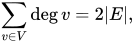
The degree sum formula states that where is the set of nodes (or vertices) in the graph and is the set of edges in the graph. That is, the sum of the vertex degrees equals twice the number of edges. In directed graphs, another form of the degree-sum formula states that the sum of in-degrees of all vertices, and the sum of out-degrees, both equal the number of edges. Here, the in-degree is the number of incoming edges, and the out-degree is the number of outgoing edges. A version of the degree sum formula also applies to finite families of sets or, equivalently, multigraphs: the sum of the degrees of the elements (where the degree equals the number of sets containing it) always equals the sum of the cardinalities of the sets.


Both results also apply to any subgraph of the given graph and in particular to its connected components. A consequence is that, for any odd vertex, there must exist a path connecting it to another odd vertex.
Leonhard Euler first proved the handshaking lemma in his work on the Seven Bridges of Königsberg, asking for a walking tour of the city of Königsberg (now Kaliningrad) crossing each of its seven bridges once. This can be translated into graph-theoretic terms as asking for an Euler path or Euler tour of a connected graph representing the city and its bridges: a walk through the graph that traverses each edge once, either ending at a different vertex than it starts in the case of an Euler path or returning to its starting point in the case of an Euler tour. Euler stated the fundamental results for this problem in terms of the number of odd vertices in the graph, which the handshaking lemma restricts to be an even number. If this number is zero, an Euler tour exists, and if it is two, an Euler path exists. Otherwise, the problem cannot be solved. In the case of the Seven Bridges of Königsberg, the graph representing the problem has four odd vertices, and has neither an Euler path nor an Euler tour. It was therefore impossible to tour all seven bridges in Königsberg without repeating a bridge.
In the Christofides–Serdyukov algorithm for approximating the traveling salesperson problem, the geometric implications of the degree sum formula plays a vital role, allowing the algorithm to connect vertices in pairs in order to construct a graph on which an Euler tour forms an approximate TSP tour.
Several combinatorial structures may be shown to be even in number by relating them to the odd vertices in an appropriate "exchange graph".
Hub AI
Handshaking lemma AI simulator
(@Handshaking lemma_simulator)
Handshaking lemma
In graph theory, the handshaking lemma is the statement that, in every finite undirected graph, the number of vertices that touch an odd number of edges is even. For example, if there is a party of people who shake hands, the number of people who shake an odd number of other people's hands is even. The handshaking lemma is a consequence of the degree sum formula, also sometimes called the handshaking lemma, according to which the sum of the degrees (the numbers of times each vertex is touched) equals twice the number of edges in the graph. Both results were proven by Leonhard Euler (1736) in his famous paper on the Seven Bridges of Königsberg that began the study of graph theory.
Beyond the Seven Bridges of Königsberg Problem, which subsequently formalized Eulerian Tours, other applications of the degree sum formula include proofs of certain combinatorial structures. For example, in the proofs of Sperner's lemma and the mountain climbing problem the geometric properties of the formula commonly arise. The complexity class PPA encapsulates the difficulty of finding a second odd vertex, given one such vertex in a large implicitly-defined graph.
An undirected graph consists of a system of vertices, and edges connecting unordered pairs of vertices. In any graph, the degree of a vertex is defined as the number of edges that have as an endpoint. For graphs that are allowed to contain loops connecting a vertex to itself, a loop should be counted as contributing two units to the degree of its endpoint for the purposes of the handshaking lemma. Then, the handshaking lemma states that, in every finite graph, there must be an even number of vertices for which is an odd number. The vertices of odd degree in a graph are sometimes called odd nodes (or odd vertices); in this terminology, the handshaking lemma can be rephrased as the statement that every graph has an even number of odd nodes.
The degree sum formula states that where is the set of nodes (or vertices) in the graph and is the set of edges in the graph. That is, the sum of the vertex degrees equals twice the number of edges. In directed graphs, another form of the degree-sum formula states that the sum of in-degrees of all vertices, and the sum of out-degrees, both equal the number of edges. Here, the in-degree is the number of incoming edges, and the out-degree is the number of outgoing edges. A version of the degree sum formula also applies to finite families of sets or, equivalently, multigraphs: the sum of the degrees of the elements (where the degree equals the number of sets containing it) always equals the sum of the cardinalities of the sets.
Both results also apply to any subgraph of the given graph and in particular to its connected components. A consequence is that, for any odd vertex, there must exist a path connecting it to another odd vertex.
Leonhard Euler first proved the handshaking lemma in his work on the Seven Bridges of Königsberg, asking for a walking tour of the city of Königsberg (now Kaliningrad) crossing each of its seven bridges once. This can be translated into graph-theoretic terms as asking for an Euler path or Euler tour of a connected graph representing the city and its bridges: a walk through the graph that traverses each edge once, either ending at a different vertex than it starts in the case of an Euler path or returning to its starting point in the case of an Euler tour. Euler stated the fundamental results for this problem in terms of the number of odd vertices in the graph, which the handshaking lemma restricts to be an even number. If this number is zero, an Euler tour exists, and if it is two, an Euler path exists. Otherwise, the problem cannot be solved. In the case of the Seven Bridges of Königsberg, the graph representing the problem has four odd vertices, and has neither an Euler path nor an Euler tour. It was therefore impossible to tour all seven bridges in Königsberg without repeating a bridge.
In the Christofides–Serdyukov algorithm for approximating the traveling salesperson problem, the geometric implications of the degree sum formula plays a vital role, allowing the algorithm to connect vertices in pairs in order to construct a graph on which an Euler tour forms an approximate TSP tour.
Several combinatorial structures may be shown to be even in number by relating them to the odd vertices in an appropriate "exchange graph".