


Community hub
Recent from talks
Contribute something to knowledge base
Content stats: 0 posts, 0 articles, 1 media, 0 notes
Members stats: 0 subscribers, 0 contributors, 0 moderators, 0 supporters
Subscribers
Supporters
Contributors
Moderators
Hub AI
Hank Wangford AI simulator
(@Hank Wangford_simulator)
Hub AI
Hank Wangford AI simulator
(@Hank Wangford_simulator)
Hank Wangford
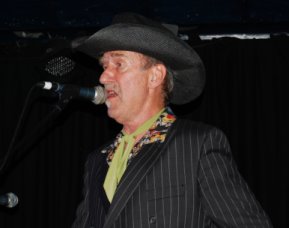
Samuel Hutt (born 15 November 1940), known by the stage name Hank Wangford, is an English country and western songwriter.
Hutt adopted the persona of Hank Wangford when he decided to become a country singer in the late 1970s. "Hank is a good smoke screen. He can do things I can't do. He's my clown," Hutt told Howell Raines in 1988. "I actually had more of an identity crisis with [being Sam Hutt] than with Hank, because Hank is a fool. I quite like him. Dr. Sam was definitely threatening to become a monster." He called himself Wangford after the village of that name in Suffolk, which is where he first conceived the idea of using a nom de plume.
In his appearance in the film A Brief History of Brocket Hall, Sam Hutt claimed that he was born in an upstairs room at Brocket Hall, Hertfordshire, on the night of 14–15 November 1940, during The Blitz. It was a forceps delivery. As he says in the film, Brocket Hall has a history of sexual scandals, involving the royal family and politicians but, by 1940, it had become a maternity home. The British Government had intelligence that the Germans were planning to flatten London on the night of the birth, when there was to be a full moon (The "Hunter Moon" or "Blood Moon"), which would provide good visibility. His mother was therefore evacuated to Hertfordshire for the birth. In the event, on the night of the birth the Germans bombed Coventry, not London.
Sam Hutt's father was the journalist and communist activist Allen Hutt, who alongside his work as chief sub-editor of the Daily Worker and member of the National Union of Journalists executive committee was also renowned for his expertise in typesetting and newspaper design. His mother, meanwhile, taught English to "admirals and students in the Russian Embassy". Hutt grew up in north London, and was educated at William Ellis School in Gospel Oak and St John's College, Cambridge, where he studied the natural sciences tripos and took part in revue performances as a member of the Cambridge Footlights. After completing his undergraduate degree, he remained in Cambridge to complete his medical training, eventually becoming a doctor.
Upon leaving Cambridge, Hutt set up practice at a drug addiction centre in London, which "brought him into contact with a lot of rockers and wide renown as London's long-haired, rock-and-roll doctor." Among those who sought his services were the likes of Ian Dury and Pink Floyd. "If any of them had sore throats, they’d call me in", he later said. "It was easy for them to see someone like me, because I had long hair like them and was unshockable." His prescriptions included tincture of cannabis, which he gave "to anyone who wanted it", and which he saw as a "revolutionary act" that would subvert both the authorities and predatory drug dealers. Nonetheless, he had his limits. "I never prescribed any harder drugs. If they wanted those, I sent them to Harley Street where they could get whatever they wanted, from the 'straight' doctors, in the pinstripe suits." Such was Hutt's fame as 'Dr Rock' that he was one of those "scenemakers" who were flown to New York to attend the show given in 1970 by the country band Brinsley Schwarz at Fillmore East, which has since gone down in infamy as the Brinsley Schwarz Hype.
Wangford was interested in music as a child, and it was through his father's prominence in Communist Party circles that he first met the folk singer Ewan MacColl, who lectured him on the need to remain true to his roots and not appropriate the music of other cultures. His first writing credit (as Sam Hutt) was on a 1965 single by Sarah Miles, "Where Am I", which he later described as having "atrocious" lyrics. His first recording (credited as Boeing Duveen & The Beautiful Soup) was "Jabberwock"/"Which Dreamed It" (issued on UK Parlophone R 5696) in May 1968; he is co-credited as "Sam Hutt" on both sides together with Lewis Carroll, with whose words the songs are adapted.
A meeting with former Byrds member Gram Parsons, whose wife was in meed of medical attention, first led Wangford to country music. During this visit Parsons played the song "You're Still on My Mind" (from the album Sweetheart of the Rodeo). "So I see here, and outside the curtain, Gram picks up my guitar and sings, 'An empty bottle. A broken heart, and you’re still on my mind,' – a song I still play to this day. That was when the penny dropped. Which it didn’t when I heard him play The Byrds. But just singing it there with his cracked voice... that was soul." Parsons also introduced Wangford to the work of George Jones, who remains his biggest musical influence.
However, Wangford only considered the idea of reinventing himself as a country music singer after breaking up with his girlfriend in 1976. He described his epiphany to Howell Raines thus:
Hank Wangford
Samuel Hutt (born 15 November 1940), known by the stage name Hank Wangford, is an English country and western songwriter.
Hutt adopted the persona of Hank Wangford when he decided to become a country singer in the late 1970s. "Hank is a good smoke screen. He can do things I can't do. He's my clown," Hutt told Howell Raines in 1988. "I actually had more of an identity crisis with [being Sam Hutt] than with Hank, because Hank is a fool. I quite like him. Dr. Sam was definitely threatening to become a monster." He called himself Wangford after the village of that name in Suffolk, which is where he first conceived the idea of using a nom de plume.
In his appearance in the film A Brief History of Brocket Hall, Sam Hutt claimed that he was born in an upstairs room at Brocket Hall, Hertfordshire, on the night of 14–15 November 1940, during The Blitz. It was a forceps delivery. As he says in the film, Brocket Hall has a history of sexual scandals, involving the royal family and politicians but, by 1940, it had become a maternity home. The British Government had intelligence that the Germans were planning to flatten London on the night of the birth, when there was to be a full moon (The "Hunter Moon" or "Blood Moon"), which would provide good visibility. His mother was therefore evacuated to Hertfordshire for the birth. In the event, on the night of the birth the Germans bombed Coventry, not London.
Sam Hutt's father was the journalist and communist activist Allen Hutt, who alongside his work as chief sub-editor of the Daily Worker and member of the National Union of Journalists executive committee was also renowned for his expertise in typesetting and newspaper design. His mother, meanwhile, taught English to "admirals and students in the Russian Embassy". Hutt grew up in north London, and was educated at William Ellis School in Gospel Oak and St John's College, Cambridge, where he studied the natural sciences tripos and took part in revue performances as a member of the Cambridge Footlights. After completing his undergraduate degree, he remained in Cambridge to complete his medical training, eventually becoming a doctor.
Upon leaving Cambridge, Hutt set up practice at a drug addiction centre in London, which "brought him into contact with a lot of rockers and wide renown as London's long-haired, rock-and-roll doctor." Among those who sought his services were the likes of Ian Dury and Pink Floyd. "If any of them had sore throats, they’d call me in", he later said. "It was easy for them to see someone like me, because I had long hair like them and was unshockable." His prescriptions included tincture of cannabis, which he gave "to anyone who wanted it", and which he saw as a "revolutionary act" that would subvert both the authorities and predatory drug dealers. Nonetheless, he had his limits. "I never prescribed any harder drugs. If they wanted those, I sent them to Harley Street where they could get whatever they wanted, from the 'straight' doctors, in the pinstripe suits." Such was Hutt's fame as 'Dr Rock' that he was one of those "scenemakers" who were flown to New York to attend the show given in 1970 by the country band Brinsley Schwarz at Fillmore East, which has since gone down in infamy as the Brinsley Schwarz Hype.
Wangford was interested in music as a child, and it was through his father's prominence in Communist Party circles that he first met the folk singer Ewan MacColl, who lectured him on the need to remain true to his roots and not appropriate the music of other cultures. His first writing credit (as Sam Hutt) was on a 1965 single by Sarah Miles, "Where Am I", which he later described as having "atrocious" lyrics. His first recording (credited as Boeing Duveen & The Beautiful Soup) was "Jabberwock"/"Which Dreamed It" (issued on UK Parlophone R 5696) in May 1968; he is co-credited as "Sam Hutt" on both sides together with Lewis Carroll, with whose words the songs are adapted.
A meeting with former Byrds member Gram Parsons, whose wife was in meed of medical attention, first led Wangford to country music. During this visit Parsons played the song "You're Still on My Mind" (from the album Sweetheart of the Rodeo). "So I see here, and outside the curtain, Gram picks up my guitar and sings, 'An empty bottle. A broken heart, and you’re still on my mind,' – a song I still play to this day. That was when the penny dropped. Which it didn’t when I heard him play The Byrds. But just singing it there with his cracked voice... that was soul." Parsons also introduced Wangford to the work of George Jones, who remains his biggest musical influence.
However, Wangford only considered the idea of reinventing himself as a country music singer after breaking up with his girlfriend in 1976. He described his epiphany to Howell Raines thus:
Recent media
Recent media