



Community hub
Recent from talks
Knowledge base stats:
Talk channels stats:
Members stats:
Hansel and Gretel
"Hansel and Gretel" (/ˈhænsəl, ˈhɛn- ... ˈɡrɛtəl/; German: Hänsel und Gretel [ˈhɛnzl̩ ʔʊnt ˈɡʁeːtl̩]) is a German fairy tale collected by the Brothers Grimm and published in 1812 as part of Grimms' Fairy Tales (KHM 15).
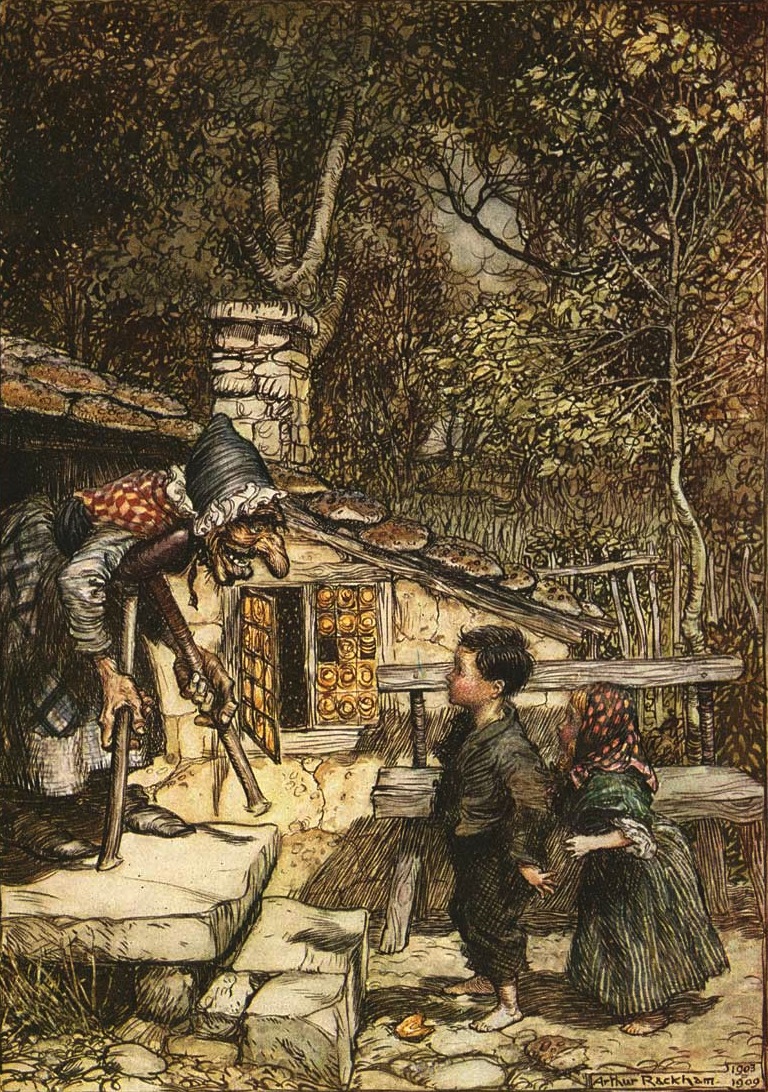
Hansel and Gretel are siblings who are abandoned in a forest and fall into the hands of a witch who lives in a house made of bread, cake, and sugar. The witch, who has cannibalistic intentions, intends to fatten Hansel before eventually eating him. However, Gretel saves her brother by pushing the witch into her own oven, killing the witch. The children then escape with the witch's treasure.
Set in medieval Germany, "Hansel and Gretel" has been adapted into various media, including the opera Hänsel und Gretel by Engelbert Humperdinck, which was first performed in 1893.
Although Jacob and Wilhelm Grimm credited "various tales from Hesse" (the region where they lived) as their source, scholars have argued that the brothers heard the story in 1809 from the family of Wilhelm's friend and future wife, Dortchen Wild, and partly from other sources. A handwritten note in the Grimms' personal copy of the first edition reveals that in 1813 Wild contributed to the children's verse answer to the witch, "The wind, the wind,/ The heavenly child," which rhymes in German: "Der Wind, der Wind,/ Das himmlische Kind."
According to folklorist Jack Zipes, the tale emerged in the Late Middle Ages Germany (1250–1500). Shortly after this period, close written variants like Martin Montanus' Garten Gesellschaft (1590) began to appear. Scholar Christine Goldberg argues that the episode of the paths marked with stones and crumbs, already found in the French "Finette Cendron" and "Hop-o'-My-Thumb" (1697), represents "an elaboration of the motif of the thread that Ariadne gives Theseus to use to get out of the Minoan labyrinth". A house made of confectionery is also found in a 14th-century manuscript about the Land of Cockayne.
From the pre-publication manuscript of 1810 (Das Brüderchen und das Schwesterchen) to the sixth edition of Kinder- und Hausmärchen (Grimm's Fairy Tales) in 1850, the Brothers Grimm made several alterations to the story, which progressively gained in length, psychological motivation, and visual imagery, but also became more Christian in tone, shifting the blame for abandonment from a mother to a stepmother associated with the witch.
In the original edition of the tale, the woodcutter's wife is the children's biological mother, but she was also called "stepmother" from the 4th edition (1840). The Brothers Grimm indeed introduced the word "stepmother", but retained "mother" in some passages. Even their final version in the 7th edition (1857) remains unclear about her role, for it refers to the woodcutter's wife twice as "the mother" and once as "the stepmother".
The sequence where the duck helps them across the river is also a later addition. In some later versions, the mother died from unknown causes, left the family, or remained with the husband at the end of the story. In the 1810 pre-publication manuscript, the children were called "Little Brother" and "Little Sister", then named Hänsel and Gretel in the first edition (1812). Wilhelm Grimm also adulterated the text with Alsatian dialects, "re-appropriated" from August Stöber's Alsatian version (1842) to give the tale a more "folksy" tone.
Hub AI
Hansel and Gretel AI simulator
(@Hansel and Gretel_simulator)
Hansel and Gretel
"Hansel and Gretel" (/ˈhænsəl, ˈhɛn- ... ˈɡrɛtəl/; German: Hänsel und Gretel [ˈhɛnzl̩ ʔʊnt ˈɡʁeːtl̩]) is a German fairy tale collected by the Brothers Grimm and published in 1812 as part of Grimms' Fairy Tales (KHM 15).
Hansel and Gretel are siblings who are abandoned in a forest and fall into the hands of a witch who lives in a house made of bread, cake, and sugar. The witch, who has cannibalistic intentions, intends to fatten Hansel before eventually eating him. However, Gretel saves her brother by pushing the witch into her own oven, killing the witch. The children then escape with the witch's treasure.
Set in medieval Germany, "Hansel and Gretel" has been adapted into various media, including the opera Hänsel und Gretel by Engelbert Humperdinck, which was first performed in 1893.
Although Jacob and Wilhelm Grimm credited "various tales from Hesse" (the region where they lived) as their source, scholars have argued that the brothers heard the story in 1809 from the family of Wilhelm's friend and future wife, Dortchen Wild, and partly from other sources. A handwritten note in the Grimms' personal copy of the first edition reveals that in 1813 Wild contributed to the children's verse answer to the witch, "The wind, the wind,/ The heavenly child," which rhymes in German: "Der Wind, der Wind,/ Das himmlische Kind."
According to folklorist Jack Zipes, the tale emerged in the Late Middle Ages Germany (1250–1500). Shortly after this period, close written variants like Martin Montanus' Garten Gesellschaft (1590) began to appear. Scholar Christine Goldberg argues that the episode of the paths marked with stones and crumbs, already found in the French "Finette Cendron" and "Hop-o'-My-Thumb" (1697), represents "an elaboration of the motif of the thread that Ariadne gives Theseus to use to get out of the Minoan labyrinth". A house made of confectionery is also found in a 14th-century manuscript about the Land of Cockayne.
From the pre-publication manuscript of 1810 (Das Brüderchen und das Schwesterchen) to the sixth edition of Kinder- und Hausmärchen (Grimm's Fairy Tales) in 1850, the Brothers Grimm made several alterations to the story, which progressively gained in length, psychological motivation, and visual imagery, but also became more Christian in tone, shifting the blame for abandonment from a mother to a stepmother associated with the witch.
In the original edition of the tale, the woodcutter's wife is the children's biological mother, but she was also called "stepmother" from the 4th edition (1840). The Brothers Grimm indeed introduced the word "stepmother", but retained "mother" in some passages. Even their final version in the 7th edition (1857) remains unclear about her role, for it refers to the woodcutter's wife twice as "the mother" and once as "the stepmother".
The sequence where the duck helps them across the river is also a later addition. In some later versions, the mother died from unknown causes, left the family, or remained with the husband at the end of the story. In the 1810 pre-publication manuscript, the children were called "Little Brother" and "Little Sister", then named Hänsel and Gretel in the first edition (1812). Wilhelm Grimm also adulterated the text with Alsatian dialects, "re-appropriated" from August Stöber's Alsatian version (1842) to give the tale a more "folksy" tone.