
Recent from talks
Haplogroup J-M172
Knowledge base stats:
Talk channels stats:
Members stats:
Haplogroup J-M172
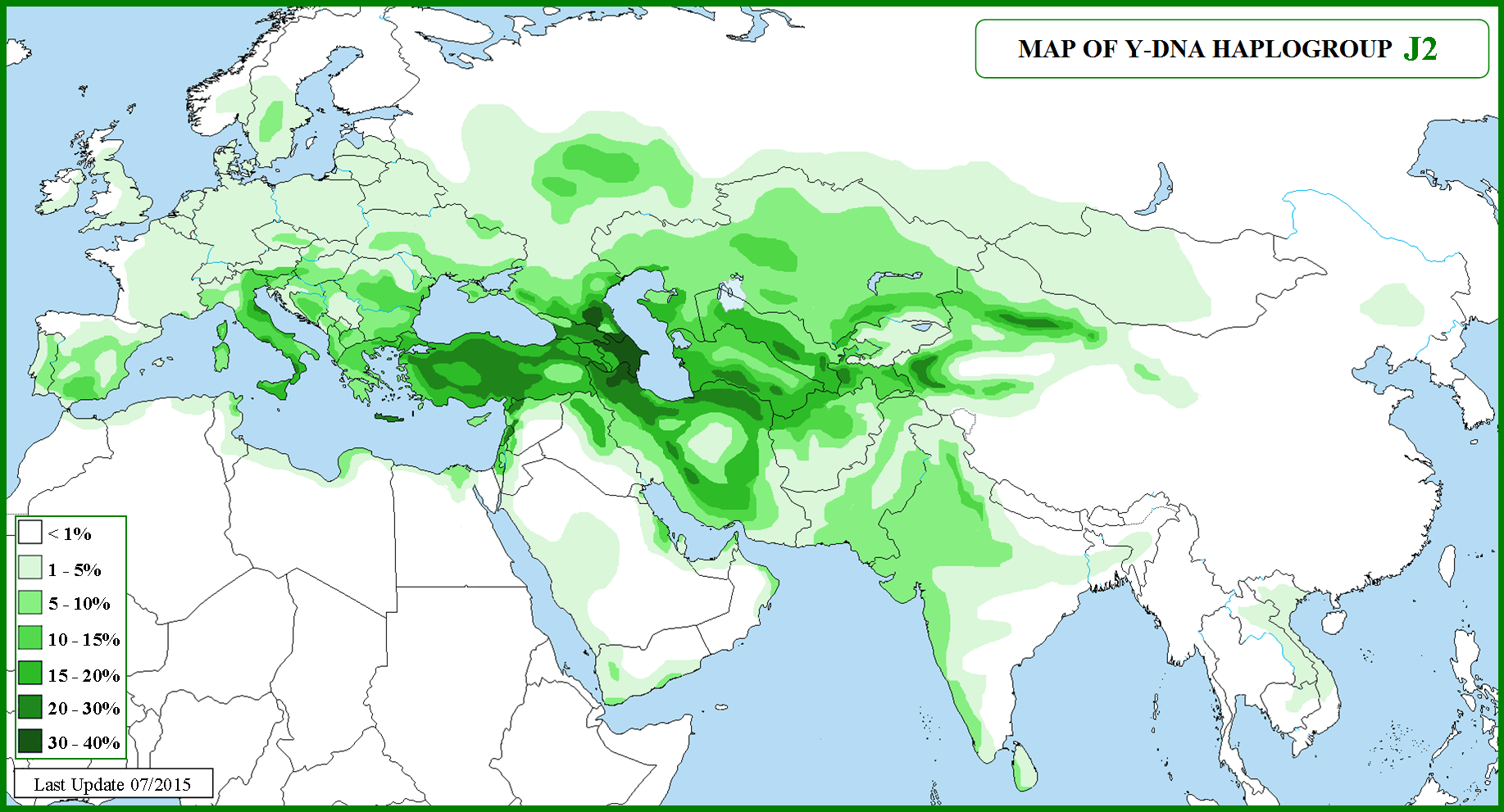
In human genetics, Haplogroup J-M172 or J2 is a Y-chromosome haplogroup which is a subclade (branch) of haplogroup J-M304. Haplogroup J-M172 is common in modern populations in Western Asia, Central Asia, South Asia, Southern Europe, Northwestern Iran and North Africa. It is thought that J-M172 may have originated in the Caucasus, Anatolia, Mesopotamia and/or present-day Western Iran.
It is further divided into two complementary clades, J-M410 and J-M12 (M12, M102, M221, M314).
The date of origin for haplogroup J-M172 was estimated by Batini et al in 2015 as between 19,000 and 24,000 years before present (BP). Samino et al in 2004 dated the origin of the parent haplogroup, J-P209, to between 18,900 and 44,500 YBP. Ancient J-M410, specifically subclade J-Y12379*, has been found, in a Mesolithic context, in a tooth from the Kotias Klde Cave in western Georgia from the Late Upper Palaeolithic (13,300 years old) and the Mesolithic (9,700 years old) This sample has been assigned to the Caucasus hunter-gatherers (CHG) autosomal component. J-M410, more specifically its subclade J-PF5008, has also been found in a Mesolithic sample from the Hotu and Kamarband Caves located in Mazandaran Province of Iran, dating back to 9,100-8,600 B.C.E (approximately 11,000 ybp). Both samples belong to the Trialetian Culture. It is likely that J2 men had settled over most of Anatolia, the South Caucasus and the Zagros mountains by the end of the Last Glaciation 12,000 years ago.
Zalloua & Wells (2004) and Al-Zahery et al. (2003) claimed to have uncovered the earliest known migration of J2, expanded possibly from Anatolia and the Caucasus. Nebel et al. (2001) found that, "According to Underhill et al. (2000), Eu 9 (H58) evolved from Eu 10 (H71) through a T→G transversion at M172 (emphasis added)," and that in today's populations, Eu 9 (the post-mutation form of M172) is strongest in the Caucasus, Asia Minor and the Levant, whilst Eu 10 becomes stronger and replaces the frequency of Eu 9 as one moves south into the Arabian Peninsula, so that people from the Caucasus met with Arabs near and between Mesopotamia (Sumer/Assyria) and the Negev Desert, as "Arabisation" spread from Arabia to the Fertile Crescent and Turkey.
Di Giacomo et al. (2004) postulated that J-M172 haplogroup spread into Southern Europe from either the Levant or Anatolia, likely parallel to the development of agriculture. As to the timing of its spread into Europe, Di Giacomo et al. points to events which post-date the Neolithic, in particular the demographic floruit associated with the rise of the Ancient Greek world. Semino et al. (2004) derived older age estimates for overall J2 (having used the Zhivotovsky method c.f. Di Giacomo)[clarify], postulating its initial spread with Neolithic farmers from the Near East. However, its subclade distribution, showing localized peaks in the Southern Balkans, southern Italy, north/central Italy and the Caucasus, does not conform to a single 'wave-of-advance' scenario, betraying a number of still poorly understood post-Neolithic processes which created its current pattern. Like Di Giacomo et al., the Bronze Age southern Balkans was suggested by Semino et al. to have been an important vector of spread.
Haplogroup J-M172 is found mainly in the Fertile Crescent, the Caucasus, Anatolia, Italy, the Mediterranean littoral, and the Iranian plateau. Y-DNA: J2 (J-M172): Syrid/Nahrainid Arabid(s).
The highest reported frequency of J-M172 ever was 87.4%, among Ingush in Malgobek.
More specifically it is found in Iraq, Kuwait, Syria, Lebanon, Turkey, Georgia, Azerbaijan, North Caucasus, Armenia, Iran, Israel, Palestine, Cyprus, Greece, Albania, Italy, Spain, and more frequently in Iraqis 24%, Chechens 51.0%-58.0%, Georgians 21%-72%, Lebanese 30%, Ossetians 24%, Balkars 24%, Syrians 23%,, Assyrians 15%, Turks 13%-40%, Cypriots 12.9%-37%, Armenians 21%-24%, Circassians 21.8%, Bahrainis 27.6%, Iranians 10%-25%, Albanians 16%, Italians 9%-36%, Sephardi Jews 15%-29%, Maltese 21%, Palestinians 17%, Saudis 14%, Jordanians 14%, Omanis 10%-15%, and North Indian Shia Muslim 18%.
Hub AI
Haplogroup J-M172 AI simulator
(@Haplogroup J-M172_simulator)
Haplogroup J-M172
In human genetics, Haplogroup J-M172 or J2 is a Y-chromosome haplogroup which is a subclade (branch) of haplogroup J-M304. Haplogroup J-M172 is common in modern populations in Western Asia, Central Asia, South Asia, Southern Europe, Northwestern Iran and North Africa. It is thought that J-M172 may have originated in the Caucasus, Anatolia, Mesopotamia and/or present-day Western Iran.
It is further divided into two complementary clades, J-M410 and J-M12 (M12, M102, M221, M314).
The date of origin for haplogroup J-M172 was estimated by Batini et al in 2015 as between 19,000 and 24,000 years before present (BP). Samino et al in 2004 dated the origin of the parent haplogroup, J-P209, to between 18,900 and 44,500 YBP. Ancient J-M410, specifically subclade J-Y12379*, has been found, in a Mesolithic context, in a tooth from the Kotias Klde Cave in western Georgia from the Late Upper Palaeolithic (13,300 years old) and the Mesolithic (9,700 years old) This sample has been assigned to the Caucasus hunter-gatherers (CHG) autosomal component. J-M410, more specifically its subclade J-PF5008, has also been found in a Mesolithic sample from the Hotu and Kamarband Caves located in Mazandaran Province of Iran, dating back to 9,100-8,600 B.C.E (approximately 11,000 ybp). Both samples belong to the Trialetian Culture. It is likely that J2 men had settled over most of Anatolia, the South Caucasus and the Zagros mountains by the end of the Last Glaciation 12,000 years ago.
Zalloua & Wells (2004) and Al-Zahery et al. (2003) claimed to have uncovered the earliest known migration of J2, expanded possibly from Anatolia and the Caucasus. Nebel et al. (2001) found that, "According to Underhill et al. (2000), Eu 9 (H58) evolved from Eu 10 (H71) through a T→G transversion at M172 (emphasis added)," and that in today's populations, Eu 9 (the post-mutation form of M172) is strongest in the Caucasus, Asia Minor and the Levant, whilst Eu 10 becomes stronger and replaces the frequency of Eu 9 as one moves south into the Arabian Peninsula, so that people from the Caucasus met with Arabs near and between Mesopotamia (Sumer/Assyria) and the Negev Desert, as "Arabisation" spread from Arabia to the Fertile Crescent and Turkey.
Di Giacomo et al. (2004) postulated that J-M172 haplogroup spread into Southern Europe from either the Levant or Anatolia, likely parallel to the development of agriculture. As to the timing of its spread into Europe, Di Giacomo et al. points to events which post-date the Neolithic, in particular the demographic floruit associated with the rise of the Ancient Greek world. Semino et al. (2004) derived older age estimates for overall J2 (having used the Zhivotovsky method c.f. Di Giacomo)[clarify], postulating its initial spread with Neolithic farmers from the Near East. However, its subclade distribution, showing localized peaks in the Southern Balkans, southern Italy, north/central Italy and the Caucasus, does not conform to a single 'wave-of-advance' scenario, betraying a number of still poorly understood post-Neolithic processes which created its current pattern. Like Di Giacomo et al., the Bronze Age southern Balkans was suggested by Semino et al. to have been an important vector of spread.
Haplogroup J-M172 is found mainly in the Fertile Crescent, the Caucasus, Anatolia, Italy, the Mediterranean littoral, and the Iranian plateau. Y-DNA: J2 (J-M172): Syrid/Nahrainid Arabid(s).
The highest reported frequency of J-M172 ever was 87.4%, among Ingush in Malgobek.
More specifically it is found in Iraq, Kuwait, Syria, Lebanon, Turkey, Georgia, Azerbaijan, North Caucasus, Armenia, Iran, Israel, Palestine, Cyprus, Greece, Albania, Italy, Spain, and more frequently in Iraqis 24%, Chechens 51.0%-58.0%, Georgians 21%-72%, Lebanese 30%, Ossetians 24%, Balkars 24%, Syrians 23%,, Assyrians 15%, Turks 13%-40%, Cypriots 12.9%-37%, Armenians 21%-24%, Circassians 21.8%, Bahrainis 27.6%, Iranians 10%-25%, Albanians 16%, Italians 9%-36%, Sephardi Jews 15%-29%, Maltese 21%, Palestinians 17%, Saudis 14%, Jordanians 14%, Omanis 10%-15%, and North Indian Shia Muslim 18%.
Recent media