Hubbry Logo
Harold L. Ickes HomesHarold L. Ickes HomesMain
Open search
Harold L. Ickes Homes
Community hub
Harold L. Ickes Homes
logo
8 pages, 0 posts
0 subscribers
Be the first to start a discussion here.
Harold L. Ickes Homes
from Wikipedia

Harold L. Ickes Homes
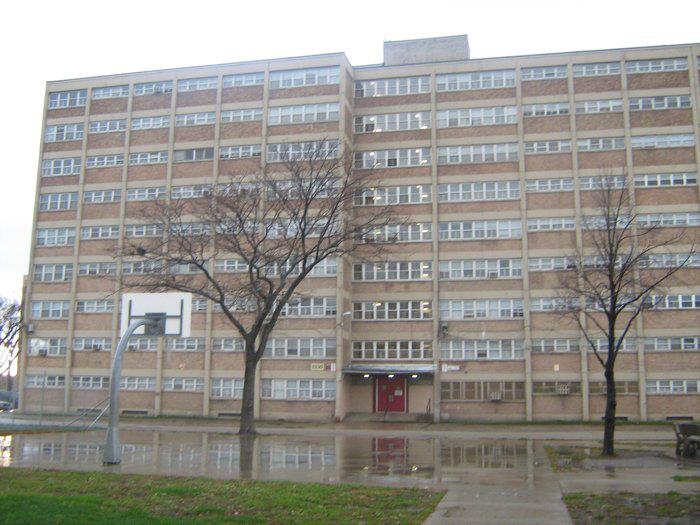
2008 photograph of one of the Harold L. Ickes Homes housing project buildings
Map
Interactive map of Harold L. Ickes Homes
General information
LocationBordered by Cermak Road, 24th Place, State Street, and Federal Street
Chicago, Illinois
 United States
Coordinates41°51′03″N 87°37′41″W / 41.8508°N 87.6280°W / 41.8508; -87.6280
StatusDemolished
Construction
Constructed1954–55
Demolished2009–11
Other information
Governing
body
Chicago Housing Authority

Harold L. Ickes Homes was a Chicago Housing Authority (CHA) public housing project on the Near South Side of Chicago, Illinois, United States. It was bordered between Cermak Road to the north, 24th Place to the south, State Street to the east, and Federal Street to the west, making it part of the State Street Corridor that included other CHA properties: Robert Taylor Homes, Dearborn Homes, Stateway Gardens and Hilliard Homes.[1]

History

[edit]

Named for a United States administrator and politician, Harold LeClair Ickes. The housing project was constructed by the Public Works Administration between 1954 and 1955. It consisted of eleven 9-story high-rise buildings with a total of 738 apartments [1]. In 2007, Ickes residents recorded acts of police harassment which included strip searches of African-American men as children watched; The footage aired on NBC's Channel 5. On October 9, 2007, Rev. Jesse Jackson along with ministers from Chicago's west side and community members moved into the housing project to bring attention to the harassment situation.[2]

Redevelopment

[edit]

As of May 2015, most of the site remains undeveloped following its demolition as part of the Plan for Transformation/Plan Forward. In September 2013, two years after the final building was demolished, former residents called for the housing authority to build replacement housing as promised. One former resident was quoted as saying: "We were told by the CHA that once the Ickes was torn down replacement units would then be built. That has not happened even though taxpayers' money is being used to help build a new Green Line station on Cermak Road and a new stadium for DePaul."[3]

Education

[edit]

Residents were zoned to schools in the Chicago Public Schools including John C. Haines School in Chinatown and Phillips Academy High School. Students from Ickes used a tunnel to get to Haines.[4]

[edit]

References

[edit]
Revisions and contributorsEdit on WikipediaRead on Wikipedia
from Grokipedia
Harold L. Ickes Homes was a public housing complex developed by the Chicago Housing Authority (CHA) on Chicago's Near South Side, consisting of eleven nine-story buildings that provided low-rent units for low-income families from its opening in 1955 until demolition in 2009. Named for Harold L. Ickes, Franklin D. Roosevelt's Secretary of the Interior who oversaw early federal housing efforts under the Public Works Administration, the development covered six blocks along State Street between 22nd and 25th Streets and was explicitly designated for African American occupancy amid the era's de facto segregation policies. Intended to replace slum conditions in the historic "Black Belt" with modern family housing, it exemplified mid-20th-century high-rise public housing design but, like similar CHA projects, deteriorated due to underfunding, concentrated poverty, and rising crime, prompting its razing as part of the CHA's Plan for Transformation to promote mixed-income redevelopment. The site's subsequent transformation into the Southbridge mixed-income community, featuring hundreds of market-rate, affordable, and public units, reflects broader shifts away from isolated public housing towers toward integrated urban housing strategies.

Origins and Construction

Site Selection and Naming

The site for the Harold L. Ickes Homes was chosen by the (CHA) in the Near South Side of , encompassing approximately 13 acres bounded by Cermak Road to the north, 25th Street to the south, State Street to the west, and the eventual path of the to the east. This location fell within the historical "Black Belt," the densely populated African American enclave that had developed since the early amid migration from the South, featuring overcrowded tenements and inadequate infrastructure. The selection aligned with CHA's practice of siting in existing segregated communities to accommodate low-income black families displaced by projects elsewhere, such as the clearance of nearby areas, while adhering to federal and local policies that maintained racial separation in housing developments. The project was explicitly designated for African American occupancy only, reflecting the era's de facto segregation enforced through site choices and tenant selection criteria, which concentrated for blacks in South Side neighborhoods like the Black Belt to avoid integration in areas. Construction began in 1954 on cleared land previously occupied by dilapidated structures, enabling the CHA to address acute shortages in this specific demographic and geographic context without encroaching on adjacent or mixed neighborhoods such as to the west or the South Loop industrial zones. The development was named the in recognition of , who served as U.S. Secretary of the Interior from 1933 to 1946 and as administrator of the (PWA), where he oversaw federal funding for early public housing initiatives under the . Ickes's advocacy for and modern low-rent housing projects, including PWA-backed developments, positioned him as a symbolic figure for CHA's high-rise efforts in the 1950s, consistent with the naming convention for other projects honoring progressive reformers supportive of public works. The full name, including the middle initial "L." for LeClaire, distinguished it from other potential namesakes while emphasizing his contributions to national infrastructure and housing policy.

Architectural Design and Initial Capacity

The Harold L. Ickes Homes were designed by the prominent Chicago architectural firm Skidmore, Owings & Merrill, known for modernist projects. The complex consisted of eleven nine-story high-rise buildings employing a slab-block form with gallery access, a common approach in mid-20th-century public housing to facilitate efficient vertical density on urban sites. This design featured elevator service and aimed to provide durable, low-maintenance structures for low-income families, reflecting post-World War II influences prioritizing functionality over ornamentation. Construction occurred between 1954 and 1955 under the , replacing older tenements in the Near South Side's "Black Belt" area. The buildings were oriented along State Street between Cermak Road and 25th Street, optimizing land use while incorporating basic amenities such as community spaces, though details on specific interior layouts or materials remain sparse in available records. Upon completion in , the development offered an initial capacity of 1,006 units across the eleven structures, serving as a key expansion of stock for African American residents during an era of urban segregation. This scale accommodated thousands of individuals, with unit configurations typically including 2- to 4-bedroom apartments suited to working-class . The project's capacity underscored ambitions for and modern relocation, though later operational realities diverged from initial projections.

Federal and Local Funding Context

The construction of Harold L. Ickes Homes, initiated in 1952 by the (CHA), relied predominantly on federal funding authorized under the , which allocated resources for and the development of up to 810,000 units of low-rent nationwide over six years. This legislation provided low-interest loans through the Housing and Home Finance Agency to local authorities like CHA for capital costs, with repayment structured over 40 years primarily from projected rental revenues, supplemented by federal annual contributions to offset operating shortfalls between low tenant rents and maintenance expenses. These federal mechanisms enabled CHA to expand its high-rise portfolio rapidly in the early 1950s, including Ickes Homes, by guaranteeing bonds issued by local agencies and covering development financing that private markets avoided due to the subsidized, non-profit nature of . The act's emphasis on urban tied funding to site clearance efforts, positioning projects like Ickes as instruments for replacing perceived slums with modern housing, though actual per-unit costs varied by location and scale without publicly detailed figures specific to Ickes in available records. Local contributions from the City of were ancillary, focusing on legislative enablement and site provision rather than direct fiscal outlays; CHA's state charter allowed it to acquire land via , often with municipal coordination for clearance, but federal loans constituted the core financing without substantial city tax subsidies or matching grants required under the 1949 framework. This federal-local dynamic reflected broader post-World War II policy, where national commitments drove construction while municipalities handled administration, though it later exposed vulnerabilities when rental incomes proved insufficient for long-term debt service and upkeep.

Early Operations and Resident Experience

Initial Occupancy and Community Formation

The Harold L. Ickes Homes accepted its first residents in 1955 upon completion of construction that year, providing modern nine-story apartment buildings as part of the Chicago Housing Authority's effort to replace substandard slum housing in the Near South Side's Black Belt neighborhood. Tenant selection by the CHA emphasized applicants with stable employment and intact structures, aiming to establish a foundation of responsible tenancy in the new development. Early occupants, drawn primarily from low-income African American households displaced from dilapidated areas, benefited from three-bedroom units featuring amenities such as storage spaces, linen closets, and access to on-site playgrounds, which residents like Vonsell Ashford described as marking a transition to "paradise" compared to prior conditions. Community formation occurred swiftly among these initial families, with shared maintenance duties—including weekly hallway cleaning rotations—instilling habits of collective upkeep and fostering interpersonal ties. Residents such as Andrew Thompson, who moved in during and stayed until , reported a secure environment devoid of immediate threats, attributing the positive atmosphere to the project's fresh and the socioeconomic stability of early tenants, many of whom maintained employment. Social bonds strengthened through informal gatherings and neighborhood events, contributing to an initial sense of pride and cohesion that contrasted with the isolation of former tenements, though this phase later gave way to demographic shifts as higher-earning families departed under evolving eligibility rules. At full early capacity, the 11 buildings accommodated approximately 1,000 families, underscoring the scale of community life established in these years.

Management Structure Under CHA

The (CHA), founded in 1937 as a , administered the Harold L. Ickes Homes through a hierarchical structure comprising a Board of Commissioners appointed by the mayor and a central responsible for policy, funding allocation, and oversight of all developments. This framework extended to Ickes Homes, opened in late 1954, where central directives governed tenant eligibility—initially prioritizing families with employed breadwinners and strict behavioral standards—along with maintenance and slum-clearance compliance tied to federal funding under the U.S. Housing Act. At the site level, a dedicated site manager, supported by an assistant and maintenance staff, handled operational responsibilities including repairs, rent collection, and resident grievances, serving as the primary liaison between tenants and CHA headquarters. Early management under executive director Elizabeth Wood (1937–1954) adopted a paternalistic approach, with site personnel fostering direct tenant engagement to promote and integration efforts, though overwhelmed caseloads—managing thousands of units from small offices—limited responsiveness. Following Wood's departure in 1954, subsequent directors maintained this model amid growing fiscal constraints, but site managers increasingly faced challenges from deferred upkeep as CHA prioritized new over sustained operations. Informal tenant councils emerged organically in the to supplement CHA oversight, with residents forming groups for tasks like child monitoring, cleaning coordination, and advocacy on repairs, predating formalized Local Advisory Councils in the . These bodies reported directly to site managers, who prioritized their requests for expedited services, though CHA's centralized bureaucracy often delayed broader policy changes, contributing to early signs of physical neglect by the late . Federal guidelines enforced via the "neighborhood composition rule" until partial integration attempts post-World War II, influencing site-level tenant selection at black-belt projects like Ickes.

Socioeconomic Profile of Early Residents

The early residents of Harold L. Ickes Homes, which opened for occupancy starting in 1955, consisted primarily of African American families, many of whom were first- or second-generation migrants from the rural or displaced from Chicago's overcrowded slums in the Black Belt neighborhood. These households were low-income working-class, with eligibility determined by (CHA) criteria requiring inability to afford decent private-market housing, typically incomes below local median levels—around $3,000–$4,000 annually in the mid-1950s, adjusted for family size—while prioritizing employed applicants over the unemployed. Employment among initial tenants was relatively high, with many holding steady jobs in , trades, or service sectors, reflecting CHA's early screening practices that favored "deserving" over welfare dependents to maintain project viability. Family structures were predominantly two-parent units, often including young children, as CHA policies initially emphasized stable households capable of contributing to community upkeep through nominal rent payments set at 25–30% of income. Residents frequently described the modern apartments and amenities—such as playgrounds and on-site services via the Henry Booth Settlement House—as a marked upgrade from prior tenements, fostering a sense of pride and initial community cohesion. Over the first decade, however, some early occupants departed due to rising CHA income ceilings for continued eligibility, which inadvertently selected against upwardly mobile families and began shifting the tenant mix toward lower-earning households. By the late 1960s, working families in CHA projects like Ickes had declined from about 50% to under 10% in similar developments, as policy changes curtailed applicant screening and prioritized accommodating all eligible low-income applicants amid urban displacement. This transition marked the onset of greater socioeconomic homogeneity, with increasing reliance on public assistance foreshadowing later challenges.

Decline and Operational Challenges

Onset of Crime and Gang Infiltration

By the late 1950s, shortly after occupancy began in 1955, the Harold L. Ickes Homes exhibited early indicators of social disorder through rampant , prompting the (CHA) to replace every wooden front door with steel and board up damaged window glass with plywood across multiple units. This physical deterioration reflected underlying behavioral issues among residents, including a high proportion of young, unsupervised children in concentrated low-income settings, which strained management resources from the outset. Although the Ickes Homes were regarded as relatively safer than larger CHA high-rises like the during the initial decade, gang infiltration accelerated in the mid-1960s amid citywide escalation of street activity and unemployment in . Resident accounts from the period, such as those of individuals living there from 1955 to 1962, noted emerging tensions, while CHA-wide trends showed becoming a fixture by 1965, fueled by youth idleness and territorial disputes spilling into projects. The CHA's decision to reduce on-site security in the 1960s intensified vulnerabilities, enabling gangs such as the to establish dominance and engage in defensive wars against invading factions and renegades, marking a shift toward entrenched . By the late 1970s, drug trafficking intertwined with these gang structures, mirroring patterns in other CHA developments where narcotics funded violence and eroded community cohesion, though Ickes avoided the extreme homicide rates of corridor projects like State Street.

Maintenance Failures and Physical Deterioration


The Harold L. Ickes Homes experienced gradual physical deterioration starting in the 1960s, following an initial period of relative stability in the 1950s. This decline was attributed to shoddy construction quality and persistent failures in repairing essential systems such as plumbing, heating, and electricity. Chicago Housing Authority (CHA) mismanagement exacerbated these issues, including fraudulent misuse of funds totaling $26 million in losses and $600 million frozen by federal authorities, as detailed in a 1995 U.S. Department of Housing and Urban Development (HUD) report. Inadequate funding and political interference further hindered routine upkeep, contributing to widespread system failures across CHA properties, including Ickes Homes.
By the 1980s and 1990s, conditions had worsened significantly, with over 20,000 CHA high-rise units, including those in the State Street Corridor encompassing Ickes Homes, failing federal habitability standards. HUD assumed control of CHA operations in 1995 due to chronic mismanagement, which included deferred that allowed physical decay to accelerate. Budget cuts specifically targeted Ickes Homes post-1995, redirecting resources to more severely distressed projects, leaving essential repairs unaddressed. In the early , visible signs of neglect became pronounced, such as unkempt lobbies and broken elevators emitting odors of and vomit in the mid-rise buildings constructed in 1955. Maintenance efforts remained insufficient into the mid-2000s; despite a $4.2 million annual allocation, including $500,000 for elevators, three of the 11 nine-story buildings were shuttered by , with occupancy dropping to just 225 of 740 units. These failures reflected broader CHA policy shortcomings, such as underinvestment in upkeep amid rising operational costs and policy shifts prioritizing demolition over rehabilitation. The cumulative effect of unrepaired and neglect rendered large portions of Ickes Homes uninhabitable, paving the way for its inclusion in CHA's Plan for Transformation and eventual demolition between 2009 and 2011.

Policy Shifts and Resident Displacement Effects

In the 1980s, federal policy shifts under the Reagan administration drastically curtailed funding for , with the Department of Housing and Urban Development (HUD) experiencing an approximately 75% reduction in operating subsidies and modernization grants between 1980 and 1988, redirecting emphasis toward private-sector vouchers over direct maintenance of existing developments. These cuts strained the (CHA), including at Harold L. Ickes Homes, where reduced capital for repairs accelerated physical decay and utility failures, fostering conditions that encouraged resident attrition as families sought alternatives amid rising uninhabitability. Responding to pervasive , CHA Chairman Vincent Lane, appointed in , implemented the "Clean Sweep" initiative, deploying intensive policing, warrantless searches, and expedited evictions for drug offenses or lease violations, which displaced over 10,000 residents systemwide by 1994 through "one-strike" enforcement precursors. At Ickes Homes, these measures targeted activity but resulted in family separations and relocations, often to other under-resourced CHA sites or Section 8 vouchers, without addressing underlying socioeconomic drivers like welfare dependency. The 1995 HUD receivership of CHA marked another pivotal shift, reallocating funds from marginally functional low-rise complexes like Ickes—deemed less critical than high-rise failures—to emergency interventions elsewhere, slashing Ickes' budget and hastening abandonment of units. This policy prioritization left Ickes with vacancy rates exceeding 50% by the late , prompting forced vacating of three buildings between 1998 and 1999 as structural hazards emerged, displacing remaining households into transient housing amid community dissolution. Displacement effects compounded resident vulnerabilities, with empirical analyses indicating that evicted or relocated families from CHA properties, including Ickes, experienced heightened instability: a 20-30% uptick in risks and school disruptions for children, alongside limited gains in neighborhood quality due to market constraints in high- areas. While proponents argued these shifts deconcentrated and deterred temporarily—evidenced by short-term dips in Ickes' incident reports—longitudinal data reveal persistent intergenerational transmission, as displaced residents faced barriers to and social networks without supportive interventions. Critics, including scholars, attribute much of to policy-induced rather than resident , underscoring causal links between and the erosion of stable tenancy.

Criticisms of the Public Housing Model

Concentration of Poverty and Social Pathology

The Harold L. Ickes Homes, like other (CHA) projects, concentrated households with incomes typically below 30% of the area (AMI), exacerbating isolation in a segregated urban environment. By the late , residents faced median household incomes often under $10,000 annually, with over half of families in comparable CHA developments falling into this bracket, far below Chicago's broader socioeconomic distribution. This density of extreme disadvantage—predominantly female-headed households reliant on public assistance—fostered from employment networks and normative influences, as eligibility rules prioritized the neediest applicants, inadvertently clustering intergenerational without . Such concentration correlated with elevated social pathologies, including rampant and dominance that transformed projects like Ickes into zones of disorder. Studies of CHA developments, including Ickes, documented how geographic isolation amplified violence, with drug trafficking and turf wars turning public spaces into battlegrounds by the and . rates in these high- enclaves exceeded city averages by multiples, driven by factors like limited policing efficacy and resident fear, which perpetuated cycles of victimization and retaliation. Demolitions under CHA's Plan for Transformation later deconcentrated , reducing extreme neighborhood rates and associated criminal activity, underscoring the causal link between density of disadvantage and breakdown in . Family and community structures deteriorated amid these conditions, with high rates of single parenthood and reinforcing dependency traps absent countervailing incentives for self-sufficiency. In Ickes and similar sites, the absence of mixed-income peers eroded informal social controls, contributing to elevated , , and out-of-wedlock births that mirrored broader patterns in isolated . Physical compounded these issues, as underfunded maintenance signaled institutional abandonment, further entrenching hopelessness and predatory behaviors over cooperative norms. from CHA's shifts away from high-rise isolation toward dispersal via vouchers showed improved outcomes in deconcentrated settings, validating critiques that massed begets self-reinforcing pathologies rather than mere coincidence.

Incentives and Dependency Issues

The traditional rent structure in (CHA) developments, including the Harold L. Ickes Homes, required residents to pay approximately 30% of their toward rent, with the remainder subsidized by federal funds. This income-based formula created significant work disincentives, as any increase in earnings directly raised monthly housing costs, often erasing financial gains from and combining with phase-outs from other welfare programs to impose effective marginal rates exceeding 100% on additional . Critics, including analysts from organizations, argued that this mechanism trapped residents in long-term dependency, discouraging job-seeking or career advancement and perpetuating cycles of rather than promoting self-sufficiency. Empirical data from CHA properties revealed high rates of welfare reliance among residents, with many households in the Ickes Homes and similar developments becoming predominantly dependent on public assistance by the late 20th century. For instance, CHA's internal assessments and federal reports documented labor force participation rates below 20% in some family housing units, attributing stagnation to the interplay of subsidized stability and the fiscal penalties on upward mobility. This dependency was exacerbated in isolated public housing like Ickes, where lack of market signals—such as competitive rents or property upkeep incentives—reduced personal agency, leading economists to describe the model as fostering a "poverty trap" through distorted economic signals rather than genuine opportunity. In response to these issues, CHA initiated programs like the 1984 Project Self-Sufficiency, targeting single mothers in public housing to transition them toward employment and off welfare, though evaluations showed limited success in breaking entrenched patterns. Later, under the federal Moving to Work demonstration authorized in 1996, CHA implemented mandatory work requirements for non-exempt residents starting in the early 2000s, requiring at least 20 hours per week of employment or training to retain housing eligibility. Compliance data indicated that about 54% of subject residents met these thresholds by 2017, with exemptions for the elderly, disabled, or students, yet studies found no clear causal link to improved overall self-sufficiency, as underlying rent structures persisted and external barriers like skill gaps remained unaddressed. Proponents of market-oriented reforms contended that such mandates treated symptoms rather than root incentives, advocating for fixed rents or vouchers to align housing costs with actual market dynamics and encourage labor participation without punitive cliffs.

Comparative Failures with Market Housing

The concentrated model of exemplified by the Harold L. Ickes Homes led to systemic failures in and physical upkeep, contrasting sharply with market-rate housing where private owners and landlords face competitive pressures to invest in property preservation. In CHA developments like Ickes, chronic underfunding and mismanagement resulted in widespread deterioration, with vacancy rates soaring as buildings fell into disrepair; for instance, leaseholders at Ickes plummeted from approximately 800 to 226 between 2000 and 2007 due to unlivable conditions and deferred repairs. Market-rate properties in comparable neighborhoods, driven by profit motives and tenant turnover, maintained rates often exceeding 90% and avoided such fiscal neglect, as landlords could not afford prolonged vacancies without revenue loss. Crime rates in Ickes and similar CHA high-rises were markedly higher than in surrounding market-oriented areas, attributable to the isolation of —block groups in averaged 77% rates, fostering environments of social disorder and violence. Empirical analysis of CHA demolitions, including those affecting Ickes residents, demonstrated that dispersing former tenants into private-market rentals via vouchers reduced citywide , with homicides falling 7.5% and assaults 2.5% overall, as deconcentration diluted the criminogenic effects of poverty clustering absent in mixed-income market settings. Property crimes showed less consistent declines, but the net effect underscored 's role in amplifying rather than mitigating urban pathology compared to the filtering mechanisms of private markets, where income diversity and mobility deter entrenched gang activity. Socioeconomic outcomes for Ickes residents lagged behind those achievable in market housing, perpetuating dependency through the absence of equity-building opportunities and signaling poor tenant behaviors via rent subsidies untethered to performance. Neighborhoods with intact CHA exhibited inferior access to credit and higher debt repayment difficulties for residents, reflecting entrenched barriers to upward mobility not observed in private-market zones with comparable demographics but greater . Post-demolition relocations to market rentals improved neighborhood property values—rising significantly near former sites—but former occupants often faced barriers like screening failures, limiting their gains relative to unsubsidized renters who benefit from market-driven incentives for and stability. This disparity highlights how 's one-size-fits-all subsidies eroded self-reliance, whereas market mechanisms reward productive tenancy with better long-term access and wealth accumulation potential.

Demolition and Redevelopment Efforts

CHA Plan for Transformation Initiation

The (CHA) launched its Plan for Transformation in February 2000, a comprehensive $1.6 billion initiative funded primarily through federal grants and other sources, aimed at demolishing or rehabilitating approximately 25,000 units across , including high-rise developments like the Harold L. Ickes Homes, and replacing them with mixed-income housing to deconcentrate and integrate public housing residents into broader neighborhoods. The plan marked a policy shift from large-scale, segregated towers—built under mid-20th-century federal programs—to lower-density, market-oriented developments with income mixing requirements, typically allocating 30% of units to public housing residents, 30% to moderate-income households, and 40% to market-rate tenants. For the Ickes Homes, comprising 738 units in 11 nine-story buildings constructed between 1954 and 1955, the transformation aligned with these goals by targeting the site's clearance for the Southbridge mixed-income project on approximately 13 acres near the intersection of State Street and Cermak Road. Specific planning for the Ickes site's revitalization under the Plan began in fiscal year 2002, as outlined in CHA's Moving to Work , which prioritized comprehensive capital improvements and resident relocation preparatory to . Initial steps included vacating buildings progressively from the mid-2000s, with HUD oversight ensuring compliance with relocation vouchers and support services to move residents to scattered-site housing or other CHA properties, though implementation faced delays due to funding constraints and site-specific assessments of structural decay. By 2007, resident concerns over spillover effects from nearby s, such as increased drug activity, highlighted early challenges in the transition phase. Demolition of unoccupied Ickes buildings commenced on August 3, 2009, with wrecking crews targeting six of the 11 structures at a cost of $3.1 million, while three remaining occupied buildings were slated for later clearance to minimize immediate displacement. This phase initiated site preparation for Southbridge, envisioned to deliver over 850 mixed-income units in low-rise formats, including replacements, though actual construction lagged until the late amid economic downturns and planning revisions. The Ickes transformation exemplified the Plan's broader execution, which by 2010 had demolished over 18,000 units citywide but encountered scrutiny for uneven replacement housing delivery and resident return rates below initial targets.

Southbridge Mixed-Income Project Details

The Southbridge mixed-income project represents the redevelopment of the approximately 13-acre site formerly occupied by the Harold Ickes Homes, demolished between 2006 and 2011 as part of the Housing Authority's (CHA) Plan for Transformation. Developed by The Community Builders in partnership with the CHA, the City of , and the Illinois Housing Development Authority, the project aims to create 877 mixed-income residential units across multiple phases, emphasizing a blend of market-rate, affordable, and options to integrate with the surrounding Near South Side neighborhood. The initial phase, known as 23rd Place at Southbridge, comprises 206 apartments in three buildings, including 68 units designated for CHA residents, 28 affordable units for households earning up to 60% of the area (AMI), and the remainder as market-rate rentals. This phase reached substantial completion, with a ribbon-cutting ceremony held on July 24, 2025, featuring amenities such as community spaces and proximity to transit and employment hubs. Subsequent phases include Phase 1C, an 80-unit, 12-story high-rise tower at the southeast corner of 23rd Street and State Street, approved for land sale and financing by the on July 16, 2025, at a cost of $49 million. This building will offer studio, one-bedroom, and two-bedroom apartments, with 36 market-rate units, 15 affordable units at 80% AMI, and 29 CHA replacement units at 30% and 60% AMI levels, incorporating ground-floor retail and infrastructure upgrades like new sewers and reconstructed streets (23rd, 24th, and Dearborn). Foundation work for Phase 1C began in October 2025, aligning with broader site improvements planned under a master plan developed by . The project's mixed-income model seeks to deconcentrate by requiring nearly half the units to be affordable for households up to 60% AMI, though critics note potential challenges in maintaining long-term affordability amid rising market pressures in the South Loop.

Resident Relocation and Return Controversies

As part of the Housing Authority's (CHA) Plan for Transformation initiated in 2000, residents of the Harold L. Ickes Homes were progressively relocated starting in the mid-2000s to facilitate and into mixed-income under the Southbridge project. By 2007, several buildings were vacated amid reports of deteriorating conditions exacerbated by the influx of residents displaced from other CHA demolitions, leading to complaints of increased and inadequate support during transitions. Relocation assistance included vouchers for private or transfers to other CHA properties, but former residents reported challenges such as lease compliance barriers, scattered placements across the city, and difficulties maintaining community ties. A core controversy centered on the CHA's promise of a "right to return" for displaced residents to the redeveloped site, with eligibility tied to factors like income limits for the new mixed-income units and prior lease compliance records. In 1999, approximately 800 families resided at Ickes, yet by 2016, when CHA approved a smaller replacement complex, officials acknowledged that the vast majority would be ineligible or unable to return due to these criteria and the reduced number of units—only about 15% of original capacity planned. Advocates argued this violated transformation pledges, as the plan aimed to replace demolished units one-for-one but fell short, leaving thousands of former CHA residents, including Ickes families, in limbo without equivalent housing options. In 2013, a group of former Ickes residents publicly demanded accelerated of replacement units, citing CHA delays that left them in substandard temporary housing while the site remained vacant post-demolition. These grievances persisted into later years, with activists protesting CHA land sales in 2023 that they claimed prioritized private developers over resident return rights, further eroding trust in the agency's commitments. CHA defended its approach by emphasizing mixed-income requirements to deconcentrate and improve site viability, though critics, including resident advocates, highlighted systemic failures in tracking return-eligible families and providing transparent relocation counseling. By 2022, ongoing shortfalls in unit replacement across CHA sites, including Ickes, underscored broader implementation flaws, with only partial new underway despite initial promises.

Recent Developments and Legacy

Post-2020 Construction Phases

Following the completion of early phases of the Southbridge mixed-income on the former Harold L. Ickes Homes site, construction activities intensified after 2020, with infrastructure improvements and vertical builds advancing amid the Housing Authority's (CHA) Plan for Transformation commitments. By November 2020, work was progressing on key parcels such as 2310 and 2344 S. State Street, contributing to the replacement of demolished with over 900 units overall, including affordable options integrated into market-rate developments. The project, led by developer The Community Builders, emphasizes transit-oriented design near the South Loop, , and Bronzeville, with Phase 1A delivering 120 mixed-income units by adhering to the master plan approved by the Chicago Plan Commission. In 2025, focus shifted to Phase 1C at 3 E. 23rd Street, a 12- to 13-story mixed-use tower featuring studio, one-, and two-bedroom apartments, of which 44 are designated affordable for households earning up to 60% of the area median income. The Community Development Commission approved $11.9 million in (TIF) on May 14, 2025, alongside city-owned land sales, enabling ground preparation. City Council authorization for land transfer and financing followed on July 16, 2025, projecting 90 construction jobs and seven permanent positions, with an 18-month build timeline targeting occupancy in April 2027. Foundation permits were issued by October 2025, with full construction permits pending since June, marking a milestone in the site's transformation into an 11-acre of approximately 867 to 877 total units, nearly half affordable or reserved for former CHA residents. Subsequent phases, including additional mid-rise and high-rise buildings, remain in , with timelines contingent on and input, as the CHA's agreements mandate comprehensive replacement of demolished units through mixed-income integration rather than isolated . This approach aligns with broader CHA goals of deconcentrating , though progress has drawn scrutiny for delays in fully realizing the 867-unit minimum stipulated in pacts.

Educational Infrastructure Plans

In July 2022, the (CHA) board approved a ground lease of approximately 6.5 acres from the former Harold L. Ickes Homes site to (CPS) for the construction of a new selective-enrollment high school serving the Near South Side. The proposed facility, estimated at $120 million initially and later revised to $150 million, was intended to accommodate up to 1,200 students from neighborhoods including Armour Square, , and the South Loop, addressing longstanding demands for a local high school option amid overcrowding at facilities like . The site, located near 24th Street and State Street within the ongoing Southbridge mixed-income redevelopment, would integrate the school into the transformed landscape, potentially creating a K-12 campus cluster with the adjacent National Teachers Academy. The agreement involved a $10.3 million land swap between CHA and CPS, with CHA retaining ownership while leasing the parcel for 99 years at a nominal rate, funded partly through tax-increment financing (TIF) districts. CPS conducted hearings in January 2023 to gather input, emphasizing the school's role in serving underserved Black and low-income students displaced by prior housing demolitions. However, the approved the plan in September 2022 by a narrow 4-3 vote, reflecting divisions over and potential displacement risks. Progress stalled by May 2024, with no construction underway and CPS citing funding shortfalls and alternative site evaluations, such as a vacant parcel at Canal and 17th Streets proposed by elected officials in February 2023. Critics, including housing activists and residents, raised concerns about CHA's of land swaps prioritizing non-residential uses over replenishment under the Plan for Transformation, alongside allegations of inadequate resident relocation support and transparency lapses in CPS records. As of late 2025, the project remains unresolved, underscoring tensions between educational expansion and equitable redevelopment in former sites.

Long-Term Impacts on Urban Policy

The experiences with the Harold L. Ickes Homes, a 1,102-unit development constructed between 1955 and 1961 as part of Chicago's mid-century high-rise building boom, underscored the structural flaws in concentrated models, including physical deterioration, of low-income residents, and elevated rates that plagued similar CHA projects by the 1980s. These failures contributed to a broader policy pivot at the federal level, exemplified by the program launched in 1992, which allocated over $6 billion through 2010 to demolish or rehabilitate approximately 250,000 distressed units nationwide and replace them with lower-density, mixed-income housing to deconcentrate poverty and integrate residents into diverse neighborhoods. The CHA's 2000 Plan for Transformation, under which the Ickes Homes were fully demolished by 2007 and redeveloped into the Southbridge mixed-income community with 850 units blending public, affordable, and market-rate housing, served as a flagship implementation of HOPE VI principles, influencing subsequent urban policy by demonstrating empirical links between high-density public housing and entrenched social pathologies such as intergenerational poverty and limited economic mobility. This approach shifted federal and local priorities away from expanding traditional public housing—evident in the moratorium on new high-rise construction since the 1970s and a 90% decline in conventional public housing inventory from 1990 to 2020—toward incentives for private-sector involvement, tenant screening, and self-sufficiency requirements to mitigate dependency. Evaluations of HOPE VI sites, including Chicago's, showed neighborhood property values rising by 20-50% post-redevelopment and reduced concentrated poverty rates, though critics from housing advocacy groups argued it displaced original residents without proportional replacement units, prompting refinements in relocation policies under HUD's Moving to Work demonstrations. On a national scale, the Ickes Homes' trajectory reinforced causal understandings of policy incentives, where rent subsidies decoupled from work requirements and lax fostered dependency cycles, informing post-2008 reforms like the Quality Housing and Work Responsibility Act's emphasis on time-limited assistance and mixed-finance developments now standard in over 200 U.S. cities. This legacy has embedded deconcentration strategies into , with federal funding increasingly directed to Housing Choice Vouchers—serving 2.3 million households by 2023—over institutional housing, reducing the scale of failures like those at Ickes but raising debates on whether market integration truly addresses root causes of or merely disperses them.

References

Add your contribution
Related Hubs
User Avatar
No comments yet.