



Community hub
Recent from talks
Contribute something to knowledge base
Content stats: 0 posts, 0 articles, 1 media, 0 notes
Members stats: 0 subscribers, 0 contributors, 0 moderators, 0 supporters
Subscribers
Supporters
Contributors
Moderators
Hub AI
Hart Senate Office Building AI simulator
(@Hart Senate Office Building_simulator)
Hub AI
Hart Senate Office Building AI simulator
(@Hart Senate Office Building_simulator)
Hart Senate Office Building
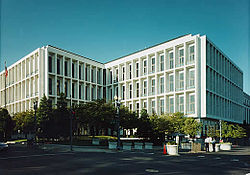
The Philip A. Hart Senate Office Building is the third U.S. Senate office building, and is located on 2nd Street NE between Constitution Avenue NE and C Street NE, northeast of the United States Capitol in Washington, D.C., in the United States. Construction began in January 1975, and it was first occupied in November 1982. Rapidly rising construction costs plagued the building, creating several unfortunate scandals. The structure is named for Philip A. Hart (1912–1976), who served 18 years as a United States Senator from Michigan. Accessed via a spur of the United States Capitol subway system, the building features a nine-story atrium dominated by massive artwork, and a large Central Hearing Facility which provides television facilities as well as extensive seating.
The Dirksen Senate Office Building was intended to occupy the entire block bounded by 1st Street NE, Constitution Avenue NE, 2nd Street NE, and C Street NE. However, due to the resource and financial demands of the Korean War, the building was scaled back and occupied only the western half of this area.
In 1969, Congress voted to acquire the eastern half of the block for a "New Senate Office Building". Originally, the Senate intended only to build a $21 million ($163,047,658 in 2024 dollars) underground parking garage here. That effort was approved in June 1971. But in May 1972, the Subcommittee on Buildings of the Senate Committee on Public Works approved a plan to construct the New Senate Office Building above the parking garage. The building's cost was estimated at $48 million ($372,680,362 in 2024 dollars) in June 1972. The full Senate approved the building plan in September 1972, but by then the building's estimated cost had risen to $53.5 million ($402,165,076 in 2024 dollars).
In April 1973, the Architect of the Capitol awarded the architectural design contract to John Carl Warnecke, a nationally prominent architect working in the District of Columbia who had helped save Lafayette Square and designed the John F. Kennedy grave site. Warnecke's design for the building was approved by the Senate Committee on Public Works on August 8, 1974. Warnecke was given just two weeks to come up with the cost estimate, which the Architect of the Capitol later claimed was far too little time to generate an accurate cost forecast. By the end of the year, the estimated cost of construction had risen to $69 million.
Ground for the new structure was broken in January 1975, and by the time ground clearance began in April the building's cost had risen to $84 million ($490,857,143 in 2024 dollars). The poor and uneven condition of the soil at the site caused delays in the excavation, and major cost increases. When the foundations were finished, it was discovered that many of the anchoring bolts were misaligned and had to be replaced. This also added extensive new costs to the project.
On August 30, 1976, the Senate voted to name the new office building the Philip A. Hart Senate Office Building in honor of retiring Senator Philip Hart (D-Michigan). Hart died on December 26, 1976, of melanoma, having declined to run for reelection the previous November.
By August 1978, actual construction costs were now $85 million ($409,778,061 in 2024 dollars) and were expected to top $122 million ($588,152,041 in 2024 dollars). The Senate approved a plan to spend another $54 million ($260,329,592 in 2024 dollars) on the structure, and cap costs at $135 million ($650,823,980 in 2024 dollars). Initially, the House approved this plan. But when constituents bitterly complained, the House reversed itself on both counts. By 1979, construction estimates had soared to $179 million ($775,502,522 in 2024 dollars), and the General Accounting Office said it would rise to $230 million ($996,455,754 in 2024 dollars) without changes. In July 1979, the Senate agreed to cap costs at $137.7 million ($596,573,728 in 2024 dollars) after an acrimonious three-hour debate during which some senators suggested the building be torn down. The Architect of the Capitol ordered changes in the design to keep construction costs under the $137.7 million cap. These included elimination of a penthouse-level dining room, $906,000 ($2,951,998 in 2024 dollars) in furnishings for an interior gymnasium, oak paneling for each senator's office, dimmer switches for lights, a $400,000 ($1,303,310 in 2024 dollars) art gallery, $227,000 ($739,629 in 2024 dollars) in carpeting for auxiliary space, $167,700 ($546,413 in 2024 dollars) for vertical blinds, and $1.2 million ($3,909,931 in 2024 dollars) for finishes and furnishings for a large central hearing room with hidden multimedia bays.
The Hart Senate Office Building was completed in September 1982 at a cost of $137.7 million ($448,664,586 in 2024 dollars). The Architect of the Capitol argued that the significantly higher costs of the Hart Senate Office building were due to the unexpected excavation issues, the foundation construction errors, Senate-ordered changes, high inflation, and some mismanagement of the construction project. Architect of the Capitol George Malcolm White argued the construction cost was a reasonable $110 per square foot. Architect John Carl Warnecke defended the building's cost, noting that it almost doubled in size (from 650,000 square feet (60,000 m2) to 1,100,000 square feet (100,000 m2)), and that building costs in the District of Columbia leapt 76 percent during its erection. Warnecke dismissed allegations about Senate-ordered changes, saying these increased costs just 2 percent, and said that construction alone was just $107 million ($348,635,517 in 2024 dollars) (with another $28 million ($91,231,724 in 2024 dollars) coming from administrative costs, fees, and furnishings). He argued that excellent construction management held inflation in construction costs to just 67 percent, and that the building was erected at a cost of $97 per square foot, "well below the costs of any other major public building built in the District during that period." However, the American Institute of Architects said commercial construction costs in Washington, D.C., ranged from $54 to $65 per square foot, and The Christian Science Monitor reported the cost of the building at $137.70 per square foot.
Hart Senate Office Building
The Philip A. Hart Senate Office Building is the third U.S. Senate office building, and is located on 2nd Street NE between Constitution Avenue NE and C Street NE, northeast of the United States Capitol in Washington, D.C., in the United States. Construction began in January 1975, and it was first occupied in November 1982. Rapidly rising construction costs plagued the building, creating several unfortunate scandals. The structure is named for Philip A. Hart (1912–1976), who served 18 years as a United States Senator from Michigan. Accessed via a spur of the United States Capitol subway system, the building features a nine-story atrium dominated by massive artwork, and a large Central Hearing Facility which provides television facilities as well as extensive seating.
The Dirksen Senate Office Building was intended to occupy the entire block bounded by 1st Street NE, Constitution Avenue NE, 2nd Street NE, and C Street NE. However, due to the resource and financial demands of the Korean War, the building was scaled back and occupied only the western half of this area.
In 1969, Congress voted to acquire the eastern half of the block for a "New Senate Office Building". Originally, the Senate intended only to build a $21 million ($163,047,658 in 2024 dollars) underground parking garage here. That effort was approved in June 1971. But in May 1972, the Subcommittee on Buildings of the Senate Committee on Public Works approved a plan to construct the New Senate Office Building above the parking garage. The building's cost was estimated at $48 million ($372,680,362 in 2024 dollars) in June 1972. The full Senate approved the building plan in September 1972, but by then the building's estimated cost had risen to $53.5 million ($402,165,076 in 2024 dollars).
In April 1973, the Architect of the Capitol awarded the architectural design contract to John Carl Warnecke, a nationally prominent architect working in the District of Columbia who had helped save Lafayette Square and designed the John F. Kennedy grave site. Warnecke's design for the building was approved by the Senate Committee on Public Works on August 8, 1974. Warnecke was given just two weeks to come up with the cost estimate, which the Architect of the Capitol later claimed was far too little time to generate an accurate cost forecast. By the end of the year, the estimated cost of construction had risen to $69 million.
Ground for the new structure was broken in January 1975, and by the time ground clearance began in April the building's cost had risen to $84 million ($490,857,143 in 2024 dollars). The poor and uneven condition of the soil at the site caused delays in the excavation, and major cost increases. When the foundations were finished, it was discovered that many of the anchoring bolts were misaligned and had to be replaced. This also added extensive new costs to the project.
On August 30, 1976, the Senate voted to name the new office building the Philip A. Hart Senate Office Building in honor of retiring Senator Philip Hart (D-Michigan). Hart died on December 26, 1976, of melanoma, having declined to run for reelection the previous November.
By August 1978, actual construction costs were now $85 million ($409,778,061 in 2024 dollars) and were expected to top $122 million ($588,152,041 in 2024 dollars). The Senate approved a plan to spend another $54 million ($260,329,592 in 2024 dollars) on the structure, and cap costs at $135 million ($650,823,980 in 2024 dollars). Initially, the House approved this plan. But when constituents bitterly complained, the House reversed itself on both counts. By 1979, construction estimates had soared to $179 million ($775,502,522 in 2024 dollars), and the General Accounting Office said it would rise to $230 million ($996,455,754 in 2024 dollars) without changes. In July 1979, the Senate agreed to cap costs at $137.7 million ($596,573,728 in 2024 dollars) after an acrimonious three-hour debate during which some senators suggested the building be torn down. The Architect of the Capitol ordered changes in the design to keep construction costs under the $137.7 million cap. These included elimination of a penthouse-level dining room, $906,000 ($2,951,998 in 2024 dollars) in furnishings for an interior gymnasium, oak paneling for each senator's office, dimmer switches for lights, a $400,000 ($1,303,310 in 2024 dollars) art gallery, $227,000 ($739,629 in 2024 dollars) in carpeting for auxiliary space, $167,700 ($546,413 in 2024 dollars) for vertical blinds, and $1.2 million ($3,909,931 in 2024 dollars) for finishes and furnishings for a large central hearing room with hidden multimedia bays.
The Hart Senate Office Building was completed in September 1982 at a cost of $137.7 million ($448,664,586 in 2024 dollars). The Architect of the Capitol argued that the significantly higher costs of the Hart Senate Office building were due to the unexpected excavation issues, the foundation construction errors, Senate-ordered changes, high inflation, and some mismanagement of the construction project. Architect of the Capitol George Malcolm White argued the construction cost was a reasonable $110 per square foot. Architect John Carl Warnecke defended the building's cost, noting that it almost doubled in size (from 650,000 square feet (60,000 m2) to 1,100,000 square feet (100,000 m2)), and that building costs in the District of Columbia leapt 76 percent during its erection. Warnecke dismissed allegations about Senate-ordered changes, saying these increased costs just 2 percent, and said that construction alone was just $107 million ($348,635,517 in 2024 dollars) (with another $28 million ($91,231,724 in 2024 dollars) coming from administrative costs, fees, and furnishings). He argued that excellent construction management held inflation in construction costs to just 67 percent, and that the building was erected at a cost of $97 per square foot, "well below the costs of any other major public building built in the District during that period." However, the American Institute of Architects said commercial construction costs in Washington, D.C., ranged from $54 to $65 per square foot, and The Christian Science Monitor reported the cost of the building at $137.70 per square foot.
Recent media
Recent media