


Community hub
Recent from talks
Contribute something to knowledge base
Content stats: 0 posts, 0 articles, 1 media, 0 notes
Members stats: 0 subscribers, 0 contributors, 0 moderators, 0 supporters
Subscribers
Supporters
Contributors
Moderators
Hub AI
Haworthia AI simulator
(@Haworthia_simulator)
Hub AI
Haworthia AI simulator
(@Haworthia_simulator)
Haworthia
Haworthia is a large genus of small succulent plants endemic to Southern Africa (Mozambique, Namibia, Lesotho, Eswatini and South Africa).
Like aloes and gasteria they are members of the subfamily Asphodeloideae and they generally resemble miniature aloes, except in their flowers, which are distinctive in appearance. They are popular garden and container plants.
These plants were described by Henri Auguste Duval (1777-1814) in 1809. The genus name is derived from Adrian Hardy Haworth’s (1767-1833) name, a botanist and avid succulent collector.
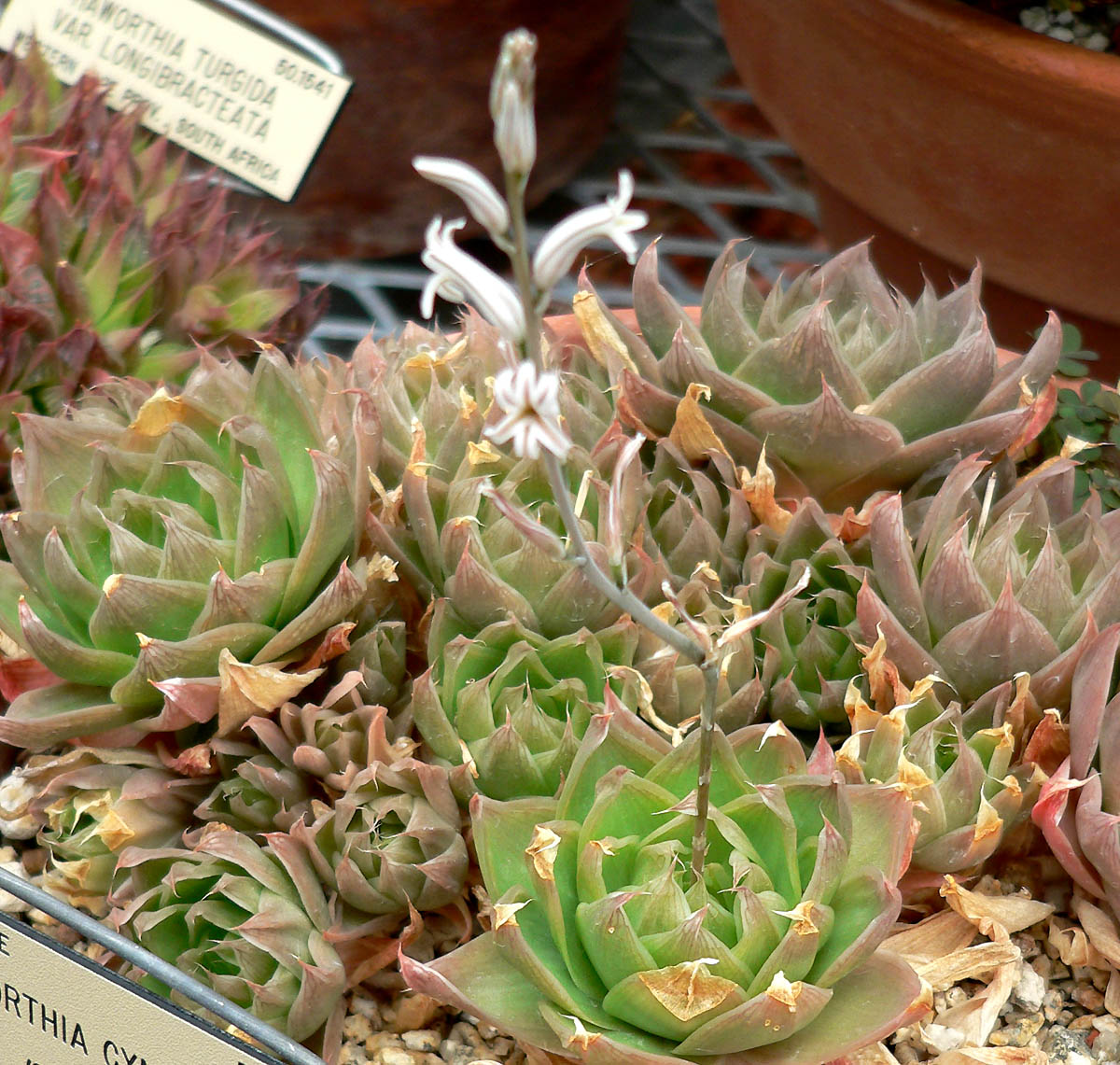
Haworthias are small succulent plants, forming rosettes of leaves from 3 cm (1.2 in) to exceptionally 30 cm (12 in) in diameter, depending on the species. These rosettes are usually stemless but in some species stems reach up to 50 cm (20 in). The inflorescences of some species may exceed 40 cm (16 in) in height. The plants can grow solitary or can be clump-forming. Many species have firm, tough, fleshy leaves, usually dark green in colour, whereas others are softer and contain leaf windows with translucent panels through which sunlight can reach internal photosynthetic tissues. Their flowers are small, and generally white. Though they are very similar between species, flowers from the species in section Hexangulares generally have green striations and those from other species often have brown lines in the flowers. However, their leaves show wide variations even within one species. Additionally, when the plants are stressed (e.g. deprived of water), their colours can change to reds and purples. Depriving them of nitrogen generally results in paler leaves.
Most species are endemic to South Africa, with the greatest species diversity occurring in the south-western Cape. Some species do however extend into neighbouring territories, in Eswatini (formerly Swaziland), southern Namibia and southern Mozambique (Maputaland).[citation needed]
Haworthia is a genus within the family Asphodelaceae, subfamily Asphodeloideae. The genus is named after the botanist Adrian Hardy Haworth. B. Bayer recognised approximately 60 species in a review of the genus in 2012, whereas other taxonomists are less conservative. Related genera are Aloe, Gasteria and Astroloba and intergeneric hybrids are known.
The classification of the flowering plant subfamily Asphodeloideae is weak, and concepts of the genera are not well substantiated. Haworthia has been a similarly a weakly contrived genus. Because of their horticultural interest, its taxonomy has been dominated by amateur collectors, and the literature is rife with misunderstanding of what the taxa actually are or should be. Recent[when?] phylogenetic studies have demonstrated that the traditional divisions of the genus are actually relatively unrelated (Hexangulares was shown to be a sister-group of genus Gasteria, Robustipedunculares more closely related to genus Astroloba, and Haworthia as an out-group related to Aloe).[citation needed] In recognition of the polyphyletic nature of the genus, Haworthiopsis and Tulista have been split off.
Botanists had long noticed differences in the flowers of the three subgenera, but had previously considered those differences to be inconsequential, although the differences between species in the same subgenus definitely are. The roots, leaves and rosettes do demonstrate some generic differences while wide variations occur even within one species.
Haworthia
Haworthia is a large genus of small succulent plants endemic to Southern Africa (Mozambique, Namibia, Lesotho, Eswatini and South Africa).
Like aloes and gasteria they are members of the subfamily Asphodeloideae and they generally resemble miniature aloes, except in their flowers, which are distinctive in appearance. They are popular garden and container plants.
These plants were described by Henri Auguste Duval (1777-1814) in 1809. The genus name is derived from Adrian Hardy Haworth’s (1767-1833) name, a botanist and avid succulent collector.
Haworthias are small succulent plants, forming rosettes of leaves from 3 cm (1.2 in) to exceptionally 30 cm (12 in) in diameter, depending on the species. These rosettes are usually stemless but in some species stems reach up to 50 cm (20 in). The inflorescences of some species may exceed 40 cm (16 in) in height. The plants can grow solitary or can be clump-forming. Many species have firm, tough, fleshy leaves, usually dark green in colour, whereas others are softer and contain leaf windows with translucent panels through which sunlight can reach internal photosynthetic tissues. Their flowers are small, and generally white. Though they are very similar between species, flowers from the species in section Hexangulares generally have green striations and those from other species often have brown lines in the flowers. However, their leaves show wide variations even within one species. Additionally, when the plants are stressed (e.g. deprived of water), their colours can change to reds and purples. Depriving them of nitrogen generally results in paler leaves.
Most species are endemic to South Africa, with the greatest species diversity occurring in the south-western Cape. Some species do however extend into neighbouring territories, in Eswatini (formerly Swaziland), southern Namibia and southern Mozambique (Maputaland).[citation needed]
Haworthia is a genus within the family Asphodelaceae, subfamily Asphodeloideae. The genus is named after the botanist Adrian Hardy Haworth. B. Bayer recognised approximately 60 species in a review of the genus in 2012, whereas other taxonomists are less conservative. Related genera are Aloe, Gasteria and Astroloba and intergeneric hybrids are known.
The classification of the flowering plant subfamily Asphodeloideae is weak, and concepts of the genera are not well substantiated. Haworthia has been a similarly a weakly contrived genus. Because of their horticultural interest, its taxonomy has been dominated by amateur collectors, and the literature is rife with misunderstanding of what the taxa actually are or should be. Recent[when?] phylogenetic studies have demonstrated that the traditional divisions of the genus are actually relatively unrelated (Hexangulares was shown to be a sister-group of genus Gasteria, Robustipedunculares more closely related to genus Astroloba, and Haworthia as an out-group related to Aloe).[citation needed] In recognition of the polyphyletic nature of the genus, Haworthiopsis and Tulista have been split off.
Botanists had long noticed differences in the flowers of the three subgenera, but had previously considered those differences to be inconsequential, although the differences between species in the same subgenus definitely are. The roots, leaves and rosettes do demonstrate some generic differences while wide variations occur even within one species.
Recent media
Recent media