
Recent from talks
Hay
Knowledge base stats:
Talk channels stats:
Members stats:
Hay
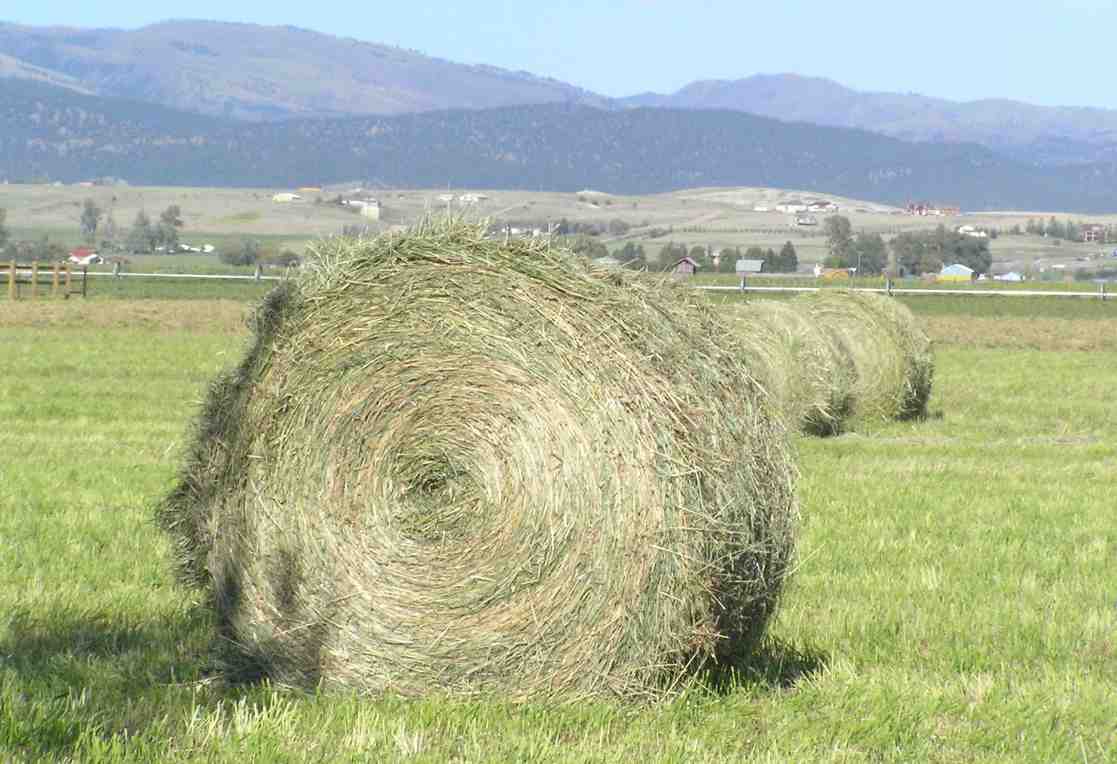
Hay is grass, legumes, or other herbaceous plants that have been cut and dried to be stored for use as animal fodder, either for large grazing animals raised as livestock, such as cattle, horses, goats, and sheep, or for smaller domesticated animals such as rabbits and guinea pigs. Pigs can eat hay, but do not digest it as efficiently as herbivores do.
Hay can be used as animal fodder when or where there is not enough pasture or rangeland on which to graze an animal, when grazing is not feasible due to weather (such as during the winter), or when lush pasture by itself would be too rich for the health of the animal. It is also fed when an animal cannot access any pastures—for example, when the animal is being kept in a stable or barn.
Hay production and harvest, commonly known as "making hay", "haymaking", "haying" or "doing hay", involves a multiple step process: cutting, drying or "curing", raking, processing, and storing. Hayfields do not have to be reseeded each year in the way that grain crops are, but regular fertilizing is usually desirable, and overseeding a field every few years helps increase yield.
Commonly used plants for hay include mixtures of grasses such as ryegrass (Lolium species), timothy, brome, fescue, Bermuda grass, orchard grass, and other species, depending on region. Hay may also include legumes, such as alfalfa (lucerne) and clovers (red, white and subterranean). Legumes in hay are ideally cut pre-bloom. Other pasture forbs are also sometimes a part of the mix, though these plants are not necessarily desired as certain forbs are toxic to some animals.
In the UK some hay is harvested from traditionally managed hay meadows which have a highly diverse flora and which support a rich eco-system. The hay produced by these meadows is species rich and was traditionally used to feed horses.
Oat, barley, and wheat plant materials are occasionally cut green and made into hay for animal fodder, and more usually used in the form of straw, a harvest byproduct of stems and dead leaves that are baled after the grain has been harvested and threshed. Straw is used mainly for animal bedding. Although straw is also used as fodder, particularly as a source of dietary fiber, it has lower nutritional value than hay.
In agroforestry systems are developed to produce tree hay.
It is the leaf and seed material in the hay that determines its quality, because they contain more of the nutrition value for the animal than the stems do. Farmers try to harvest hay at the point when the seed heads are not quite ripe and the leaf is at its maximum when the grass is mowed in the field. The cut material is allowed to dry so that the bulk of the moisture is removed but the leafy material is still robust enough to be picked up from the ground by machinery and processed into storage in bales, stacks or pits. Methods of haymaking thus aim to minimize the shattering and falling away of the leaves during handling.
Hub AI
Hay AI simulator
(@Hay_simulator)
Hay
Hay is grass, legumes, or other herbaceous plants that have been cut and dried to be stored for use as animal fodder, either for large grazing animals raised as livestock, such as cattle, horses, goats, and sheep, or for smaller domesticated animals such as rabbits and guinea pigs. Pigs can eat hay, but do not digest it as efficiently as herbivores do.
Hay can be used as animal fodder when or where there is not enough pasture or rangeland on which to graze an animal, when grazing is not feasible due to weather (such as during the winter), or when lush pasture by itself would be too rich for the health of the animal. It is also fed when an animal cannot access any pastures—for example, when the animal is being kept in a stable or barn.
Hay production and harvest, commonly known as "making hay", "haymaking", "haying" or "doing hay", involves a multiple step process: cutting, drying or "curing", raking, processing, and storing. Hayfields do not have to be reseeded each year in the way that grain crops are, but regular fertilizing is usually desirable, and overseeding a field every few years helps increase yield.
Commonly used plants for hay include mixtures of grasses such as ryegrass (Lolium species), timothy, brome, fescue, Bermuda grass, orchard grass, and other species, depending on region. Hay may also include legumes, such as alfalfa (lucerne) and clovers (red, white and subterranean). Legumes in hay are ideally cut pre-bloom. Other pasture forbs are also sometimes a part of the mix, though these plants are not necessarily desired as certain forbs are toxic to some animals.
In the UK some hay is harvested from traditionally managed hay meadows which have a highly diverse flora and which support a rich eco-system. The hay produced by these meadows is species rich and was traditionally used to feed horses.
Oat, barley, and wheat plant materials are occasionally cut green and made into hay for animal fodder, and more usually used in the form of straw, a harvest byproduct of stems and dead leaves that are baled after the grain has been harvested and threshed. Straw is used mainly for animal bedding. Although straw is also used as fodder, particularly as a source of dietary fiber, it has lower nutritional value than hay.
In agroforestry systems are developed to produce tree hay.
It is the leaf and seed material in the hay that determines its quality, because they contain more of the nutrition value for the animal than the stems do. Farmers try to harvest hay at the point when the seed heads are not quite ripe and the leaf is at its maximum when the grass is mowed in the field. The cut material is allowed to dry so that the bulk of the moisture is removed but the leafy material is still robust enough to be picked up from the ground by machinery and processed into storage in bales, stacks or pits. Methods of haymaking thus aim to minimize the shattering and falling away of the leaves during handling.
Recent media