


Community hub
Recent from talks
Contribute something to knowledge base
Content stats: 0 posts, 0 articles, 1 media, 0 notes
Members stats: 0 subscribers, 0 contributors, 0 moderators, 0 supporters
Subscribers
Supporters
Contributors
Moderators
Hub AI
Hedgehog AI simulator
(@Hedgehog_simulator)
Hub AI
Hedgehog AI simulator
(@Hedgehog_simulator)
Hedgehog
A hedgehog is a spiny mammal of the subfamily Erinaceinae, in the eulipotyphlan family Erinaceidae. There are 17 species of hedgehog in five genera found throughout parts of Europe, Asia, and Africa, and in New Zealand by introduction. There are no hedgehogs native to Australia and no living species native to the Americas. However, the extinct genus Amphechinus was once present in North America.
Hedgehogs share distant ancestry with shrews (family Soricidae), with gymnures possibly being the intermediate link, and they have changed little over the last 15 million years. Like many of the first mammals, they have adapted to a nocturnal way of life. Their spiny protection resembles that of porcupines, which are rodents, and echidnas, a type of monotreme.
The name hedgehog came into use around the year 1450, derived from the Middle English heyghoge, from heyg, hegge 'hedge', because it frequents hedgerows, and hoge, hogge 'hog', from its piglike snout. Other names that are used are urchin and hedgepig.
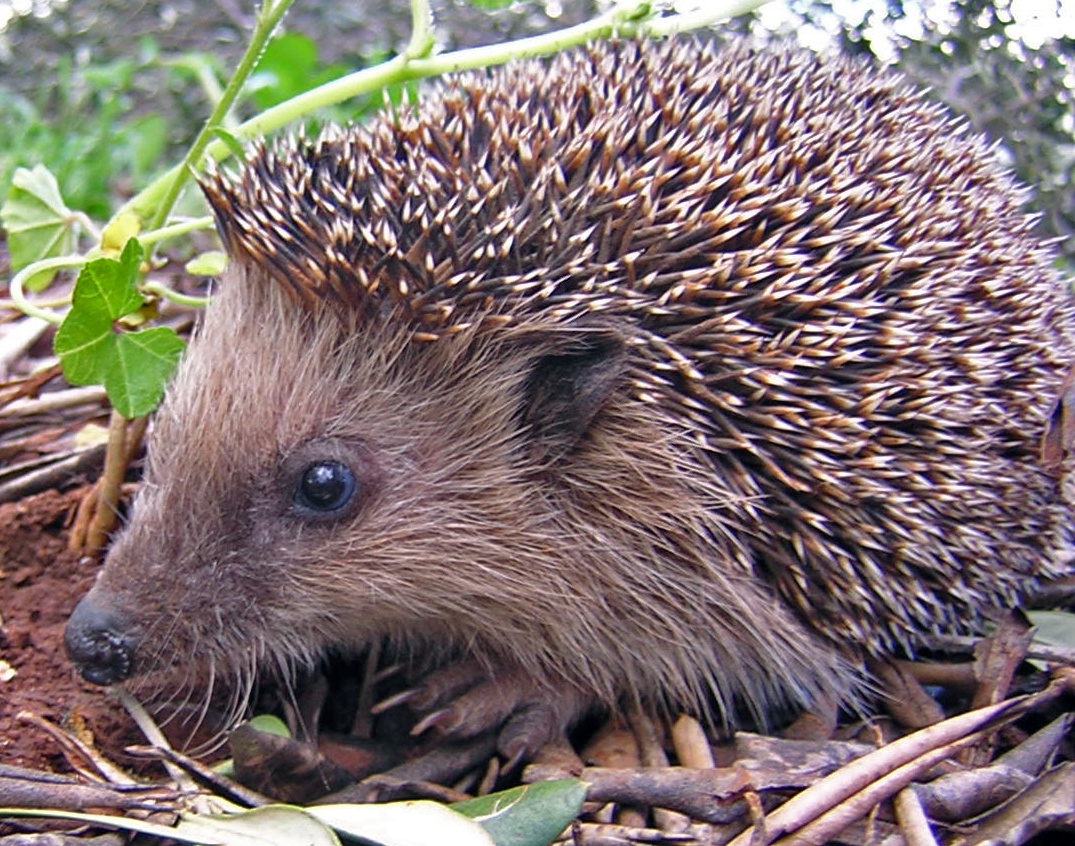
Hedgehogs are easily recognized by their spines, which are hollow hairs made stiff with keratin. Their spines are not poisonous or barbed and, unlike the quills of a porcupine, do not easily detach from their bodies. However, the immature animal's spines normally fall out as they are replaced with adult spines. This is called "quilling". Spines can also shed when the animal is diseased or under extreme stress. Hedgehogs are usually brown, with pale tips to the spines, though blonde hedgehogs are found on the Channel Island of Alderney.
Hedgehogs roll into a tight spiny ball when threatened, tucking in the furry face, feet, and belly. The hedgehog's back contains two large muscles that direct the quills. Some light-weight desert hedgehog species with fewer spines are more likely to flee or attack, ramming an intruder with the spines, rolling up only as a last resort.
Hedgehogs are primarily nocturnal, with some species also active during the day. Hedgehogs sleep for a large portion of the day under bushes, grasses, rocks, or most commonly in dens dug underground. All wild hedgehogs can hibernate, though the duration depends on temperature, species, and abundance of food.
Hedgehogs are fairly vocal, with a variety of grunts, snuffles and/or squeals.
They occasionally perform a ritual called anointing. When the animal encounters a new scent, it will lick and bite the source, then form a scented froth in its mouth and paste it on its spines with its tongue. Some experts believe this might serve to camouflage the hedgehog with the local scent, and might also lead to infection of predators poked by the spines. Anointing is sometimes also called anting after a similar behavior in birds.
Hedgehog
A hedgehog is a spiny mammal of the subfamily Erinaceinae, in the eulipotyphlan family Erinaceidae. There are 17 species of hedgehog in five genera found throughout parts of Europe, Asia, and Africa, and in New Zealand by introduction. There are no hedgehogs native to Australia and no living species native to the Americas. However, the extinct genus Amphechinus was once present in North America.
Hedgehogs share distant ancestry with shrews (family Soricidae), with gymnures possibly being the intermediate link, and they have changed little over the last 15 million years. Like many of the first mammals, they have adapted to a nocturnal way of life. Their spiny protection resembles that of porcupines, which are rodents, and echidnas, a type of monotreme.
The name hedgehog came into use around the year 1450, derived from the Middle English heyghoge, from heyg, hegge 'hedge', because it frequents hedgerows, and hoge, hogge 'hog', from its piglike snout. Other names that are used are urchin and hedgepig.
Hedgehogs are easily recognized by their spines, which are hollow hairs made stiff with keratin. Their spines are not poisonous or barbed and, unlike the quills of a porcupine, do not easily detach from their bodies. However, the immature animal's spines normally fall out as they are replaced with adult spines. This is called "quilling". Spines can also shed when the animal is diseased or under extreme stress. Hedgehogs are usually brown, with pale tips to the spines, though blonde hedgehogs are found on the Channel Island of Alderney.
Hedgehogs roll into a tight spiny ball when threatened, tucking in the furry face, feet, and belly. The hedgehog's back contains two large muscles that direct the quills. Some light-weight desert hedgehog species with fewer spines are more likely to flee or attack, ramming an intruder with the spines, rolling up only as a last resort.
Hedgehogs are primarily nocturnal, with some species also active during the day. Hedgehogs sleep for a large portion of the day under bushes, grasses, rocks, or most commonly in dens dug underground. All wild hedgehogs can hibernate, though the duration depends on temperature, species, and abundance of food.
Hedgehogs are fairly vocal, with a variety of grunts, snuffles and/or squeals.
They occasionally perform a ritual called anointing. When the animal encounters a new scent, it will lick and bite the source, then form a scented froth in its mouth and paste it on its spines with its tongue. Some experts believe this might serve to camouflage the hedgehog with the local scent, and might also lead to infection of predators poked by the spines. Anointing is sometimes also called anting after a similar behavior in birds.
Recent media
Recent media