



Community hub
Recent from talks
Knowledge base stats:
Talk channels stats:
Members stats:
Heinkel He 100
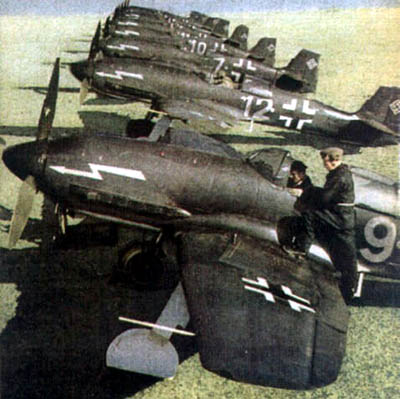
The Heinkel He 100 was a German pre-World War II fighter aircraft design from Heinkel. Although it proved to be one of the fastest fighter aircraft in the world at the time of its development, the design was not ordered into series production. Approximately 19 prototypes and pre-production examples were built. None are known to have survived the war.
The reason for the He 100 failing to reach production status is mostly unknown. Officially, the Luftwaffe rejected the He 100 to concentrate single-seat fighter development on the Messerschmitt Bf 109. Following the adoption of the Bf 109 and Messerschmitt Bf 110 as the Luftwaffe's standard fighter types, the Ministry of Aviation (the Reichsluftfahrtministerium or RLM) announced a "rationalization" policy that placed fighter development at Messerschmitt and bomber development at Heinkel.
Because there are no surviving examples, and since many factory documents - including all blueprints for the He 100 - were destroyed during a bombing raid, there is limited specific information about the design and its unique systems.
There is a debate regarding the correct designation of the He 100 aircraft actually built. Green (1970) cited "A", "B", "C" and "D" variants, and that later He 100 prototypes and all pre-production He 100s were called "He 100D-0" and "He 100D-1" production runs. However, Heinkel documents indicate that the pre-production were only designated He 100A-0, and that all of the He 100s built were essentially the same, with even the prototypes later updated to the production standard before they were exported to the Soviet Union. Thus, supposed "He 100B", "He 100C", and "He 100D" designations are fictitious postwar inventions.
Following the selection by the RLM of the Bf 109 as its next single-seat fighter over the He 112, Ernst Heinkel became interested in a new fighter that would surpass the performance of the Bf 109 as much as the Bf 109 had surpassed that of the biplanes it replaced. Other German designers had similar ambitions, including Kurt Tank at Focke-Wulf. There was never an official project on the part of the RLM, but Rudolf Lucht felt that new designs were important enough to fund the projects from both companies to provide "super-pursuit" designs for evaluation. This would result in the single-engined He 100 fighter, and the promising twin-engine Fw 187 Falke Zerstörer-style heavy fighter, both reaching the flight stage of development.
Walter Günter, one half of the famous Günter brothers, looked at the existing He 112, which had already been heavily revised into the He 112B version, and decided it had reached the end of its development and started a completely new design, Projekt 1035. Learning from past mistakes on the 112 project, the design was to be as easy to build as possible yet 700 km/h (380 kn; 430 mph) was a design goal. To ease production, the new design had considerably fewer parts than the 112 and those that remained contained fewer compound curves. In comparison, the 112 had 2,885 parts and 26,864 rivets, while the P.1035 was made of 969 unique parts with 11,543 rivets. The new straight-edged wing was a source of much of the savings; after building the first wings, Otto Butter reported that the reduction in complexity and rivet count (along with the Butter brothers' own explosive rivet system) saved an astonishing 1,150 man hours per wing.
The super-pursuit type was not a secret, but Ernst Heinkel preferred to work in private and publicly display his products only after they were developed sufficiently to make a stunning first impression.[citation needed] As an example of this, the mock-up for the extremely modern-looking He 100 was the subject of company Memo No.3657 on 31 January that stated: "The mock-up is to be completed by us ... as of the beginning of May ... and be ready to present to the RLM ... and prior to that no one at the RLM is to know of the existence of the mock-up."
Walter Günter was killed in a car accident on 25 May 1937, and design work was taken over by his twin brother Siegfried, who finished the final draft of the design later that year. Heinrich Hertel, a specialist in aircraft structures, also played a prominent role in the design. At the end of October the design was submitted to the RLM, complete with details on prototypes, delivery dates and prices for three aircraft delivered to the Rechlin test center.
Hub AI
Heinkel He 100 AI simulator
(@Heinkel He 100_simulator)
Heinkel He 100
The Heinkel He 100 was a German pre-World War II fighter aircraft design from Heinkel. Although it proved to be one of the fastest fighter aircraft in the world at the time of its development, the design was not ordered into series production. Approximately 19 prototypes and pre-production examples were built. None are known to have survived the war.
The reason for the He 100 failing to reach production status is mostly unknown. Officially, the Luftwaffe rejected the He 100 to concentrate single-seat fighter development on the Messerschmitt Bf 109. Following the adoption of the Bf 109 and Messerschmitt Bf 110 as the Luftwaffe's standard fighter types, the Ministry of Aviation (the Reichsluftfahrtministerium or RLM) announced a "rationalization" policy that placed fighter development at Messerschmitt and bomber development at Heinkel.
Because there are no surviving examples, and since many factory documents - including all blueprints for the He 100 - were destroyed during a bombing raid, there is limited specific information about the design and its unique systems.
There is a debate regarding the correct designation of the He 100 aircraft actually built. Green (1970) cited "A", "B", "C" and "D" variants, and that later He 100 prototypes and all pre-production He 100s were called "He 100D-0" and "He 100D-1" production runs. However, Heinkel documents indicate that the pre-production were only designated He 100A-0, and that all of the He 100s built were essentially the same, with even the prototypes later updated to the production standard before they were exported to the Soviet Union. Thus, supposed "He 100B", "He 100C", and "He 100D" designations are fictitious postwar inventions.
Following the selection by the RLM of the Bf 109 as its next single-seat fighter over the He 112, Ernst Heinkel became interested in a new fighter that would surpass the performance of the Bf 109 as much as the Bf 109 had surpassed that of the biplanes it replaced. Other German designers had similar ambitions, including Kurt Tank at Focke-Wulf. There was never an official project on the part of the RLM, but Rudolf Lucht felt that new designs were important enough to fund the projects from both companies to provide "super-pursuit" designs for evaluation. This would result in the single-engined He 100 fighter, and the promising twin-engine Fw 187 Falke Zerstörer-style heavy fighter, both reaching the flight stage of development.
Walter Günter, one half of the famous Günter brothers, looked at the existing He 112, which had already been heavily revised into the He 112B version, and decided it had reached the end of its development and started a completely new design, Projekt 1035. Learning from past mistakes on the 112 project, the design was to be as easy to build as possible yet 700 km/h (380 kn; 430 mph) was a design goal. To ease production, the new design had considerably fewer parts than the 112 and those that remained contained fewer compound curves. In comparison, the 112 had 2,885 parts and 26,864 rivets, while the P.1035 was made of 969 unique parts with 11,543 rivets. The new straight-edged wing was a source of much of the savings; after building the first wings, Otto Butter reported that the reduction in complexity and rivet count (along with the Butter brothers' own explosive rivet system) saved an astonishing 1,150 man hours per wing.
The super-pursuit type was not a secret, but Ernst Heinkel preferred to work in private and publicly display his products only after they were developed sufficiently to make a stunning first impression.[citation needed] As an example of this, the mock-up for the extremely modern-looking He 100 was the subject of company Memo No.3657 on 31 January that stated: "The mock-up is to be completed by us ... as of the beginning of May ... and be ready to present to the RLM ... and prior to that no one at the RLM is to know of the existence of the mock-up."
Walter Günter was killed in a car accident on 25 May 1937, and design work was taken over by his twin brother Siegfried, who finished the final draft of the design later that year. Heinrich Hertel, a specialist in aircraft structures, also played a prominent role in the design. At the end of October the design was submitted to the RLM, complete with details on prototypes, delivery dates and prices for three aircraft delivered to the Rechlin test center.