Hubbry Logo
logo
Messerschmitt Bf 110
Community hub

Messerschmitt Bf 110

logo
0 subscribers
Be the first to start a discussion here.
Contribute something to knowledge base
Hub AI

Messerschmitt Bf 110 AI simulator

(@Messerschmitt Bf 110_simulator)

Messerschmitt Bf 110

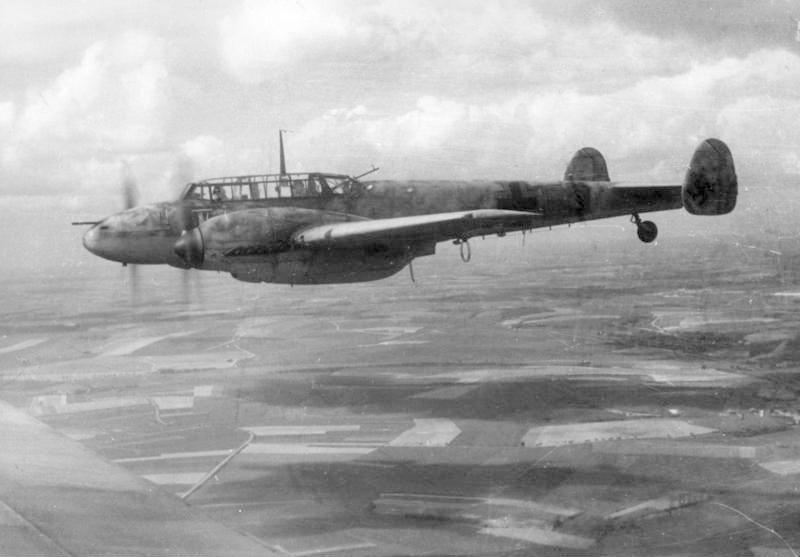
The Messerschmitt Bf 110, often known unofficially as the Me 110, is a twin-engined Zerstörer (destroyer, heavy fighter), fighter-bomber (Jagdbomber or Jabo), and night fighter (Nachtjäger) designed by the German aircraft company Bayerische Flugzeugwerke (BFW) and produced by successor company Messerschmitt. It was primarily operated by the Luftwaffe and was active throughout the Second World War.

Development of the Bf 110 commenced during the first half of the 1930s; one early proponent of the type was Hermann Göring, who believed its heavy armament, speed, and range would make it the premier offensive fighter of the Luftwaffe. Early variants were armed with a pair of MG FF 20 mm cannon, four 7.92 mm (.323 in) MG 17 machine guns, and one 7.92 mm (.323 in) MG 15 machine gun for defence (later variants would replace the MG FFs with MG 151s and the rear gunner station would be armed with the twin-barreled MG 81Z). Development work on an improved type to replace the Bf 110 – the Messerschmitt Me 210 – began before the conflict started, but its shakedown troubles resulted in the Bf 110 soldiering on until the end of the war in various roles. Its intended replacements, the aforementioned Me 210 and the significantly improved Me 410 Hornisse, never fully replaced the Bf 110.

The Bf 110 served with considerable success in the early campaigns in Poland, Norway, and France. The primary weakness of the Bf 110 was its lack of manoeuvrability, although this could be mitigated with better tactics. This weakness was exploited by the RAF, when Bf 110s were flown as close escort to German bombers during the Battle of Britain. When British bombers began targeting German territory with nightly raids, some Bf 110-equipped units were converted to night fighters, a role to which the aircraft was well suited. After the Battle of Britain, the Bf 110 enjoyed a successful period as an air superiority fighter and strike aircraft in other theatres and defended Germany from strategic air attack by day against the United States Army Air Forces (USAAF)'s Eighth Air Force, until an American change in fighter tactics rendered them increasingly vulnerable to developing American air supremacy over the Reich as 1944 began.

During the Balkans and North African campaigns and on the Eastern Front, the Bf 110 rendered valuable ground support to the German Army as a potent fighter-bomber. Later in the conflict, it was developed into a formidable radar-equipped night fighter, becoming the principal night-fighting aircraft of the Luftwaffe. The majority of the German night fighter aces flew the Bf 110 at some point during their combat careers and the top night fighter ace, Major Heinz-Wolfgang Schnaufer, flew it exclusively and claimed 121 victories in 164 sorties. In addition to its use by the Luftwaffe, other operators of the type included the Hungarian Air Force, the Regia Aeronautica, and the Romanian Air Force.

Throughout the 1930s, the air forces of many major military powers were engaged in a transition from biplane to monoplane designs. Most concentrated on the single-engined fighter aircraft, but the problem of range arose. The Ministry of Aviation (RLM, for Reichsluftfahrtministerium), at the encouragement of Hermann Göring, issued a request for a new multipurpose fighter called the Kampfzerstörer (battle destroyer) with long range and an internal bomb bay. This request called for a twin-engined, three-seat, all-metal monoplane that was armed with cannon and a bomb bay. Of the seven companies approached, only Bayerische Flugzeugwerke (which later became Messerschmitt), Focke-Wulf, and Henschel responded to the request.

The Focke-Wulf design, the Focke-Wulf Fw 57, had a wingspan of 25.6 m (84 ft) and was powered by a pair of DB 600 engines. It was armed with two 20 mm MG FF cannons in the nose, while a third was positioned in a dorsal turret. The Fw 57 V1 flew in 1936, but its performance was poor and the machine crashed. The Henschel Hs 124 was similar in construction layout to the Fw 57, equipped with two Jumo 210C for the V1. The V2 used the BMW 132Dc radial engines generating 870 PS compared with the 640 PS Jumo. The armament consisted of a single rearward-firing 7.92 mm (.312 in) MG 15 machine gun and a single forward-firing 20 mm MG FF cannon.

Bayerische Flugzeugwerke omitted the internal bomb load requirement from the RLM directive to increase the armament element of the RLM's specification. The Bf 110 proved to be far superior to its rivals in providing the speed, range, and firepower to meet its role requirements. Accordingly, Bayerische Flugzeugwerke's submission bested Focke-Wulf, Henschel, and Arado, and thus the firm was given the funds to build several prototype aircraft. By the end of 1935, the Bf 110 had evolved into an all-metal, low-wing cantilever monoplane of semimonocoque design featuring twin vertical stabilizers and powered by two DB 600A engines. The design was also fitted with Handley-Page wing slots (actually, leading-edge slats).

By luck (and pressure by Ernst Udet), the RLM reconsidered the ideas of the Kampfzerstörer and began focusing on the Zerstörer. Due to these changes, the Bayerische Flugzeugwerke design better fit the Ministry's requests. On 12 May 1936, Rudolf Opitz flew the first Bf 110 from Augsburg. As many pre-war designs found, the engine technologies promised were of insufficient reliability. Even with the temperamental DB 600 engines, the RLM found that the Bf 110, while not as manoeuvrable as desired, was rather faster than its original request specified, as well as faster than the front-line fighter, the Bf 109 B-1. The order for four pre-production A-0 units was promptly placed, the first of which was delivered in January 1937. Amid this phase of testing, both the Focke-Wulf Fw 187 and Henschel Hs 124 competitors were rejected and the Bf 110 was ordered into full rate production.

See all
German heavy fighter
User Avatar
No comments yet.