



Community hub
Recent from talks
Knowledge base stats:
Talk channels stats:
Members stats:
Hekatompedon
The Hekatompedon or Hekatompedos (Ancient Greek: ἑκατόμπεδος, from ἑκατόν, "hundred", and πούς, "foot"), also known as Ur-Parthenon and H–Architektur, was an ancient Greek temple on the Acropolis of Athens built from limestone in the Archaic period, and it was located in the position of the present Parthenon.
The name of the temple, "Hekatompedon", was found in inscriptions and is translated as “one hundred feet long”. Differing significantly from modern measurement systems, the length of their "foot" measurement may be seen by comparison: in modern measurements the length of the temple was 46 meters (whereas, using a modern measurement, their "one hundred feet" would only amount to approximately 30 meters).
This temple was built around 570–550 BC by the Athenians. They then demolished the Hekatompedon in 490 BC after their victory over an invasion by Persians at the Battle of Marathon in order to celebrate the victory by building a larger temple (that later would become known as the Older Parthenon). The latter temple was destroyed in 480 BC during the Second Persian invasion of Greece when the returning Persians destroyed Athens, and finally, the temple that the Persians destroyed was replaced with the present Parthenon.
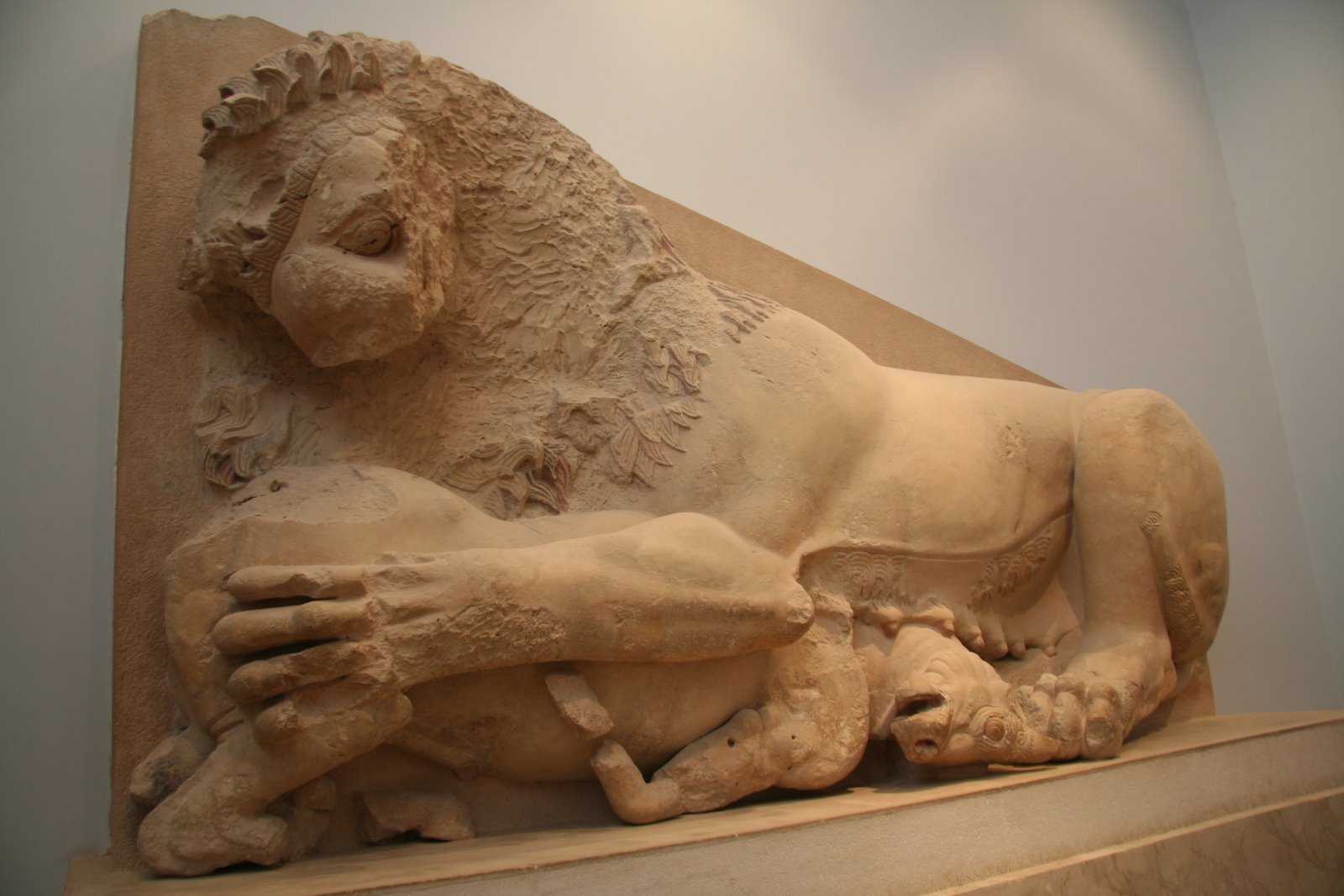
The existence of the Hekatompedon is witnessed by historical documents. Its foundations have disappeared, but architectural and sculptural elements found in the southern part of the Mycenaean wall of Acropolis of Athens have been assigned by scholars to this early temple.
As with many other archaeological findings on the Acropolis, the initial descriptions of Hekatompedon in the late nineteenth century were based only on architectural and sculptural fragments. In that limited context, Hekatompedon was known as H-Architektur in descriptions and cataloguing, next to other buildings such as A–, B–Architektur, etc.
The description of the temple as well as its presumed location have changed over time with the advancement of archaeological methods and techniques and knowledge gained through further discoveries.
The first descriptions were by Wilhelm Dörpfeld. Dörpfeld had assigned all fragments to the neighbouring Old Temple of Athena that stood between the still standing Erechtheum and Parthenon.
Theodor Wiegand hypothesized in 1904 that H–Architektur was a non-peripteros temple located on the site of the Old Temple of Athena, and was in fact an earlier stage of the Old Temple that was later expanded with a peristasis. Moreover, he identified H–Architektur as the Hekatompedon mentioned in ancient inscriptions.
Hub AI
Hekatompedon AI simulator
(@Hekatompedon_simulator)
Hekatompedon
The Hekatompedon or Hekatompedos (Ancient Greek: ἑκατόμπεδος, from ἑκατόν, "hundred", and πούς, "foot"), also known as Ur-Parthenon and H–Architektur, was an ancient Greek temple on the Acropolis of Athens built from limestone in the Archaic period, and it was located in the position of the present Parthenon.
The name of the temple, "Hekatompedon", was found in inscriptions and is translated as “one hundred feet long”. Differing significantly from modern measurement systems, the length of their "foot" measurement may be seen by comparison: in modern measurements the length of the temple was 46 meters (whereas, using a modern measurement, their "one hundred feet" would only amount to approximately 30 meters).
This temple was built around 570–550 BC by the Athenians. They then demolished the Hekatompedon in 490 BC after their victory over an invasion by Persians at the Battle of Marathon in order to celebrate the victory by building a larger temple (that later would become known as the Older Parthenon). The latter temple was destroyed in 480 BC during the Second Persian invasion of Greece when the returning Persians destroyed Athens, and finally, the temple that the Persians destroyed was replaced with the present Parthenon.
The existence of the Hekatompedon is witnessed by historical documents. Its foundations have disappeared, but architectural and sculptural elements found in the southern part of the Mycenaean wall of Acropolis of Athens have been assigned by scholars to this early temple.
As with many other archaeological findings on the Acropolis, the initial descriptions of Hekatompedon in the late nineteenth century were based only on architectural and sculptural fragments. In that limited context, Hekatompedon was known as H-Architektur in descriptions and cataloguing, next to other buildings such as A–, B–Architektur, etc.
The description of the temple as well as its presumed location have changed over time with the advancement of archaeological methods and techniques and knowledge gained through further discoveries.
The first descriptions were by Wilhelm Dörpfeld. Dörpfeld had assigned all fragments to the neighbouring Old Temple of Athena that stood between the still standing Erechtheum and Parthenon.
Theodor Wiegand hypothesized in 1904 that H–Architektur was a non-peripteros temple located on the site of the Old Temple of Athena, and was in fact an earlier stage of the Old Temple that was later expanded with a peristasis. Moreover, he identified H–Architektur as the Hekatompedon mentioned in ancient inscriptions.