
Recent from talks
Second Persian invasion of Greece
Knowledge base stats:
Talk channels stats:
Members stats:
Second Persian invasion of Greece
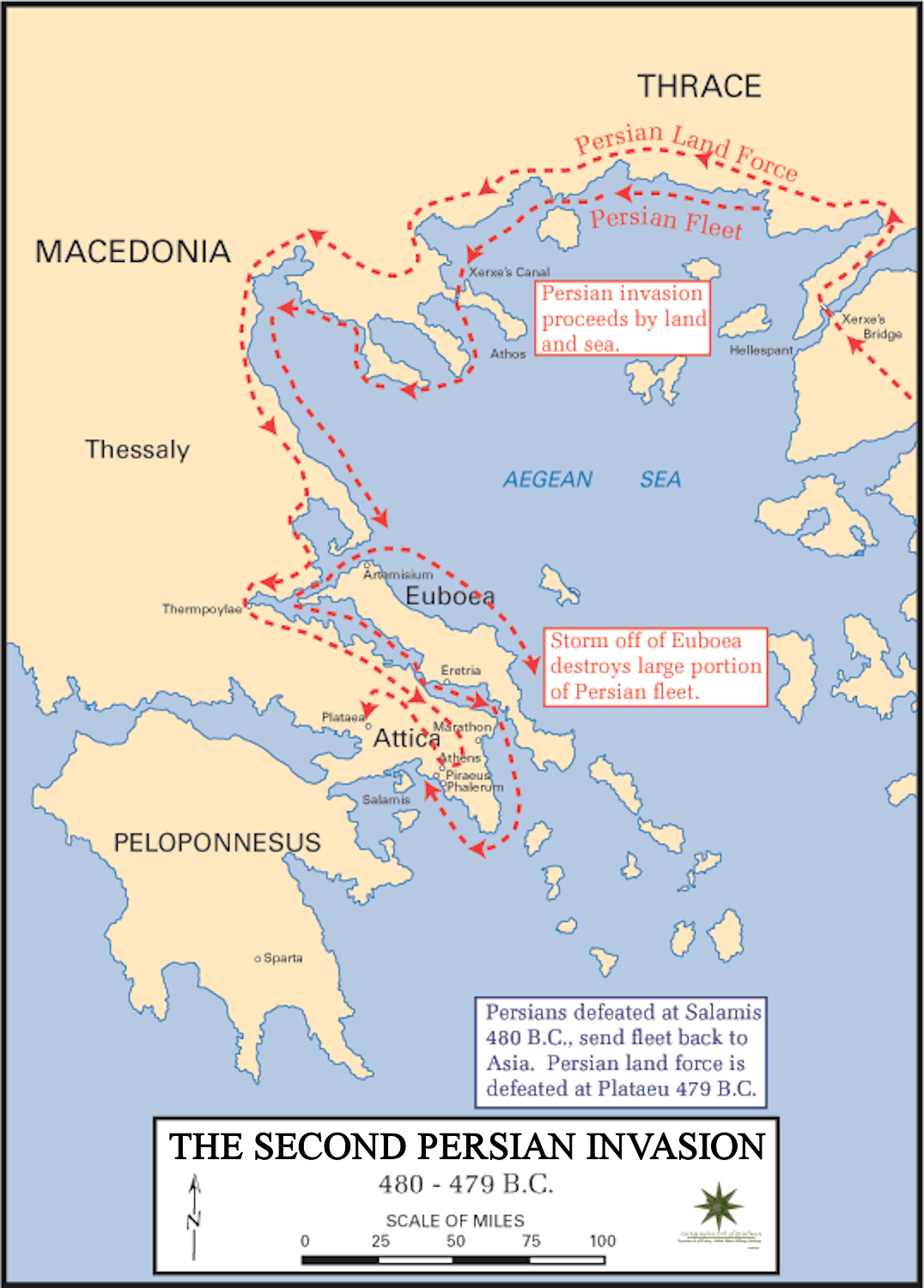
The second Persian invasion of Greece (480–479 BC) occurred during the Greco-Persian Wars, as King Xerxes I of Persia sought to conquer all of Greece. The invasion was a direct, if delayed, response to the defeat of the first Persian invasion of Greece (492–490 BC) at the Battle of Marathon, which ended Darius I's attempts to subjugate Greece. After Darius's death, his son Xerxes spent several years planning for the second invasion, mustering an enormous army and navy. The Athenians and Spartans led the Greek resistance. About a tenth of the Greek city-states joined the 'Allied' effort; most remained neutral or submitted to Xerxes.
The invasion began in spring 480 BC, when the Persian army crossed the Hellespont and marched through Thrace and Macedon to Thessaly. The Persian advance was blocked at the pass of Thermopylae by a small Allied force under King Leonidas I of Sparta; simultaneously, the Persian fleet was blocked by an Allied fleet at the straits of Artemisium. At the famous Battle of Thermopylae, the Allied army held back the Persian army for three days, before they were outflanked by a mountain path and the Allied rearguard was trapped and annihilated. The Allied fleet had also withstood two days of Persian attacks at the Battle of Artemisium, but when news reached them of the disaster at Thermopylae, they withdrew to Salamis.
After Thermopylae, all of Euboea, Phocis, Boeotia and Attica fell to the Persian army, which captured and burnt Athens. However, a larger Allied army fortified the narrow Isthmus of Corinth, protecting the Peloponnesus from Persian conquest. Both sides thus sought a naval victory that might decisively alter the course of the war. The Athenian general Themistocles succeeded in luring the Persian navy into the narrow Straits of Salamis, where the huge number of Persian ships became disorganised, and were soundly beaten by the Allied fleet. The Allied victory at Salamis prevented a quick conclusion to the invasion, and fearing becoming trapped in Europe, Xerxes retreated to Asia leaving his general Mardonius to finish the conquest with the elite of the army.
The following spring, the Allies assembled the largest ever hoplite army and marched north from the Isthmus to confront Mardonius. At the ensuing Battle of Plataea, the Greek infantry again proved its superiority, inflicting a severe defeat on the Persians and killing Mardonius in the process. On the same day, across the Aegean Sea an Allied navy destroyed the remnants of the Persian navy at the Battle of Mycale. With this double defeat, the invasion was ended, and Persian power in the Aegean severely dented. The Greeks would now move to the offensive, eventually expelling the Persians from Europe, the Aegean Islands and Ionia before the war finally came to an end in 449 BC with the Peace of Callias.
The main source for the Great Greco-Persian Wars is the Greek historian Herodotus. Herodotus, who has been called the 'Father of History', was born in 484 BC in Halicarnassus, Asia Minor (then under Persian overlordship). He wrote his 'Enquiries' (Greek—Historia; English—(The) Histories) around 440–430 BC, trying to trace the origins of the Greco-Persian Wars, which would still have been relatively recent history (the wars finally ending in 450 BC). Herodotus's approach was entirely novel, and at least in Western society, he does seem to have invented 'history' as we know it. As Holland has it: "For the first time, a chronicler set himself to trace the origins of a conflict not to a past so remote so as to be utterly fabulous, nor to the whims and wishes of some god, nor to a people's claim to manifest destiny, but rather explanations he could verify personally".
Some subsequent ancient historians, despite following in his footsteps, criticised Herodotus, starting with Thucydides. Nevertheless, Thucydides chose to begin his history where Herodotus left off (at the Siege of Sestos), and therefore evidently felt that Herodotus's history was accurate enough not to need re-writing or correcting. Plutarch criticised Herodotus in his essay "On The Malignity of Herodotus", describing Herodotus as "Philobarbaros" (barbarian-lover), for not being pro-Greek enough, which suggests that Herodotus might actually have done a reasonable job of being even-handed. A negative view of Herodotus was passed on to Renaissance Europe, though he remained well read. However, since the 19th century his reputation has been dramatically rehabilitated by archaeological finds that have repeatedly confirmed his version of events. The prevailing modern view is that Herodotus generally did a remarkable job in his Historia, but that some of his specific details (particularly troop numbers and dates) should be viewed with skepticism. Nevertheless, there are still some historians who believe Herodotus made up much of his story.
The Greek historian Diodorus Siculus from Sicily, writing in the 1st century BC in his Bibliotheca Historica, also provides an account of the Greco-Persian wars, partially derived from the earlier Greek historian Ephorus. This account is fairly consistent with Herodotus's. The Greco-Persian wars are also described in less detail by a number of other ancient historians including Plutarch, Ctesias, and are alluded by other authors, such as the playwright Aeschylus. Archaeological evidence, such as the Serpent Column, also supports some of Herodotus's specific claims.
The Greek city-states of Athens and Eretria had supported the unsuccessful Ionian Revolt against the Persian Empire of Darius I in 499–494 BC. The Persian Empire was still relatively young and prone to revolts among its subject peoples. Moreover, Darius was a usurper and had spent considerable time extinguishing revolts against his rule. The Ionian revolt threatened the integrity of his empire, and Darius thus vowed to punish those involved (especially those not already part of the empire). Darius also saw the opportunity to expand his empire into the fractious world of Ancient Greece. A preliminary expedition under Mardonius, in 492 BC, to secure the land approaches to Greece ended with the re-conquest of Thrace and forced Macedon to become a fully subordinate kingdom part of Persia. It had previously been a vassal as early as the late 6th century BC, but remained having autonomy and not fully subordinate yet.
Hub AI
Second Persian invasion of Greece AI simulator
(@Second Persian invasion of Greece_simulator)
Second Persian invasion of Greece
The second Persian invasion of Greece (480–479 BC) occurred during the Greco-Persian Wars, as King Xerxes I of Persia sought to conquer all of Greece. The invasion was a direct, if delayed, response to the defeat of the first Persian invasion of Greece (492–490 BC) at the Battle of Marathon, which ended Darius I's attempts to subjugate Greece. After Darius's death, his son Xerxes spent several years planning for the second invasion, mustering an enormous army and navy. The Athenians and Spartans led the Greek resistance. About a tenth of the Greek city-states joined the 'Allied' effort; most remained neutral or submitted to Xerxes.
The invasion began in spring 480 BC, when the Persian army crossed the Hellespont and marched through Thrace and Macedon to Thessaly. The Persian advance was blocked at the pass of Thermopylae by a small Allied force under King Leonidas I of Sparta; simultaneously, the Persian fleet was blocked by an Allied fleet at the straits of Artemisium. At the famous Battle of Thermopylae, the Allied army held back the Persian army for three days, before they were outflanked by a mountain path and the Allied rearguard was trapped and annihilated. The Allied fleet had also withstood two days of Persian attacks at the Battle of Artemisium, but when news reached them of the disaster at Thermopylae, they withdrew to Salamis.
After Thermopylae, all of Euboea, Phocis, Boeotia and Attica fell to the Persian army, which captured and burnt Athens. However, a larger Allied army fortified the narrow Isthmus of Corinth, protecting the Peloponnesus from Persian conquest. Both sides thus sought a naval victory that might decisively alter the course of the war. The Athenian general Themistocles succeeded in luring the Persian navy into the narrow Straits of Salamis, where the huge number of Persian ships became disorganised, and were soundly beaten by the Allied fleet. The Allied victory at Salamis prevented a quick conclusion to the invasion, and fearing becoming trapped in Europe, Xerxes retreated to Asia leaving his general Mardonius to finish the conquest with the elite of the army.
The following spring, the Allies assembled the largest ever hoplite army and marched north from the Isthmus to confront Mardonius. At the ensuing Battle of Plataea, the Greek infantry again proved its superiority, inflicting a severe defeat on the Persians and killing Mardonius in the process. On the same day, across the Aegean Sea an Allied navy destroyed the remnants of the Persian navy at the Battle of Mycale. With this double defeat, the invasion was ended, and Persian power in the Aegean severely dented. The Greeks would now move to the offensive, eventually expelling the Persians from Europe, the Aegean Islands and Ionia before the war finally came to an end in 449 BC with the Peace of Callias.
The main source for the Great Greco-Persian Wars is the Greek historian Herodotus. Herodotus, who has been called the 'Father of History', was born in 484 BC in Halicarnassus, Asia Minor (then under Persian overlordship). He wrote his 'Enquiries' (Greek—Historia; English—(The) Histories) around 440–430 BC, trying to trace the origins of the Greco-Persian Wars, which would still have been relatively recent history (the wars finally ending in 450 BC). Herodotus's approach was entirely novel, and at least in Western society, he does seem to have invented 'history' as we know it. As Holland has it: "For the first time, a chronicler set himself to trace the origins of a conflict not to a past so remote so as to be utterly fabulous, nor to the whims and wishes of some god, nor to a people's claim to manifest destiny, but rather explanations he could verify personally".
Some subsequent ancient historians, despite following in his footsteps, criticised Herodotus, starting with Thucydides. Nevertheless, Thucydides chose to begin his history where Herodotus left off (at the Siege of Sestos), and therefore evidently felt that Herodotus's history was accurate enough not to need re-writing or correcting. Plutarch criticised Herodotus in his essay "On The Malignity of Herodotus", describing Herodotus as "Philobarbaros" (barbarian-lover), for not being pro-Greek enough, which suggests that Herodotus might actually have done a reasonable job of being even-handed. A negative view of Herodotus was passed on to Renaissance Europe, though he remained well read. However, since the 19th century his reputation has been dramatically rehabilitated by archaeological finds that have repeatedly confirmed his version of events. The prevailing modern view is that Herodotus generally did a remarkable job in his Historia, but that some of his specific details (particularly troop numbers and dates) should be viewed with skepticism. Nevertheless, there are still some historians who believe Herodotus made up much of his story.
The Greek historian Diodorus Siculus from Sicily, writing in the 1st century BC in his Bibliotheca Historica, also provides an account of the Greco-Persian wars, partially derived from the earlier Greek historian Ephorus. This account is fairly consistent with Herodotus's. The Greco-Persian wars are also described in less detail by a number of other ancient historians including Plutarch, Ctesias, and are alluded by other authors, such as the playwright Aeschylus. Archaeological evidence, such as the Serpent Column, also supports some of Herodotus's specific claims.
The Greek city-states of Athens and Eretria had supported the unsuccessful Ionian Revolt against the Persian Empire of Darius I in 499–494 BC. The Persian Empire was still relatively young and prone to revolts among its subject peoples. Moreover, Darius was a usurper and had spent considerable time extinguishing revolts against his rule. The Ionian revolt threatened the integrity of his empire, and Darius thus vowed to punish those involved (especially those not already part of the empire). Darius also saw the opportunity to expand his empire into the fractious world of Ancient Greece. A preliminary expedition under Mardonius, in 492 BC, to secure the land approaches to Greece ended with the re-conquest of Thrace and forced Macedon to become a fully subordinate kingdom part of Persia. It had previously been a vassal as early as the late 6th century BC, but remained having autonomy and not fully subordinate yet.
Recent media