
Recent from talks
Helianthus
Knowledge base stats:
Talk channels stats:
Members stats:
Helianthus
Helianthus (/ˌhiːliˈænθəs/) is a genus comprising around 50 species of annual and perennial flowering plants in the daisy family Asteraceae commonly known as sunflowers. The species of Helianthus are native to North America and Mexico. The best-known species is the common sunflower (Helianthus annuus). This and other species, notably Jerusalem artichoke (H. tuberosus), are cultivated in temperate regions and some tropical regions, as food crops for humans, cattle, and poultry, and as ornamental plants. The species H. annuus typically grows during the summer and into early fall, with the peak growth season being mid-summer.
Several perennial Helianthus species are grown in gardens, but have a tendency to spread rapidly and can become aggressive. On the other hand, the whorled sunflower, Helianthus verticillatus, was listed as an endangered species in 2014 when the U.S. Fish and Wildlife Service issued a final rule protecting it under the Endangered Species Act. The primary threats to this species are industrial forestry and pine plantations in Alabama, Georgia, and Tennessee. They grow to 1.8 metres (6 feet) and are primarily found in woodlands, adjacent to creeks and moist, prairie-like areas.
The common sunflower is the national flower of Ukraine, cultivated there for several centuries.
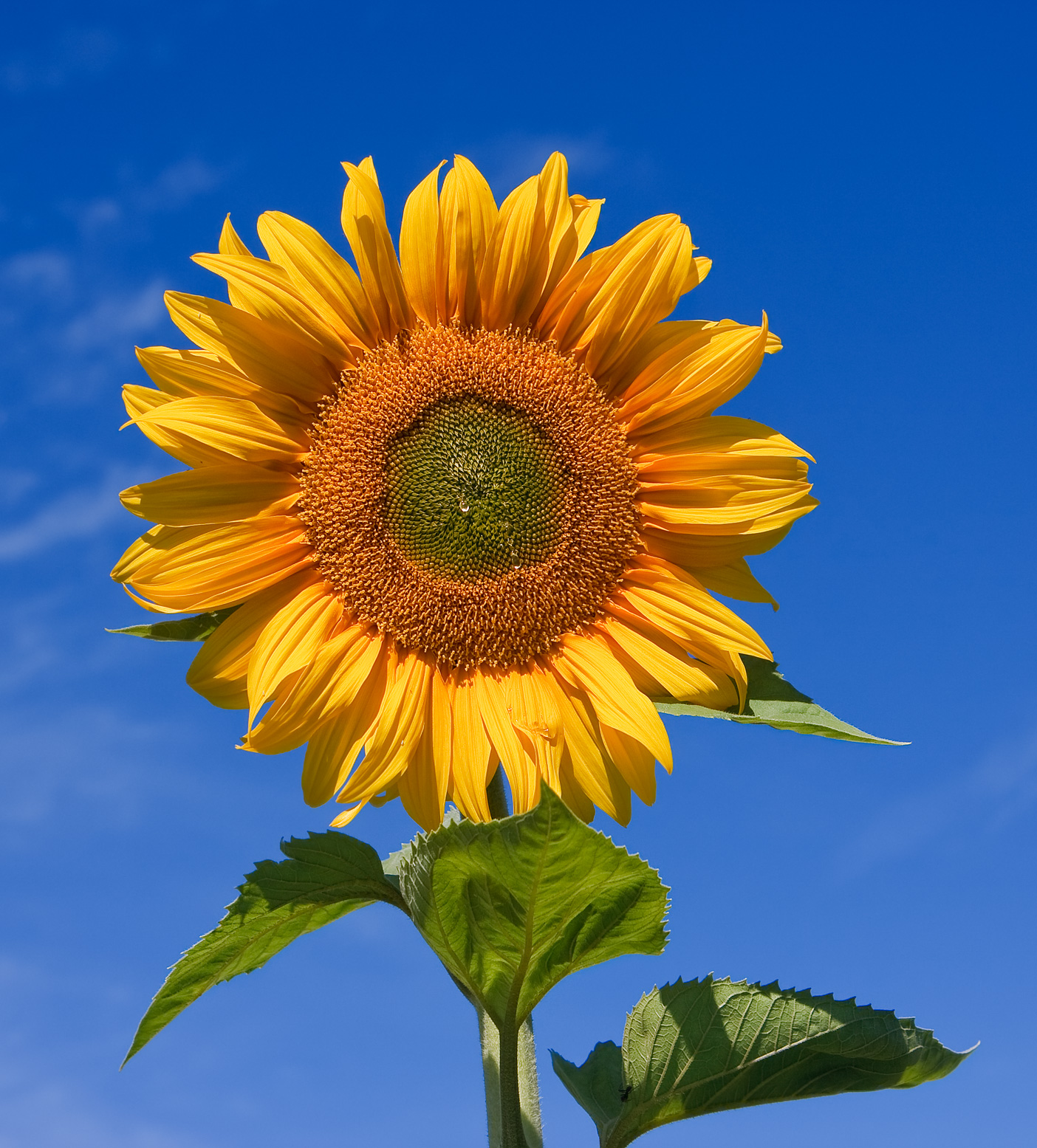
Sunflowers are usually tall annual or perennial plants that in some species can grow to a height of 300 centimetres (120 inches) or more. Each "flower" is actually a disc made up of tiny flowers, to form a larger false flower to better attract pollinators. The plants bear one or more wide, terminal capitula (flower heads made up of many tiny flowers), with bright yellow ray florets (mini flowers inside a flower head) at the outside and yellow or maroon (also known as a brown/red) disc florets inside. Several ornamental cultivars of H. annuus have red-colored ray florets; all of them stem from a single original mutant. While the majority of sunflowers are yellow, there are branching varieties in other colors including, orange, red and purple.
The petiolate leaves are dentate and often sticky. The lower leaves are opposite, ovate, or often heart-shaped. The rough and hairy stem is branched in the upper part in wild plants, but is usually unbranched in domesticated cultivars.
This genus is distinguished technically by the fact that the ray florets (when present) are sterile, and by the presence on the disk flowers of a pappus that is of two awn-like scales that are caducous (that is, easily detached and falling at maturity). Some species also have additional shorter scales in the pappus, and one species lacks a pappus entirely. Another technical feature that distinguishes the genus more reliably, but requires a microscope to see, is the presence of a prominent, multicellular appendage at the apex of the style. Further, the florets of a sunflower are arranged in a natural spiral.
Variability is seen among the perennial species that make up the bulk of those in the genus. Some have most or all of the large leaves in a rosette at the base of the plant and produce a flowering stem that has leaves that are reduced in size. Most of the perennials have disk flowers that are entirely yellow, but a few have disk flowers with reddish lobes. One species, H. radula, lacks ray flowers altogether.
Overall, the macroevolution of the Helianthus is driven by multiple biotic and abiotic factors and influences various floral morphology.
Hub AI
Helianthus AI simulator
(@Helianthus_simulator)
Helianthus
Helianthus (/ˌhiːliˈænθəs/) is a genus comprising around 50 species of annual and perennial flowering plants in the daisy family Asteraceae commonly known as sunflowers. The species of Helianthus are native to North America and Mexico. The best-known species is the common sunflower (Helianthus annuus). This and other species, notably Jerusalem artichoke (H. tuberosus), are cultivated in temperate regions and some tropical regions, as food crops for humans, cattle, and poultry, and as ornamental plants. The species H. annuus typically grows during the summer and into early fall, with the peak growth season being mid-summer.
Several perennial Helianthus species are grown in gardens, but have a tendency to spread rapidly and can become aggressive. On the other hand, the whorled sunflower, Helianthus verticillatus, was listed as an endangered species in 2014 when the U.S. Fish and Wildlife Service issued a final rule protecting it under the Endangered Species Act. The primary threats to this species are industrial forestry and pine plantations in Alabama, Georgia, and Tennessee. They grow to 1.8 metres (6 feet) and are primarily found in woodlands, adjacent to creeks and moist, prairie-like areas.
The common sunflower is the national flower of Ukraine, cultivated there for several centuries.
Sunflowers are usually tall annual or perennial plants that in some species can grow to a height of 300 centimetres (120 inches) or more. Each "flower" is actually a disc made up of tiny flowers, to form a larger false flower to better attract pollinators. The plants bear one or more wide, terminal capitula (flower heads made up of many tiny flowers), with bright yellow ray florets (mini flowers inside a flower head) at the outside and yellow or maroon (also known as a brown/red) disc florets inside. Several ornamental cultivars of H. annuus have red-colored ray florets; all of them stem from a single original mutant. While the majority of sunflowers are yellow, there are branching varieties in other colors including, orange, red and purple.
The petiolate leaves are dentate and often sticky. The lower leaves are opposite, ovate, or often heart-shaped. The rough and hairy stem is branched in the upper part in wild plants, but is usually unbranched in domesticated cultivars.
This genus is distinguished technically by the fact that the ray florets (when present) are sterile, and by the presence on the disk flowers of a pappus that is of two awn-like scales that are caducous (that is, easily detached and falling at maturity). Some species also have additional shorter scales in the pappus, and one species lacks a pappus entirely. Another technical feature that distinguishes the genus more reliably, but requires a microscope to see, is the presence of a prominent, multicellular appendage at the apex of the style. Further, the florets of a sunflower are arranged in a natural spiral.
Variability is seen among the perennial species that make up the bulk of those in the genus. Some have most or all of the large leaves in a rosette at the base of the plant and produce a flowering stem that has leaves that are reduced in size. Most of the perennials have disk flowers that are entirely yellow, but a few have disk flowers with reddish lobes. One species, H. radula, lacks ray flowers altogether.
Overall, the macroevolution of the Helianthus is driven by multiple biotic and abiotic factors and influences various floral morphology.
Recent media