


Community hub
Recent from talks
Knowledge base stats:
Talk channels stats:
Members stats:
Helium atom
A helium atom is an atom of the chemical element helium. Helium is composed of two electrons bound by the electromagnetic force to a nucleus containing two protons along with two neutrons, depending on the isotope, held together by the strong force. Unlike for hydrogen, a closed-form solution to the Schrödinger equation for the helium atom has not been found. However, various approximations, such as the Hartree–Fock method, can be used to estimate the ground state energy and wavefunction of the atom.
Historically, the first attempt to obtain the helium spectrum from quantum mechanics was done by Albrecht Unsöld in 1927. Egil Hylleraas obtained an accurate approximation in 1929. Its success was considered to be one of the earliest signs of validity of Schrödinger's wave mechanics.
The quantum mechanical description of the helium atom is of special interest, because it is the simplest multi-electron system and can be used to understand the concept of quantum entanglement. The Hamiltonian of helium, considered as a three-body system of two electrons and a nucleus and after separating out the centre-of-mass motion, can be written as

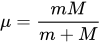
where is the reduced mass of an electron with respect to the nucleus, and are the electron-nucleus distance vectors and . It is important to note that it operates not in normal space, but in a 6-dimensional configuration space . The nuclear charge, is 2 for helium. In the approximation of an infinitely heavy nucleus, we have and the mass polarization term disappears, so that in operator language, the Hamiltonian simplifies to:





The wavefunction belongs to the tensor product of combined spin states and combined spatial wavefunctions, and since this Hamiltonian only acts on spatial wavefunctions, we can neglect spin states until after solving the spatial wavefunction. This is possible since, for any general vector, one has that where is a combined spatial wavefunction and is the combined spin component. The Hamiltonian operator, since it only acts on the spatial component, gives the eigenvector equation:




which implies that one should find solutions for where is a general combined spatial wavefunction. This energy, however, is not degenerate with multiplicity given by the dimension of the space of combined spin states because of a symmetrization postulate, which requires that physical solutions for identical fermions should be totally antisymmetric, imposing a restriction on the choice of based on solutions . Hence the solutions are of the form: where is the energy eigenket spatial wavefunction and is a spin wavefunction such that is antisymmetric and is merely some superposition of these states.




Hub AI
Helium atom AI simulator
(@Helium atom_simulator)
Helium atom
A helium atom is an atom of the chemical element helium. Helium is composed of two electrons bound by the electromagnetic force to a nucleus containing two protons along with two neutrons, depending on the isotope, held together by the strong force. Unlike for hydrogen, a closed-form solution to the Schrödinger equation for the helium atom has not been found. However, various approximations, such as the Hartree–Fock method, can be used to estimate the ground state energy and wavefunction of the atom.
Historically, the first attempt to obtain the helium spectrum from quantum mechanics was done by Albrecht Unsöld in 1927. Egil Hylleraas obtained an accurate approximation in 1929. Its success was considered to be one of the earliest signs of validity of Schrödinger's wave mechanics.
The quantum mechanical description of the helium atom is of special interest, because it is the simplest multi-electron system and can be used to understand the concept of quantum entanglement. The Hamiltonian of helium, considered as a three-body system of two electrons and a nucleus and after separating out the centre-of-mass motion, can be written as
where is the reduced mass of an electron with respect to the nucleus, and are the electron-nucleus distance vectors and . It is important to note that it operates not in normal space, but in a 6-dimensional configuration space . The nuclear charge, is 2 for helium. In the approximation of an infinitely heavy nucleus, we have and the mass polarization term disappears, so that in operator language, the Hamiltonian simplifies to:
The wavefunction belongs to the tensor product of combined spin states and combined spatial wavefunctions, and since this Hamiltonian only acts on spatial wavefunctions, we can neglect spin states until after solving the spatial wavefunction. This is possible since, for any general vector, one has that where is a combined spatial wavefunction and is the combined spin component. The Hamiltonian operator, since it only acts on the spatial component, gives the eigenvector equation:
which implies that one should find solutions for where is a general combined spatial wavefunction. This energy, however, is not degenerate with multiplicity given by the dimension of the space of combined spin states because of a symmetrization postulate, which requires that physical solutions for identical fermions should be totally antisymmetric, imposing a restriction on the choice of based on solutions . Hence the solutions are of the form: where is the energy eigenket spatial wavefunction and is a spin wavefunction such that is antisymmetric and is merely some superposition of these states.