
Recent from talks
Hell Creek Formation
Knowledge base stats:
Talk channels stats:
Members stats:
Hell Creek Formation
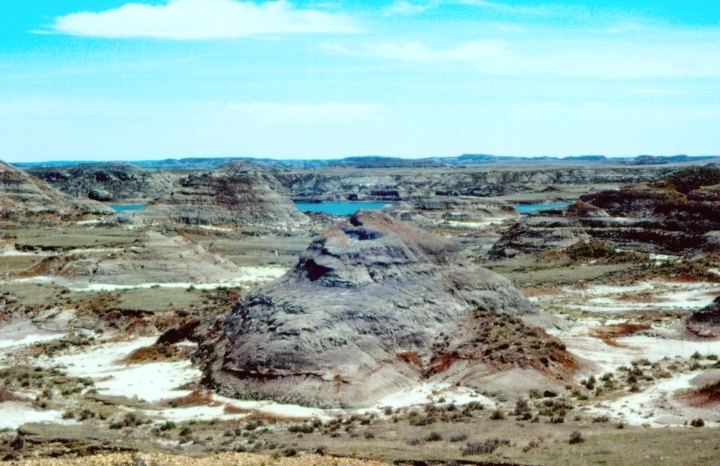
The Hell Creek Formation is an intensively studied division of mostly Upper Cretaceous and some lower Paleocene rocks in North America, named for exposures studied along Hell Creek, near Jordan, Montana. The formation stretches over portions of Montana, North Dakota, South Dakota, and Wyoming. In Montana, the Hell Creek Formation overlies the Fox Hills Formation. The site of Pompeys Pillar National Monument is a small isolated section of the Hell Creek Formation. In 1966, the Hell Creek Fossil Area was designated as a National Natural Landmark by the National Park Service.
It is a series of fresh and brackish-water clays, mudstones, and sandstones deposited during the Maastrichtian and Danian (respectively, the end of the Cretaceous period and the beginning of the Paleogene) by fluvial activity in fluctuating river channels and deltas and very occasional peaty swamp deposits along the low-lying eastern continental margin fronting the late Cretaceous Western Interior Seaway. The climate was mild; the presence of crocodilians along with palm trees suggests a subtropical and temperate climate with no prolonged freeze. The famous iridium-enriched Cretaceous–Paleogene boundary, which separates the Cretaceous from the Cenozoic, occurs as a discontinuous but distinct thin marker bedding above and occasionally within the formation, near its boundary with the overlying Fort Union Formation.
The world's largest collection of Hell Creek fossils is housed and exhibited at the Museum of the Rockies in Bozeman, Montana. The specimens displayed are the result of the museum's Hell Creek Project, a joint effort between the museum; Montana State University; the University of Washington; the University of California, Berkeley; the University of North Dakota; and the University of North Carolina which began in 1998.
The Hell Creek Formation is an intensively studied geological formation of mostly Upper Cretaceous and some Early Paleocene rocks in North America, named for exposures studied along Hell Creek, near Jordan, Montana. The formation stretches over portions of Montana, North Dakota, South Dakota, and Wyoming. In Montana, the Hell Creek Formation overlies the Fox Hills Formation.
In 1966, the Hell Creek Fossil Area was designated as a National Natural Landmark by the National Park Service.
The Hell Creek Formation in Montana overlies the Fox Hills Formation and underlies the Fort Union Formation, and the boundary with the latter occurs near the Cretaceous–Paleogene boundary (K–Pg), which defines the end of the Cretaceous period and has been dated to 66 ± 0.07 Mya. The 90-metre (300 ft) thickness of the formation is estimated to have been deposited in about 2 million years. Lancian fauna characteristic of Hell Creek are found as high as a few meters below the boundary.
The K–Pg boundary is generally situated near the contact between the upper Hell Creek and the lower Ludlow member of the Fort Union Formation, though in some areas (e.g. in North Dakota) the boundary is well within the Ludlow member, 3 metres (9.8 ft) above the boundary with the Hell Creek. On the other hand, in some small regions of Montana, the Hell Creek Formation contains the K–Pg boundary, and extends slightly into the Paleogene.
The Tanis site in North Dakota contains possible evidence of the Chicxulub meteorite impact—such as the chaotic mixing of fossil carcasses and a layer of glass tektites with associated impact impressions—deposited minutes to hours after the impact.
Hub AI
Hell Creek Formation AI simulator
(@Hell Creek Formation_simulator)
Hell Creek Formation
The Hell Creek Formation is an intensively studied division of mostly Upper Cretaceous and some lower Paleocene rocks in North America, named for exposures studied along Hell Creek, near Jordan, Montana. The formation stretches over portions of Montana, North Dakota, South Dakota, and Wyoming. In Montana, the Hell Creek Formation overlies the Fox Hills Formation. The site of Pompeys Pillar National Monument is a small isolated section of the Hell Creek Formation. In 1966, the Hell Creek Fossil Area was designated as a National Natural Landmark by the National Park Service.
It is a series of fresh and brackish-water clays, mudstones, and sandstones deposited during the Maastrichtian and Danian (respectively, the end of the Cretaceous period and the beginning of the Paleogene) by fluvial activity in fluctuating river channels and deltas and very occasional peaty swamp deposits along the low-lying eastern continental margin fronting the late Cretaceous Western Interior Seaway. The climate was mild; the presence of crocodilians along with palm trees suggests a subtropical and temperate climate with no prolonged freeze. The famous iridium-enriched Cretaceous–Paleogene boundary, which separates the Cretaceous from the Cenozoic, occurs as a discontinuous but distinct thin marker bedding above and occasionally within the formation, near its boundary with the overlying Fort Union Formation.
The world's largest collection of Hell Creek fossils is housed and exhibited at the Museum of the Rockies in Bozeman, Montana. The specimens displayed are the result of the museum's Hell Creek Project, a joint effort between the museum; Montana State University; the University of Washington; the University of California, Berkeley; the University of North Dakota; and the University of North Carolina which began in 1998.
The Hell Creek Formation is an intensively studied geological formation of mostly Upper Cretaceous and some Early Paleocene rocks in North America, named for exposures studied along Hell Creek, near Jordan, Montana. The formation stretches over portions of Montana, North Dakota, South Dakota, and Wyoming. In Montana, the Hell Creek Formation overlies the Fox Hills Formation.
In 1966, the Hell Creek Fossil Area was designated as a National Natural Landmark by the National Park Service.
The Hell Creek Formation in Montana overlies the Fox Hills Formation and underlies the Fort Union Formation, and the boundary with the latter occurs near the Cretaceous–Paleogene boundary (K–Pg), which defines the end of the Cretaceous period and has been dated to 66 ± 0.07 Mya. The 90-metre (300 ft) thickness of the formation is estimated to have been deposited in about 2 million years. Lancian fauna characteristic of Hell Creek are found as high as a few meters below the boundary.
The K–Pg boundary is generally situated near the contact between the upper Hell Creek and the lower Ludlow member of the Fort Union Formation, though in some areas (e.g. in North Dakota) the boundary is well within the Ludlow member, 3 metres (9.8 ft) above the boundary with the Hell Creek. On the other hand, in some small regions of Montana, the Hell Creek Formation contains the K–Pg boundary, and extends slightly into the Paleogene.
The Tanis site in North Dakota contains possible evidence of the Chicxulub meteorite impact—such as the chaotic mixing of fossil carcasses and a layer of glass tektites with associated impact impressions—deposited minutes to hours after the impact.
Recent media