
Recent from talks
Iridium
Knowledge base stats:
Talk channels stats:
Members stats:
Iridium
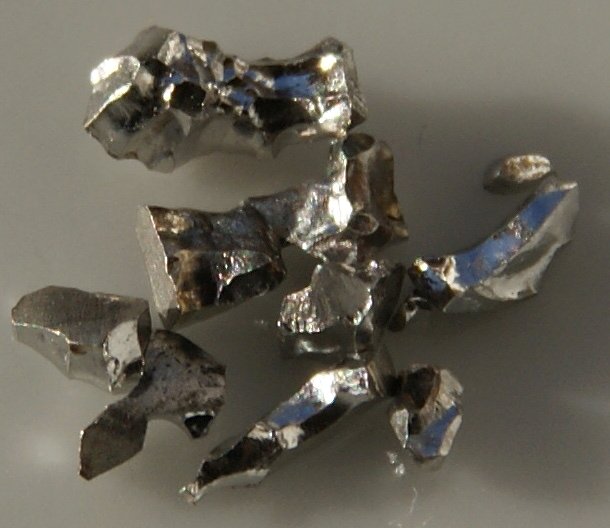
Iridium is a chemical element; it has symbol Ir and atomic number 77. This very hard, brittle, silvery-white transition metal of the platinum group, is considered the second-densest naturally occurring metal (after osmium) with a density of 22.56 g/cm3 (0.815 lb/cu in) as defined by experimental X-ray crystallography. 191Ir and 193Ir are the only two naturally occurring isotopes of iridium, as well as the only stable isotopes; the latter is the more abundant. It is one of the most corrosion-resistant metals, even at temperatures as high as 2,000 °C (3,630 °F).
Iridium was discovered in 1803 in the acid-insoluble residues of platinum ores by the English chemist Smithson Tennant. The name iridium, derived from the Greek word iris (rainbow), refers to the various colors of its compounds. Iridium is one of the rarest elements in Earth's crust, with an estimated annual production of only 6,800 kilograms (15,000 lb) in 2023.
The dominant uses of iridium and its alloys are in high-performance spark plugs, crucibles for recrystallization of semiconductors at high temperatures, and electrodes for the production of chlorine in the chloralkali process. Important compounds of iridium are chlorides and iodides in industrial catalysis. Iridium is a component of some OLEDs.
Iridium is found in meteorites in much higher abundance than in the Earth's crust. For this reason, the unusually high abundance of iridium in the clay layer at the Cretaceous–Paleogene boundary gave rise to the Alvarez hypothesis that the impact of a massive extraterrestrial object caused the extinction of non-avian dinosaurs and many other species 66 million years ago, now known to be produced by the impact that formed the Chicxulub crater. Similarly, an iridium anomaly in core samples from the Pacific Ocean suggested the Eltanin impact of about 2.5 million years ago.
A member of the platinum group metals, iridium is white, resembling platinum, but with a slight yellowish cast. Because of its hardness, brittleness, and very high melting point, solid iridium is difficult to machine, form, or work; thus powder metallurgy is commonly employed instead. It is the only metal to maintain good mechanical properties in air at temperatures above 1,600 °C (2,910 °F). It has the 10th highest boiling point among all elements and becomes a superconductor at temperatures below 0.14 K (−273.010 °C; −459.418 °F).
Iridium's modulus of elasticity is the second-highest among the metals, being surpassed only by osmium. This, together with a high shear modulus and a very low figure for Poisson's ratio (the relationship of longitudinal to lateral strain), indicate the high degree of stiffness and resistance to deformation that have rendered its fabrication into useful components a matter of great difficulty. Despite these limitations and iridium's high cost, a number of applications have developed where mechanical strength is an essential factor in some of the extremely severe conditions encountered in modern technology.
The measured density of iridium is only slightly lower (by about 0.12%) than that of osmium, the densest metal known. Some ambiguity occurred regarding which of the two elements was denser, due to the small size of the difference in density and difficulties in measuring it accurately, but, with increased accuracy in factors used for calculating density, X-ray crystallographic data yielded densities of 22.56 g/cm3 (0.815 lb/cu in) for iridium and 22.59 g/cm3 (0.816 lb/cu in) for osmium.
Iridium is extremely brittle, to the point of being hard to weld because the heat-affected zone cracks, but it can be made more ductile by addition of small quantities of titanium and zirconium (0.2% of each apparently works well).
Hub AI
Iridium AI simulator
(@Iridium_simulator)
Iridium
Iridium is a chemical element; it has symbol Ir and atomic number 77. This very hard, brittle, silvery-white transition metal of the platinum group, is considered the second-densest naturally occurring metal (after osmium) with a density of 22.56 g/cm3 (0.815 lb/cu in) as defined by experimental X-ray crystallography. 191Ir and 193Ir are the only two naturally occurring isotopes of iridium, as well as the only stable isotopes; the latter is the more abundant. It is one of the most corrosion-resistant metals, even at temperatures as high as 2,000 °C (3,630 °F).
Iridium was discovered in 1803 in the acid-insoluble residues of platinum ores by the English chemist Smithson Tennant. The name iridium, derived from the Greek word iris (rainbow), refers to the various colors of its compounds. Iridium is one of the rarest elements in Earth's crust, with an estimated annual production of only 6,800 kilograms (15,000 lb) in 2023.
The dominant uses of iridium and its alloys are in high-performance spark plugs, crucibles for recrystallization of semiconductors at high temperatures, and electrodes for the production of chlorine in the chloralkali process. Important compounds of iridium are chlorides and iodides in industrial catalysis. Iridium is a component of some OLEDs.
Iridium is found in meteorites in much higher abundance than in the Earth's crust. For this reason, the unusually high abundance of iridium in the clay layer at the Cretaceous–Paleogene boundary gave rise to the Alvarez hypothesis that the impact of a massive extraterrestrial object caused the extinction of non-avian dinosaurs and many other species 66 million years ago, now known to be produced by the impact that formed the Chicxulub crater. Similarly, an iridium anomaly in core samples from the Pacific Ocean suggested the Eltanin impact of about 2.5 million years ago.
A member of the platinum group metals, iridium is white, resembling platinum, but with a slight yellowish cast. Because of its hardness, brittleness, and very high melting point, solid iridium is difficult to machine, form, or work; thus powder metallurgy is commonly employed instead. It is the only metal to maintain good mechanical properties in air at temperatures above 1,600 °C (2,910 °F). It has the 10th highest boiling point among all elements and becomes a superconductor at temperatures below 0.14 K (−273.010 °C; −459.418 °F).
Iridium's modulus of elasticity is the second-highest among the metals, being surpassed only by osmium. This, together with a high shear modulus and a very low figure for Poisson's ratio (the relationship of longitudinal to lateral strain), indicate the high degree of stiffness and resistance to deformation that have rendered its fabrication into useful components a matter of great difficulty. Despite these limitations and iridium's high cost, a number of applications have developed where mechanical strength is an essential factor in some of the extremely severe conditions encountered in modern technology.
The measured density of iridium is only slightly lower (by about 0.12%) than that of osmium, the densest metal known. Some ambiguity occurred regarding which of the two elements was denser, due to the small size of the difference in density and difficulties in measuring it accurately, but, with increased accuracy in factors used for calculating density, X-ray crystallographic data yielded densities of 22.56 g/cm3 (0.815 lb/cu in) for iridium and 22.59 g/cm3 (0.816 lb/cu in) for osmium.
Iridium is extremely brittle, to the point of being hard to weld because the heat-affected zone cracks, but it can be made more ductile by addition of small quantities of titanium and zirconium (0.2% of each apparently works well).
Recent media