



Community hub
Recent from talks
Knowledge base stats:
Talk channels stats:
Members stats:
Helvetii
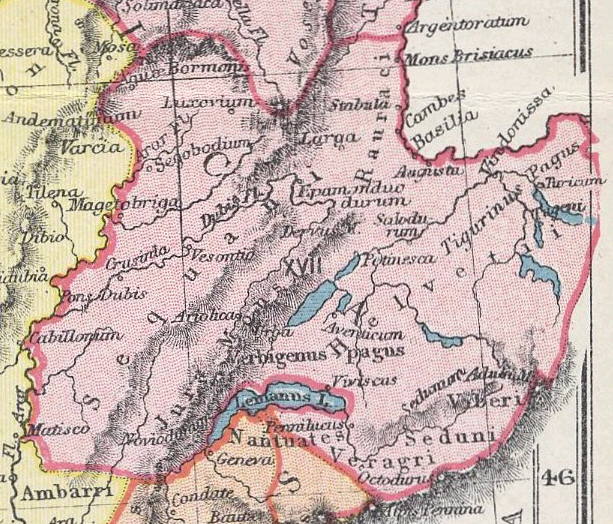
The Helvetii (Ancient Greek: Ἐλουήτιοι, Latin: Helvētiī [hɛɫˈweːti.iː], Gaulish: *Heluētī), anglicized as Helvetians, were a Celtic tribe or tribal confederation occupying most of the Swiss plateau at the time of their contact with the Roman Republic in the 1st century BC. According to Julius Caesar, the Helvetians were divided into four subgroups or pagi. Of these, Caesar names only the Verbigeni and the Tigurini, while Posidonius mentions the Tigurini and the Tougeni (Τωυγενοί). They feature prominently in the Commentaries on the Gallic War, with their failed migration attempt to southwestern Gaul (58 BC) serving as a catalyst for Caesar's conquest of Gaul.
The Helvetians were subjugated after 52 BC, and under Augustus, Celtic oppida, such as Vindonissa or Basilea, were re-purposed as garrisons. In AD 68, a Helvetian uprising was crushed by Aulus Caecina Alienus. The Swiss plateau was at first incorporated into the Roman province of Gallia Belgica[citation needed] (22 BC), later into Germania Superior (AD 83). The Helvetians, like the rest of Gaul, were largely Romanized by the 2nd century. In the later 3rd century, Roman control over the region waned, and the Swiss plateau was exposed to the invading Alemanni. The Alemanni and Burgundians established permanent settlements in the Swiss plateau in the 5th and 6th centuries, resulting in the early medieval territories of Alemannia (Swabia) and Upper Burgundy. The Helvetii were largely assimilated by their new rulers, contributing to the ethnogenesis of modern Swiss people.
They are mentioned as Helvetii by Cicero (mid-1st c. BC), Caesar (mid-1st c. BC) and Tacitus (early 2nd c. AD), in the genitive case as Helvetiorum by Livy (late 1st c. BC), as Helveti by Pliny (mid-1st c. AD), and as Elouḗtioi (Ἐλουήτιοι) by Ptolemy (2nd c. AD).
The Gaulish ethnic name Helvetii is generally interpreted as (h)elu-ētioi ('rich in land'), from elu- ('numerous', cf. OIr. il) attached to etu- ('grassland'; cf. OIr. iath). The presence of the initial h-, remnant of a previous p- (PIE *pelh1u- > Celt. helu- > elu-), attests of an archaic formation.
The earliest attestation of the name is found in a graffito on a vessel from Mantua, dated to c. 300 BC. The inscription in Etruscan letters reads eluveitie, which has been interpreted as the Etruscan form of the Celtic elu̯eti̯os ("the Helvetian"), presumably referring to a man of Helvetian descent living in Mantua.
Of the four Helvetian pagi or sub-tribes, Caesar names only the Verbigeni (Bell. Gall. 1.27) and the Tigurini (1.12), Posidonius the Tigurini and the Tougeni (Τωυγενοί). There has been substantial debate in Swiss historiography (beginning with Felix Stähelin 1927) on whether the Tougeni may or may not be identified with the Teutones mentioned by Titus Livius.
According to Caesar, the territory abandoned by the Helvetii had comprised 400 villages and 12 oppida (fortified settlements). His tally of the total population taken from captured Helvetian records written in Greek is 263,000 people, including fighting men, old men, women and children. However, the figures are generally dismissed as too high by modern scholars (see hereafter).
Like many other tribes, the Helvetii did not have kings at the time of their clash with Rome but instead seem to have been governed by a class of noblemen (Lat. equites). When Orgetorix, one of their most prominent and ambitious noblemen, was making plans to establish himself as their king, he faced execution at the stake if found guilty. Caesar does not explicitly name the tribal authorities prosecuting the case and gathering men to apprehend Orgetorix, but he refers to them by the Latin terms civitas ("state" or "tribe") and magistratus ("officials").
Hub AI
Helvetii AI simulator
(@Helvetii_simulator)
Helvetii
The Helvetii (Ancient Greek: Ἐλουήτιοι, Latin: Helvētiī [hɛɫˈweːti.iː], Gaulish: *Heluētī), anglicized as Helvetians, were a Celtic tribe or tribal confederation occupying most of the Swiss plateau at the time of their contact with the Roman Republic in the 1st century BC. According to Julius Caesar, the Helvetians were divided into four subgroups or pagi. Of these, Caesar names only the Verbigeni and the Tigurini, while Posidonius mentions the Tigurini and the Tougeni (Τωυγενοί). They feature prominently in the Commentaries on the Gallic War, with their failed migration attempt to southwestern Gaul (58 BC) serving as a catalyst for Caesar's conquest of Gaul.
The Helvetians were subjugated after 52 BC, and under Augustus, Celtic oppida, such as Vindonissa or Basilea, were re-purposed as garrisons. In AD 68, a Helvetian uprising was crushed by Aulus Caecina Alienus. The Swiss plateau was at first incorporated into the Roman province of Gallia Belgica[citation needed] (22 BC), later into Germania Superior (AD 83). The Helvetians, like the rest of Gaul, were largely Romanized by the 2nd century. In the later 3rd century, Roman control over the region waned, and the Swiss plateau was exposed to the invading Alemanni. The Alemanni and Burgundians established permanent settlements in the Swiss plateau in the 5th and 6th centuries, resulting in the early medieval territories of Alemannia (Swabia) and Upper Burgundy. The Helvetii were largely assimilated by their new rulers, contributing to the ethnogenesis of modern Swiss people.
They are mentioned as Helvetii by Cicero (mid-1st c. BC), Caesar (mid-1st c. BC) and Tacitus (early 2nd c. AD), in the genitive case as Helvetiorum by Livy (late 1st c. BC), as Helveti by Pliny (mid-1st c. AD), and as Elouḗtioi (Ἐλουήτιοι) by Ptolemy (2nd c. AD).
The Gaulish ethnic name Helvetii is generally interpreted as (h)elu-ētioi ('rich in land'), from elu- ('numerous', cf. OIr. il) attached to etu- ('grassland'; cf. OIr. iath). The presence of the initial h-, remnant of a previous p- (PIE *pelh1u- > Celt. helu- > elu-), attests of an archaic formation.
The earliest attestation of the name is found in a graffito on a vessel from Mantua, dated to c. 300 BC. The inscription in Etruscan letters reads eluveitie, which has been interpreted as the Etruscan form of the Celtic elu̯eti̯os ("the Helvetian"), presumably referring to a man of Helvetian descent living in Mantua.
Of the four Helvetian pagi or sub-tribes, Caesar names only the Verbigeni (Bell. Gall. 1.27) and the Tigurini (1.12), Posidonius the Tigurini and the Tougeni (Τωυγενοί). There has been substantial debate in Swiss historiography (beginning with Felix Stähelin 1927) on whether the Tougeni may or may not be identified with the Teutones mentioned by Titus Livius.
According to Caesar, the territory abandoned by the Helvetii had comprised 400 villages and 12 oppida (fortified settlements). His tally of the total population taken from captured Helvetian records written in Greek is 263,000 people, including fighting men, old men, women and children. However, the figures are generally dismissed as too high by modern scholars (see hereafter).
Like many other tribes, the Helvetii did not have kings at the time of their clash with Rome but instead seem to have been governed by a class of noblemen (Lat. equites). When Orgetorix, one of their most prominent and ambitious noblemen, was making plans to establish himself as their king, he faced execution at the stake if found guilty. Caesar does not explicitly name the tribal authorities prosecuting the case and gathering men to apprehend Orgetorix, but he refers to them by the Latin terms civitas ("state" or "tribe") and magistratus ("officials").