
Recent from talks
Hemodialysis
Knowledge base stats:
Talk channels stats:
Members stats:
Hemodialysis
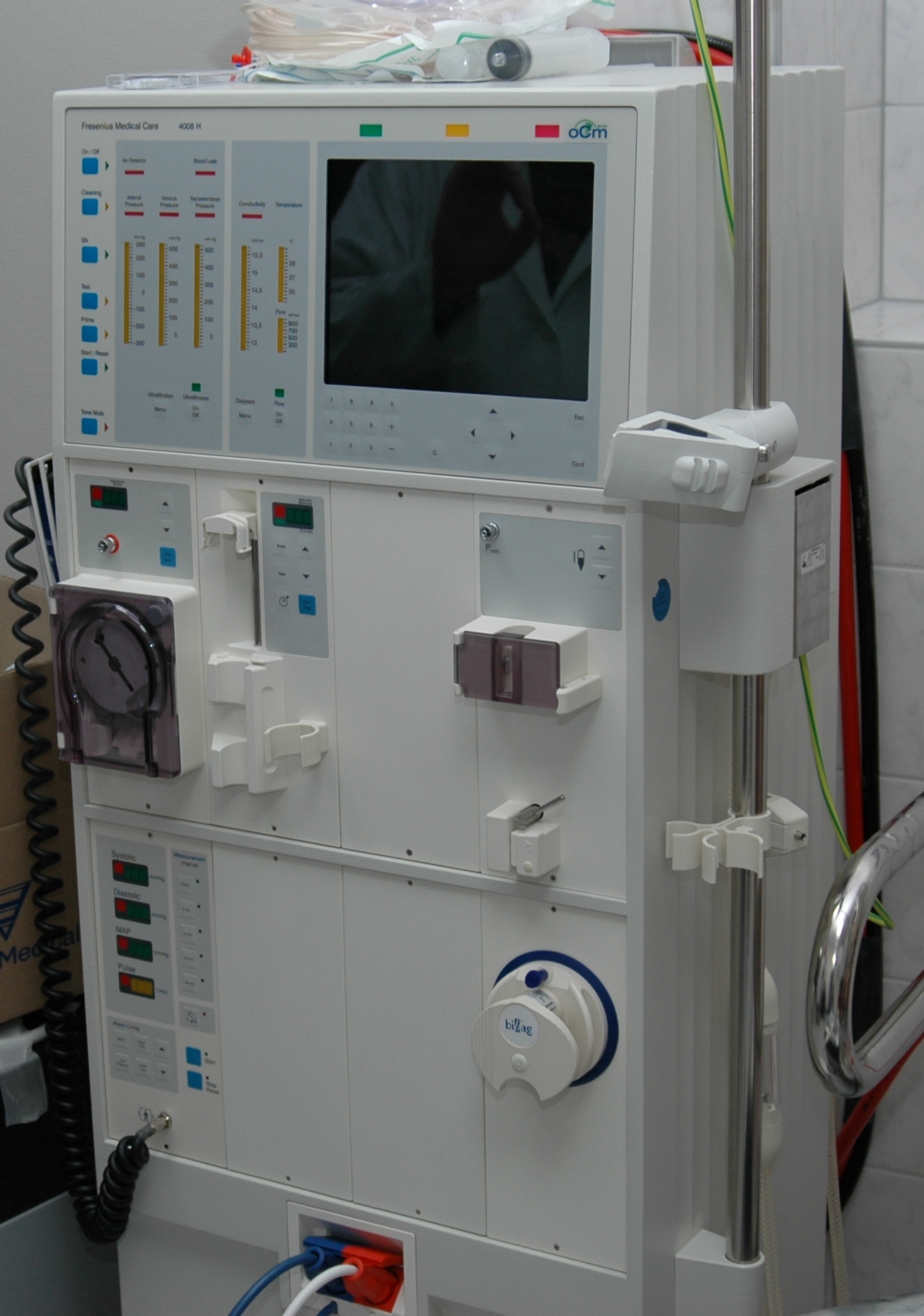
Hemodialysis, also spelled haemodialysis, or simply "'dialysis'", is a process of filtering the blood of a person whose kidneys are not working normally. This type of dialysis achieves the extracorporeal removal of waste products such as creatinine and urea and free water from the blood when the kidneys are in a state of kidney failure. Hemodialysis is one of three renal replacement therapies (the other two being kidney transplant and peritoneal dialysis). An alternative method for extracorporeal separation of blood components such as plasma or cells is apheresis.
Hemodialysis can be an outpatient or inpatient therapy. Routine hemodialysis is conducted in a dialysis outpatient facility, either a purpose-built room in a hospital or a dedicated, stand-alone clinic. Less frequently hemodialysis is done at home. Dialysis treatments in a clinic are initiated and managed by specialized staff made up of nurses and technicians; dialysis treatments at home can be self-initiated and managed or done jointly with the assistance of a trained helper who is usually a family member.
Hemodialysis is the choice of renal replacement therapy for patients who need dialysis acutely, and for many patients as maintenance therapy. It provides excellent, rapid clearance of solutes.
A nephrologist (a medical kidney specialist) decides when hemodialysis is needed and the various parameters for a dialysis treatment. These include frequency (how many treatments per week), length of each treatment, and the blood and dialysis solution flow rates, as well as the size of the dialyzer. The composition of the dialysis solution is also sometimes adjusted in terms of its sodium, potassium, and bicarbonate levels. In general, the larger the body size of an individual, the more dialysis they will need. In North America and the UK, 3–4 hour treatments (sometimes up to 5 hours for larger patients) given 3 times a week are typical. For some patients, nephrologists may suggest an incremental approach, especially for those with substantial residual kidney function at the time of dialysis initiation. With "incremental hemodialysis", the initial dialysis prescription begins with fewer and/or shorter sessions per week—usually one or two 3 hour session—and gradually increases frequency and duration as kidney function declines. Four sessions per week may be prescribed for larger patients, as well as patients who have trouble with fluid overload.
There is growing interest in short daily home hemodialysis, which is 1.5 – 4 hr sessions given 5–7 times per week, usually at home. There is also interest in nocturnal dialysis, which involves dialyzing a patient, usually at home, for 8–10 hours per night, 3–6 nights per week. Nocturnal in-center dialysis, 3–4 times per week, was first described more than 40 years ago, and is offered at some dialysis units.
Hemodialysis often involves fluid removal (through ultrafiltration), because most patients with renal failure pass little or no urine. Side effects caused by removing too much fluid and/or removing fluid too rapidly include low blood pressure, fatigue, chest pains, leg-cramps, nausea and headaches. These symptoms can occur during the treatment and can persist post treatment; they are sometimes collectively referred to as the dialysis hangover or dialysis washout. The severity of these symptoms is usually proportionate to the amount and speed of fluid removal. However, the impact of a given amount or rate of fluid removal can vary greatly from person to person and day to day. These side effects can be avoided and/or their severity lessened by limiting fluid intake between treatments or increasing the dose of dialysis e.g. dialyzing more often or longer per treatment than the standard three times a week, 3–4 hours per treatment schedule.
Since hemodialysis requires access to the circulatory system, patients undergoing hemodialysis may expose their circulatory system to microbes, which can lead to bacteremia, an infection affecting the heart valves (endocarditis) or an infection affecting the bones (osteomyelitis). The risk of infection varies depending on the type of access used (see below). Bleeding may also occur, again the risk varies depending on the type of access used. Infections can be minimized by strictly adhering to infection control best practices.
Venous needle dislodgement (VND) is a fatal complication of hemodialysis where the patient experiences rapid blood loss due to a faltering attachment of the needle to the venous access point.
Hub AI
Hemodialysis AI simulator
(@Hemodialysis_simulator)
Hemodialysis
Hemodialysis, also spelled haemodialysis, or simply "'dialysis'", is a process of filtering the blood of a person whose kidneys are not working normally. This type of dialysis achieves the extracorporeal removal of waste products such as creatinine and urea and free water from the blood when the kidneys are in a state of kidney failure. Hemodialysis is one of three renal replacement therapies (the other two being kidney transplant and peritoneal dialysis). An alternative method for extracorporeal separation of blood components such as plasma or cells is apheresis.
Hemodialysis can be an outpatient or inpatient therapy. Routine hemodialysis is conducted in a dialysis outpatient facility, either a purpose-built room in a hospital or a dedicated, stand-alone clinic. Less frequently hemodialysis is done at home. Dialysis treatments in a clinic are initiated and managed by specialized staff made up of nurses and technicians; dialysis treatments at home can be self-initiated and managed or done jointly with the assistance of a trained helper who is usually a family member.
Hemodialysis is the choice of renal replacement therapy for patients who need dialysis acutely, and for many patients as maintenance therapy. It provides excellent, rapid clearance of solutes.
A nephrologist (a medical kidney specialist) decides when hemodialysis is needed and the various parameters for a dialysis treatment. These include frequency (how many treatments per week), length of each treatment, and the blood and dialysis solution flow rates, as well as the size of the dialyzer. The composition of the dialysis solution is also sometimes adjusted in terms of its sodium, potassium, and bicarbonate levels. In general, the larger the body size of an individual, the more dialysis they will need. In North America and the UK, 3–4 hour treatments (sometimes up to 5 hours for larger patients) given 3 times a week are typical. For some patients, nephrologists may suggest an incremental approach, especially for those with substantial residual kidney function at the time of dialysis initiation. With "incremental hemodialysis", the initial dialysis prescription begins with fewer and/or shorter sessions per week—usually one or two 3 hour session—and gradually increases frequency and duration as kidney function declines. Four sessions per week may be prescribed for larger patients, as well as patients who have trouble with fluid overload.
There is growing interest in short daily home hemodialysis, which is 1.5 – 4 hr sessions given 5–7 times per week, usually at home. There is also interest in nocturnal dialysis, which involves dialyzing a patient, usually at home, for 8–10 hours per night, 3–6 nights per week. Nocturnal in-center dialysis, 3–4 times per week, was first described more than 40 years ago, and is offered at some dialysis units.
Hemodialysis often involves fluid removal (through ultrafiltration), because most patients with renal failure pass little or no urine. Side effects caused by removing too much fluid and/or removing fluid too rapidly include low blood pressure, fatigue, chest pains, leg-cramps, nausea and headaches. These symptoms can occur during the treatment and can persist post treatment; they are sometimes collectively referred to as the dialysis hangover or dialysis washout. The severity of these symptoms is usually proportionate to the amount and speed of fluid removal. However, the impact of a given amount or rate of fluid removal can vary greatly from person to person and day to day. These side effects can be avoided and/or their severity lessened by limiting fluid intake between treatments or increasing the dose of dialysis e.g. dialyzing more often or longer per treatment than the standard three times a week, 3–4 hours per treatment schedule.
Since hemodialysis requires access to the circulatory system, patients undergoing hemodialysis may expose their circulatory system to microbes, which can lead to bacteremia, an infection affecting the heart valves (endocarditis) or an infection affecting the bones (osteomyelitis). The risk of infection varies depending on the type of access used (see below). Bleeding may also occur, again the risk varies depending on the type of access used. Infections can be minimized by strictly adhering to infection control best practices.
Venous needle dislodgement (VND) is a fatal complication of hemodialysis where the patient experiences rapid blood loss due to a faltering attachment of the needle to the venous access point.
Recent media