


Community hub
Recent from talks
Contribute something to knowledge base
Content stats: 0 posts, 0 articles, 1 media, 0 notes
Members stats: 0 subscribers, 0 contributors, 0 moderators, 0 supporters
Subscribers
Supporters
Contributors
Moderators
Hub AI
Henri Braconnot AI simulator
(@Henri Braconnot_simulator)
Hub AI
Henri Braconnot AI simulator
(@Henri Braconnot_simulator)
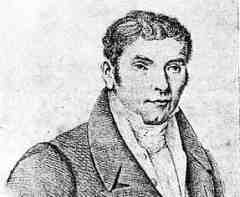
Henri Braconnot
Henri Braconnot (French: [ɑ̃ʁi bʁakɔno]; 29 May 1780 – 13 January 1855) was a French chemist and pharmacist.
He was born in Commercy, his father being a counsel at the local parliament. At the death of his father, in 1787, Henri began his instruction in an elementary school in Commercy and then with private teachers.
At 13, he was placed as apprentice in a pharmacy in Nancy where he learned and practiced pharmacy, chemistry, and botany. At 15, he left Nancy for a military service in a hospital in Strasbourg.
In 1801-1802, he lived in Paris where he learnt in various schools, Museum, school of medicine among others, and followed the lectures of Antoine François, comte de Fourcroy, Jean-Baptiste Lamarck and Étienne Geoffroy Saint-Hilaire. He carried out some chemical investigations on the composition of a fossil horn which were published later (J Chim Phys 1806).
From 1802 to his death, he lived in Nancy where he was named in 1807 as director of the botanical garden and member of the scientific academy of the town. He worked as a chemist until his death mainly on plant chemistry. He made several research studies of plant assimilation, organic acids, plant composition and fats. He made also minor contributions to mineralogy and hydrology.
He was elected in 1823 correspondent member of the Académie des Sciences in Paris. Until his death in 1855, he published 112 works.
In the fat domain, Braconnot described in 1815 that fats are formed of a solid part ("absolute tallow") and an oily compound ("absolute oil"), their consistency resulting from the proportions of the two parts. This conclusion was obtained after pressing fats in the cold between filter papers (Ann Chimie 1815, 93, 225). Furthermore, after saponification and acidification Braconnot separated a solid fraction similar to "adipocire" described by Fourcroy (1806). Unfortunately, he did not observe its acid properties which led Chevreul to discover in 1820 stearic acid.
As these data were similar to the first data obtained by Chevreul as soon as 1813, the later sent a letter to the journal Annales de Chimie claiming his priority and contesting the originality of Braconnot's work (Ann Chim 1815, 94, 73). As an application of his laboratory work, it occurred to Braconnot that the "absolute tallow" (similar to stearine) from beef or sheep could be used to make candles. He named that substance "céromimène" (wax-like). With Simonin F, a pharmacist in Nancy, he patented in 1818 a process of candle manufacture. An improved process using stearic acid was patented by Chevreul seven years later.
Henri Braconnot
Henri Braconnot (French: [ɑ̃ʁi bʁakɔno]; 29 May 1780 – 13 January 1855) was a French chemist and pharmacist.
He was born in Commercy, his father being a counsel at the local parliament. At the death of his father, in 1787, Henri began his instruction in an elementary school in Commercy and then with private teachers.
At 13, he was placed as apprentice in a pharmacy in Nancy where he learned and practiced pharmacy, chemistry, and botany. At 15, he left Nancy for a military service in a hospital in Strasbourg.
In 1801-1802, he lived in Paris where he learnt in various schools, Museum, school of medicine among others, and followed the lectures of Antoine François, comte de Fourcroy, Jean-Baptiste Lamarck and Étienne Geoffroy Saint-Hilaire. He carried out some chemical investigations on the composition of a fossil horn which were published later (J Chim Phys 1806).
From 1802 to his death, he lived in Nancy where he was named in 1807 as director of the botanical garden and member of the scientific academy of the town. He worked as a chemist until his death mainly on plant chemistry. He made several research studies of plant assimilation, organic acids, plant composition and fats. He made also minor contributions to mineralogy and hydrology.
He was elected in 1823 correspondent member of the Académie des Sciences in Paris. Until his death in 1855, he published 112 works.
In the fat domain, Braconnot described in 1815 that fats are formed of a solid part ("absolute tallow") and an oily compound ("absolute oil"), their consistency resulting from the proportions of the two parts. This conclusion was obtained after pressing fats in the cold between filter papers (Ann Chimie 1815, 93, 225). Furthermore, after saponification and acidification Braconnot separated a solid fraction similar to "adipocire" described by Fourcroy (1806). Unfortunately, he did not observe its acid properties which led Chevreul to discover in 1820 stearic acid.
As these data were similar to the first data obtained by Chevreul as soon as 1813, the later sent a letter to the journal Annales de Chimie claiming his priority and contesting the originality of Braconnot's work (Ann Chim 1815, 94, 73). As an application of his laboratory work, it occurred to Braconnot that the "absolute tallow" (similar to stearine) from beef or sheep could be used to make candles. He named that substance "céromimène" (wax-like). With Simonin F, a pharmacist in Nancy, he patented in 1818 a process of candle manufacture. An improved process using stearic acid was patented by Chevreul seven years later.
Recent media
Recent media