



Community hub
Recent from talks
Knowledge base stats:
Talk channels stats:
Members stats:
Henry Post Army Airfield
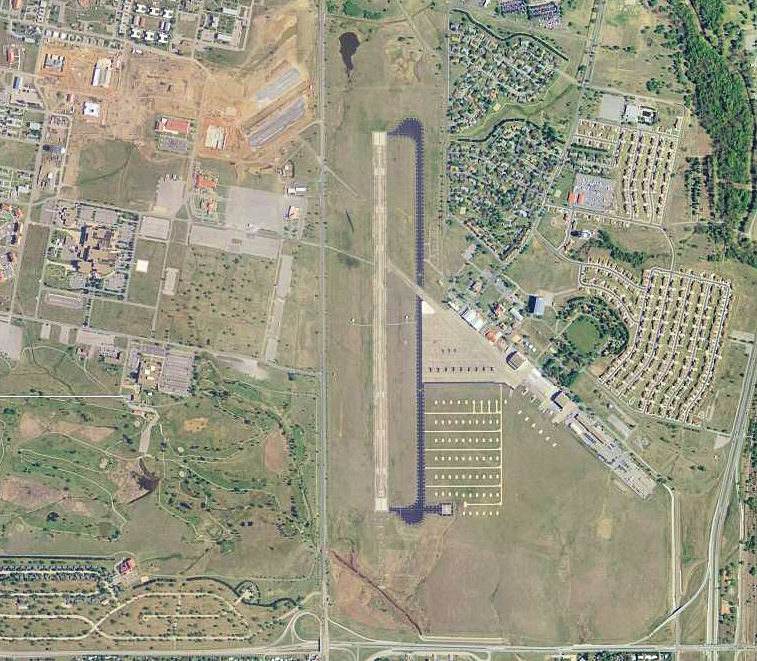
Henry Post Army Airfield (IATA: FSI, ICAO: KFSI, FAA LID: FSI) is a military use airport located at Fort Sill in Comanche County, Oklahoma, United States. This military airport is owned by United States Army. Established as Post Field in 1917, it was one of thirty-two Air Service training camps established after the United States entry into World War I in April 1917.
Henry Post Army Airfield was the first home of all Army Aviation Training after World War II before moving to Fort Rucker, Alabama, in 1954. It is a very historic airfield. There is still a balloon hangar, transported by rail cars from the Naval Air Station Moffett Field airship hangars in California and reassembled at Fort Sill in 1935.
During the On-Site Inspection Agency (OSIA) four phase inspections as authorized by the INF Treaty of 1988, the 20th century Lighter-Than-Air (LTA) hangar was a point of convergence by the Soviet Union prior to Revolutions of 1989 and discontinuation of the Cold War.
Henry Post AAF has one runway designated 17/35 with a concrete surface measuring 5,001 by 200 feet (1,524 x 61 m). There are no permanently assigned Army aviation units, and the facilities are operated as a military airport. The primary users of the airfield are USAF training aircraft from Sheppard AFB, Wichita Falls, TX, and Dyess AFB, Abilene, TX.
The field was named in honor of pioneer aviator 2d Lieutenant Henry Post (1885–1914). Post was assigned to the 25th Infantry, and reported for aeronautical duty at the Signal Corps Aviation School, Rockwell Field, San Diego, California on 26 May 1913. On 18 December, Post set an altitude record for Air Service aviation, attaining a height of 10,500 feet. On 9 February 1914, while at Rockwell Field, he was killed in an airplane crash, after reaching an altitude of 12,140 feet. While descending, the Wright Model C, Signal Corps 10, suffered the collapse of a wing and the airframe dropped into San Diego Bay. Following this accident, the Signal Corps condemned all pusher types, essentially removing Wright brothers designs from further service.
The first Army aviation at Fort Sill began on 26 July 1915 when eight Curtiss JN-3 airplanes of the 1st Aero Squadron arrived from Rockwell Field, California. The squadron was ordered to Fort Sill as a result of the Tampico Affair threatened war between the United States and Mexico. However, the aviation facilities at Fort Sill consisted of little more than a grass field. Using Fort Sill as a base of operations, a detachment was flown to Brownsville, Texas in August until a proper airfield was built for the squadron at Fort Sam Houston, near San Antonio. On 26 November, the 1st Aero Squadron departed for Fort Sam Houston, from which it would eventually deploy as part of the 1916 Punitive Expedition against Mexico as a result of Pancho Villa's raid on Columbus, Texas in March 1916.
As a result of the United States' entry into World War I, Fort Sill was selected for a primary pilot school. Construction of some 50 buildings began to support the school. Post Field was established as an Airfield on 10 September 1917. The field covered over 700 acres and could accommodate up to 1,000 personnel. Dozens of wooden buildings served as headquarters, maintenance, and officers' quarters.
The Signal Corps had been supplying observation aircraft for the United States Army Field Artillery School since 1915. In the early days of aviation, observation balloons were considered a little more reliable than Airplanes for artillery spotting. Company A 1st Balloon Squadron was assigned to the post on 24 September 1917. but was split up into the 25th, and 26th Balloon Companies. The first aircraft squadron to arrive was the 3d Aero Squadron on 29 August 1917. Although the 3d was equipped with twelve Curtiss R-4 planes, they were replaced with Curtiss JN-4Ds that were shipped in wooden crates by rail car.
Hub AI
Henry Post Army Airfield AI simulator
(@Henry Post Army Airfield_simulator)
Henry Post Army Airfield
Henry Post Army Airfield (IATA: FSI, ICAO: KFSI, FAA LID: FSI) is a military use airport located at Fort Sill in Comanche County, Oklahoma, United States. This military airport is owned by United States Army. Established as Post Field in 1917, it was one of thirty-two Air Service training camps established after the United States entry into World War I in April 1917.
Henry Post Army Airfield was the first home of all Army Aviation Training after World War II before moving to Fort Rucker, Alabama, in 1954. It is a very historic airfield. There is still a balloon hangar, transported by rail cars from the Naval Air Station Moffett Field airship hangars in California and reassembled at Fort Sill in 1935.
During the On-Site Inspection Agency (OSIA) four phase inspections as authorized by the INF Treaty of 1988, the 20th century Lighter-Than-Air (LTA) hangar was a point of convergence by the Soviet Union prior to Revolutions of 1989 and discontinuation of the Cold War.
Henry Post AAF has one runway designated 17/35 with a concrete surface measuring 5,001 by 200 feet (1,524 x 61 m). There are no permanently assigned Army aviation units, and the facilities are operated as a military airport. The primary users of the airfield are USAF training aircraft from Sheppard AFB, Wichita Falls, TX, and Dyess AFB, Abilene, TX.
The field was named in honor of pioneer aviator 2d Lieutenant Henry Post (1885–1914). Post was assigned to the 25th Infantry, and reported for aeronautical duty at the Signal Corps Aviation School, Rockwell Field, San Diego, California on 26 May 1913. On 18 December, Post set an altitude record for Air Service aviation, attaining a height of 10,500 feet. On 9 February 1914, while at Rockwell Field, he was killed in an airplane crash, after reaching an altitude of 12,140 feet. While descending, the Wright Model C, Signal Corps 10, suffered the collapse of a wing and the airframe dropped into San Diego Bay. Following this accident, the Signal Corps condemned all pusher types, essentially removing Wright brothers designs from further service.
The first Army aviation at Fort Sill began on 26 July 1915 when eight Curtiss JN-3 airplanes of the 1st Aero Squadron arrived from Rockwell Field, California. The squadron was ordered to Fort Sill as a result of the Tampico Affair threatened war between the United States and Mexico. However, the aviation facilities at Fort Sill consisted of little more than a grass field. Using Fort Sill as a base of operations, a detachment was flown to Brownsville, Texas in August until a proper airfield was built for the squadron at Fort Sam Houston, near San Antonio. On 26 November, the 1st Aero Squadron departed for Fort Sam Houston, from which it would eventually deploy as part of the 1916 Punitive Expedition against Mexico as a result of Pancho Villa's raid on Columbus, Texas in March 1916.
As a result of the United States' entry into World War I, Fort Sill was selected for a primary pilot school. Construction of some 50 buildings began to support the school. Post Field was established as an Airfield on 10 September 1917. The field covered over 700 acres and could accommodate up to 1,000 personnel. Dozens of wooden buildings served as headquarters, maintenance, and officers' quarters.
The Signal Corps had been supplying observation aircraft for the United States Army Field Artillery School since 1915. In the early days of aviation, observation balloons were considered a little more reliable than Airplanes for artillery spotting. Company A 1st Balloon Squadron was assigned to the post on 24 September 1917. but was split up into the 25th, and 26th Balloon Companies. The first aircraft squadron to arrive was the 3d Aero Squadron on 29 August 1917. Although the 3d was equipped with twelve Curtiss R-4 planes, they were replaced with Curtiss JN-4Ds that were shipped in wooden crates by rail car.