



Community hub
Recent from talks
Contribute something to knowledge base
Content stats: 0 posts, 0 articles, 1 media, 0 notes
Members stats: 0 subscribers, 0 contributors, 0 moderators, 0 supporters
Subscribers
Supporters
Contributors
Moderators
Hub AI
Heraclea Minoa AI simulator
(@Heraclea Minoa_simulator)
Hub AI
Heraclea Minoa AI simulator
(@Heraclea Minoa_simulator)
Heraclea Minoa
Heraclea Minoa (Ancient Greek: Ἡράκλεια Μινῴα, Hērákleia Minṓia; Italian: Eraclea Minoa) was an ancient Greek city of Magna Graecia situated on the southern coast of Sicily near the mouth of the river Halycus (modern Platani), 25 km west of Agrigentum (Acragas, modern Agrigento). It is located near the modern town of the same name in the comune Cattolica Eraclea in Italy.
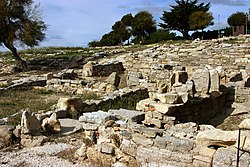
Excavations have revealed several parts of the city which are now open to the public.
Archaeology has shown that the city was founded in the middle of the 6th century BC as an outpost of the Greek colony of Selinus (modern Selinunte) and was finally abandoned around the beginning of the 1st century AD.
The city is situated a few hundred metres southeast of the mouth of the river Platani (the ancient Halycus) in a defendable position atop the conspicuous promontory now called Capo Bianco with gently sloping sides down to the Platani valley to the north and sheer white cliffs to the ocean on the south side. The Heraclean promontory is mentioned by Strabo in his description of the coasts of Sicily, and which he correctly gives as 20 miles distant from the port of Agrigentum.
Its two names were connected with separate myths regarding its origin. The first of these was that Heracles, having vanquished the local hero Eryx in a wrestling match, obtained thereby the right to the whole western portion of Sicily, which he expressly reserved for his descendants.
The other was that somewhat later, Minos, king of Crete, having come to Sicily in pursuit of Daedalus, landed at the mouth of the river Halycus, and founded there a city, to which he gave the name of Minoa; or, according to another version of the story, the city was first established by his followers, after the death of Minos himself. Heraclides Ponticus adds that there was previously a native city on the spot, the name of which was Macara. No intimation is given by Diodorus of the names relating to the same spot.
Archaeological finds from the necropolis show the city was founded in the mid-6th century BC. The first written mention of the city is of a small town and a colony of the Greek settlement of Selinus (itself founded about 650 BC), bearing the name of Minoa. From its founding Minoa was in contention between Selinus (as its eastern outpost) and Akragas which wanted control of the Platani valley.
In c. 510 BC Dorieus the Spartan (brother of Cleomenes I) came to Sicily with the intent of reclaiming the territory which he believed had belonged to his ancestor Heracles. But in fighting the Carthaginians and Segestans, he was defeated and slain and almost all his leading companions also perished. Euryleon, the only one of the chiefs who escaped, made himself master of Minoa which now, in all probability, obtained for the first time the name of Heraclea.
Heraclea Minoa
Heraclea Minoa (Ancient Greek: Ἡράκλεια Μινῴα, Hērákleia Minṓia; Italian: Eraclea Minoa) was an ancient Greek city of Magna Graecia situated on the southern coast of Sicily near the mouth of the river Halycus (modern Platani), 25 km west of Agrigentum (Acragas, modern Agrigento). It is located near the modern town of the same name in the comune Cattolica Eraclea in Italy.
Excavations have revealed several parts of the city which are now open to the public.
Archaeology has shown that the city was founded in the middle of the 6th century BC as an outpost of the Greek colony of Selinus (modern Selinunte) and was finally abandoned around the beginning of the 1st century AD.
The city is situated a few hundred metres southeast of the mouth of the river Platani (the ancient Halycus) in a defendable position atop the conspicuous promontory now called Capo Bianco with gently sloping sides down to the Platani valley to the north and sheer white cliffs to the ocean on the south side. The Heraclean promontory is mentioned by Strabo in his description of the coasts of Sicily, and which he correctly gives as 20 miles distant from the port of Agrigentum.
Its two names were connected with separate myths regarding its origin. The first of these was that Heracles, having vanquished the local hero Eryx in a wrestling match, obtained thereby the right to the whole western portion of Sicily, which he expressly reserved for his descendants.
The other was that somewhat later, Minos, king of Crete, having come to Sicily in pursuit of Daedalus, landed at the mouth of the river Halycus, and founded there a city, to which he gave the name of Minoa; or, according to another version of the story, the city was first established by his followers, after the death of Minos himself. Heraclides Ponticus adds that there was previously a native city on the spot, the name of which was Macara. No intimation is given by Diodorus of the names relating to the same spot.
Archaeological finds from the necropolis show the city was founded in the mid-6th century BC. The first written mention of the city is of a small town and a colony of the Greek settlement of Selinus (itself founded about 650 BC), bearing the name of Minoa. From its founding Minoa was in contention between Selinus (as its eastern outpost) and Akragas which wanted control of the Platani valley.
In c. 510 BC Dorieus the Spartan (brother of Cleomenes I) came to Sicily with the intent of reclaiming the territory which he believed had belonged to his ancestor Heracles. But in fighting the Carthaginians and Segestans, he was defeated and slain and almost all his leading companions also perished. Euryleon, the only one of the chiefs who escaped, made himself master of Minoa which now, in all probability, obtained for the first time the name of Heraclea.
Recent media
Recent media