


Community hub
Recent from talks
Contribute something to knowledge base
Content stats: 0 posts, 0 articles, 1 media, 0 notes
Members stats: 0 subscribers, 0 contributors, 0 moderators, 0 supporters
Subscribers
Supporters
Contributors
Moderators
Hub AI
Hermann Joseph Muller AI simulator
(@Hermann Joseph Muller_simulator)
Hub AI
Hermann Joseph Muller AI simulator
(@Hermann Joseph Muller_simulator)
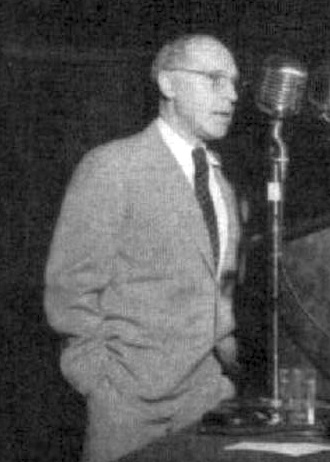
Hermann Joseph Muller
Hermann Joseph Muller (December 21, 1890 – April 5, 1967) was an American geneticist who was awarded the 1946 Nobel Prize in Physiology or Medicine, "for the discovery that mutations can be induced by X-rays". Muller warned of long-term dangers of radioactive fallout from nuclear war and nuclear testing, which resulted in greater public scrutiny of these practices.
Muller was born in New York City, the son of Frances (Lyons) and Hermann Joseph Muller Sr., an artisan who worked with metals. Muller was a third-generation American whose father's ancestors were originally Catholic and came to the United States from Koblenz. His mother's family was of mixed Jewish (descended from Spanish and Portuguese Jews) and Anglican background, and had come from Britain. Among his first cousins was Alfred Kroeber (Kroeber was Ursula Le Guin's father) and first cousins once removed was Herbert J. Muller. As an adolescent, Muller attended a Unitarian church and considered himself a pantheist; in high school, he became an atheist. He excelled in the public schools. At 16, he entered Columbia College. From his first semester, he was interested in biology; he became an early convert of the Mendelian-chromosome theory of heredity—and the concept of genetic mutations and natural selection as the basis for evolution. He formed a biology club and also became a proponent of eugenics; the connections between biology and society would be his perennial concern. Muller earned a Bachelor of Arts degree in 1910.
Muller remained at Columbia (the pre-eminent American zoology program at the time, due to E. B. Wilson and his students) for graduate school. He became interested in the Drosophila genetics work of Thomas Hunt Morgan's fly lab after undergraduate bottle washers Alfred Sturtevant and Calvin Bridges joined his biology club. In 1911–1912, he studied metabolism at Cornell University, but remained involved with Columbia. He followed the drosophilists as the first genetic maps emerged from Morgan's experiments, and joined Morgan's group in 1912 (after two years of informal participation).
In the fly group, Muller's contributions were primarily theoretical—explanations for experimental results and ideas and predictions for new experiments. In the emerging collaborative culture of the drosophilists, however, credit was assigned based on results rather than ideas; Muller felt cheated when he was left out of major publications.
In 1914, Julian Huxley offered Muller a position at the recently founded William Marsh Rice Institute, now Rice University; he hurried to complete his Doctor of philosophy degree and moved to Houston for the beginning of the 1915–1916 academic year (his degree was issued in 1916). At Rice, Muller taught biology and continued Drosophila lab work. In 1918, he proposed an explanation for the dramatic discontinuous alterations in Oenothera lamarckiana that were the basis of Hugo de Vries's theory of mutationism: "balanced lethals" allowed the accumulation of recessive mutations, and rare crossing over events resulted in the sudden expression of these hidden traits. In other words, de Vries's experiments were explainable by the Mendelian-chromosome theory. Muller's work was increasingly focused on mutation rate and lethal mutations. In 1918, Morgan, short-handed because many of his students and assistants were drafted for the U.S. entry into World War I, convinced Muller to return to Columbia to teach and to expand his experimental program.
At Columbia, Muller and his collaborator and longtime friend Edgar Altenburg continued the investigation of lethal mutations. The primary method for detecting such mutations was to measure the sex ratios of the offspring of female flies. They predicted the ratio would vary from 1:1 due to recessive mutations on the X chromosome, which would be expressed only in males (which lacked the functional allele on a second X chromosome). Muller found a strong temperature dependence in mutation rate, leading him to believe that spontaneous mutation was the dominant mode (and to initially discount the role of external factors such as ionizing radiation or chemical agents). In 1920, Muller and Altenburg coauthored a seminal paper in Genetics on "modifier genes" that determine the size of mutant Drosophila wings. In 1919, Muller made the important discovery of a mutant (later found to be a chromosomal inversion) that appeared to suppress crossing over, which opened up new avenues in mutation-rate studies. However, his appointment at Columbia was not continued; he accepted an offer from the University of Texas and left Columbia after the summer of 1920.
Muller taught at the University of Texas from 1920 until 1932. Soon after returning to Texas, he married mathematics professor Jessie Marie Jacobs, whom he had courted previously. In his early years at Texas, Muller's Drosophila work was slow going; the data from his mutation rate studies were difficult to interpret. In 1923, he began using radium and X-rays, but the relationship between radiation and mutation was difficult to measure because such radiation also sterilized the flies. In this period, he also became involved with eugenics and human genetics. He carried out a study of twins separated at birth that seemed to indicate a strong hereditary component of I.Q. Muller was critical of the new directions of the eugenics movement (such as anti-immigration), but was hopeful about the prospects for positive eugenics. In 1932, at the Third International Eugenics Congress, Muller gave a speech and stated, "eugenics might yet perfect the human race, but only in a society consciously organized for the common good".
In 1926, a series of major breakthroughs began. In November, Muller carried out two experiments with varied doses of X-rays, the second of which used the crossing over suppressor stock ("ClB") he had found in 1919. A clear, quantitative connection between radiation and lethal mutations quickly emerged. Muller's discovery created a media sensation after he delivered a paper entitled "The Problem of Genetic Modification" at the Fifth International Congress of Genetics in Berlin; it would make him one of the better-known public intellectuals of the early 20th century. By 1928, others had replicated his dramatic results, expanding them to other model organisms, such as wasps and maize. In the following years, he began publicizing the likely dangers of radiation exposure in humans (such as physicians who frequently operate X-ray equipment or shoe sellers who radiated their customers' feet).
Hermann Joseph Muller
Hermann Joseph Muller (December 21, 1890 – April 5, 1967) was an American geneticist who was awarded the 1946 Nobel Prize in Physiology or Medicine, "for the discovery that mutations can be induced by X-rays". Muller warned of long-term dangers of radioactive fallout from nuclear war and nuclear testing, which resulted in greater public scrutiny of these practices.
Muller was born in New York City, the son of Frances (Lyons) and Hermann Joseph Muller Sr., an artisan who worked with metals. Muller was a third-generation American whose father's ancestors were originally Catholic and came to the United States from Koblenz. His mother's family was of mixed Jewish (descended from Spanish and Portuguese Jews) and Anglican background, and had come from Britain. Among his first cousins was Alfred Kroeber (Kroeber was Ursula Le Guin's father) and first cousins once removed was Herbert J. Muller. As an adolescent, Muller attended a Unitarian church and considered himself a pantheist; in high school, he became an atheist. He excelled in the public schools. At 16, he entered Columbia College. From his first semester, he was interested in biology; he became an early convert of the Mendelian-chromosome theory of heredity—and the concept of genetic mutations and natural selection as the basis for evolution. He formed a biology club and also became a proponent of eugenics; the connections between biology and society would be his perennial concern. Muller earned a Bachelor of Arts degree in 1910.
Muller remained at Columbia (the pre-eminent American zoology program at the time, due to E. B. Wilson and his students) for graduate school. He became interested in the Drosophila genetics work of Thomas Hunt Morgan's fly lab after undergraduate bottle washers Alfred Sturtevant and Calvin Bridges joined his biology club. In 1911–1912, he studied metabolism at Cornell University, but remained involved with Columbia. He followed the drosophilists as the first genetic maps emerged from Morgan's experiments, and joined Morgan's group in 1912 (after two years of informal participation).
In the fly group, Muller's contributions were primarily theoretical—explanations for experimental results and ideas and predictions for new experiments. In the emerging collaborative culture of the drosophilists, however, credit was assigned based on results rather than ideas; Muller felt cheated when he was left out of major publications.
In 1914, Julian Huxley offered Muller a position at the recently founded William Marsh Rice Institute, now Rice University; he hurried to complete his Doctor of philosophy degree and moved to Houston for the beginning of the 1915–1916 academic year (his degree was issued in 1916). At Rice, Muller taught biology and continued Drosophila lab work. In 1918, he proposed an explanation for the dramatic discontinuous alterations in Oenothera lamarckiana that were the basis of Hugo de Vries's theory of mutationism: "balanced lethals" allowed the accumulation of recessive mutations, and rare crossing over events resulted in the sudden expression of these hidden traits. In other words, de Vries's experiments were explainable by the Mendelian-chromosome theory. Muller's work was increasingly focused on mutation rate and lethal mutations. In 1918, Morgan, short-handed because many of his students and assistants were drafted for the U.S. entry into World War I, convinced Muller to return to Columbia to teach and to expand his experimental program.
At Columbia, Muller and his collaborator and longtime friend Edgar Altenburg continued the investigation of lethal mutations. The primary method for detecting such mutations was to measure the sex ratios of the offspring of female flies. They predicted the ratio would vary from 1:1 due to recessive mutations on the X chromosome, which would be expressed only in males (which lacked the functional allele on a second X chromosome). Muller found a strong temperature dependence in mutation rate, leading him to believe that spontaneous mutation was the dominant mode (and to initially discount the role of external factors such as ionizing radiation or chemical agents). In 1920, Muller and Altenburg coauthored a seminal paper in Genetics on "modifier genes" that determine the size of mutant Drosophila wings. In 1919, Muller made the important discovery of a mutant (later found to be a chromosomal inversion) that appeared to suppress crossing over, which opened up new avenues in mutation-rate studies. However, his appointment at Columbia was not continued; he accepted an offer from the University of Texas and left Columbia after the summer of 1920.
Muller taught at the University of Texas from 1920 until 1932. Soon after returning to Texas, he married mathematics professor Jessie Marie Jacobs, whom he had courted previously. In his early years at Texas, Muller's Drosophila work was slow going; the data from his mutation rate studies were difficult to interpret. In 1923, he began using radium and X-rays, but the relationship between radiation and mutation was difficult to measure because such radiation also sterilized the flies. In this period, he also became involved with eugenics and human genetics. He carried out a study of twins separated at birth that seemed to indicate a strong hereditary component of I.Q. Muller was critical of the new directions of the eugenics movement (such as anti-immigration), but was hopeful about the prospects for positive eugenics. In 1932, at the Third International Eugenics Congress, Muller gave a speech and stated, "eugenics might yet perfect the human race, but only in a society consciously organized for the common good".
In 1926, a series of major breakthroughs began. In November, Muller carried out two experiments with varied doses of X-rays, the second of which used the crossing over suppressor stock ("ClB") he had found in 1919. A clear, quantitative connection between radiation and lethal mutations quickly emerged. Muller's discovery created a media sensation after he delivered a paper entitled "The Problem of Genetic Modification" at the Fifth International Congress of Genetics in Berlin; it would make him one of the better-known public intellectuals of the early 20th century. By 1928, others had replicated his dramatic results, expanding them to other model organisms, such as wasps and maize. In the following years, he began publicizing the likely dangers of radiation exposure in humans (such as physicians who frequently operate X-ray equipment or shoe sellers who radiated their customers' feet).
Recent media
Recent media