Hubbry Logo
HeteropodaHeteropodaMain
Open search
Heteropoda
Community hub
Heteropoda
logo
8 pages, 0 posts
0 subscribers
Be the first to start a discussion here.
Heteropoda
Heteropoda
from Wikipedia

Heteropoda
Temporal range: Palaeogene–present
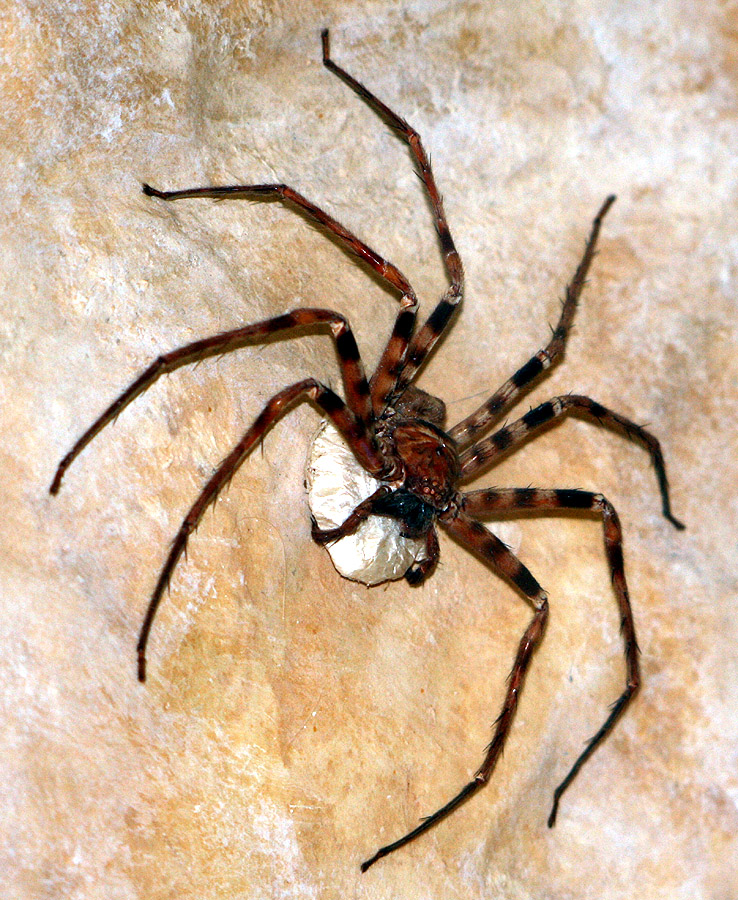
Heteropoda maxima
Scientific classification Edit this classification
Kingdom: Animalia
Phylum: Arthropoda
Subphylum: Chelicerata
Class: Arachnida
Order: Araneae
Infraorder: Araneomorphae
Family: Sparassidae
Genus: Heteropoda
Latreille, 1804
Species

189 accepted species; see text.

The eye arrangement of spiders in the genus Heteropoda

Heteropoda is a genus of spiders in the family Sparassidae (the huntsman spiders). They are mainly distributed in tropical Asia and Australia, while at least one species, H. venatoria, has a cosmopolitan distribution,[1] and H. variegata occurs in the Mediterranean.[2]

These spiders catch and eat insects, but in a laboratory study one species readily ate fish and tadpoles when offered.[1] H. venatoria has also been known to eat scorpions and bats.[3]

The largest species in the genus, H. maxima, is about 4.6 centimeters long but has a legspan of up to 30 centimeters, making it the largest of any extant spider.[4]

Species

[edit]

As of August 2022, there were 189 species in the genus, after series of revisions.[5][6]

References

[edit]
Revisions and contributorsEdit on WikipediaRead on Wikipedia
from Grokipedia
Heteropoda is a of huntsman spiders belonging to the family Sparassidae, characterized by their large body size, elongated legs, and nocturnal predatory lifestyle. These spiders are agile hunters that rely on speed, keen vision, and powerful to ambush and capture prey primarily consisting of , with rare instances of small vertebrates. With approximately 240 valid recognized as of 2025, the genus represents a significant portion of the Sparassidae family's diversity. Established by in 1804, with (Linnaeus, 1767) as the , Heteropoda encompasses a wide array of morphologies, though most species exhibit cryptic coloration ranging from brown to gray, often with banded legs for in their habitats. The includes several junior synonyms, such as Ocypete and Sarotes, reflecting historical taxonomic revisions. Recent molecular phylogenies have delineated species groups, such as the H. javana group and newly proposed ones like the H. helge and H. simplex groups, aiding in better understanding evolutionary relationships. Heteropoda species are predominantly distributed across tropical and subtropical regions, with a core range in , including countries like , , , , and , extending to and Pacific Islands. Some species, notably H. venatoria, have been introduced to other areas, including , , , and , often via human-mediated transport. Ecologically, these spiders inhabit diverse environments from lowland forests and caves to urban settings, where they play a role in controlling pest populations like . They are generally non-aggressive toward humans, with bites causing mild symptoms comparable to a wasp sting. Among the most notable species is Heteropoda venatoria, a cosmopolitan with a body length of 22–28 mm and leg spans of 7–12 cm, commonly found in homes and known for its role in . Heteropoda maxima Jäger, 2001, discovered in Laotian caves, holds the record for the largest leg span in the genus at up to 30 cm, making it one of the world's largest spiders by . Ongoing taxonomic research continues to describe new , particularly from Southeast Asian biodiversity hotspots, highlighting the genus's underexplored diversity.

Taxonomy

Etymology and history

The genus name Heteropoda derives from the Ancient Greek words heteros (ἕτερος), meaning "different," and pous (πούς), meaning "foot," alluding to the distinctive flattened leg structure adapted for running on tree trunks and surfaces, which differs from other spiders. The genus was established by French entomologist Pierre André Latreille in 1804, with Heteropoda venatoria (originally described as Araneus venator by Carl Linnaeus in 1767) designated as the type species by monotypy. Initial species descriptions within the occurred primarily in the , with contributions from arachnologists such as Charles Athanase Walckenaer, who described Olios leucosius and Olios antillianus (now of H. venatoria) in 1837, and , who named several species including Ocypete setulosa (also a of H. venatoria) in 1836. During this period, H. venatoria was recognized as a cosmopolitan species, with records indicating its widespread tropical distribution across , , and the by the mid-1800s, likely facilitated by human-mediated introductions via trade routes. Key milestones in the genus's history include taxonomic revisions in the mid-20th century and more extensive modern overhauls by Peter Jäger starting in the late 20th century, notably his 2008 revision of species with exceptional male palpal conformations from and . A notable event was the 2009 description of Heteropoda davidbowie by Jäger from , named in honor of musician due to the species's patterned leg markings resembling his iconic lightning bolt logo, highlighting ongoing discoveries amid threats. Most recently, the first molecular phylogeny of Heteropoda species, published in 2025 and describing two new species (H. flamma sp. nov. and H. curvata sp. nov.), utilized mitochondrial and nuclear genes to resolve systematic relationships and patterns, providing a foundation for future taxonomic refinements.

Classification and phylogeny

Heteropoda belongs to the taxonomic hierarchy Kingdom: Animalia, Phylum: Arthropoda, Class: Arachnida, Order: Araneae, Family: Sparassidae, Subfamily: Heteropodinae, Genus: Heteropoda. The genus Heteropoda is placed within the Heteropodinae subfamily of huntsman spiders, a diverse group characterized by their cursorial lifestyle and flattened bodies adapted for rapid movement. Phylogenetic analyses have confirmed the monophyly of Heteropodinae, with Heteropoda forming a core clade alongside related genera such as Sinopoda and Pseudopoda, based on molecular data from mitochondrial and nuclear markers. A 2025 molecular phylogeny of Heteropoda, utilizing two mitochondrial genes (COI and 16S) and four nuclear genes (18S, 28S, H3, and EF-1α), represents the first comprehensive study of the genus's internal relationships and reveals its close affinity to other huntsman genera like Holconia, with some species historically transferred between them (e.g., Heteropoda armillata originally described as Holconia armillata). This study supports an ancient for Heteropodinae during the Palaeogene, with fossil-calibrated estimates indicating key splits within the subfamily around 40-50 million years ago. Within Heteropoda, no formal subgenera are recognized, but the 2025 phylogeny delineates five informal species groups based on molecular and morphological data, including leg spination patterns: the H. javana group, H. helge group, H. tetrica group, H. simplex group, and H. amphora group. These groupings highlight evolutionary adaptations, such as semi-aquatic traits in H. natans, which clusters within the genus despite its unique behavior observed in Bornean streams. Historical synonymies have been resolved for several Heteropoda species, including the synonymization of names like Olios albifrons under H. venatoria, based on genital morphology and distribution data from the . Transfers within Heteropodinae, such as from genera like Torania to Heteropoda, further clarify the genus's boundaries and reduce taxonomic confusion from early 19th-century descriptions.

Description

Morphology

Heteropoda spiders exhibit a distinctive flattened, crab-like body , characterized by a prosoma and opisthosoma connected by a narrow pedicel, which allows them to navigate tight spaces effectively. The prosoma houses the eight eyes arranged in two recurved rows, providing a wide field of vision suited to their nocturnal hunting lifestyle. This compact supports the , pedipalps, and walking legs, while the opisthosoma contains vital organs such as the heart and reproductive systems. The legs of Heteropoda are laterigrade, oriented sideways in a crab-like fashion, enabling rapid lateral movements essential for pursuing prey. Leg lengths vary across species, with the first pair often the longest, facilitating precise grasping and stability during hunts; tarsi terminate in claw tufts that enhance to surfaces. Dense setae cover the legs, serving as sensory structures for detecting vibrations from nearby prey or threats through mechanoreception. Chelicerae in Heteropoda are robust and vertically oriented, functioning like to grasp and immobilize prey with powerful bites. Associated glands, extending from the into the prosoma, produce toxins specifically adapted for subduing and occasionally small vertebrates, delivering efficient without excessive tissue damage. Unlike some genera, Heteropoda lacks distinct stridulatory organs, relying instead on vibrational cues for communication and prey detection.

Size and variation

Heteropoda species display considerable variation in body size, with adult body lengths generally ranging from 5 to 46 mm (0.5 to 4.6 cm), though leg spans can extend much farther due to their long, slender limbs. For instance, the huntsman spider (H. venatoria) measures 2.2 to 2.8 cm in body length, with a leg span of 7 to 12 cm, allowing it to navigate narrow crevices despite its overall size. At the upper extreme, H. maxima, the largest known huntsman spider, reaches a body length of 4.6 cm and a leg span of up to 30 cm, making it the record holder for leg span among spiders. Coloration in Heteropoda is typically adapted for , featuring mottled patterns in shades of brown, gray, or pale yellow that blend with bark, leaves, and rocky surfaces in their tropical habitats. In H. venatoria, the has a wide marginal band—tan in females and cream in males—accompanied by distinct black spots on the legs for added . Some species deviate from this subdued palette; for example, H. davidbowie exhibits vibrant orange to reddish-brown hues with annulated legs featuring dark spots on lighter bands, contributing to its striking appearance. Sexual dimorphism is evident across the genus, particularly in size and body proportions, with females typically larger overall and possessing more robust s suited for egg production, while males have proportionally longer legs for agility during mate-searching and smaller, more streamlined s. In H. venatoria, females show a larger and tan carapace bands, whereas males have cream bands, a dark longitudinal abdominal stripe, and enlarged palpal structures. Similarly, in H. maxima, females exhibit bulkier bodies, but males possess relatively longer legs, a pattern consistent with the 's emphasis on male mobility. Certain species, such as H. lebar, further display sexual color dimorphism, with males and females differing markedly in hue and pattern intensity. Intraspecific variation in Heteropoda includes differences in size and coloration among populations or individuals, often reflecting local environmental adaptations. For example, in H. schwendingeri, multiple specimens show variability in leg spination and color patterning, supporting its status as a distinct despite these differences. In H. davidbowie, female dorsal coloration ranges from grayish to reddish-brown, highlighting individual-level polymorphism within the species.

Distribution and habitat

Geographic range

The genus Heteropoda is primarily native to tropical regions of , including and , as well as , with extensions into Pacific islands such as those in and . Species distributions span from southern eastward through countries like , , , , and , reflecting the genus's adaptation to warm, humid environments across this vast area. In , Heteropoda occurs widely but is notably absent from most of southeastern regions and . Several species have been introduced beyond their native ranges through human activities, particularly shipping. , the pantropical , has achieved a , establishing populations in the (including subtropical , , , Georgia, and ), , , and additional Pacific islands. Similarly, H. variegata has been introduced to the Mediterranean basin, where it is now established in coastal Levantine regions such as the in , favoring zones. Biogeographically, the region serves as a diversity hotspot for Heteropoda, with 233 valid documented as of November 2025, many concentrated in Southeast Asia's tropical forests. Recent surveys in 2025 have expanded records into subtropical areas of , including new from Hainan Province and the Zhuang Autonomous Region, highlighting ongoing discoveries in this expanding range. is particularly high in Australian rainforests, where like H. jugulans are restricted to eastern coastal habitats, and on islands such as , which host endemics including H. novaguineensis.

Habitat preferences

Heteropoda spiders primarily inhabit tropical environments, favoring warm and humid conditions that support their activity and survival. These spiders are commonly found in tropical forests, where they utilize microhabitats such as under loose bark on trees, in leaf litter, and on foliage. They also occur in s, particularly limestone systems in regions like , where species such as Heteropoda steineri and Heteropoda maxima dwell in dark, humid interiors. Additionally, many Heteropoda species, including H. venatoria, thrive in urban areas, seeking shelter under boards, in sheds, and on building walls. During the day, Heteropoda spiders typically hide in crevices, under bark, or in rock fissures to avoid and predators, emerging at night to hunt on foliage or open surfaces. This diurnal concealment and nocturnal foraging pattern is adapted to their and edge habitats, enhancing their predation efficiency. In human-modified settings, they often rest in sheltered spots within structures during daylight hours. A notable exception is Heteropoda natans, which exhibits semi-aquatic adaptations in lowland rainforests of , where it hunts on water surfaces and preys on aquatic organisms, including . This species demonstrates specialized behaviors for interacting with stream habitats, distinguishing it from the predominantly terrestrial preferences of other Heteropoda. Such versatility underscores the genus's broad within tropical ecosystems. Heteropoda species tolerate warm, humid climates typical of their distribution but are sensitive to cold, limiting outdoor persistence in temperate zones without heated refuges. Some, like H. venatoria, readily colonize human-altered habitats such as buildings and ships, facilitating their dispersal across subtropical and urban landscapes.

Behavior and ecology

Locomotion and hunting

Heteropoda spiders exhibit rapid locomotion characterized by sideways running. This movement is facilitated by their long, robust legs, which provide stability and power for quick pursuits. They also demonstrate adept climbing on vertical surfaces, utilizing adhesive setae—specialized microscopic hairs on their tarsi—that generate van der Waals forces for attachment to smooth substrates. While capable of limited jumps during chases or escapes, such leaps are not their primary mode of movement and typically span short distances. As active hunters, Heteropoda species employ pursuit strategies, rapidly chasing down prey across open ground or ambushing from concealed positions such as bark crevices or foliage. Their hunting success at night relies heavily on acute vision provided by large anterior eyes, which offer forward-facing binocular detection, supplemented by mechanoreceptors like sensory hairs and slit sensilla that detect vibrations and air currents. Unlike orb-weavers, they do not construct webs, instead depending on stealth, speed, and these sensory adaptations for prey localization. The elongated legs further enable precise pouncing strikes to immobilize targets. A notable adaptation occurs in Heteropoda natans, where individuals perform modified motions, using their pedipalps and anterior legs to propel and steer while diving or navigating stream edges for hunting. This semi-aquatic behavior allows brief submersion without specialized respiratory structures, distinguishing it from terrestrial congeners.

Diet and predation

Heteropoda spiders are primarily insectivorous predators, targeting a wide range of s including , , moths, flies, and other insects that share their tropical habitats. These spiders exhibit polyphagous feeding habits, preying on a wide range of arthropod species in certain ecosystems, reflecting their opportunistic nature as generalist hunters. Upon capturing prey, Heteropoda species employ a typical araneid feeding strategy involving envenomation to immobilize the victim, followed by external digestion through the regurgitation of enzyme-rich fluids that liquefy the prey's tissues. The resulting nutrient soup is then ingested via the spider's sucking stomach, a specialized organ that facilitates the intake of liquified matter while discarding indigestible solids. This process allows efficient nutrient extraction from prey larger than the spider itself, often exceeding the spider's body size. While form the core of their diet, Heteropoda occasionally prey on small vertebrates, such as geckos in natural settings. In laboratory observations, H. natans has demonstrated the ability to consume small fish, and targets and small fish in riparian environments, expanding its niche in ecosystems. As apex predators in tropical forests and urban fringes, Heteropoda species play a key ecological role by regulating pest populations, particularly and other household in human-modified habitats. Their predation helps maintain balance, reducing outbreaks of agricultural and domestic pests in regions where they are abundant. occurs among Heteropoda, particularly in confined or resource-limited conditions, where females may consume males post-mating. This behavior, though not dominant, provides an energy boost during periods of scarcity and has been observed across species like H. venatoria.

Reproduction and life cycle

Mating behaviors

Males of Heteropoda venatoria, a representative species in the genus, initiate courtship by constructing a sperm web approximately two hours prior to mating, during which they transfer sperm to their pedipalps and groom them for 5-25 seconds. Courtship rituals involve vibratory signals produced by rapid oscillations of the legs, generating low-frequency "buzzes" or "hums" at 63, 83, or 125 Hz, audible up to 0.3 meters away; these signals last 2.5-4 seconds and occur at intervals of about 37 seconds. Accompanying these vibrations are leg waving with the second pair of legs and periodic body jerks every 0.15 seconds, which serve to signal the male's presence and reduce female aggression. These behaviors typically unfold over 1-3 hours as the male dances slowly near or around the female. Mate location in H. venatoria occurs primarily at night through active searching, with males wandering over surfaces in the female's vicinity, potentially guided by contact pheromones deposited on the substrate. While silk draglines are not explicitly documented as primary cues in this species, general mating strategies suggest they may aid in following female trails, though aggressive encounters between rival males have not been detailed in laboratory observations. , with males significantly smaller than females, influences these interactions by heightening the male's vulnerability during approach. Copulation follows successful and involves direct sperm transfer via alternating insertions of the male's pedipalps into the female's , with each insertion lasting an average of 20.4 seconds (range 6-50 seconds). The process occurs in multiple bouts totaling 1-6 hours over a 24-hour period, often initiated after body vibrations signal mounting. No evidence of use or post-copulatory guarding by males has been reported in Heteropoda species. Sexual conflicts are prominent, particularly the risk of female cannibalism, which frequently occurs post- and may contribute to female-biased sex ratios observed in field populations (e.g., 3.4:1 females to males). This predation risk underscores the adaptive value of elaborate displays in mitigating female predatory responses during vulnerable mating encounters.

Development and longevity

Following mating, female Heteropoda spiders, exemplified by the pantropical huntsman spider Heteropoda venatoria, produce egg sacs approximately 12–14 days later, depositing an average of 163 eggs per sac (range 100–400), encased in a flattened, disc-shaped silk structure measuring 1.27–2.54 cm in diameter and 3.18–6.35 mm thick. In many species, including H. venatoria, these lenticular sacs are typically carried beneath the body using pedipalps; however, some like H. jugulans plaster sacs to substrates. Females are capable of producing up to five sacs over their reproductive period, though laboratory studies indicate an average of 2.16 fertile sacs per female. Parental care in Heteropoda is limited but includes maternal guarding of the egg sac, which the female carries beneath her body using her pedipalps for approximately 30 days during incubation, during which she refrains from feeding to protect the sac from predators and environmental threats. Upon after an incubation of 8–30 days (depending on ), the spiderlings remain clustered around or on the mother's body for a few days, typically during their first (1–6 days), before dispersing primarily by walking over short distances to minimize and competition. While detailed studies are primarily on H. venatoria, representing solitary species in the genus, reproductive traits may vary, with some exhibiting plastered egg sacs and life history differences influenced by habitat. Juvenile Heteropoda undergo 8–12 instars (males averaging 8.7, females 10.6), with rapid growth facilitated by molting, where width increases progressively from about 1.4 mm in the first to over 20 mm by maturity; in warm tropical climates (24–27°C and 60–70% relative humidity), juveniles reach in 6–12 months, with males maturing faster at around 242 days and females at 316 days under conditions. Adult longevity in Heteropoda typically spans 1–2 years total lifespan, with females outliving males (averaging 580 days versus 465 days) and some females surviving up to 3 years; males often have shorter post-mating lifespans due to predation or exhaustion, while environmental factors such as high humidity (above 60%) enhance survival by supporting extended starvation tolerance (over 4 months) and molting success in humid .

Species

Diversity and distribution

The genus Heteropoda currently includes 183 accepted , according to the (as of November 2025). Recent taxonomic revisions have added several , particularly from (e.g., five new described in 2024 from Indonesia, , , and ) and Vietnam (e.g., Heteropoda acris and Heteropoda taygiangensis in 2024), as well as two new (H. flamma and H. curvata) described in a 2025 molecular phylogeny from Laos and . Heteropoda species exhibit a predominantly tropical distribution, with the majority occurring in and ; many are endemic to these regions, reflecting the genus's origins in hotspots. Some species, such as the cosmopolitan H. venatoria, have broader ranges due to human-mediated introductions to , the , and Pacific islands. Patterns of within the are associated with historical fragmentation of tropical forests, as evidenced by molecular analyses showing diversification tied to biogeographic barriers in . The conservation status of most Heteropoda species remains unassessed by the , a common gap for arachnids due to limited data on population trends. However, habitat loss from and in tropical rainforests threatens several species, particularly endemics in fragmented Asian and Australian ecosystems. Significant research gaps persist, especially in understudied remote island habitats where undescribed diversity is likely high. A 2025 molecular phylogeny of the genus has established four new species groups (H. helge, tetrica, simplex, and amphora) and described two new species (H. flamma and H. curvata), underscoring the need for integrated morphological and genetic surveys to refine and distribution maps.

Notable species

Heteropoda venatoria, commonly known as the , is one of the most widespread in the , native to tropical regions and introduced to subtropical areas worldwide, including parts of , , and . This large features a flattened body measuring 2.2 to 2.8 cm in length, with a leg span reaching 7 to 12 cm, enabling it to navigate tight spaces like cracks and crevices. Valued as a natural pest controller, it actively hunts , flies, and other household , making it a beneficial presence in human dwellings across its cosmopolitan range. Heteropoda maxima, the giant huntsman spider, holds the distinction of being the largest species in the genus by leg span, which can extend up to 30 cm, though its body length is approximately 4.6 cm. Endemic to Laos, it was discovered in 2001 within a cave system and formally described in 2001, highlighting the biodiversity of Southeast Asian karst habitats. Its impressive size and cave-dwelling lifestyle underscore the extreme morphological diversity within Heteropoda, where leg spans generally range from a few centimeters to over 30 cm across species. Heteropoda davidbowie, named in 2008 after musician David Bowie, is notable for its iridescent, shiny exoskeleton that evokes the glam rock aesthetic of Bowie's Ziggy Stardust era, with patterned markings in shades of yellow, orange, and black. Found in the of and nearby regions in , this medium-sized contributes to the genus's reputation for striking visual displays among tropical arachnids. Heteropoda natans, described in 2005, represents a unique semi-aquatic adaptation within the , inhabiting stream edges in where it hunts on surfaces and can dive underwater to evade threats or pursue prey. Its specific name, meaning "swimming" in Latin, reflects specialized behaviors such as submerging for short periods, allowing it to capture and small vertebrates in riparian environments. This species exemplifies the ecological versatility of Heteropoda in exploiting marginal habitats.

References

Add your contribution
Related Hubs
User Avatar
No comments yet.