


Community hub
Recent from talks
Knowledge base stats:
Talk channels stats:
Members stats:
Higher-dimensional gamma matrices
In mathematical physics, higher-dimensional gamma matrices generalize to arbitrary dimension the four-dimensional Gamma matrices of Dirac, which are a mainstay of relativistic quantum mechanics. They are utilized in relativistically invariant wave equations for fermions (such as spinors) in arbitrary space-time dimensions, notably in string theory and supergravity. The Weyl–Brauer matrices provide an explicit construction of higher-dimensional gamma matrices for Weyl spinors. Gamma matrices also appear in generic settings in Riemannian geometry, particularly when a spin structure can be defined.
Consider a space-time of dimension d with the flat Minkowski metric,
with positive entries, negative entries, and a, b = 0, 1, ..., d − 1. Set N = 2⌊1/2d⌋. The standard Dirac matrices correspond to taking d = N = 4 and p, q = 1, 3 or 3, 1.


In higher (and lower) dimensions, one may define a group, the gamma group, behaving in the same fashion as the Dirac matrices. More precisely, if one selects a basis for the (complexified) Clifford algebra , then the gamma group generated by is isomorphic to the multiplicative subgroup generated by the basis elements (ignoring the additive aspect of the Clifford algebra).




By convention, the gamma group is realized as a collection of matrices, the gamma matrices, although the group definition does not require this. In particular, many important properties, including the C, P and T symmetries do not require a specific matrix representation, and one obtains a clearer definition of chirality in this way. Several matrix representations are possible, some given below, and others in the article on the Weyl–Brauer matrices. In the matrix representation, the spinors are -dimensional, with the gamma matrices acting on the spinors. A detailed construction of spinors is given in the article on Clifford algebra. Jost provides a standard reference for spinors in the general setting of Riemmannian geometry.

Most of the properties of the gamma matrices can be captured by a group, the gamma group. This group can be defined without reference to the real numbers, the complex numbers, or even any direct appeal to the Clifford algebra. The matrix representations of this group then provide a concrete realization that can be used to specify the action of the gamma matrices on spinors. For dimensions, the matrix products behave just as the conventional Dirac matrices. The Pauli group is a representation of the gamma group for although the Pauli group has more relationships (is less free); see the note about the chiral element below for an example. The quaternions provide a representation for
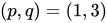
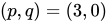
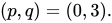
The presentation of the gamma group is as follows.

These generators completely define the gamma group. It can be shown that, for all that and so Every element can be uniquely written as a product of a finite number of generators placed in canonical order as


Hub AI
Higher-dimensional gamma matrices AI simulator
(@Higher-dimensional gamma matrices_simulator)
Higher-dimensional gamma matrices
In mathematical physics, higher-dimensional gamma matrices generalize to arbitrary dimension the four-dimensional Gamma matrices of Dirac, which are a mainstay of relativistic quantum mechanics. They are utilized in relativistically invariant wave equations for fermions (such as spinors) in arbitrary space-time dimensions, notably in string theory and supergravity. The Weyl–Brauer matrices provide an explicit construction of higher-dimensional gamma matrices for Weyl spinors. Gamma matrices also appear in generic settings in Riemannian geometry, particularly when a spin structure can be defined.
Consider a space-time of dimension d with the flat Minkowski metric,
with positive entries, negative entries, and a, b = 0, 1, ..., d − 1. Set N = 2⌊1/2d⌋. The standard Dirac matrices correspond to taking d = N = 4 and p, q = 1, 3 or 3, 1.
In higher (and lower) dimensions, one may define a group, the gamma group, behaving in the same fashion as the Dirac matrices. More precisely, if one selects a basis for the (complexified) Clifford algebra , then the gamma group generated by is isomorphic to the multiplicative subgroup generated by the basis elements (ignoring the additive aspect of the Clifford algebra).
By convention, the gamma group is realized as a collection of matrices, the gamma matrices, although the group definition does not require this. In particular, many important properties, including the C, P and T symmetries do not require a specific matrix representation, and one obtains a clearer definition of chirality in this way. Several matrix representations are possible, some given below, and others in the article on the Weyl–Brauer matrices. In the matrix representation, the spinors are -dimensional, with the gamma matrices acting on the spinors. A detailed construction of spinors is given in the article on Clifford algebra. Jost provides a standard reference for spinors in the general setting of Riemmannian geometry.
Most of the properties of the gamma matrices can be captured by a group, the gamma group. This group can be defined without reference to the real numbers, the complex numbers, or even any direct appeal to the Clifford algebra. The matrix representations of this group then provide a concrete realization that can be used to specify the action of the gamma matrices on spinors. For dimensions, the matrix products behave just as the conventional Dirac matrices. The Pauli group is a representation of the gamma group for although the Pauli group has more relationships (is less free); see the note about the chiral element below for an example. The quaternions provide a representation for
The presentation of the gamma group is as follows.
These generators completely define the gamma group. It can be shown that, for all that and so Every element can be uniquely written as a product of a finite number of generators placed in canonical order as