



Community hub
Recent from talks
Contribute something
Nothing was collected or created yet.
Gamma matrices
View on WikipediaIn mathematical physics, the gamma matrices, also called the Dirac matrices, are a set of conventional matrices with specific anticommutation relations that ensure they generate a matrix representation of the Clifford algebra It is also possible to define higher-dimensional gamma matrices. When interpreted as the matrices of the action of a set of orthogonal basis vectors for contravariant vectors in Minkowski space, the column vectors on which the matrices act become a space of spinors, on which the Clifford algebra of spacetime acts. This in turn makes it possible to represent infinitesimal spatial rotations and Lorentz boosts. Spinors facilitate spacetime computations in general, and in particular are fundamental to the Dirac equation for relativistic spin particles. Gamma matrices were introduced by Paul Dirac in 1928.[1][2]



In the Dirac representation, the four contravariant gamma matrices are

is the time-like, Hermitian matrix. The other three are space-like, anti-Hermitian matrices. More compactly, and where denotes the Kronecker product and the (for j = 1, 2, 3) denote the Pauli matrices.

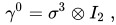
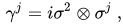


In addition, for discussions of group theory the identity matrix (I) is sometimes included with the four gamma matricies, and there is an auxiliary, "fifth" traceless matrix used in conjunction with the regular gamma matrices

The "fifth matrix" is not a proper member of the main set of four; it is used for separating nominal left and right chiral representations.

The gamma matrices have a group structure, the gamma group, that is shared by all matrix representations of the group, in any dimension, for any signature of the metric. For example, the 2×2 Pauli matrices are a set of "gamma" matrices in three dimensional space with metric of Euclidean signature (3, 0). In five spacetime dimensions, the four gammas, above, together with the fifth gamma-matrix to be presented below generate the Clifford algebra.
Mathematical structure
[edit]The defining property for the gamma matrices to generate a Clifford algebra is the anticommutation relation

where the curly brackets represent the anticommutator, is the Minkowski metric with signature (+ − − −), and is the 4 × 4 identity matrix.


This defining property is more fundamental than the numerical values used in the specific representation of the gamma matrices. Covariant gamma matrices are defined by

and Einstein notation is assumed.
Note that the other sign convention for the metric, (− + + +) necessitates either a change in the defining equation:

or a multiplication of all gamma matrices by , which of course changes their hermiticity properties detailed below. Under the alternative sign convention for the metric the covariant gamma matrices are then defined by


Physical structure
[edit]The Clifford algebra over spacetime V can be regarded as the set of real linear operators from V to itself, End(V), or more generally, when complexified to as the set of linear operators from any four-dimensional complex vector space to itself. More simply, given a basis for V, is just the set of all 4×4 complex matrices, but endowed with a Clifford algebra structure. Spacetime is assumed to be endowed with the Minkowski metric ημν. A space of bispinors, Ux , is also assumed at every point in spacetime, endowed with the bispinor representation of the Lorentz group. The bispinor fields Ψ of the Dirac equations, evaluated at any point x in spacetime, are elements of Ux (see below). The Clifford algebra is assumed to act on Ux as well (by matrix multiplication with column vectors Ψ(x) in Ux for all x). This will be the primary view of elements of in this section.


For each linear transformation S of Ux, there is a transformation of End(Ux) given by S E S−1 for E in If S belongs to a representation of the Lorentz group, then the induced action E ↦ S E S−1 will also belong to a representation of the Lorentz group, see Representation theory of the Lorentz group.

If S(Λ) is the bispinor representation acting on Ux of an arbitrary Lorentz transformation Λ in the standard (4 vector) representation acting on V, then there is a corresponding operator on given by equation:


showing that the quantity of γμ can be viewed as a basis of a representation space of the 4 vector representation of the Lorentz group sitting inside the Clifford algebra. The last identity can be recognized as the defining relationship for matrices belonging to an indefinite orthogonal group, which is written in indexed notation. This means that quantities of the form
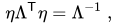

should be treated as 4 vectors in manipulations. It also means that indices can be raised and lowered on the γ using the metric ημν as with any 4 vector. The notation is called the Feynman slash notation. The slash operation maps the basis eμ of V, or any 4 dimensional vector space, to basis vectors γμ. The transformation rule for slashed quantities is simply
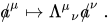
This is different from the transformation rule for the γμ, which are now treated as (fixed) basis vectors. The designation of the 4 tuple as a 4 vector sometimes found in the literature is thus a slight misnomer. The latter transformation corresponds to an active transformation of the components of a slashed quantity in terms of the basis γμ, and the former to a passive transformation of the basis γμ itself.

The elements form a representation of the Lie algebra of the Lorentz group. This is a spin representation. When these matrices, and linear combinations of them, are exponentiated, they are bispinor representations of the Lorentz group, e.g., the S(Λ) of above are of this form. The 6 dimensional space the σμν span is the representation space of a tensor representation of the Lorentz group. For the higher order elements of the Clifford algebra in general and their transformation rules, see the article Dirac algebra. The spin representation of the Lorentz group is encoded in the spin group Spin(1, 3) (for real, uncharged spinors) and in the complexified spin group Spin(1, 3) for charged (Dirac) spinors.

Expressing the Dirac equation
[edit]In natural units, the Dirac equation may be written as

where is a Dirac spinor.

Switching to Feynman notation, the Dirac equation is

The fifth "gamma" matrix, γ5
[edit]It is useful to define a product of the four gamma matrices as , so that

- (in the Dirac basis).
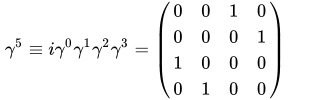
Although uses the letter gamma, it is not one of the gamma matrices of The index number 5 is a relic of old notation: used to be called "".


has also an alternative form:

using the convention or


using the convention Proof:

This can be seen by exploiting the fact that all the four gamma matrices anticommute, so
![{\displaystyle \gamma ^{0}\gamma ^{1}\gamma ^{2}\gamma ^{3}=\gamma ^{[0}\gamma ^{1}\gamma ^{2}\gamma ^{3]}={\tfrac {1}{4!}}\delta _{\mu \nu \varrho \sigma }^{0123}\gamma ^{\mu }\gamma ^{\nu }\gamma ^{\varrho }\gamma ^{\sigma }\ ,}](https://wikimedia.org/api/rest_v1/media/math/render/svg/4aad023da6b72826bf57a69501faba2a9908532c)
where is the type (4,4) generalized Kronecker delta in 4 dimensions, in full antisymmetrization. If denotes the Levi-Civita symbol in n dimensions, we can use the identity . Then we get, using the convention


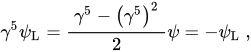
This matrix is useful in discussions of quantum mechanical chirality. For example, a Dirac field can be projected onto its left-handed and right-handed components by:

Some properties are:
- It is Hermitian:
- Its eigenvalues are ±1, because:
- It anticommutes with the four gamma matrices:



In fact, and are eigenvectors of since


- and
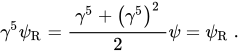
Five dimensions
[edit]The Clifford algebra in odd dimensions behaves like two copies of the Clifford algebra of one less dimension, a left copy and a right copy.[3]: 68 Thus, one can employ a bit of a trick to repurpose i γ 5 as one of the generators of the Clifford algebra in five dimensions. In this case, the set {γ 0, γ 1, γ 2, γ 3, i γ 5} therefore, by the last two properties (keeping in mind that i 2 ≡ −1) and those of the ‘old’ gammas, forms the basis of the Clifford algebra in 5 spacetime dimensions for the metric signature (1,4).[a] .[4]: 97 In metric signature (4,1), the set {γ 0, γ 1, γ 2, γ 3, γ 5} is used, where the γ μ are the appropriate ones for the (3,1) signature.[5] This pattern is repeated for spacetime dimension 2n even and the next odd dimension 2n + 1 for all n ≥ 1.[6]: 457 For more detail, see higher-dimensional gamma matrices.
Identities
[edit]The following identities follow from the fundamental anticommutation relation, so they hold in any basis (although the last one depends on the sign choice for ).

Miscellaneous identities
[edit]1.

| Proof | ||||||||||||||||||
|---|---|---|---|---|---|---|---|---|---|---|---|---|---|---|---|---|---|---|
|
Take the standard anticommutation relation: One can make this situation look similar by using the metric :
|







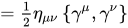

2.

| Proof |
|---|
|
Similarly to the proof of 1, again beginning with the standard anticommutation relation: |
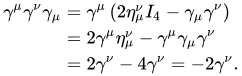
3.

| Proof | ||||||||||||
|---|---|---|---|---|---|---|---|---|---|---|---|---|
|
To show Use the anticommutator to shift to the right
Using the relation we can contract the last two gammas, and get
Finally using the anticommutator identity, we get |









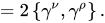
4.

| Proof | ||||||||||
|---|---|---|---|---|---|---|---|---|---|---|
|





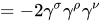
5.

| Proof |
|---|
|
If then and it is easy to verify the identity. That is the case also when , or . On the other hand, if all three indices are different, , and and both sides are completely antisymmetric; the left hand side because of the anticommutativity of the matrices, and on the right hand side because of the antisymmetry of . It thus suffices to verify the identities for the cases of , , and . |


6. where

![{\displaystyle \ \sigma _{\mu \nu }={\tfrac {i}{2}}[\gamma _{\mu },\gamma _{\nu }]={\tfrac {i}{2}}(\gamma _{\mu }\gamma _{\nu }-\gamma _{\nu }\gamma _{\mu })\ }](https://wikimedia.org/api/rest_v1/media/math/render/svg/d24b5e47a1e1317165fe5e953633dd7e9101ea45)
| Proof | ||||||||||
|---|---|---|---|---|---|---|---|---|---|---|
|
For and both sides vanish. Otherwise, multiplying identity 5 by from the right gives that
where since . The left hand side of this equation also vanishes since by property 3. Rearranging gives that
Note that for (for , vanishes) by the standard anticommutation relation. It follows that
Multiplying from the left times and using that yields the desired result. |






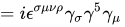

![{\displaystyle 2\gamma _{\sigma }\gamma _{\mu }=\gamma _{\sigma }\gamma _{\mu }-\gamma _{\mu }\gamma _{\sigma }=[\gamma _{\sigma },\gamma _{\mu }]}](https://wikimedia.org/api/rest_v1/media/math/render/svg/0217ab5205a77fd49f04c615fd311929ea3bebd1)


![{\displaystyle -[\gamma ^{\nu },\gamma ^{\rho }]}](https://wikimedia.org/api/rest_v1/media/math/render/svg/9082d9fb9fc49aa442f25cec5bf4227cba536dca)
![{\displaystyle =-{\tfrac {i}{2}}\epsilon ^{\sigma \mu \nu \rho }\gamma ^{5}[\gamma _{\sigma },\gamma _{\mu }]\,}](https://wikimedia.org/api/rest_v1/media/math/render/svg/3dc7c71a6e506f7965e1c75c6ad164a557803416)


Trace identities
[edit]The gamma matrices obey the following trace identities:
- Trace of any product of an odd number of is zero
- Trace of times a product of an odd number of is still zero






Proving the above involves the use of three main properties of the trace operator:
- tr(A + B) = tr(A) + tr(B)
- tr(rA) = r tr(A)
- tr(ABC) = tr(CAB) = tr(BCA)
| Proof of 1 | ||||
|---|---|---|---|---|
|
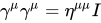
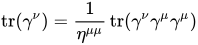
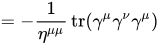
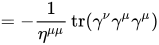
From the definition of the gamma matrices, We get or equivalently, where is a number, and is a matrix.
This implies |






| Proof of 2 | ||||||||
|---|---|---|---|---|---|---|---|---|
|
To show First note that We'll also use two facts about the fifth gamma matrix that says: So lets use these two facts to prove this identity for the first non-trivial case: the trace of three gamma matrices. Step one is to put in one pair of 's in front of the three original 's, and step two is to swap the matrix back to the original position, after making use of the cyclicity of the trace.
This can only be fulfilled if The extension to 2n + 1 (n integer) gamma matrices, is found by placing two gamma-5s after (say) the 2n-th gamma-matrix in the trace, commuting one out to the right (giving a minus sign) and commuting the other gamma-5 2n steps out to the left [with sign change (-1)^2n = 1]. Then we use cyclic identity to get the two gamma-5s together, and hence they square to identity, leaving us with the trace equalling minus itself, i.e. 0. |









| Proof of 3 |
|---|
|
If an odd number of gamma matrices appear in a trace followed by , our goal is to move from the right side to the left. This will leave the trace invariant by the cyclic property. In order to do this move, we must anticommute it with all of the other gamma matrices. This means that we anticommute it an odd number of times and pick up a minus sign. A trace equal to the negative of itself must be zero. |
| Proof of 4 | ||||||
|---|---|---|---|---|---|---|
|
To show Begin with, |




| Proof of 5 | ||||||||||||
|---|---|---|---|---|---|---|---|---|---|---|---|---|
|
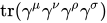
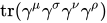
For the term on the right, we'll continue the pattern of swapping with its neighbor to the left, Again, for the term on the right swap with its neighbor to the left, Eq (3) is the term on the right of eq (2), and eq (2) is the term on the right of eq (1). We'll also use identity number 3 to simplify terms like so: So finally Eq (1), when you plug all this information in gives The terms inside the trace can be cycled, so So really (4) is or |














| Proof of 6 | ||||||||||||
|---|---|---|---|---|---|---|---|---|---|---|---|---|
|
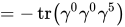
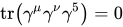
To show
begin with
Add to both sides of the above to see
Now, this pattern can also be used to show
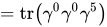
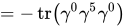
Simply add two factors of , with different from and . Anticommute three times instead of once, picking up three minus signs, and cycle using the cyclic property of the trace. So,
|







| Proof of 7 |
|---|
|
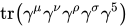
For a proof of identity 7, the same trick still works unless is some permutation of (0123), so that all 4 gammas appear. The anticommutation rules imply that interchanging two of the indices changes the sign of the trace, so must be proportional to . The proportionality constant is , as can be checked by plugging in , writing out , and remembering that the trace of the identity is 4. |





| Proof of 8 | |||||||||||||||||
|---|---|---|---|---|---|---|---|---|---|---|---|---|---|---|---|---|---|
|
Denote the product of gamma matrices by Consider the Hermitian conjugate of :
Conjugating with one more time to get rid of the two s that are there, we see that is the reverse of . Now,
|









Normalization
[edit]The gamma matrices can be chosen with extra hermiticity conditions which are restricted by the above anticommutation relations however. We can impose
- , compatible with


and for the other gamma matrices (for k = 1, 2, 3)
- , compatible with
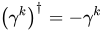
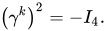
One checks immediately that these hermiticity relations hold for the Dirac representation.
The above conditions can be combined in the relation
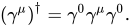
The hermiticity conditions are not invariant under the action of a Lorentz transformation because is not necessarily a unitary transformation due to the non-compactness of the Lorentz group.[citation needed]



Charge conjugation
[edit]The charge conjugation operator, in any basis, may be defined as

where denotes the matrix transpose. The explicit form that takes is dependent on the specific representation chosen for the gamma matrices, up to an arbitrary phase factor. This is because although charge conjugation is an automorphism of the gamma group, it is not an inner automorphism (of the group). Conjugating matrices can be found, but they are representation-dependent.


Representation-independent identities include:
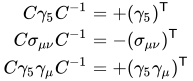
The charge conjugation operator is also unitary , while for it also holds that for any representation. Given a representation of gamma matrices, the arbitrary phase factor for the charge conjugation operator can not always be chosen such that , as is the case for the common four representations given below, known as Dirac, chiral and Majorana representation.


Feynman slash notation
[edit]The Feynman slash notation is defined by

for any 4-vector .

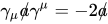
Here are some similar identities to the ones above, but involving slash notation:
- [7]
- [7]
- [7]
- where is the Levi-Civita symbol and Actually traces of products of odd number of is zero and thus
- for n odd.[8]
![{\displaystyle {a\!\!\!/}{b\!\!\!/}=\left[a\cdot b-ia_{\mu }\sigma ^{\mu \nu }b_{\nu }\right]I_{4}}](https://wikimedia.org/api/rest_v1/media/math/render/svg/8b464aa284573877a760f48af1366acb5ad11a96)
![{\displaystyle {a\!\!\!/}{a\!\!\!/}=\left[a^{\mu }a^{\nu }\gamma _{\mu }\gamma _{\nu }\right]I_{4}=\left[{\tfrac {1}{2}}a^{\mu }a^{\nu }\left(\gamma _{\mu }\gamma _{\nu }+\gamma _{\nu }\gamma _{\mu }\right)\right]I_{4}=\left[\eta _{\mu \nu }a^{\mu }a^{\nu }\right]I_{4}=a^{2}I_{4}}](https://wikimedia.org/api/rest_v1/media/math/render/svg/f5bbfd0c5bed9d8b388e127e4b5a2a5f5c604f4f)

![{\displaystyle \operatorname {tr} \left({a\!\!\!/}{b\!\!\!/}{c\!\!\!/}{d\!\!\!/}\right)=4\left[(a\cdot b)(c\cdot d)-(a\cdot c)(b\cdot d)+(a\cdot d)(b\cdot c)\right]}](https://wikimedia.org/api/rest_v1/media/math/render/svg/56c57a7d1c73aea6e330e803d9ac401224d8a0d3)





![{\displaystyle \sigma ^{\mu \nu }={\tfrac {i}{2}}\left[\gamma ^{\mu },\gamma ^{\nu }\right]~.}](https://wikimedia.org/api/rest_v1/media/math/render/svg/3c9b8d421ce7196e44d1eb22bbceb1c131b4aa85)


Many follow directly from expanding out the slash notation and contracting expressions of the form with the appropriate identity in terms of gamma matrices.

Other representations
[edit]The matrices are also sometimes written using the 2×2 identity matrix, , and

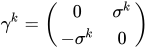
where k runs from 1 to 3 and the σk are Pauli matrices.
Dirac basis
[edit]The gamma matrices we have written so far are appropriate for acting on Dirac spinors written in the Dirac basis; in fact, the Dirac basis is defined by these matrices. To summarize, in the Dirac basis:

or using the Kronecker product:

In the Dirac basis, the charge conjugation operator is real antisymmetric,[9]: 691–700

Weyl (chiral) basis
[edit]Another common choice is the Weyl or chiral basis, in which remains the same but is different, and so is also different, and diagonal,


or in more compact notation:

The Weyl basis has the advantage that its chiral projections take a simple form,

The idempotence of the chiral projections is manifest.
By slightly abusing the notation and reusing the symbols we can then identify


where now and are left-handed and right-handed two-component Weyl spinors.


The charge conjugation operator in this basis is real antisymmetric,

The Weyl basis can be obtained from the Dirac basis as

via the unitary transform

Weyl (chiral) basis (alternate form)
[edit]Another possible choice[10] of the Weyl basis has

The chiral projections take a slightly different form from the other Weyl choice,

In other words,

where and are the left-handed and right-handed two-component Weyl spinors, as before.
The charge conjugation operator in this basis is

This basis can be obtained from the Dirac basis above as via the unitary transform


Majorana basis
[edit]There is also the Majorana basis, in which all of the Dirac matrices are imaginary, and the spinors and Dirac equation are real. Using the Pauli matrices, the basis can be written as

where is the charge conjugation matrix, which matches the Dirac version defined above.
The reason for making all gamma matrices imaginary is solely to obtain the particle physics metric (+, −, −, −), in which squared masses are positive. The Majorana representation, however, is real. One can factor out the to obtain a different representation with four component real spinors and real gamma matrices. The consequence of removing the is that the only possible metric with real gamma matrices is (−, +, +, +).

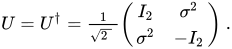
The Majorana basis can be obtained from the Dirac basis above as via the unitary transform

Cl1,3(C) and Cl1,3(R)
[edit] | This article may benefit from being shortened by the use of summary style. |
The Dirac algebra can be regarded as a complexification of the real algebra Cl1,3(), called the space time algebra:


Cl1,3() differs from Cl1,3(): in Cl1,3() only real linear combinations of the gamma matrices and their products are allowed.

Two things deserve to be pointed out. As Clifford algebras, Cl1,3() and Cl4() are isomorphic, see classification of Clifford algebras. The reason is that the underlying signature of the spacetime metric loses its signature (1,3) upon passing to the complexification. However, the transformation required to bring the bilinear form to the complex canonical form is not a Lorentz transformation and hence not "permissible" (at the very least impractical) since all physics is tightly knit to the Lorentz symmetry and it is preferable to keep it manifest.
Proponents of geometric algebra strive to work with real algebras wherever that is possible. They argue that it is generally possible (and usually enlightening) to identify the presence of an imaginary unit in a physical equation. Such units arise from one of the many quantities in a real Clifford algebra that square to −1, and these have geometric significance because of the properties of the algebra and the interaction of its various subspaces. Some of these proponents also question whether it is necessary or even useful to introduce an additional imaginary unit in the context of the Dirac equation.[11]: x–xi
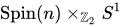
In the mathematics of Riemannian geometry, it is conventional to define the Clifford algebra Clp,q() for arbitrary dimensions p,q. The Weyl spinors transform under the action of the spin group . The complexification of the spin group, called the spinc group , is a product of the spin group with the circle The product just a notational device to identify with The geometric point of this is that it disentangles the real spinor, which is covariant under Lorentz transformations, from the component, which can be identified with the fiber of the electromagnetic interaction. The is entangling parity and charge conjugation in a manner suitable for relating the Dirac particle/anti-particle states (equivalently, the chiral states in the Weyl basis). The bispinor, insofar as it has linearly independent left and right components, can interact with the electromagnetic field. This is in contrast to the Majorana spinor and the ELKO spinor (Eigenspinoren des Ladungskonjugationsoperators), which cannot (i.e. they are electrically neutral), as they explicitly constrain the spinor so as to not interact with the part coming from the complexification. The ELKO spinor is a Lounesto class 5 spinor.[12]: 84







However, in contemporary practice in physics, the Dirac algebra rather than the space-time algebra continues to be the standard environment the spinors of the Dirac equation "live" in.
Other representation-free properties
[edit]The gamma matrices are diagonalizable with eigenvalues for , and eigenvalues for .


| Proof |
|---|
|
This can be demonstrated for and follows similarly for . We can rewrite as By a well-known result in linear algebra, this means there is a basis in which is diagonal with eigenvalues . |




In particular, this implies that is simultaneously Hermitian and unitary, while the are simultaneously anti–Hermitian and unitary.
Further, the multiplicity of each eigenvalue is two.
| Proof |
|---|
|
If is an eigenvector of then is an eigenvector with the opposite eigenvalue. Then eigenvectors can be paired off if they are related by multiplication by Result follows similarly for |


More generally, if is not null, a similar result holds. For concreteness, we restrict to the positive norm case with The negative case follows similarly.



| Proof |
|---|
|
It can be shown so by the same argument as the first result, is diagonalizable with eigenvalues We can adapt the argument for the second result slightly. We pick a non-null vector which is orthogonal to Then eigenvectors can be paired off similarly if they are related by multiplication by |


It follows that the solution space to (that is, the kernel of the left-hand side) has dimension 2. This means the solution space for plane wave solutions to Dirac's equation has dimension 2.

This result still holds for the massless Dirac equation. In other words, if null, then has nullity 2.


| Proof |
|---|
|
If null, then By generalized eigenvalue decomposition, this can be written in some basis as diagonal in Jordan blocks with eigenvalue 0, with either 0, 1, or 2 blocks, and other diagonal entries zero. It turns out to be the 2 block case. The zero case is not possible as if by linear independence of the we must have But null vectors are by definition non-zero. Consider and a zero-eigenvector of . Note is also null and satisfies If , then it cannot simultaneously be a zero eigenvector of by (*). Considering , if we apply then we get . Therefore, after a rescaling, and give a Jordan block. This gives a pairing. There must be another zero eigenvector of
There is also a pleasant structure to these pairs. If left arrows correspond to application of , and right arrows to application of , and is a zero eigenvector of , up to scalar factors we have
|








Euclidean Dirac matrices
[edit]In quantum field theory one can Wick rotate the time axis to transit from Minkowski space to Euclidean space. This is particularly useful in some renormalization procedures as well as lattice gauge theory. In Euclidean space, there are two commonly used representations of Dirac matrices:
Chiral representation
[edit]
Notice that the factors of have been inserted in the spatial gamma matrices so that the Euclidean Clifford algebra

will emerge. It is also worth noting that there are variants of this which insert instead on one of the matrices, such as in lattice QCD codes which use the chiral basis.

In Euclidean space,

Using the anti-commutator and noting that in Euclidean space , one shows that


In chiral basis in Euclidean space,
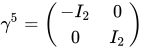
which is unchanged from its Minkowski version.
Non-relativistic representation
[edit]
Footnotes
[edit]- ^ The set of matrices (Γa) = (γ μ, i γ 5 ) with a = (0, 1, 2, 3, 4) satisfy the five-dimensional Clifford algebra {Γa, Γb} = 2 ηab
See also
[edit]
Citations
[edit]- ^ Kukin 2016.
- ^ Lonigro 2023.
- ^ Jost 2002.
- ^ Tong 2007, These introductory quantum field theory notes are for Part III (masters level) students..
- ^ Weinberg 2002, § 5.5.
- ^ de Wit & Smith 2012.
- ^ a b c Feynman, Richard P. (1949). "Space-time approach to quantum electrodynamics". Physical Review. 76 (6): 769–789. Bibcode:1949PhRv...76..769F. doi:10.1103/PhysRev.76.769 – via APS.
- ^ Kaplunovsky 2008.
- ^ Itzykson & Zuber 2012.
- ^ Kaku 1993.
- ^ Hestenes 2015.
- ^ Rodrigues & Oliveira 2007.
References
[edit]- de Wit, B.; Smith, J. (2 December 2012). Field Theory in Particle Physics, Volume 1. Elsevier. ISBN 978-0-444-59622-2.[1]
- Halzen, Francis; Martin, Alan D. (17 May 2008). Quark & Leptons: An Introductory Course in Modern Particle Physics. Wiley India Pvt. Limited. ISBN 978-81-265-1656-8.
- Hestenes, David (2015). Space-Time Algebra. Springer International Publishing. ISBN 978-3-319-18412-8.
- Itzykson, Claude; Zuber, Jean-Bernard (20 September 2012). Quantum Field Theory. Courier Corporation. Appendix A. ISBN 978-0-486-13469-7.
- Jost, Jürgen (2002). Riemannian Geometry and Geometric Analysis. Springer. p. 68, Corollary 1.8.1. ISBN 978-3-540-42627-1.
- Kaku, Michio (1993). Quantum Field Theory: A Modern Introduction. Oxford University Press. ISBN 978-0-19-509158-8.
- Kaplunovsky, Vadim (2008). "Traceology" (PDF). Quantum Field Theory (course homework / class notes). Physics Department. University of Texas at Austin. Archived from the original (PDF) on 2019-11-13.
- Kukin, V.D. (2016). "Dirac matrices - Encyclopedia of Mathematics". encyclopediaofmath.org. Retrieved 2023-11-02.
- Lonigro, Davide (2023). "Dimensional reduction of the Dirac equation in arbitrary spatial dimensions". The European Physical Journal Plus. 138 (4): 324. arXiv:2212.11965. Bibcode:2023EPJP..138..324L. doi:10.1140/epjp/s13360-023-03919-0.
- Pauli, W. (1936). "Contributions mathématiques à la théorie des matrices de Dirac". Annales de l'Institut Henri Poincaré. 6: 109.
- Peskin, M.; Schroeder, D. (1995). An Introduction to Quantum Field Theory. Westview Press. chapter 3.2. ISBN 0-201-50397-2.
- Rodrigues, Waldyr A.; Oliveira, Edmundo C. de (2007). The Many Faces of Maxwell, Dirac and Einstein Equations: A Clifford Bundle Approach. Springer Science & Business Media. ISBN 978-3-540-71292-3.
- Tong, David (2007). Lectures on Quantum Field Theory (course lecture notes). David Tong at University of Cambridge. p. 93. Retrieved 2015-03-07.
- Weinberg, S. (2002). The Quantum Theory of Fields. Vol. 1. Cambridge University Press. ISBN 0-521-55001-7 – via Internet Archive (archive.org).
- Zee, A. (2003). Quantum Field Theory in a Nutshell. Princeton, NJ: Princeton University Press. chapter II.1. ISBN 0-691-01019-6.
External links
[edit]- Dirac matrices on mathworld including their group properties
- Dirac matrices as an abstract group on GroupNames
- "Dirac matrices", Encyclopedia of Mathematics, EMS Press, 2001 [1994]

Gamma matrices
View on GrokipediaFundamentals
Definition and Notation
In relativistic quantum mechanics, the gamma matrices, denoted as where , form a set of four 4×4 complex matrices that serve as the fundamental building blocks for representing Dirac spinors in four-dimensional Minkowski spacetime.[8] These matrices are essential for constructing Lorentz-covariant expressions in the Dirac equation, with the index corresponding to the time component () and spatial components () in the standard convention.[8] The notation employs Greek letters such as and to denote Lorentz indices, ranging from 0 to 3, which transform under the Lorentz group SO(1,3).[8] In the Dirac representation, is Hermitian, satisfying , while the spatial matrices (for ) are anti-Hermitian, with , ensuring the overall structure aligns with the metric signature of Minkowski space, typically .[8] A common shorthand is the slashed notation, , where is a four-vector, which simplifies contractions in field theory calculations.[8] Each matrix has 16 complex components, but their role in representing spin-1/2 particles imposes constraints via algebraic relations, reducing the independent degrees of freedom while preserving the 4-dimensional spinor space for Dirac fields.[8] The gamma matrices originated in Paul Dirac's seminal 1928 paper, where he introduced them to formulate a relativistic wave equation for the electron that is first-order in both time and space derivatives, resolving inconsistencies between quantum mechanics and special relativity.[3]Clifford Algebra Relations
The gamma matrices () in four-dimensional Minkowski spacetime satisfy the defining anticommutation relations of the Clifford algebra , where is the Minkowski metric tensor with mostly minus signature, and is the identity matrix. These relations ensure that the gamma matrices generate a faithful matrix representation of the Clifford algebra associated with the Lorentz group SO(1,3). This algebra arises directly from the structure of the Dirac equation, which posits a first-order relativistic wave equation for the electron. In natural units (), the Dirac equation is , where and is the electron mass. To recover the second-order Klein-Gordon equation (with ), apply the Dirac operator again to both sides: The left side expands to . Since partial derivatives commute, , the antisymmetric commutator term vanishes upon contraction, leaving . For this to equal , the anticommutator must hold as stated, yielding on the right side after multiplying by . This derivation, originally motivated by the need for a linear relativistic equation consistent with the Klein-Gordon relativistic energy-momentum relation , uniquely determines the algebraic structure required of the . A direct consequence of the anticommutation relations is the orthogonality for distinct indices: if , then , while squaring gives (no sum), so and for spatial indices . To ensure the Dirac equation is consistent with a positive-definite probability density and conserved current in the Schrödinger-like form , the matrices must satisfy specific hermiticity properties: (Hermitian) and (anti-Hermitian) for . These follow from requiring the Hamiltonian form of the Dirac equation to be Hermitian, with playing the role of the "beta" matrix in Dirac's original notation. Any two sets of gamma matrices satisfying these relations are equivalent up to a similarity transformation: there exists an invertible matrix such that for all , preserving the algebra and ensuring all representations yield equivalent physics. The full Clifford algebra generated by the has dimension , spanned by the independent products , (4 basis elements), (6 elements), (4 elements), and (1 element), all matrices. This 16-dimensional structure implies that the minimal faithful representation requires matrices of size at least 4, as the algebra dimension for spacetime dimensions demands a spinor space of dimension , corresponding to matrices; smaller sizes (e.g., 2x2) cannot accommodate the full algebra without irreducibility loss. To see this, note that the complexification of the universal Clifford algebra , the algebra of complex matrices, confirming the minimality.[9]Physical Interpretation
Role in Relativistic Quantum Mechanics
In the quest to reconcile quantum mechanics with special relativity, physicists encountered challenges with existing wave equations like the Klein-Gordon equation, which is second-order in both time and space derivatives and leads to issues such as negative probability densities. To address this, Paul Dirac sought a first-order linear relativistic wave equation for the electron that would naturally incorporate its spin-1/2 nature without ad hoc assumptions. The introduction of the gamma matrices enabled the construction of such an equation, allowing the Hamiltonian to be expressed in a form that respects both relativistic invariance and the requirements of quantum theory, thus predicting the existence of spin and antimatter.[3][10] The gamma matrices are essential for ensuring the Lorentz covariance of the theory. Under a Lorentz transformation parameterized by Λ, the Dirac spinor transforms as ψ → S(Λ) ψ, where the spinor representation S(Λ) satisfies S(Λ) γ^μ S(Λ)^{-1} = (Λ^{-1})^μ_ν γ^ν. This relation guarantees that bilinear forms involving the spinors and gamma matrices transform appropriately under the Lorentz group, preserving the form of physical laws across inertial frames. In this way, the gamma matrices provide the matrix representation of the Lorentz generators in the spinor space, bridging the vector representation of spacetime with the half-integer spin of fermions.[11][12] Key observables in the theory are captured by Lorentz-covariant bilinears constructed from the Dirac spinor ψ and its adjoint \bar{ψ} = ψ^\dagger γ^0, combined with products of gamma matrices. The scalar bilinear \bar{ψ} ψ is a Lorentz scalar, representing the fermion mass term in the Lagrangian and, in the non-relativistic limit, approximating the particle density. The vector bilinear \bar{ψ} γ^μ ψ transforms as a contravariant 4-vector, serving as the conserved Noether current for phase invariance, which couples to the electromagnetic field in quantum electrodynamics. The tensor bilinear \bar{ψ} σ^{μν} ψ, with σ^{μν} = \frac{i}{2} [γ^μ, γ^ν], forms an antisymmetric second-rank tensor associated with the spin and magnetic dipole moment interactions. The axial-vector bilinear \bar{ψ} γ^μ γ^5 ψ behaves as an axial 4-vector, linked to chiral currents and parity-violating processes like weak interactions. Finally, the pseudoscalar bilinear \bar{ψ} i γ^5 ψ is a pseudoscalar under Lorentz transformations, relevant for pseudoscalar meson couplings and parity-odd observables. These bilinears classify the possible interaction terms in relativistic quantum field theories involving spin-1/2 fields.[13][14] The four-component structure of the Dirac spinor, facilitated by the 4×4 gamma matrices, accommodates both positive-energy (electron) and negative-energy (positron) solutions, resolving the issue of negative probabilities through Dirac's hole interpretation and paving the way for quantum field theory. In the modern quantum field theory framework, the Dirac field operator quantizes these modes, creating or annihilating electrons and positrons while maintaining relativistic invariance through the gamma matrix algebra, thus describing the fermionic content of the Standard Model.[15][13]Connection to the Dirac Equation
The Dirac equation provides a relativistic description of spin-1/2 particles, such as the electron, by incorporating the gamma matrices to achieve a first-order differential equation in both time and space. In 1928, Paul Dirac sought to resolve the limitations of the non-relativistic Schrödinger equation, which failed to be Lorentz invariant, and the Klein-Gordon equation, a relativistic but second-order wave equation that suffered from negative probability densities and did not distinguish spin naturally. Dirac postulated a linear ansatz for the Hamiltonian form: , where is a four-component spinor, are momentum operators, and the (for ) and are 4×4 Hermitian matrices satisfying specific anticommutation relations , , and to ensure the equation squares to the Klein-Gordon form .[3] To express this in covariant form under Lorentz transformations, the equation is rewritten using the gamma matrices (), defined in the Dirac representation as and (or equivalently in some conventions), which satisfy the Clifford algebra with metric signature . The full Dirac equation then becomes , where and natural units are assumed. This form is derived by factoring the Klein-Gordon operator: starting from the scalar Klein-Gordon equation , Dirac introduced the gamma matrices to "square root" it into first-order factors, yielding , which expands to the Klein-Gordon equation via the anticommutation relations, ensuring Lorentz covariance while allowing for spinor solutions.[3][16] The corresponding Lagrangian density for the Dirac field is , where the adjoint spinor is defined as to ensure the action is a Lorentz scalar and the equation of motion follows from the Euler-Lagrange equations. This Hermitian conjugate form guarantees current conservation and positive-definite probabilities.[16] The solutions to the Dirac equation reveal a spectrum with both positive and negative energy states: for a free particle, plane-wave solutions (positive energy) or (negative energy) satisfy the equation, where and are four-component spinors determined by and . Dirac initially interpreted the negative-energy solutions as filled "Dirac sea" states, leading to the prediction of antiparticles like the positron, later confirmed experimentally; this hole theory bridges to quantum field theory, where positive and negative frequencies correspond to particles and antiparticles with positive energy.[3][16]Gamma5 and Extensions
Properties of Gamma5
The fifth gamma matrix, denoted , is defined in four-dimensional Minkowski spacetime as the ordered product where the () are the Dirac gamma matrices satisfying the Clifford algebra relations with metric signature . This specific convention, including the factor of , ensures that is Hermitian, , and traceless, .[17][18] A key property of is that its square equals the identity matrix, , and it anticommutes with each of the Dirac matrices, for all . The anticommutation relation follows directly from the Clifford algebra relations defining the . This uniqueness of is fixed up to an overall phase by its product definition, with the standard choice preserving hermiticity and the required algebraic structure in representations of the Dirac algebra.[18][19] The matrix plays a central role in defining chirality through the chiral projection operators which are idempotent () and mutually orthogonal (), satisfying . These projectors decompose a general Dirac spinor into its left- and right-handed chiral components, and , corresponding to Weyl spinors of definite handedness.[19] The eigenvalues of are , labeling states of definite chirality: left-handed spinors satisfy , while right-handed ones satisfy . For massless fermions, chirality aligns with helicity, such that left-handed (negative helicity) and right-handed (positive helicity) components are eigenstates of the Dirac operator. In quantum field theory, this distinction is essential for applications like the electroweak interactions, where the weak force couples exclusively to left-handed chiral fermions via the SU(2)_L gauge group, enabling parity violation observed in processes such as beta decay.[18][6]Interpretation in Five Dimensions
In the context of extending the four-dimensional spacetime of relativistic quantum mechanics to five dimensions, the matrix can be interpreted within a five-dimensional Clifford algebra, such as or , depending on the metric signature. The original four gamma matrices () satisfy the standard anticommutation relations . In common conventions, the fifth gamma matrix is taken as , which anticommutes with each and satisfies , corresponding to a space-like extra dimension in the signature.[20] For the mostly plus signature , when the extra dimension is space-like (as typical in applications), itself can serve as the fifth gamma matrix with . Geometrically, represents the oriented volume element (pseudoscalar) in four-dimensional spacetime, analogous to how the product of all basis vectors in a Clifford algebra generates the highest-grade element. In five dimensions, this interpretation embeds the four-dimensional volume form into a higher-dimensional structure, providing a unified framework for understanding chirality and parity as aspects of rotational invariance in odd-dimensional spaces. This analogy highlights how Dirac spinors in four dimensions can be viewed as restrictions of five-dimensional spinors, where the fifth gamma encodes the extra direction's contribution to the algebra. This five-dimensional viewpoint finds applications in techniques such as dimensional regularization, where quantum field theory calculations are performed in dimensions to handle divergences; here, is extended consistently to maintain its anticommutation properties across dimensions, facilitating the evaluation of traces involving gamma matrices.[21] Similarly, in Kaluza-Klein theories, which compactify an extra spatial dimension to recover four-dimensional physics, the five gamma matrices—including (or in some conventions) as the fifth—describe the Dirac operator on the five-dimensional manifold, enabling the study of fermion modes and their effective four-dimensional behavior.[22] Regarding parity transformations, behaves as a pseudoscalar, acquiring a minus sign under parity inversion , since it involves an odd number of spatial gamma matrices in its definition . This property underscores its role in distinguishing left- and right-handed components in the five-dimensional extension, where parity acts non-trivially on the extra dimension.[20]Algebraic Properties
Anticommutation and Normalization
The anticommutation relations of the gamma matrices, , where is the identity matrix and is the Minkowski metric with signature , form the foundation for deriving key product identities.[23] For , this simplifies to (no sum), yielding and for spatial indices . These relations ensure the gamma matrices generate the Clifford algebra Cl(1,3).[24] To expand the product , decompose it using the anticommutator and commutator. The commutator is defined as . Introducing the antisymmetric tensor , which serves as the generator of Lorentz transformations in the spinor representation (acting as spin operators for Dirac fields), the commutator becomes .[23] Solving for the product, add the anticommutator and commutator: , so , yielding . For , where , this reduces to (no sum), highlighting the antisymmetric nature since .[24][23] Normalization conventions for the gamma matrices include the trace identity , which follows directly from the anticommutation relations. To derive this, note that by cyclicity of the trace, so , since the gamma matrices are and .[25] This trace normalizes the completeness relation for Dirac spinors and is essential for computing loop diagrams in quantum field theory.[26] Overall phase conventions fix the gamma matrices up to similarity transformations while preserving the algebra. In the standard Dirac-Pauli representation, is Hermitian, are Hermitian, ensuring , which maintains Lorentz invariance and reality conditions for currents. Alternative phases, such as multiplying all by , alter hermiticity but are equivalent via unitary transformations; the choice is often dictated by the need for to be Hermitian to yield a Hermitian Dirac Hamiltonian.[15] These conventions ensure consistent normalization across representations.[27]Trace and Miscellaneous Identities
Trace identities for products of gamma matrices play a central role in quantum field theory, particularly in evaluating matrix elements for processes involving closed fermion loops in Feynman diagrams. These identities exploit the algebraic structure of the gamma matrices and the properties of the trace operation to simplify complex expressions arising from spinor contractions. Derived from the Clifford algebra relations and the dimensionality of the Dirac space, they enable efficient computation of loop integrals without explicit matrix representations. A fundamental property is that the trace of an odd number of gamma matrices vanishes:for any odd number of indices. This follows from the anticommutation relations and the fact that the trace is invariant under cyclic permutations combined with sign changes from anticommuting an odd number of matrices through , which anticommutes with all ; since traces involving with fewer than four are zero, the odd trace must be zero. In particular, the trace of a single gamma matrix is . For an even number of gamma matrices, the traces reduce to metric tensor contractions. The simplest case is two gamma matrices:
This is obtained by decomposing the product using the anticommutator:
where , and taking the trace yields , since the trace of the antisymmetric vanishes and in four spacetime dimensions. Extending to four gamma matrices, the identity is
A proof sketch uses recursive application of the anticommutation relations to pair the matrices. For instance, move through the others:
by cyclicity, then apply repeatedly, reducing to traces of two gammas and the identity, while antisymmetric parts cancel under the trace. This yields the symmetric combination of metrics shown.[28] Traces of zero or more than four gammas follow similarly, but up to four suffice for most four-dimensional calculations due to the 16-dimensional Dirac space. The cyclicity of the trace, , holds for any product of matrices and is essential for loop integrals, where it allows reordering gamma matrices to match propagators or vertices without altering the value. In practice, this property simplifies the evaluation of fermion loop contributions by aligning indices for contraction. Traces involving vanish unless accompanied by exactly four distinct gamma matrices, reflecting the pseudoscalar nature of :
The nonzero case is the parity-odd structure
where is the Levi-Civita tensor with . This arises from the totally antisymmetric product defining and the completeness of the Dirac basis, where the trace picks out the unique pseudotensor component; a derivation involves expanding the product and using the odd-trace vanishing for non-antisymmetric parts. These traces generate epsilon structures in weak interaction amplitudes, distinguishing parity-violating effects.[29] More generally, the completeness of the basis (16 elements) implies that any product of gamma matrices can be expanded in this basis, with traces orthogonal: , where are basis elements. This orthogonality underpins proofs of all trace identities by projecting onto the scalar component. For example, the four-gamma trace expansion uses this to isolate metric pairings.[28]
Charge Conjugation
The charge conjugation matrix satisfies the defining relation , where are the gamma matrices and the superscript denotes the matrix transpose.[30] This relation ensures that charge conjugation exchanges particles and antiparticles while preserving the structure of the Lorentz group representations. In the Dirac basis, the explicit form is .[31] Key properties of include , reflecting its anti-unitary nature in standard representations.[32] For Majorana fermions, where particles are their own antiparticles, is unitary, enabling real spinor representations.[6] These properties arise from the Clifford algebra constraints and ensure consistency under discrete symmetries. In applications, the charge conjugate spinor is defined as , where .[33] This transformation leaves the Dirac equation invariant: if , then the same equation holds for , demonstrating the symmetry between particle and antiparticle solutions.[34] The explicit construction of depends on the chosen representation of the gamma matrices, varying across bases to maintain the defining relation while adapting to specific physical contexts, such as chiral or Majorana formulations. Charge conjugation forms one component of the CPT theorem, which asserts that the combined charge conjugation, parity, and time reversal is a fundamental symmetry of local quantum field theories.[35]Feynman Slash Notation
The Feynman slash notation provides a compact way to represent the contraction of a four-vector with the gamma matrices, a convention introduced by Richard Feynman to streamline calculations in quantum field theory. For a contravariant four-vector , it is defined as , where the summation over the Lorentz index is implied and the metric tensor raises or lowers indices as needed. This notation preserves Lorentz covariance while avoiding explicit index summation, making expressions more readable in relativistic contexts.[36] The notation extends naturally to other four-vector-like objects, such as the partial derivative operator, yielding . A key algebraic property arises from the product of two slashed four-vectors: , where is the identity matrix and encodes the antisymmetric part of the gamma matrix commutator. This relation, derived from the defining anticommutation relations of the gamma matrices, facilitates manipulations in Dirac space without expanding indices. In the context of the Dirac equation, which governs the behavior of spin-1/2 fields, the slash form appears as , highlighting its role in maintaining the equation's manifestly covariant structure.[36][37] In applications to quantum electrodynamics (QED), the slash notation simplifies the formulation of Feynman rules for perturbative calculations. The momentum-space propagator for a Dirac fermion is given by , where directly incorporates the Dirac structure. At interaction vertices, such as the QED electron-photon coupling , slashed incoming or outgoing momenta enter when contracting with external spinors, reducing the complexity of amplitude computations. For propagator simplifications, the notation aids in decomposing denominators and numerators during diagram evaluations, as seen in loop corrections where slashed terms combine efficiently with gamma matrix identities.[36] The primary advantage of the Feynman slash notation lies in its ability to minimize index clutter while preserving the tensorial nature of expressions, which is especially beneficial in higher-order Feynman diagram calculations involving multiple gamma matrices. In QED examples like Compton scattering or electron-positron annihilation, it allows for concise writing of spin-averaged matrix elements, such as traces involving chains of and , thereby accelerating both symbolic and numerical evaluations without loss of precision. This shorthand has become ubiquitous in quantum field theory literature, enhancing the efficiency of covariant perturbation theory.[36]Representations
Dirac Basis
The Dirac basis, also referred to as the Dirac-Pauli or standard representation, provides an explicit construction of the four gamma matrices () in four-dimensional Minkowski spacetime with metric signature , satisfying the Clifford algebra . This basis employs 2×2 block matrices built from the 2×2 identity and the Pauli matrices (for ), where the Pauli matrices are defined as The explicit forms are This off-diagonal block structure for the spatial components and diagonal for the temporal one distinguishes the Dirac basis from other representations.[38][39] The block form naturally separates the four-component Dirac spinor into upper and lower two-component parts, which correspond to the large and small components in the non-relativistic limit of the Dirac equation. In this limit, for low velocities and positive energy states, the upper components dominate and satisfy the Pauli-Schrödinger equation, while the lower components are suppressed by factors of , providing a direct bridge to non-relativistic quantum mechanics.[14][15] This representation is advantageous for solving the Dirac equation analytically, particularly for hydrogen-like atoms, as the eigenvalue problem aligns well with the separation into large and small components, yielding solutions that reduce to the non-relativistic hydrogen atom wave functions plus fine-structure corrections.[39][14] The chirality operator takes the simple off-diagonal form in this basis, with and anticommuting with all .[38] These matrices satisfy the defining anticommutation relations, which can be verified using the properties of the Pauli matrices and . Specifically:- , so ;
- , so (no sum);
- For , ;
- .