



Community hub
Recent from talks
Contribute something to knowledge base
Content stats: 0 posts, 0 articles, 1 media, 0 notes
Members stats: 0 subscribers, 0 contributors, 0 moderators, 0 supporters
Subscribers
Supporters
Contributors
Moderators
Hub AI
Hip AI simulator
(@Hip_simulator)
Hub AI
Hip AI simulator
(@Hip_simulator)
Hip
In vertebrate anatomy, the hip, or coxa (pl.: coxae) in medical terminology, refers to either an anatomical region or a joint on the outer (lateral) side of the pelvis.
The hip region is located lateral and anterior to the gluteal region, inferior to the iliac crest, and lateral to the obturator foramen, with muscle tendons and soft tissues overlying the greater trochanter of the femur. In adults, the three pelvic bones (ilium, ischium and pubis) have fused into one hip bone, which forms the superomedial/deep wall of the hip region.
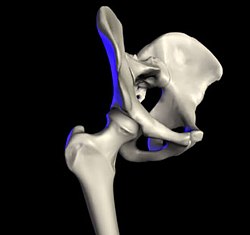
The hip joint, scientifically referred to as the acetabulofemoral joint (art. coxae), is the ball-and-socket joint between the pelvic acetabulum and the femoral head. Its primary function is to support the weight of the torso in both static (e.g. standing) and dynamic (e.g. walking or running) postures. The hip joints have very important roles in retaining balance, and for maintaining the pelvic inclination angle.
Pain of the hip may be the result of numerous causes, including nervous, osteoarthritic, infectious, traumatic, and genetic.
The hip joint, also known as a ball and socket joint, is formed by the acetabulum of the pelvis and the femoral head, which is the top portion of the thigh bone (femur). It allows for a wide range of movement and stability in the lower body.
The proximal femur is largely covered by muscles and, as a consequence, the greater trochanter is often the only palpable bony structure in the hip region.
The hip joint or coxofemoral joint is a ball and socket synovial joint formed by the articulation of the rounded head of the femur and the cup-like acetabulum of the pelvis. The socket of the acetabulum is pointing downwards and anterolaterally. The socket is also turned such that the outer edge of its roof is more lateral than outer edge of the floor. It forms the primary connection between the bones of the lower limb and the axial skeleton of the trunk and pelvis. Both joint surfaces are covered with a strong but lubricated layer called articular hyaline cartilage.
The cuplike acetabulum forms at the union of three pelvic bones — the ilium, pubis, and ischium. The Y-shaped growth plate that separates them, the triradiate cartilage, is fused definitively at ages 14–16. It is a special type of spheroidal or ball and socket joint where the roughly spherical femoral head is largely contained within the acetabulum and has an average radius of curvature of 2.5 cm. The acetabulum grasps almost half the femoral ball, a grip deepened by a ring-shaped fibrocartilaginous lip, the acetabular labrum, which extends the joint beyond the equator. The centre of the acetabulum (fovea) does not articulate to anything. Instead, it is lined with fat pad and attached to ligamentum teres. The acetabular labrum is horse-shoe shaped. Its inferior notch is bridged by transverse acetabular ligament. The joint space between the femoral head and the superior acetabulum is normally between 2 and 7 mm.
Hip
In vertebrate anatomy, the hip, or coxa (pl.: coxae) in medical terminology, refers to either an anatomical region or a joint on the outer (lateral) side of the pelvis.
The hip region is located lateral and anterior to the gluteal region, inferior to the iliac crest, and lateral to the obturator foramen, with muscle tendons and soft tissues overlying the greater trochanter of the femur. In adults, the three pelvic bones (ilium, ischium and pubis) have fused into one hip bone, which forms the superomedial/deep wall of the hip region.
The hip joint, scientifically referred to as the acetabulofemoral joint (art. coxae), is the ball-and-socket joint between the pelvic acetabulum and the femoral head. Its primary function is to support the weight of the torso in both static (e.g. standing) and dynamic (e.g. walking or running) postures. The hip joints have very important roles in retaining balance, and for maintaining the pelvic inclination angle.
Pain of the hip may be the result of numerous causes, including nervous, osteoarthritic, infectious, traumatic, and genetic.
The hip joint, also known as a ball and socket joint, is formed by the acetabulum of the pelvis and the femoral head, which is the top portion of the thigh bone (femur). It allows for a wide range of movement and stability in the lower body.
The proximal femur is largely covered by muscles and, as a consequence, the greater trochanter is often the only palpable bony structure in the hip region.
The hip joint or coxofemoral joint is a ball and socket synovial joint formed by the articulation of the rounded head of the femur and the cup-like acetabulum of the pelvis. The socket of the acetabulum is pointing downwards and anterolaterally. The socket is also turned such that the outer edge of its roof is more lateral than outer edge of the floor. It forms the primary connection between the bones of the lower limb and the axial skeleton of the trunk and pelvis. Both joint surfaces are covered with a strong but lubricated layer called articular hyaline cartilage.
The cuplike acetabulum forms at the union of three pelvic bones — the ilium, pubis, and ischium. The Y-shaped growth plate that separates them, the triradiate cartilage, is fused definitively at ages 14–16. It is a special type of spheroidal or ball and socket joint where the roughly spherical femoral head is largely contained within the acetabulum and has an average radius of curvature of 2.5 cm. The acetabulum grasps almost half the femoral ball, a grip deepened by a ring-shaped fibrocartilaginous lip, the acetabular labrum, which extends the joint beyond the equator. The centre of the acetabulum (fovea) does not articulate to anything. Instead, it is lined with fat pad and attached to ligamentum teres. The acetabular labrum is horse-shoe shaped. Its inferior notch is bridged by transverse acetabular ligament. The joint space between the femoral head and the superior acetabulum is normally between 2 and 7 mm.
Recent media
Recent media